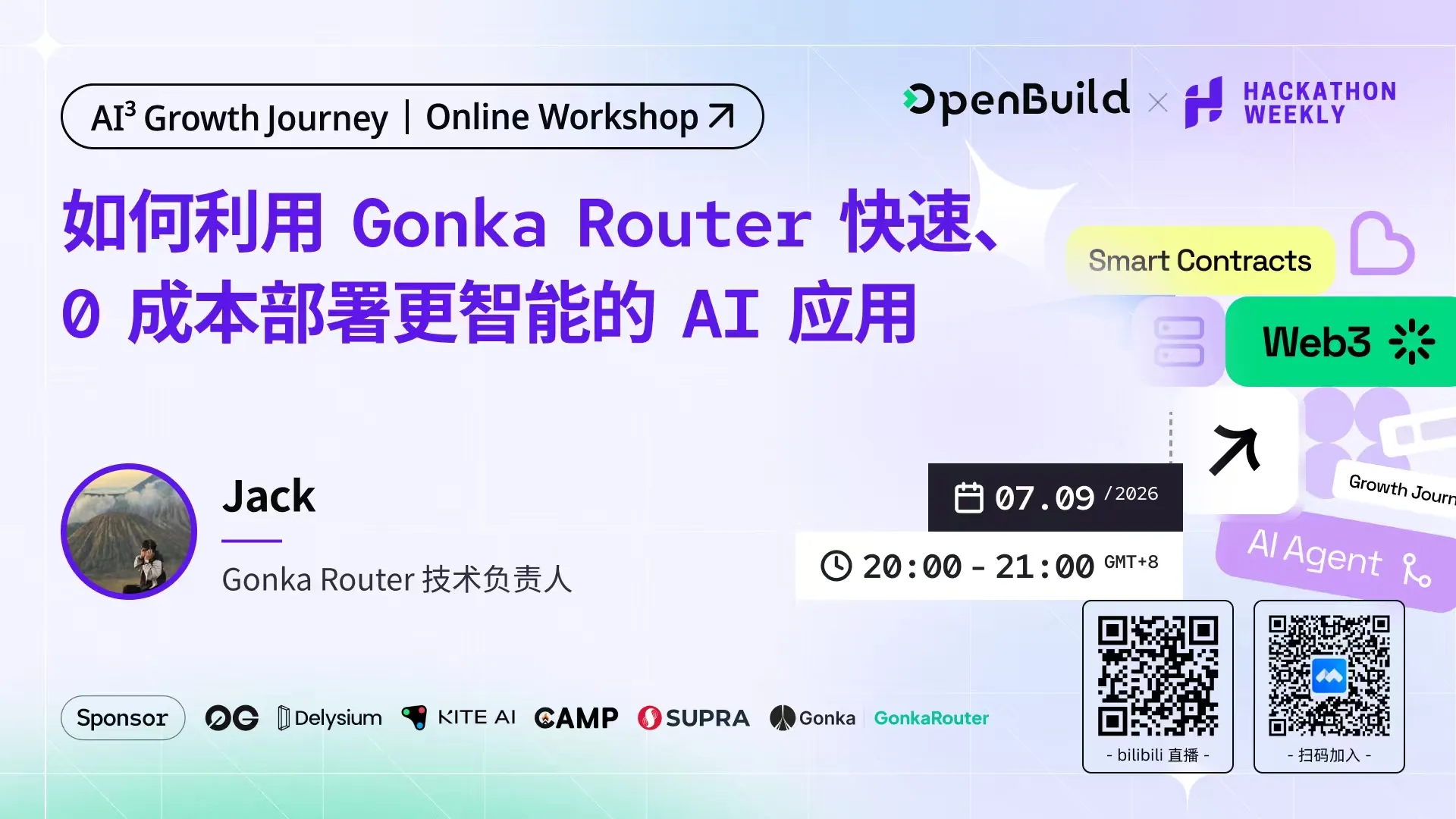
GonkaRouter supported builders during a recently concluded online AI hackathon by sponsoring the event and providing registered participants with free API inference access through a shared event-wide pool of up to 50 billion free tokens. The event brought together developers who moved from ideas to working prototypes, with 56 registrations, 32 total project submissions, and 16 submissions in the Gonka track.
The outcome is a strong signal for AI builders: practical access to models, familiar API formats, and flexible AI developer tools can help teams iterate faster during a focused build window. GonkaRouter participated as a sponsor and ecosystem supporter, not as the host or organizer, and our goal was straightforward: reduce friction for registered participants experimenting with AI applications.
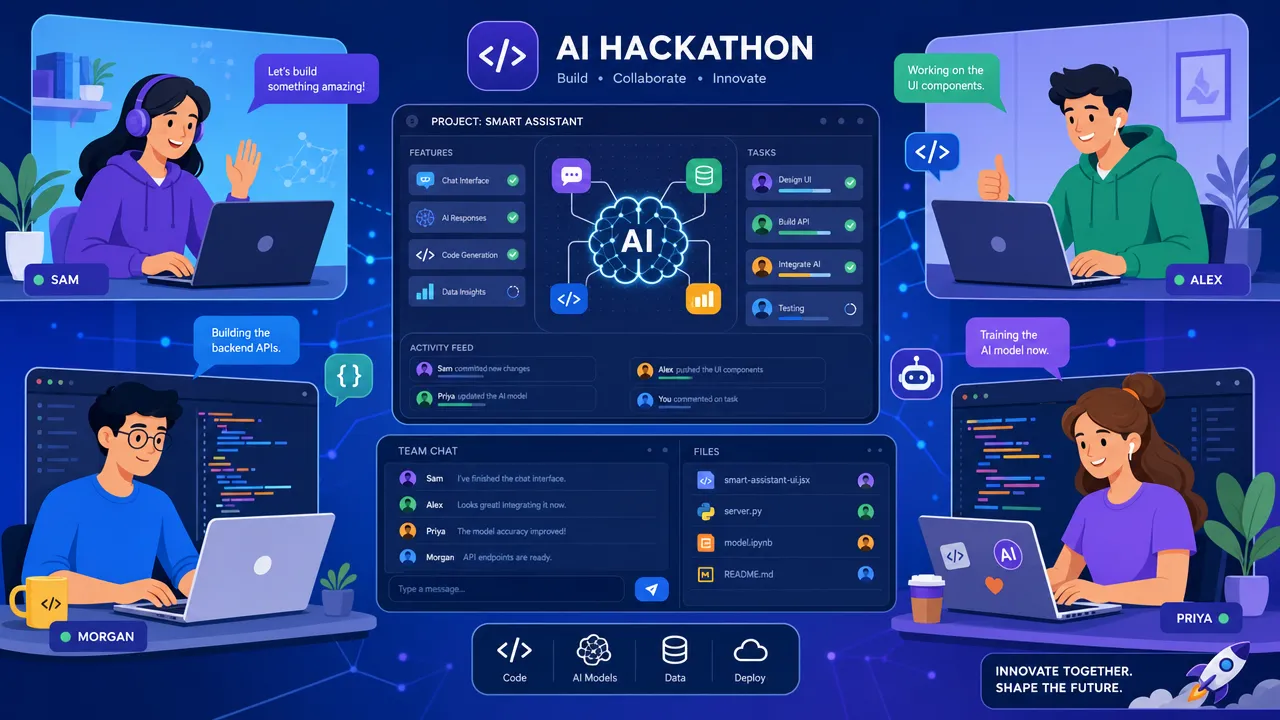
How the online AI hackathon moved from registration to submitted projects
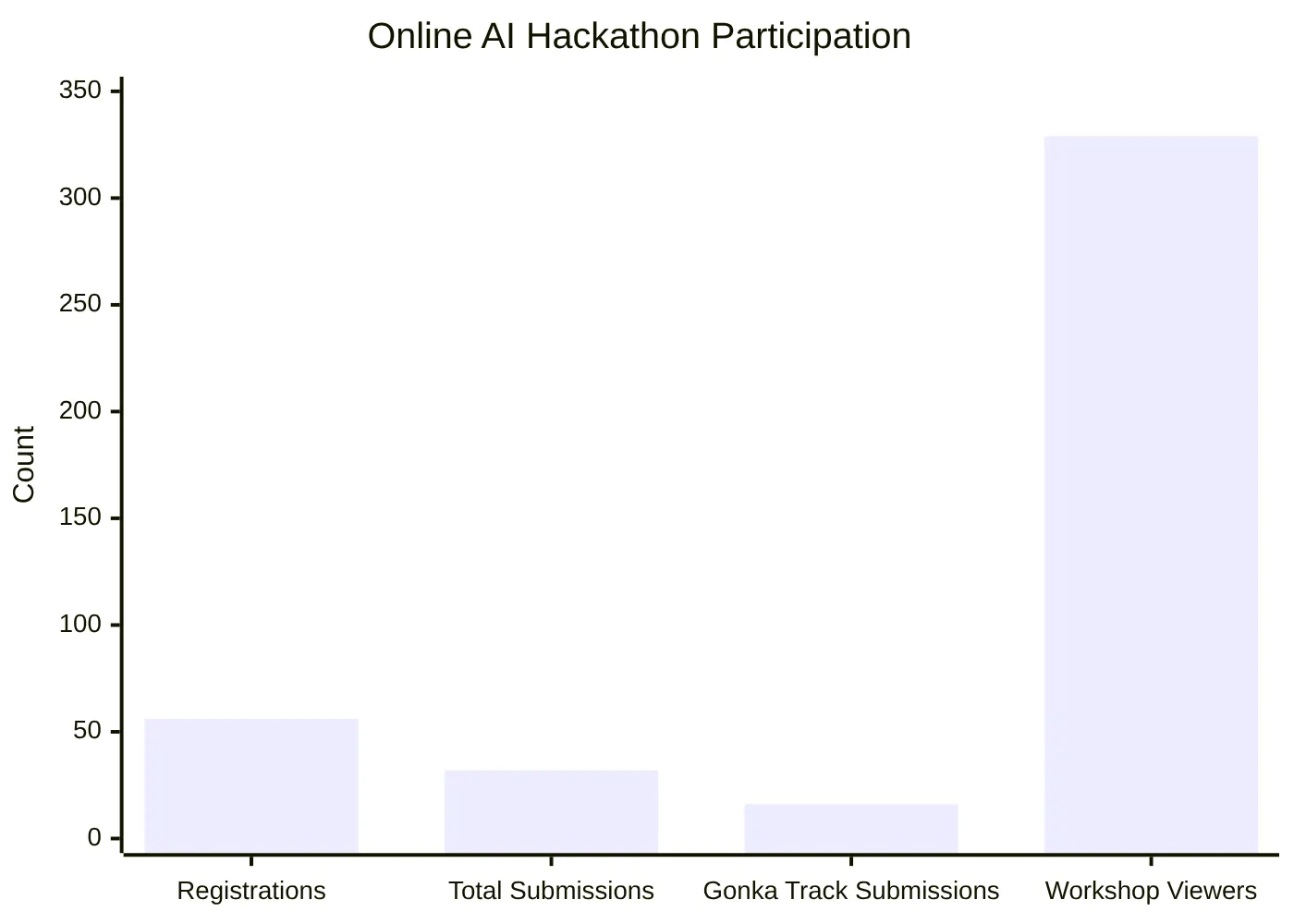
The online AI hackathon received 56 registrations and resulted in 32 total project submissions. Within that submission pool, the Gonka track received 16 project submissions, representing half of all submitted projects.
Event metric | Confirmed count | What it reflects |
|---|---|---|
Registrations | 56 | Initial builder interest in the online AI hackathon |
Total project submissions | 32 | Completed project work submitted during the event |
Gonka track submissions | 16 | Projects submitted specifically in the Gonka track |
Live online workshop viewers | 329 | Broader community engagement during the event period |
The 32 submitted projects also show that many participants went beyond exploration and produced something concrete. For an online AI hackathon, that transition from concept to project is the central achievement. Builders had to make tradeoffs, decide how to use an AI API, connect workflows, prepare demos, and shape their ideas into a form that could be evaluated or shared.
The Gonka track's 16 submissions are especially meaningful in this AI hackathon recap because they show direct engagement with the GonkaRouter ecosystem. Without making unsupported claims about the specific implementation details of each project, the number confirms that a substantial share of builders chose to participate in the Gonka track.
An 888 USDT prize and a closer look at the Gonka track
The event included an 888 USDT prize for the first-place winner, adding a clear incentive for teams to turn their ideas into usable AI applications. The prize complemented the technical support available through GonkaRouter's shared event-wide inference pool and gave builders another reason to focus on completing and presenting their work.
The following examples are selected from the submitted projects to illustrate the range of problems teams explored. They are examples of project directions, not a ranking or an announcement of winners.
Truth Verify: structured verification for university and major claims
Truth Verify focuses on a practical problem for high school students and parents: assessing claims about universities, majors, employment prospects, campus locations, and transfer policies. The project turns vague or overstated claims into a structured verification report, combining a local knowledge base, RAG workflows, and AI model APIs. Its goal is to make education-related information easier to examine instead of asking users to accept unsupported statements at face value.
ProofMesh: auditable, multi-agent fact verification
ProofMesh treats fact verification as an auditable process rather than a single black-box answer. The application breaks a claim into atomic propositions, gathers evidence, asks another model to challenge the findings, and then produces a Truth Score, uncertainty information, supporting sources, model information, and an audit trail. This structure shows how GonkaRouter can support applications that need both model reasoning and a transparent record of how a conclusion was formed.
Fact Atlas: a private knowledge map with optional public commitments
Fact Atlas combines fact checking with personal knowledge management. The hybrid knowledge application uses Gonka-powered inference for evidence retrieval and multi-model review, then lets users save verified claims into a private knowledge map. It also supports spatial organization and optional public version commitments, creating a workflow that connects investigation, personal context, and selective public sharing.
TrustLens AI: verification for scams, phishing, and misleading content
TrustLens AI applies multi-model verification to URLs, social posts, text claims, emails, and suspicious Web3 messages. The project combines a Truth Score with evidence, confidence levels, human-readable reasoning, model outputs, and Gonka request records. Its community reporting feature also points toward a shared knowledge base for identifying scams, phishing attempts, misinformation, and other forms of digital deception.
Together, these projects show how the Gonka track supported more than one type of AI application. Teams explored education information, public fact verification, private knowledge systems, online safety, and auditable model workflows. The variety also reinforces the value of accessible inference infrastructure: once model access is available through a familiar API pattern, builders can focus on the product problem, user experience, and trust model that make each application distinct.
How free AI inference supported online AI hackathon builders
GonkaRouter provided registered participants with free AI inference access through a shared event-wide pool of up to 50 billion free tokens. This was the total allocation for the entire event. It was not an individual 50 billion-token allowance for each participant.
That distinction is important. The token pool was designed as event-wide support for registered builders, helping participants experiment with model calls, test prompts, refine application behavior, and connect AI features into working prototypes. In a hackathon environment, developers often need multiple rounds of iteration before an idea becomes usable. A prompt may need adjustment. An agent workflow may need better structure. A chatbot may need clearer guardrails. A backend integration may need several test runs before the demo behaves as expected.
Free API inference access helps reduce the cost of those early experiments. It gives builders more room to compare outputs, debug assumptions, and move from local ideas into application-level workflows. For participants using GonkaRouter as an AI model router, the ability to make API calls through a familiar integration pattern was a practical way to focus on building rather than spending time on access setup.

The shared pool also aligned with the way online hackathons operate. Participants build at different speeds, test different types of applications, and often iterate heavily near submission time. Event-wide free AI inference support creates a practical foundation for experimentation while keeping the allocation clearly tied to the hackathon as a whole.
Why the online AI hackathon workshop expanded developer engagement
During the event period, a live online workshop attracted 329 viewers. That audience extended engagement beyond the 56 registered participants and the 32 submitted projects, giving the broader builder community an opportunity to follow along during the hackathon period.
The workshop was publicly shared through the workshop announcement on X. Because only the confirmed engagement figure is being cited here, we are not adding unverified details about the workshop title, speakers, dates, agenda, or specific content.
The size of the workshop audience reflects the broader interest around AI developer tools and practical AI application building. A live audience of 329 viewers is larger than the registration pool, which suggests that the learning component reached people beyond those who submitted projects. Some viewers may have been participants, while others may have joined to learn, observe, or evaluate how to approach future AI builds.
For GonkaRouter, this kind of learning moment is an important part of ecosystem support. Hackathons are not only about final submissions. They are also about helping developers become more confident with infrastructure, APIs, model access, and integration patterns. A successful online AI hackathon creates value when builders leave with both completed work and clearer technical intuition.
How the online AI hackathon connected builders with Kimi, MiniMax, and compatible APIs
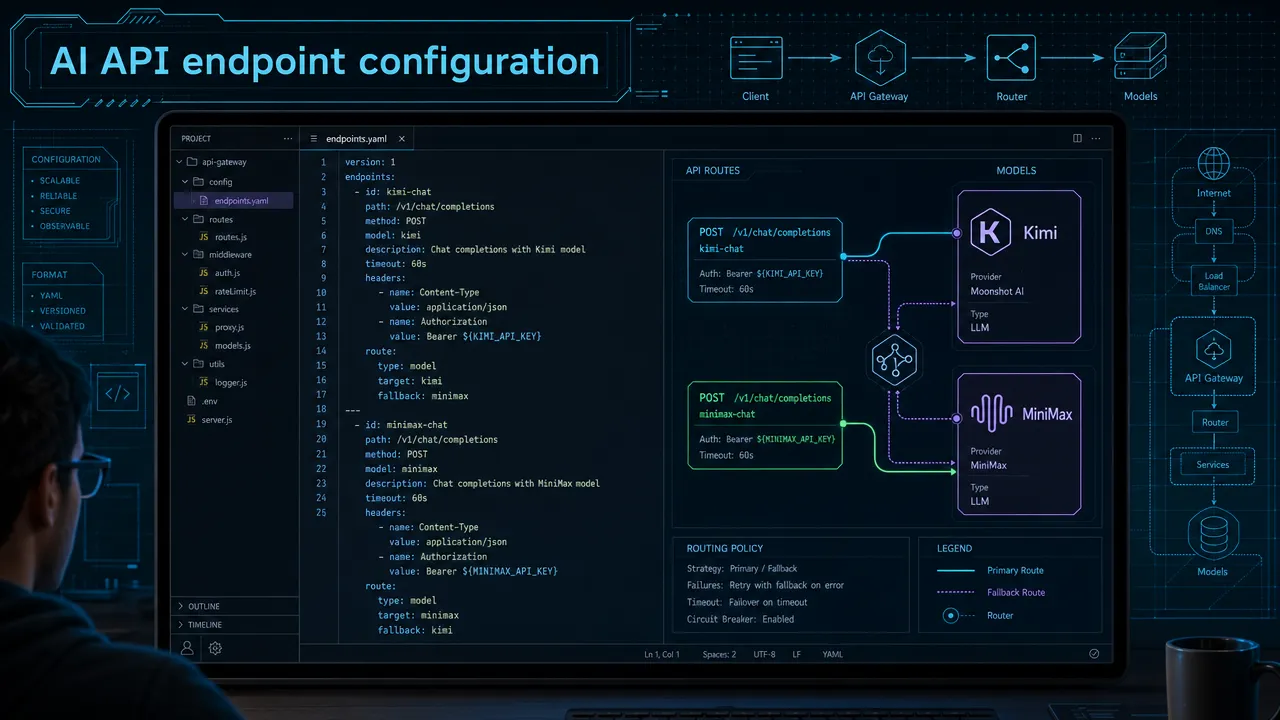
GonkaRouter currently supports Kimi and MiniMax models, giving developers options for building AI applications through a router-based workflow. GLM and additional models are planned for future availability, but GLM should be understood as coming soon rather than currently available.
For builders who already work with common API patterns, GonkaRouter is compatible with both Anthropic API and OpenAI API formats. These are format compatibility options that help developers integrate with familiar request structures. They should not be interpreted as a claim that GonkaRouter provides official OpenAI or Anthropic models.
This compatibility can be useful during an online AI hackathon because developer time is limited. Teams often need to connect an AI API quickly, test behavior, and move on to product logic, UI, workflow design, or demo preparation. By changing the API endpoint and using a GonkaRouter API key, developers can configure GonkaRouter with AI developer tools such as Cursor, Claude Code, and OpenClaw.
Developer capability | Current status | Developer relevance |
|---|---|---|
Kimi support | Available | Lets builders call supported Kimi models through GonkaRouter |
MiniMax support | Available | Gives developers another supported model option for AI application experiments |
GLM support | Planned | Expected as part of future model availability |
Additional models | Planned | Intended to expand future options for builders |
Anthropic-compatible API format | Available | Helps developers use familiar Anthropic-style API patterns |
OpenAI-compatible API format | Available | Helps developers use familiar OpenAI-style API patterns |
Cursor, Claude Code, and OpenClaw setup | Available through endpoint configuration | Lets builders connect supported AI developer tools by changing the API endpoint |
Developers can find implementation details in the GonkaRouter documentation, including guidance for working with compatible API formats and model calls. For a guided setup path, the GonkaRouter tutorial provides a practical starting point for configuring a project and making requests.
These capabilities are especially relevant for hackathon-style development. Builders often need to integrate AI features into existing tools, test multiple ideas, and keep their workflow simple. Endpoint-based configuration helps teams preserve familiar development habits while routing requests through GonkaRouter.
What this online AI hackathon recap means for the developer community
This online AI hackathon showed a healthy builder funnel: 56 registrations, 32 submitted projects, 16 Gonka track submissions, and a workshop audience of 329 live online viewers. More importantly, it showed that developers continue to look for practical ways to experiment with AI models, AI API workflows, and tools that support fast iteration.
GonkaRouter was proud to support the event as a sponsor and ecosystem supporter. The shared event-wide pool of up to 50 billion free tokens gave registered participants room to prototype, test, and refine their ideas. The Gonka track submissions demonstrated meaningful engagement with the ecosystem, while the workshop audience reflected broader interest in learning and building with AI.
We thank every participant who registered, built, submitted, watched, or contributed to the event's momentum. The creativity behind the submitted projects reflects the strength of the builder community and the growing role of accessible AI developer tools in turning ideas into working software.
Developers who want to keep building can explore the GonkaRouter documentation or follow the GonkaRouter tutorial to start configuring compatible APIs, connecting supported tools, and experimenting with Kimi and MiniMax through GonkaRouter.