A new model evaluation pipeline is a version-controlled verification sequence that runs a candidate model against frozen datasets, normalized request adapters, automated graders, human review checkpoints, and operational regression thresholds before production promotion.
Major provider announcements—such as OpenAI's release documented in Introducing GPT-6 Sol and Luna, Anthropic's updates on the Anthropic models news page, and Google's builder release notes in Gemini 4 Argon for Builders—serve as industry launch signals that trigger pipeline execution across engineering teams.
Treat provider announcements as triggers for a controlled evaluation run. Test each candidate at its documented endpoint, then compare it with the production baselines selected from the live GonkaRouter model catalog using the same frozen dataset and scoring rules.
The live GonkaRouter model catalog provides the model identifiers and capability information needed to configure current production baselines without hardcoding a stale list into the evaluation process.
When teams evaluate models available on GonkaRouter alongside external baselines, the evaluation harness must treat each model ID as an independent candidate without assuming cross-provider model equivalence.
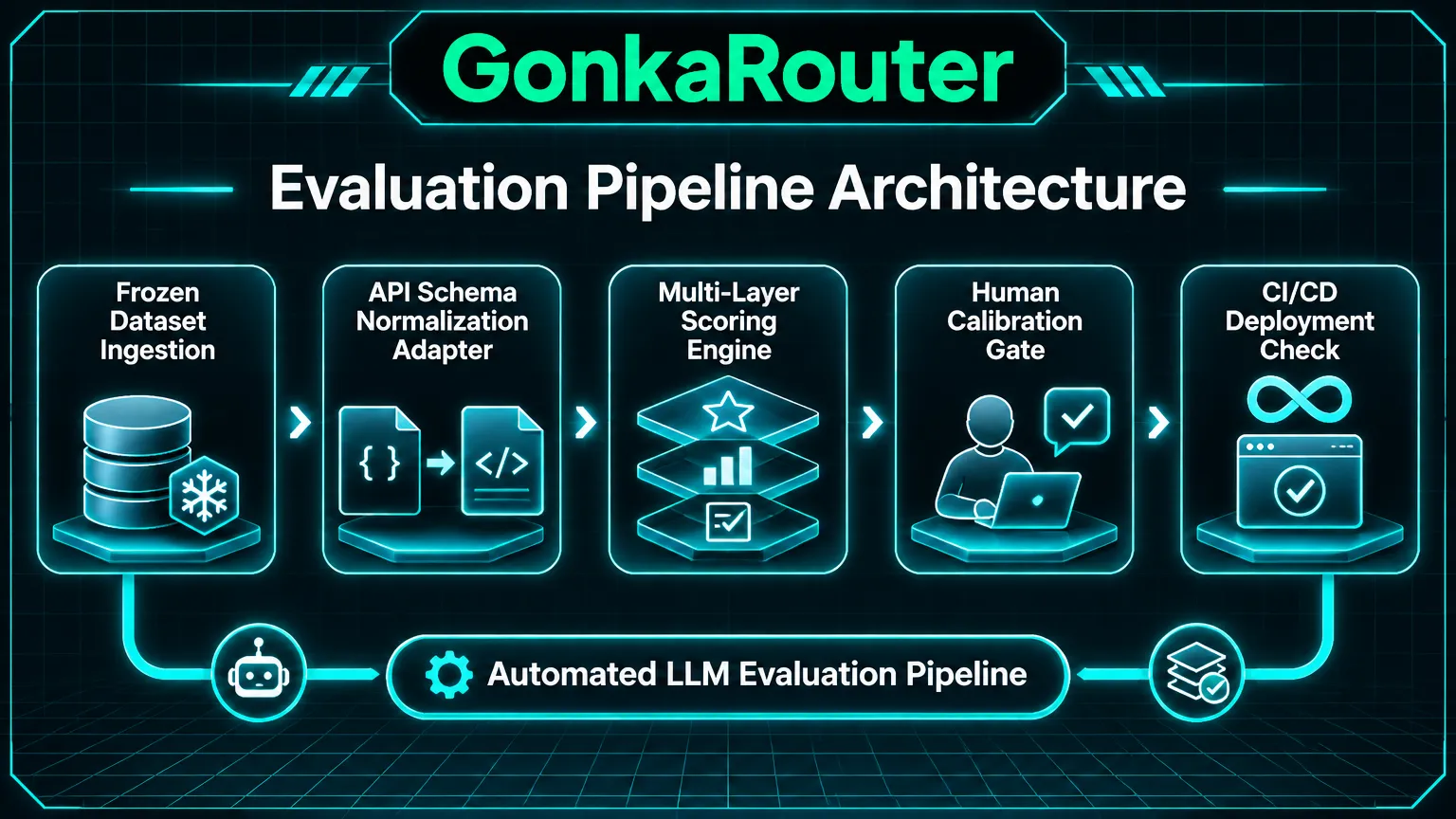
Define Dataset Rules and Adapter Contracts
A repeatable evaluation harness separates test cases from model transport code.
Frozen Golden Dataset Versioning
A frozen golden dataset is an immutable collection of input prompts, system instructions, tool definitions, retrieved contexts, and reference outputs stored under a cryptographic hash.
Do not modify prompts inside an active dataset version to accommodate a specific model's formatting preferences.
Follow these rules to maintain dataset integrity and control data contamination:
Sample 150 to 500 production-representative records stratified across core task classes: structured JSON extraction, multi-turn tool use, retrieval-augmented generation (RAG), and refusal boundaries.
Strip personally identifiable information (PII), session secrets, and live tenant identifiers before committing records to the evaluation repository.
Generate a SHA-256 digest for the serialized JSONL dataset file and bind that digest to every evaluation run log.
Rotate 15% of the test suite every quarter using fresh, post-cutoff application logs to prevent benchmark contamination from public training corpora.
Maintain three distinct dataset splits: a fast smoke split (25 records), a core regression split (200 records), and an adversarial edge-case split (100 records).
Request Schema Normalization and API Adapters
An evaluation adapter translates a canonical internal test case into the exact HTTP payload expected by a target endpoint and normalizes the response back into a standard evaluation record.
Reviewing how verified AI models prevent bad production selections helps teams define strict verification criteria before writing adapter logic.
GonkaRouter supports OpenAI-compatible and Anthropic-compatible API formats as documented in the GonkaRouter developer documentation.
OpenAI-compatible and Anthropic-compatible interfaces standardize request and response transport. Keep model identity explicit in the evaluation manifest and resolve valid IDs from the target endpoint before every run.
For deeper context on separating transport contracts from model identity, see our breakdown of why an OpenAI-compatible API interface reduces client rewrites.
Configure the adapter layer to enforce identical runtime conditions across every tested route:
Pin the exact model identifier string (for example,
zai-org/GLM-5.3-Flash,deepseek-ai/DeepSeek-V4-Flash-0731, orMiniMaxAI/MiniMax-M2.7when testing supported GonkaRouter catalog models).Fix sampling parameters across comparable runs: set
temperatureto0.0for deterministic extraction tasks, or capture five seeded runs attemperature0.2to measure output variance.Normalize system prompt placement, tool-call argument arrays, and stop sequences so the downstream scorer parses a single schema regardless of whether the request used an OpenAI-style chat completions payload or an Anthropic-style messages payload.
Record raw HTTP status codes, retry counts, prompt token counts, completion token counts, and wall-clock timestamps at the adapter boundary.
Pipeline Component | Required Artifact | Verification Rule | Failure Condition |
|---|---|---|---|
Golden Dataset | Immutable JSONL + SHA-256 manifest | Hash must match baseline run manifest | Mismatched hash invalidates comparison |
Canary Holdout | Private post-cutoff task set | Zero overlap with public benchmarks | Leakage detected via n-gram overlap |
Schema Adapter | Canonical request/response translator | Preserves tool schemas and system roles | Silent field dropping or truncation |
Parameter Lock | Frozen config file ( | Identical limits applied to all candidates | Unbounded generation length skews cost |
Combine Automated Scoring with Human Calibration
A single composite score hides critical regressions in formatting, tool execution, or factual grounding.
Implement a three-tier scoring funnel that executes deterministic checks first, semantic checks second, and human calibration third.
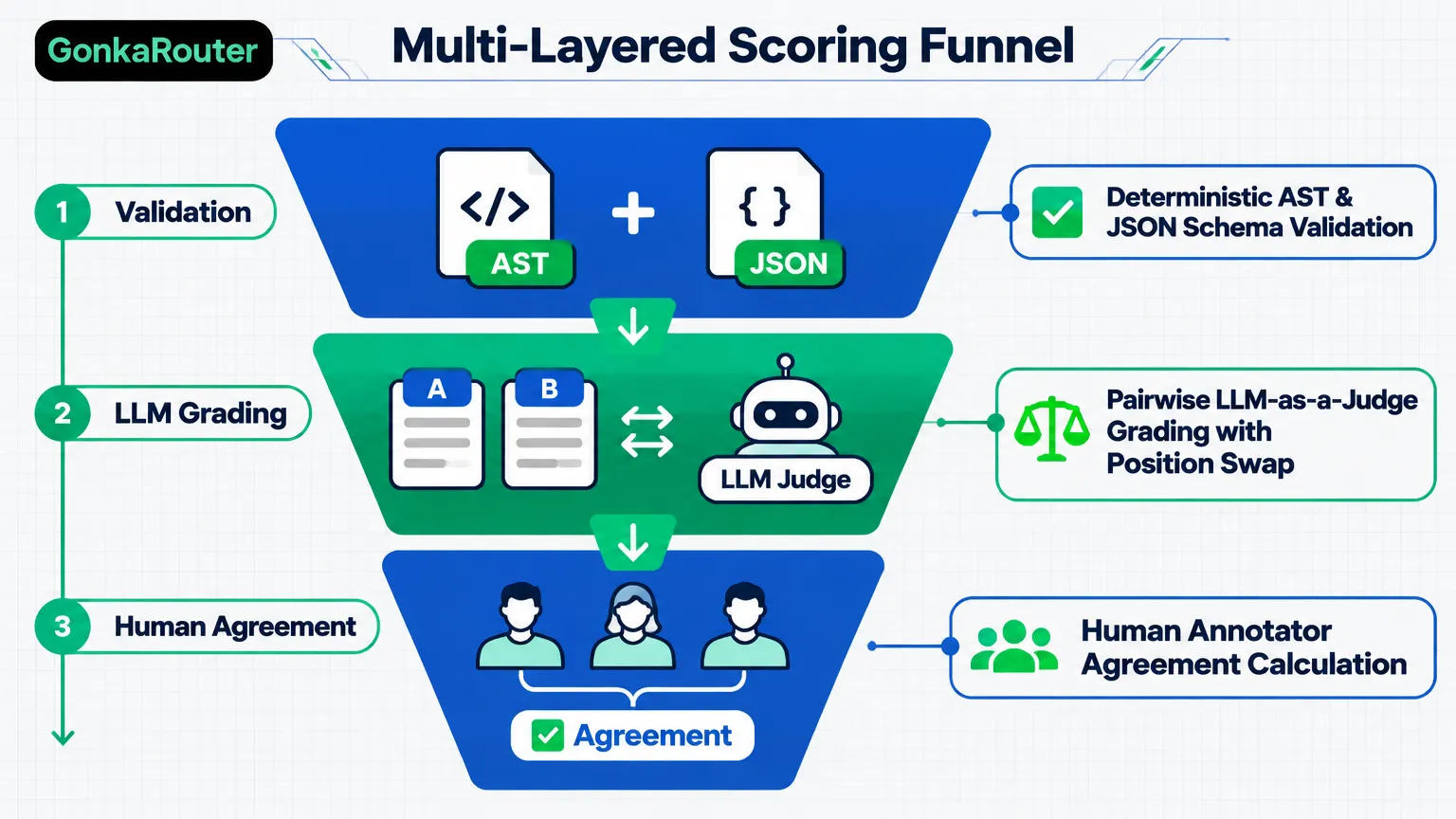
Tier 1: Deterministic and Programmatic Verification
Deterministic graders run in milliseconds and require zero inference spend.
If a candidate response fails a deterministic gate on a structured workflow, mark the task as failed immediately without invoking an LLM judge.
Validate JSON outputs against the production JSON Schema or Pydantic definition.
Verify tool-call invocations by checking that the selected function name exists in the allowed tool registry and all required arguments match declared types.
Execute generated code snippets inside an isolated sandbox against unit assertions.
Check hard constraints including maximum character length, forbidden regex patterns, and required citation markers.
Tier 2: Semantic Similarity and Calibrated LLM-as-a-Judge
Use semantic and model-based graders only after the response passes Tier 1 syntactic validation.
LLM judges exhibit position bias, verbosity bias, and self-preference bias unless controlled by explicit evaluation rules:
Use binary pass/fail or 3-point integer rubrics (1 = Fail, 2 = Acceptable with minor omission, 3 = Exact match to reference criteria) instead of unanchored 1-to-10 scales.
Run pairwise comparisons twice for every test case by swapping the presentation order (
(Candidate_A, Baseline_B)followed by(Baseline_B, Candidate_A)).Declare a pairwise tie or escalate to human review if the judge flips its verdict when response positions are swapped.
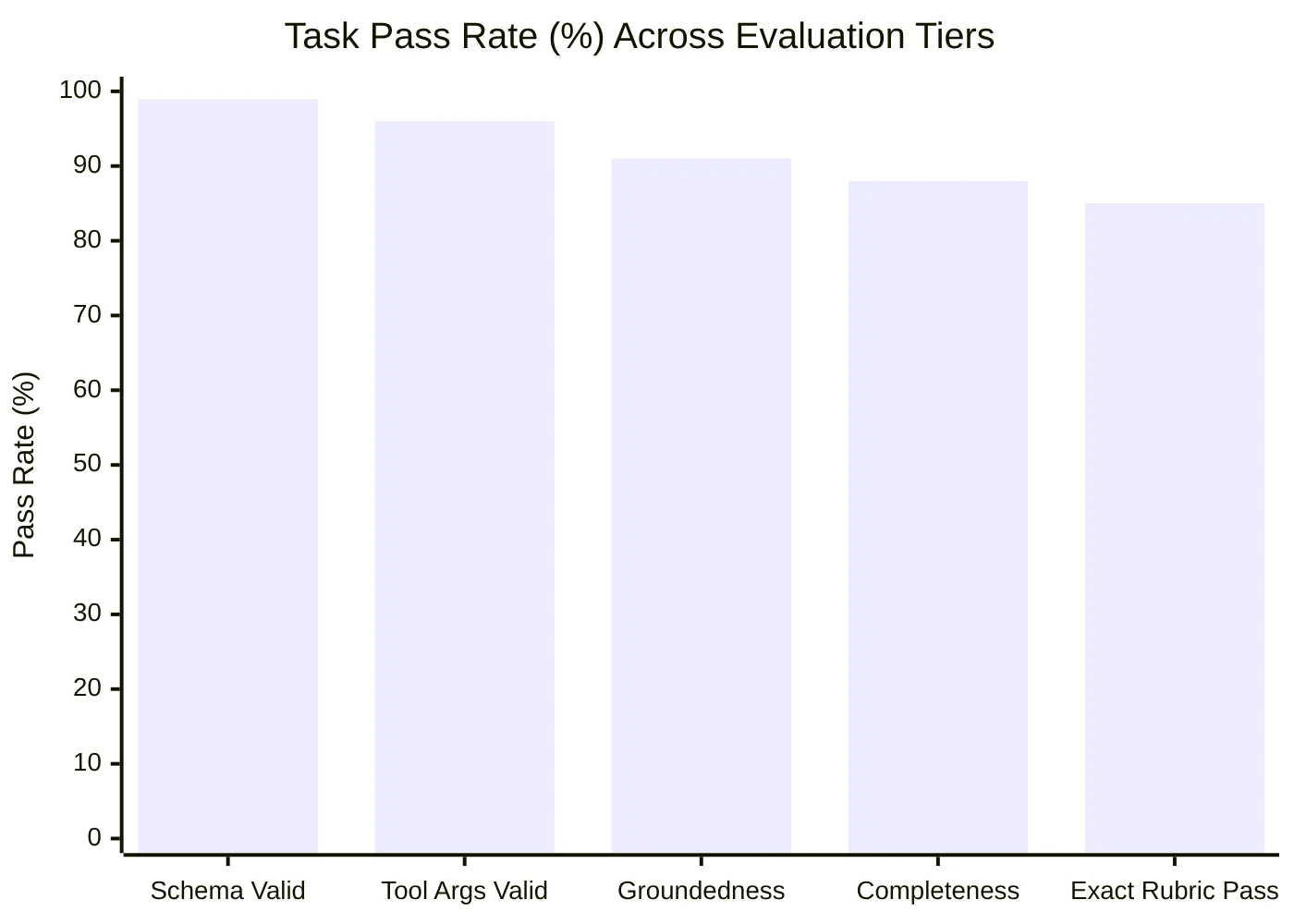
Decompose RAG evaluation into four distinct sub-checks: context relevance, groundedness (zero hallucinated claims outside retrieved chunks), answer completeness, and citation accuracy.
Tier 3: Structured Human Review and Inter-Annotator Agreement
Automated judges cannot replace domain experts on ambiguous edge cases, policy refusals, or complex multi-step reasoning.
Calibrate your automated judge against human labels before trusting automated scores for promotion decisions:
Sample 50 to 100 stratified outputs from the evaluation run and assign each record to at least two independent domain reviewers in a blind interface that hides model identity.
Provide reviewers with the exact binary or 3-point rubric given to the automated judge.
Calculate Cohen's Kappa (κ\kappaκ) for two raters or Krippendorff's Alpha (α\alphaα) for multiple raters across the human annotation batch.
Require a human inter-annotator agreement score of κ≥0.75\kappa \ge 0.75κ≥0.75 before treating the rubric as valid; if human raters disagree, rewrite the rubric instructions.
Measure agreement between the majority human vote and the LLM judge; block automated grading until judge-to-human agreement reaches at least 85%.
Test Latency, Reliability, and Cost Regressions
A candidate model that improves rubric quality by 2% but doubles tail latency or triples retry volume will degrade production service levels.
Architecture teams designing boundary tests can reference our guide on isolating gateway adapters during workload migrations to keep operational metrics clean.
Latency and Streaming Metrics
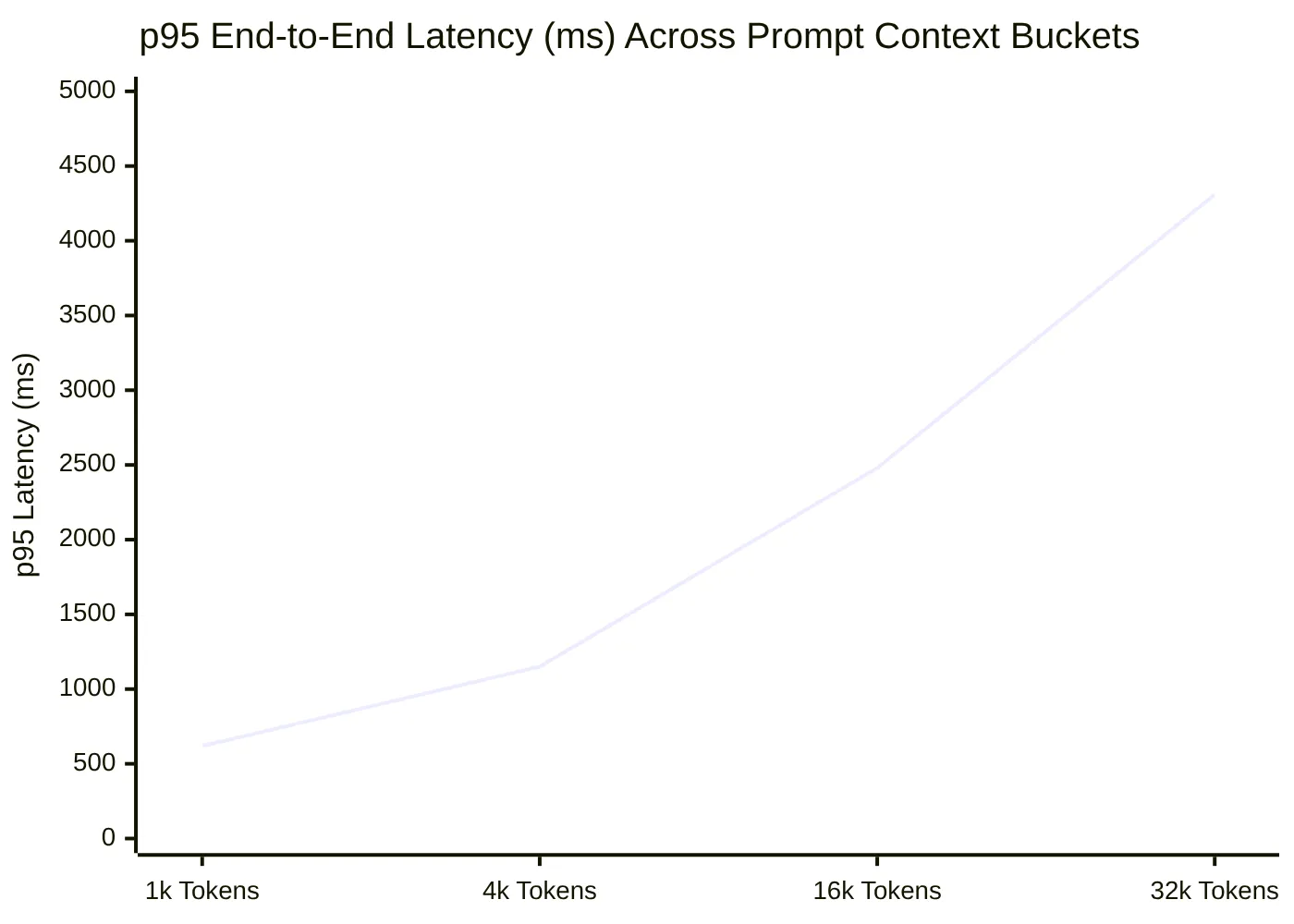
Measure latency under concurrent load that matches peak application traffic rather than sequential single-threaded requests.
Record four timing distributions across the core regression split:
Time to First Token (TTFT): Elapsed milliseconds from request dispatch to the arrival of the first non-empty content delta in a streaming response.
Inter-Token Latency (ITL): Mean milliseconds between consecutive output tokens during stream generation.
End-to-End Completion Time (p50, p95, p99): Total duration until the stream terminates or the full payload returns.
Timeout and Error Rate: Percentage of calls failing due to HTTP 429, HTTP 5xx, stream disconnects, or client deadline expiration.
Cost per Successful Task Calculation
Never evaluate model economics using published per-million-token rates alone.
Check the current GonkaRouter pricing schedule for current token billing details on supported catalog models, and calculate total cost per accepted task inside your evaluation harness.
Calculate Cost per Successful Task using this operational formula:
Sum all input tokens and output tokens consumed across the initial attempt plus any automated schema-repair retries across all NNN test cases.
Multiply total input and output tokens by the candidate route's verified token rates to obtain Total Run Spend (escaped in logs as $, for example $1.45 per 1,000 tasks).
Divide Total Run Spend by the count of tasks that passed both Tier 1 deterministic validation and Tier 2 quality thresholds (NacceptedN_{\text{accepted}}Naccepted).
Compare the resulting $ per accepted task against the production baseline route.
Operational Metric | Calculation Method | Promotion Threshold vs. Baseline | Action on Violation |
|---|---|---|---|
TTFT (p95) | 95th percentile time to first streamed token | ≤+10%\le +10\%≤+10% over current production baseline | Reject for interactive chat routes |
End-to-End Latency (p99) | 99th percentile full completion time | Must remain below hard client timeout budget | Reject or restrict to async batch |
Schema Pass Rate | Valid JSON / tool calls on first attempt | ≥98.5%\ge 98.5\%≥98.5% without repair retries | Block promotion; inspect adapter |
Cost per Successful Task | Total spend (including retries) / Accepted tasks | Within defined unit economics ceiling (e.g., ≤$0.005\le \$0.005≤$0.005) | Reject or restrict to low-volume tier |
Set Promotion Gates and Run the Pipeline
A model change is a production dependency change and must pass an automated CI/CD promotion gate before receiving live user traffic.
Teams managing explicit route policies should review how to enforce deterministic evaluation gates per endpoint route and how to handle application-level error classification across routes.
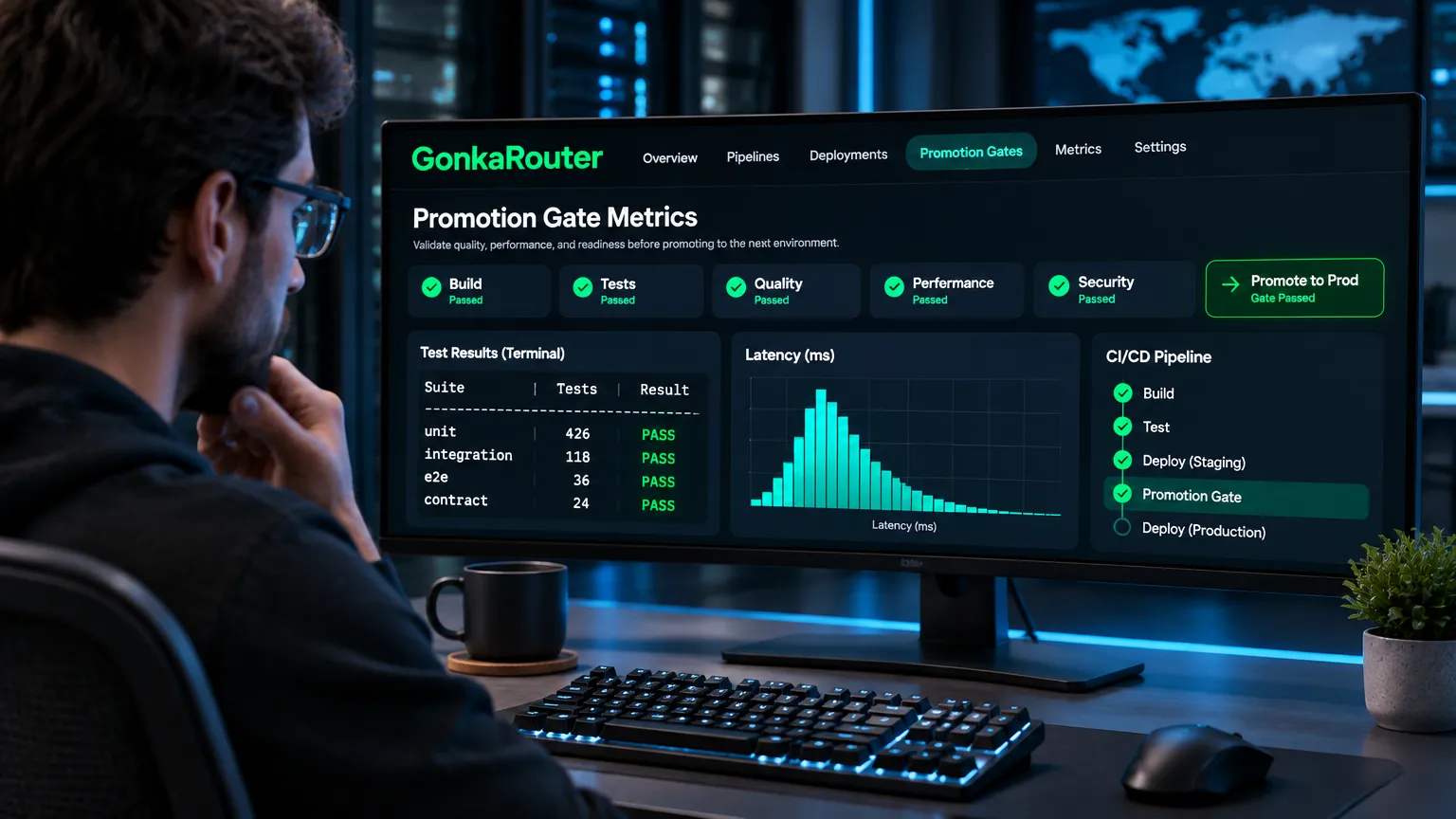
Step-by-Step Pipeline Execution Procedure
Execute these steps whenever a candidate model enters staging or a prompt template changes:
Lock the Candidate Configuration: Record the exact model ID, endpoint URL, API format adapter (OpenAI-compatible or Anthropic-compatible format), and sampling parameters in a versioned YAML manifest.
Run Smoke Verification (Gate 1): Execute the 25-record smoke dataset to confirm authentication, request schema compatibility, streaming delta parsing, and tool-call execution. Stop immediately if any transport error occurs.
Run Full Offline Evaluation (Gate 2): Execute the 200-record regression split and 100-record adversarial split under controlled concurrency. Capture all raw responses, token counts, and latency timestamps.
Execute Automated Grading (Gate 3): Run Tier 1 programmatic validators and Tier 2 position-swapped pairwise judges. Flag any task where the candidate regresses on a previously passing baseline record.
Complete Human Calibration Audit (Gate 4): Route swapped-verdict ties and a 10% random sample to human reviewers. Verify κ≥0.75\kappa \ge 0.75κ≥0.75 and confirm zero high-severity safety or policy violations.
Verify Operational Thresholds (Gate 5): Compare p95 TTFT, p99 completion latency, first-attempt schema validity, and $ per accepted task against the promotion matrix.
Stage Canary Rollout (Gate 6): If all offline gates pass, deploy the new configuration behind an application feature flag to a bounded test cohort, monitor client-side error rates and validation pass rates, and keep an immediate configuration rollback switch ready.
Common Mistakes and Precautions
Avoid these operational errors when running evaluations:
Testing unpinned aliases: Never run evaluations against floating model aliases when a versioned snapshot identifier is available.
Ignoring repair-loop token spend: Do not mark a task as a low-cost success if the application had to execute three retry calls to fix malformed JSON.
Skipping endpoint identity checks: Resolve the exact candidate model ID from the target endpoint before each run and store it with the dataset and adapter version.
Skipping adversarial refusal checks: Always verify that the candidate model neither over-refuses benign technical queries nor bypasses application safety boundaries.
Run the Baseline on Current Catalog Models
To run this evaluation workflow against GonkaRouter's currently supported models, inspect the live GonkaRouter model catalog to verify the exact identifiers for zai-org/GLM-5.3-Flash, deepseek-ai/DeepSeek-V4-Flash-0731, and MiniMaxAI/MiniMax-M2.7. Review the request schemas in the GonkaRouter developer documentation, check token rates on the GonkaRouter pricing page, and connect your evaluation adapter to test one of those currently supported catalog models against your frozen golden dataset.