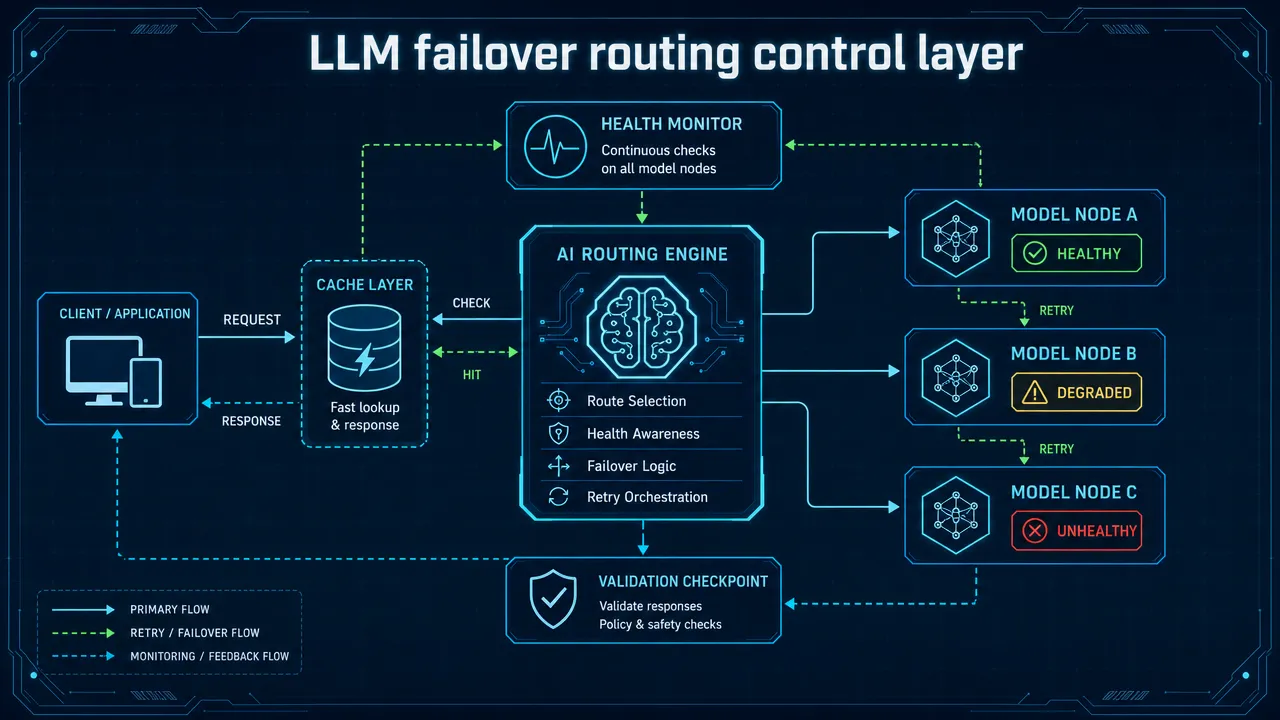
Smooth LLM routing keeps AI applications working by moving each request through a controlled layer that can classify failures, choose an eligible model route, validate output, and recover without exposing raw errors to users. In production, llm failover is not a last-minute patch. It is the reliability pattern that lets teams use multiple AI models while keeping latency, model context, request caching, and fallback behavior under control.
Why llm failover starts with a routing layer
LLM requests fail in ways that ordinary API calls do not. A traditional API either returns a clear success or error. An LLM can return HTTP 200 and still fail the application because the response is malformed JSON, ignores a schema, times out during streaming, refuses a task, exceeds the model context, or breaks an agent tool-call contract.
That is why llm failover belongs in an AI routing engine rather than scattered across application code. The router can decide whether to retry, repair the prompt, use model fallback routing, or return a graceful error.
Several technical sources describe failover as a production routing concern. Portkey's guide on failover routing strategies for LLMs emphasizes fallback paths for rate limits and provider failures, while TrueFoundry discusses LLM failover and load balancing as part of outage resilience.
A practical routing layer should evaluate four questions before every model call:
Routing question | Why it matters | Typical action |
|---|---|---|
Is the request cacheable? | Repeated prompts can waste tokens and latency. | Check request caching before inference. |
Does the model context fit? | Context overflow causes errors or bad truncation. | Compress context or choose another eligible route. |
Is the route healthy? | Rate limits, outages, and high latency degrade UX. | Use health checks and circuit breakers. |
Is the output valid? | A model response can be syntactically or functionally wrong. | Validate, repair, retry, or fallback. |
For teams building AI agents, chatbots, content generation tools, code generation products, and automated workflows, this routing layer becomes the difference between a demo and a durable product.
What llm failover should handle before fallback
The strongest llm failover systems do not blindly switch models on every error. They classify the failure first. Some failures are transient and retryable. Some require request repair. Some should never be retried because the problem is authentication, configuration, or policy.
A useful taxonomy looks like this:
Failure mode | Example symptom | Best routing response |
|---|---|---|
Rate limit | 429 response during traffic spike | Fallback to an approved route or queue low-priority traffic. |
Provider outage | 502, 503, 504, or failed health probe | Open circuit breaker and route to a healthy backup. |
Timeout | No response within latency budget | Retry briefly, then use ai model failover. |
Context overflow | Prompt exceeds route limit | Summarize, trim retrieval context, or use another eligible route. |
Invalid output | Bad JSON, missing fields, unusable tool call | Repair once, then fallback to a route tested for schema behavior. |
Auth issue | 401 or 403 | Do not retry blindly. Alert and fail gracefully. |
Safety or policy outcome | Refusal or blocked response | Apply product policy. Do not use fallback to bypass safeguards. |
Agent tool failure | Invalid arguments or looped action | Validate tool calls and stop repeated loops. |
This is also where model context becomes a first-class routing signal. The router should know the estimated input tokens, output budget, system prompt, conversation history, retrieved documents, tool definitions, and agent state before it chooses a route. A short classification task and a long RAG answer should not be treated as equal traffic.
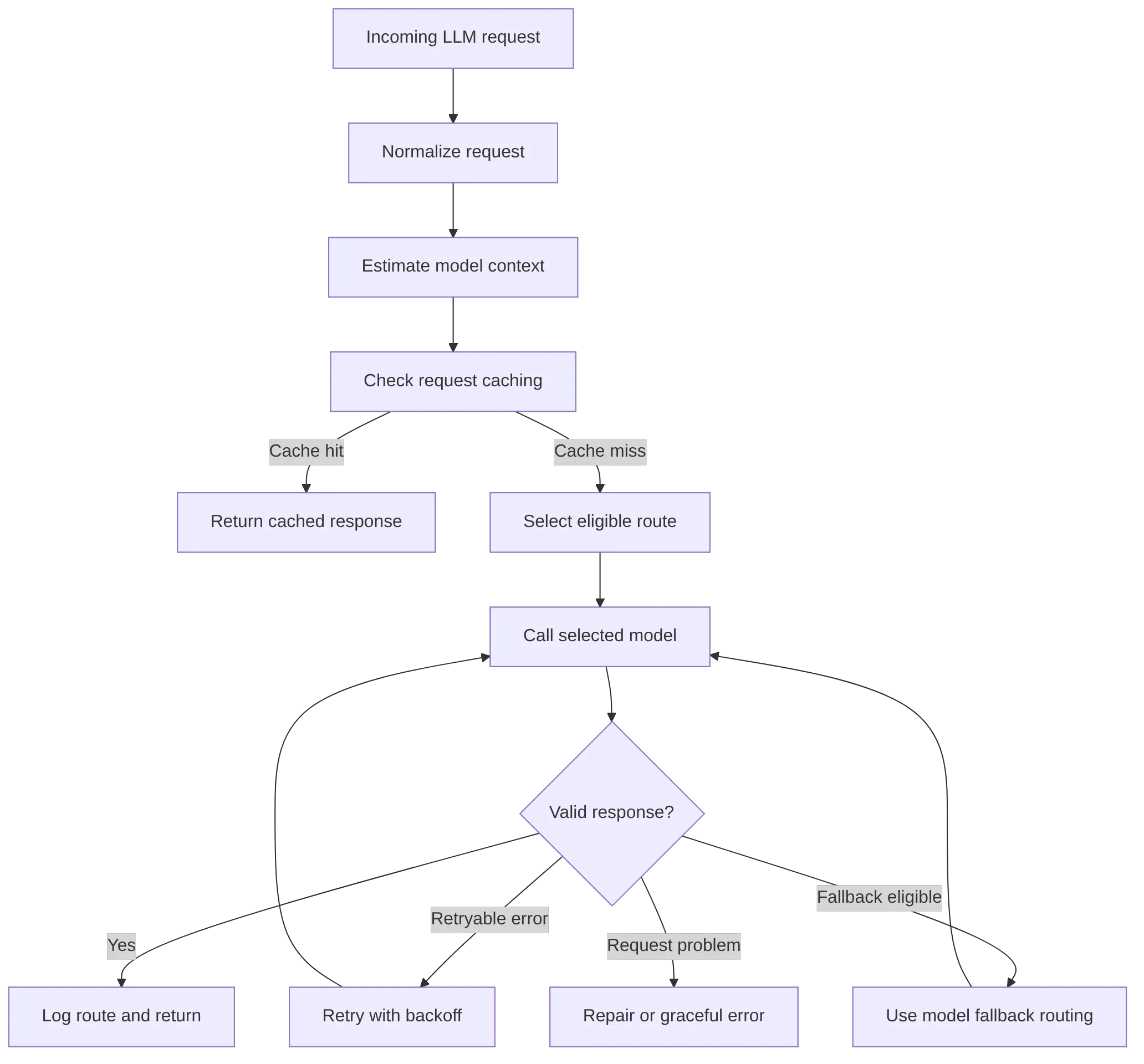
The opinionated takeaway is simple: fallback is only safe when the backup route has been tested for the same model context, prompt template, output format, and product policy.
Core llm failover strategies for smooth routing
The phrase "route requests between llms" often sounds like a model picker. In production, it is closer to a control system. The router balances quality, latency, cost, availability, token size, user tier, and task intent.
Here are the most useful llm routing strategies:
Strategy | Best fit | Watch out for |
|---|---|---|
Static routing | Early prototypes and simple workloads | Creates single-route dependency. |
Rule-based routing | Known product flows and user tiers | Rules can become hard to debug. |
Cost-aware routing | High-volume summarization or extraction | Lowest cost is not always lowest cost per successful task. |
Latency-aware routing | Chat, interactive assistants, agent steps | Fast routes may produce weaker output. |
Availability-aware routing | Production reliability | Needs circuit breakers and recovery probes. |
Context-aware routing | Long conversations, RAG, code analysis | Requires token estimation before routing. |
Semantic routing llm | Multi-purpose assistants and agents | Misclassification can send tasks to poor routes. |
Agent-step routing | Planners, validators, tool callers, final answers | Requires stable metadata from the agent framework. |
LLM load balancing deserves special attention because LLM traffic is not uniform. A 200-token classification call and a 20,000-token analysis request create very different load, latency, and failure risk. Traditional round-robin balancing is usually too shallow. A better llm load balancing policy considers token estimates, route health, P95 latency, rate-limit state, task type, and validation history.
Semantic routing llm patterns add another layer. Instead of sending everything to a default route, the ai routing engine classifies the task as summarization, code generation, extraction, reasoning, translation, Q&A, or tool calling. Then it chooses a route based on task fit. This is the foundation of intelligent model routing.
The common search query "how to switch between claude and gpt" points to the same architecture pattern: abstract model calls behind a router interface, normalize request and response shapes, version prompts per model family, validate outputs, and log every route decision. For GonkaRouter specifically, this must be stated precisely: OpenAI-compatible API and Anthropic-compatible API mean API format compatibility only. They do not mean GonkaRouter provides those providers' official models.
A compact implementation policy might look like this:
Condition | Routing decision |
|---|---|
Cache hit is safe | Return cached response. |
Input exceeds default context | Compress context or choose another eligible supported model route. |
Primary route returns 429 | Use model fallback routing. |
Primary route is slow but available | Use latency-aware routing for user-facing requests. |
Output fails schema | Try repair once, then fallback if eligible. |
Agent step is validation | Use a route tested for structured checking. |
No route satisfies policy | Return a graceful error instead of guessing. |
How llm failover improves agents, caching, and context control
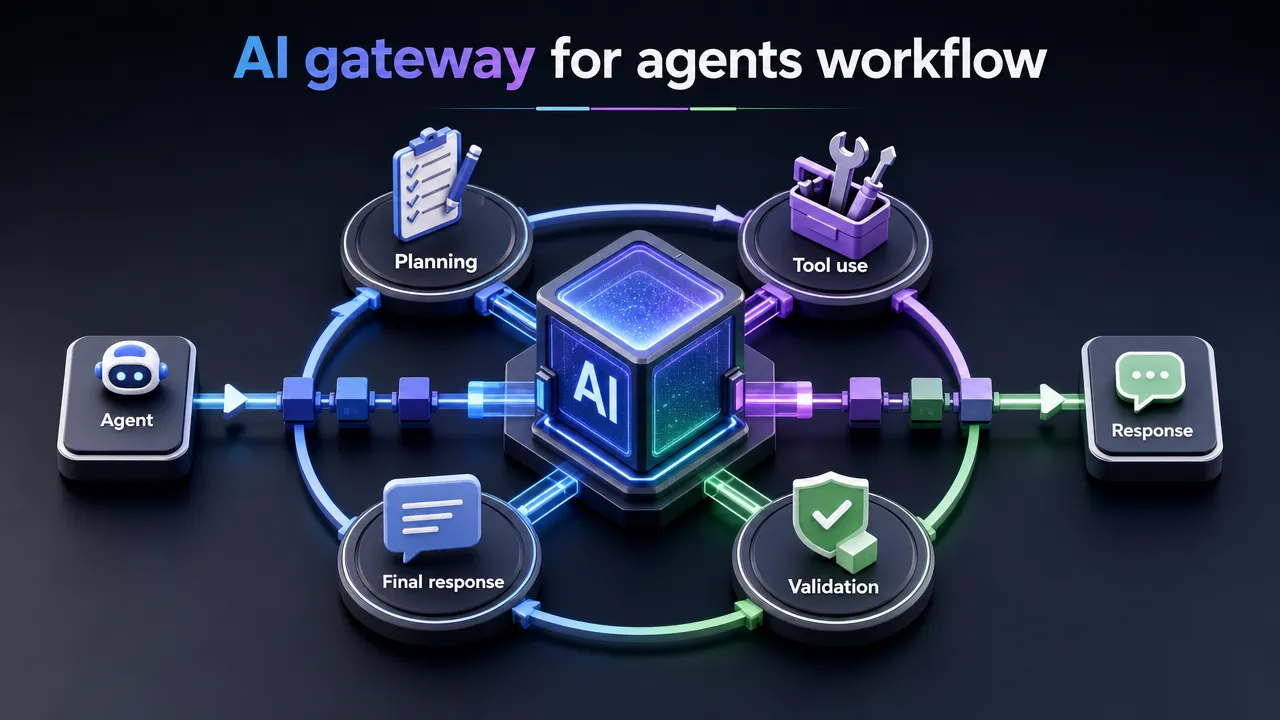
AI agents make llm failover more important because one user request can trigger many model calls: planning, tool selection, tool execution review, memory summarization, validation, and final response generation. A single failed step can break the whole workflow.
A model router for agents should route by step metadata, not only by model name. For example:
Agent step | Routing priority |
|---|---|
Intent classification | Low latency and predictable labels. |
Planning | Strong reasoning and stable decomposition. |
Tool calling | Strict schema and argument reliability. |
Tool result summary | Cost-efficient summarization. |
Validation | Consistent output checking. |
Final response | User-facing quality and tone. |
This is why an ai gateway for agents or llm gateway for agents is valuable. It centralizes credentials, endpoint configuration, model selection, fallback policy, output normalization, and logs. It also keeps agent code cleaner because the agent does not need to know every operational detail of every model route.
Request caching is another practical layer. Exact-match caching works well for deterministic tasks, documentation Q&A, repeated classification, and stable extraction prompts. Semantic caching can help with similar questions, but it requires strict tenant boundaries, similarity thresholds, and invalidation rules. Caching user-specific or time-sensitive outputs without policy controls creates reliability and privacy risk.
Good cache keys should include the route, prompt template version, model identifier, system prompt, retrieval corpus version, tool schema version, temperature, max output tokens, and tenant policy. Cache invalidation should happen when documentation changes, prompt templates change, permissions change, or output schemas change.
For model context, the router should avoid naive truncation. Removing system instructions, output schema constraints, retrieved evidence, tool results, or agent state can make a fallback response look successful while silently breaking the task. Context-aware routing should count tokens, estimate output size, compress safely, and log context length with the final route.
Where llm failover fits with GonkaRouter
GonkaRouter fits this architecture as a focused AI Model Router and AI Gateway for developers who want one API for currently supported models. It is designed for fast integration through OpenAI-compatible and Anthropic-compatible API formats, where compatible applications can update the API endpoint, use a GonkaRouter API key, and test supported model routes through a unified access layer.
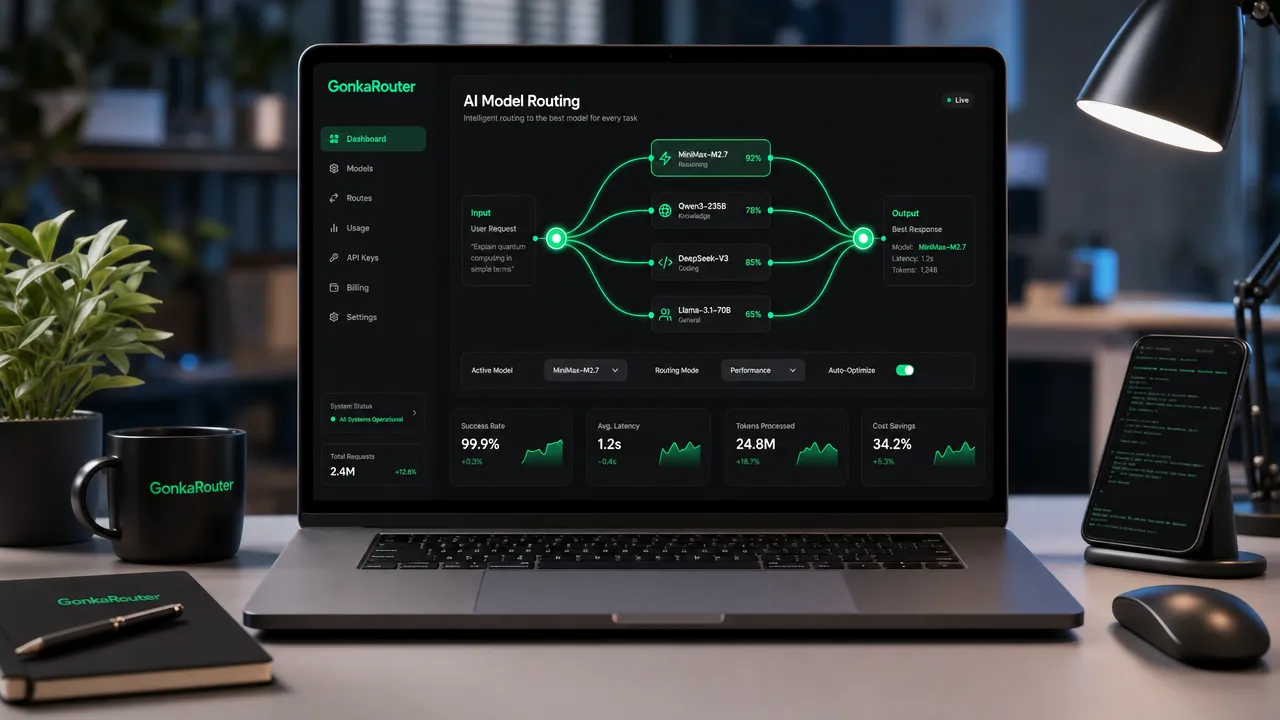
The supported models are strictly:
MiniMax-M2.7
Kimi-K2.6
GLM-5.2
Developers can review the current list on the GonkaRouter supported models page. In SEO terms, this makes GonkaRouter relevant for MiniMax-M2.7 API, Kimi-K2.6 API, GLM-5.2 API, MiniMax API, Kimi API, and GLM API use cases, but only for the supported models listed above.
The OpenAI Compatible API and Anthropic Compatible API wording should be understood as format compatibility. It does not mean access to GPT, Claude, or any other model outside the current GonkaRouter supported model list.
For teams comparing routing approaches, GonkaRouter's strongest practical value is simplicity:
GonkaRouter capability | Developer value |
|---|---|
One API for supported models | Reduces separate integration work. |
OpenAI-compatible API format | Helps compatible apps migrate by changing the endpoint. |
Anthropic-compatible API format | Supports Anthropic-style request format compatibility. |
Email-based login | Lowers onboarding friction for global developers. |
Pricing as low as $0.0004 / 1M tokens | Helps teams test inference economically. |
One-time 20 USDT trial credit after email login | Provides product usage credit for testing supported models. |
Gonka decentralized AI compute network | Connects globally distributed compute resources for inference access. |
For implementation details, start with the GonkaRouter developer documentation. For pricing context, see GonkaRouter pricing. For deeper related reading, GonkaRouter has useful posts on using one OpenAI-compatible API endpoint for multiple supported AI models, getting AI API access for cost-efficient inference, verified AI models and reliability, and choosing models for cost and quality.
Llm failover checklist for production teams
A smooth route between LLMs needs explicit rules, not hope. Use this checklist before deploying model fallback routing or intelligent model routing:
Area | Production checklist |
|---|---|
Request normalization | Keep request and response formats consistent across routes. |
Model context | Count input tokens, output budget, tools, history, and retrieved documents. |
Fallback eligibility | Approve fallback routes per task, tenant, schema, and policy. |
Retry policy | Retry transient errors with backoff and jitter. |
Circuit breaker | Remove routes with high error rates, high latency, or failed health checks. |
Request caching | Cache only safe, repeatable, non-sensitive outputs. |
Output validation | Validate JSON, tool calls, citations, and required fields. |
Observability | Log route ID, model ID, fallback reason, latency, tokens, cache status, and validation result. |
Agent routing | Add metadata for task type, agent step, complexity, and latency sensitivity. |
User experience | Return graceful degradation instead of raw provider errors. |
The best opinionated architecture is a small, testable control loop: normalize, estimate context, check cache, select route, call model, validate output, retry or fallback when eligible, and log everything. That loop makes llm failover reliable enough for real products.
For teams ready to test a focused Multi Model API, log in to GonkaRouter with email, get an API key, and use the one-time 20 USDT trial credit to try MiniMax-M2.7, Kimi-K2.6, and GLM-5.2 through one API.