GonkaRouter helps developers get AI API access for low-cost inference by combining one unified API, OpenAI- and Anthropic-compatible formats, and focused access to MiniMax-M2.7, Kimi-K2.6, and GLM-5.2.
Many searches for "get ai" point to consumer tools such as chatbots, AI characters, grammar checkers, essay writers, or image generators. For developers, the more useful meaning is different: get AI access through an AI Inference API that can be integrated into an app, Agent, chatbot, backend workflow, or enterprise product without rebuilding the entire stack for every model.
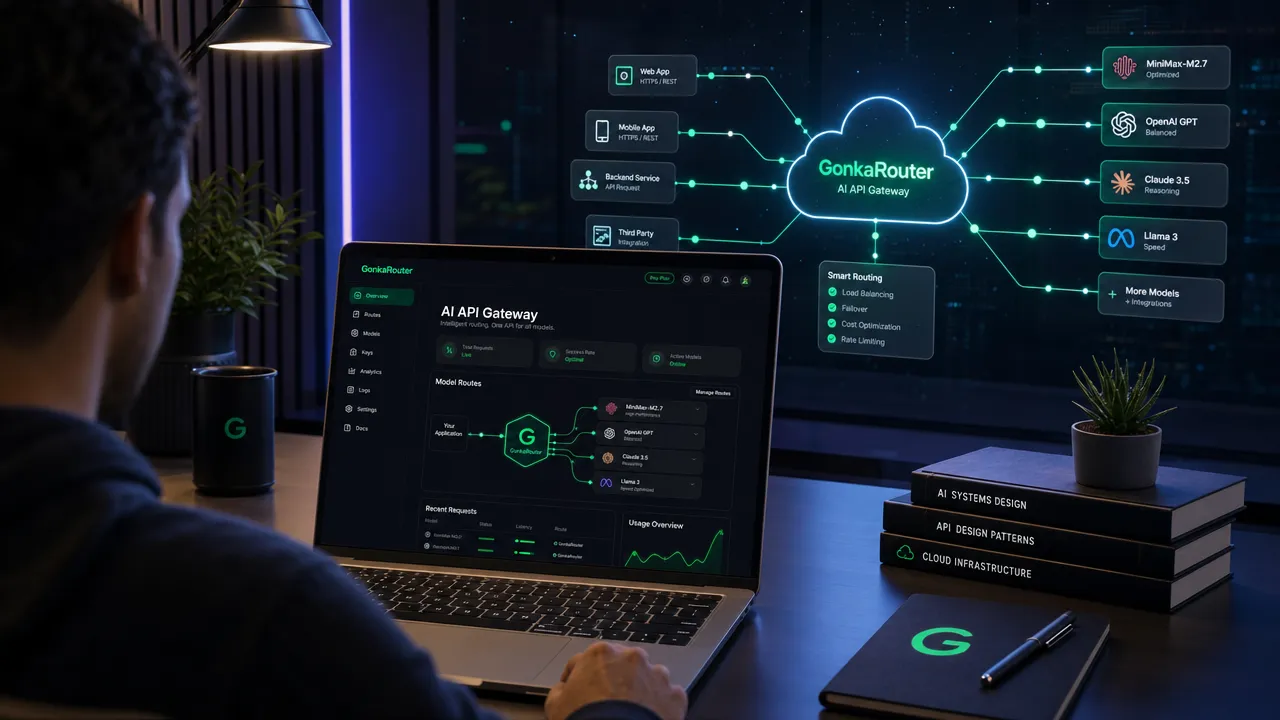
How to get AI API access without rebuilding your inference stack
The practical developer problem behind "get ai" is access. A product team may need model calls for summarization, code generation, intelligent Q&A, workflow automation, or an Agent API. The challenge is not just calling one model once. The challenge is keeping integration work manageable as model experiments, prompts, endpoints, authentication, and usage patterns change.
GonkaRouter is designed as an AI Gateway and AI Model Router for this problem. It provides one API layer for currently supported models, with both OpenAI Compatible API and Anthropic Compatible API formats. That compatibility refers to API format and integration style only. It does not mean GonkaRouter provides official OpenAI or Anthropic models.
A direct provider-by-provider setup can work for early experiments, but it often creates overhead when a team wants to test multiple supported models or adjust routing logic. GonkaRouter reduces that friction by letting developers work through one unified API for MiniMax-M2.7, Kimi-K2.6, and GLM-5.2.
For more context on the endpoint-first approach, see the GonkaRouter guide to an endpoint migration pattern. For product positioning, the article on the Gonka Network routing layer explains how the router fits into the broader decentralized AI compute network.
Developer need | Typical pain point | GonkaRouter approach |
|---|---|---|
Get AI into a product quickly | Multiple APIs, keys, and schemas | One unified API for supported models |
Test model behavior | Slow integration for every model | Access MiniMax-M2.7, Kimi-K2.6, and GLM-5.2 through one router |
Control inference cost | Agent workflows call models repeatedly | Token pricing as low as $0.0004 / 1M tokens |
Migrate existing code | Backend rewrites slow adoption | OpenAI- and Anthropic-compatible API formats |
Start evaluation | Account creation and usage setup delay tests | Email-based login and one-time 20 USDT trial credit |
Why get AI inference cheaply matters for Agents and apps
Cheap AI API 2026 searches are rising because inference cost compounds quickly in real products. A single user action may trigger retrieval, classification, planning, tool selection, summarization, validation, and final response generation. In an Agent workflow, one visible answer can require many model calls.
That is why developers should evaluate cost per completed task, not only cost per token. A low token rate matters, but so do prompt size, output length, retry behavior, model fit, and whether routine steps can use a lower-cost supported model.
GonkaRouter supports this cost-sensitive workflow with token pricing as low as $0.0004 / 1M tokens. New users also receive a one-time 20 USDT trial credit after logging in with email, which helps teams run real API tests before committing production traffic.
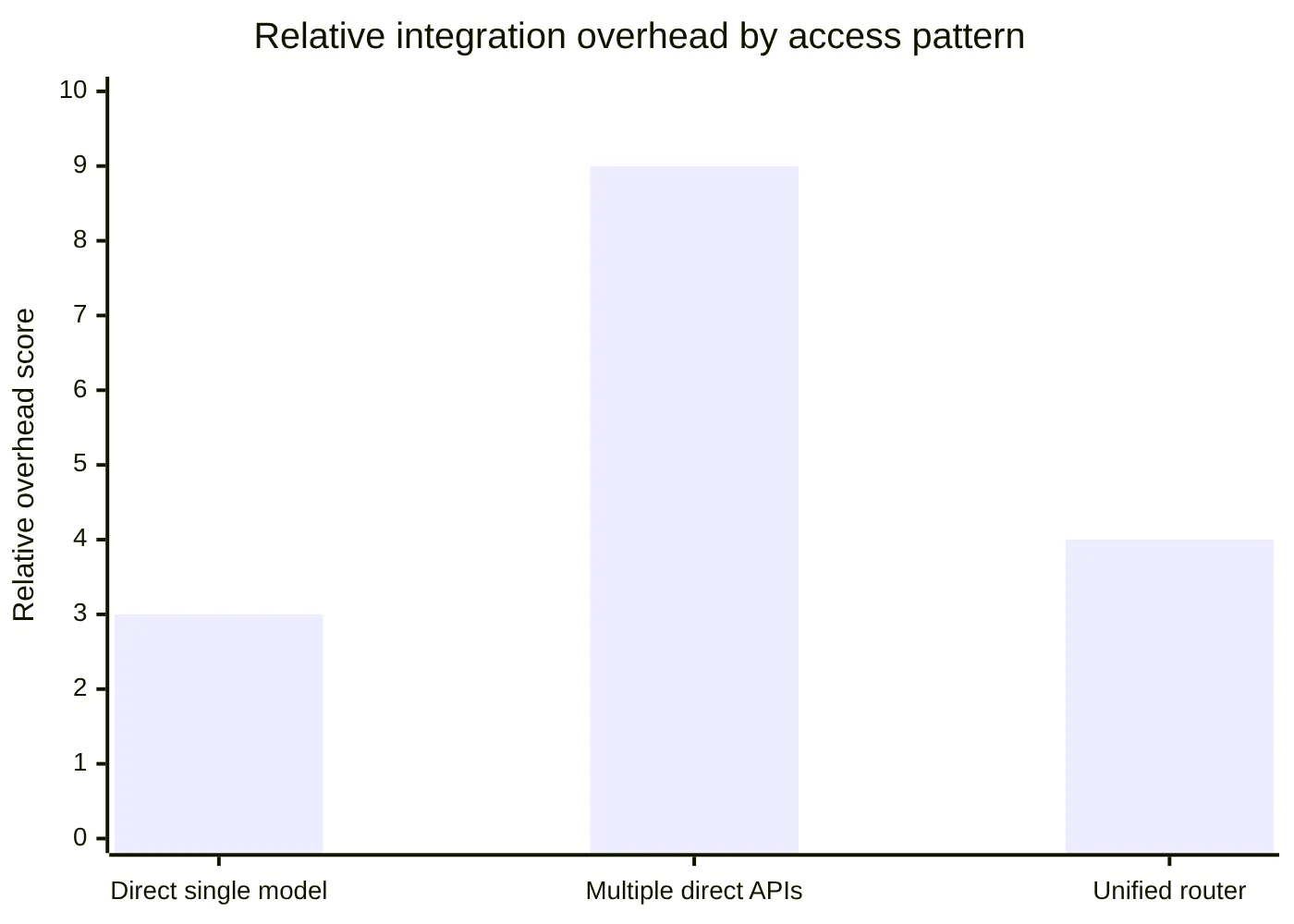
The chart is a qualitative planning model: direct integration can be simple for one model, but overhead rises when teams maintain multiple SDKs, endpoints, and request formats. A unified AI Model Router can reduce that complexity when the supported model set fits the application.
GonkaRouter can be used for developer-built use cases such as:
AI Agents that need planning, summarization, and decision steps.
Chatbots and intelligent Q&A systems.
Content generation and code generation workflows.
Enterprise AI applications and automated internal tools.
Data analysis workflows where multiple prompt patterns need testing.
For model selection strategy, the GonkaRouter article on how to evaluate models for faster work provides a useful next step.
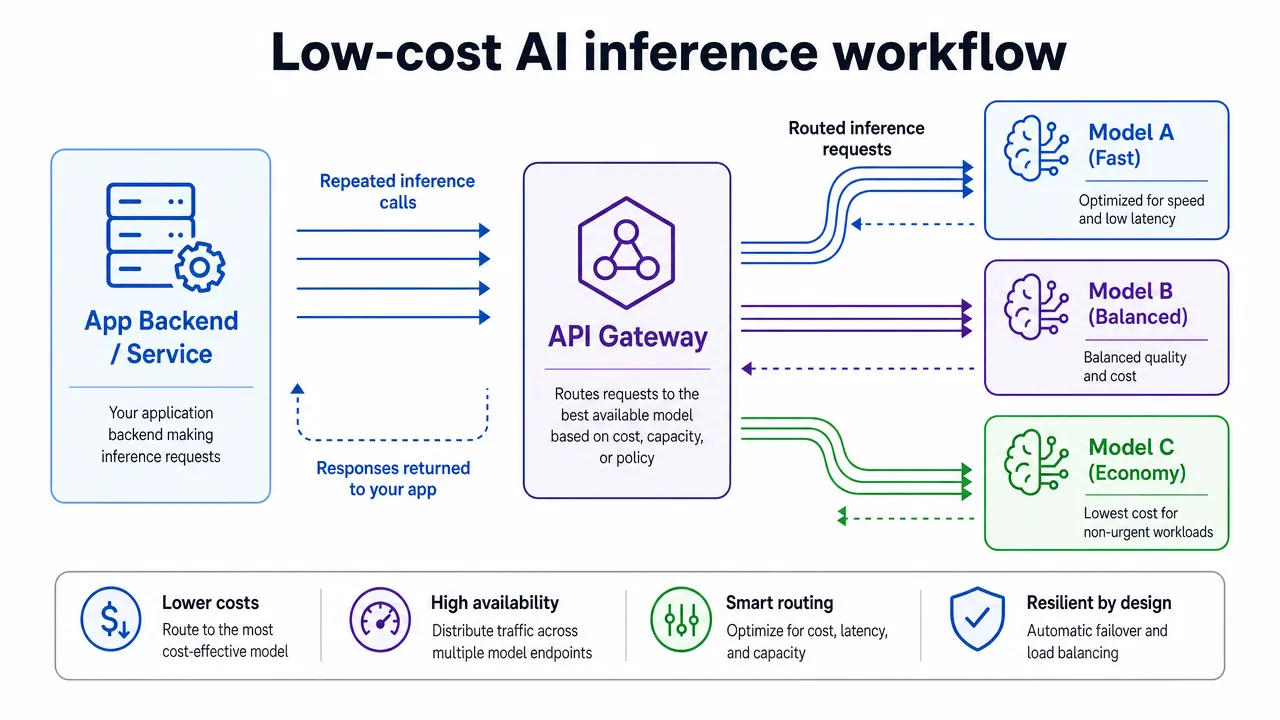
What get AI through an AI Model Router really means
An AI Model Router is an infrastructure layer that lets an application send inference requests to selected supported models through one interface. It is closely related to an AI Gateway, which often centralizes access, authentication, request formatting, monitoring, and routing decisions.
For GonkaRouter, "multi model API" means unified access to the currently supported model list only:
Supported model | API positioning keyword | Typical evaluation use |
|---|---|---|
MiniMax-M2.7 | MiniMax-M2.7 API | General inference testing, workflow tasks, app backend calls |
Kimi-K2.6 | Kimi-K2.6 API | Agent reasoning tests, content workflows, structured prompts |
GLM-5.2 | GLM-5.2 API | Chatbot, Q&A, automation, and product integration tests |
This focused approach matters. Some platforms compete on very broad model catalogs, but GonkaRouter should be understood as a focused AI Model Router for MiniMax-M2.7, Kimi-K2.6, and GLM-5.2. It is not a claim to support every model ecosystem, every provider, or official OpenAI or Anthropic models.
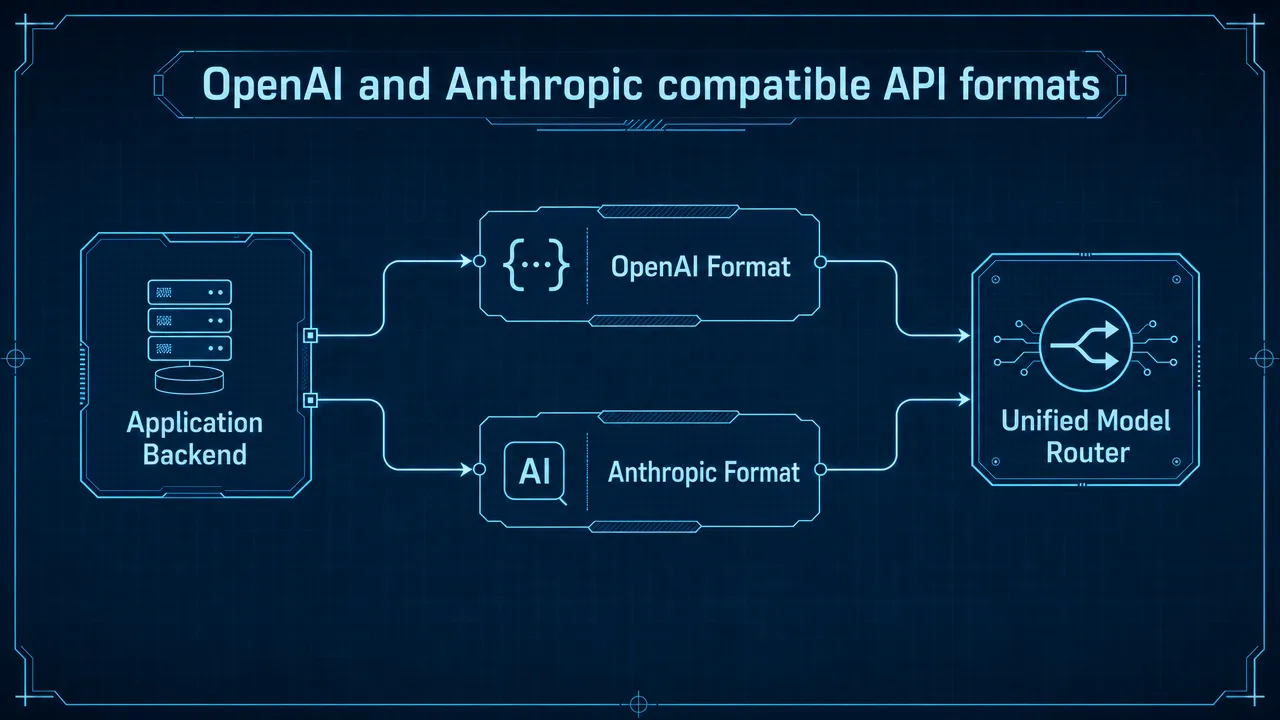
The OpenAI Compatible API format is useful because many developers already understand OpenAI-style request and response patterns. The official API reference shows the canonical OpenAI developer pattern. An OpenAI-compatible provider follows a similar integration style so teams can often adapt configuration, such as the base URL, instead of rewriting the whole application.
The Anthropic-compatible format serves a similar purpose for teams using Anthropic-style message structures. The official Messages API documentation describes the message-oriented request pattern. GonkaRouter compatibility should be read as format compatibility, not official Anthropic model access.
How to get AI with GonkaRouter in a developer workflow
The fastest way to evaluate GonkaRouter is to follow a simple API adoption path: log in with email, get an API key, test supported models, and then integrate the selected route into your app or Agent.
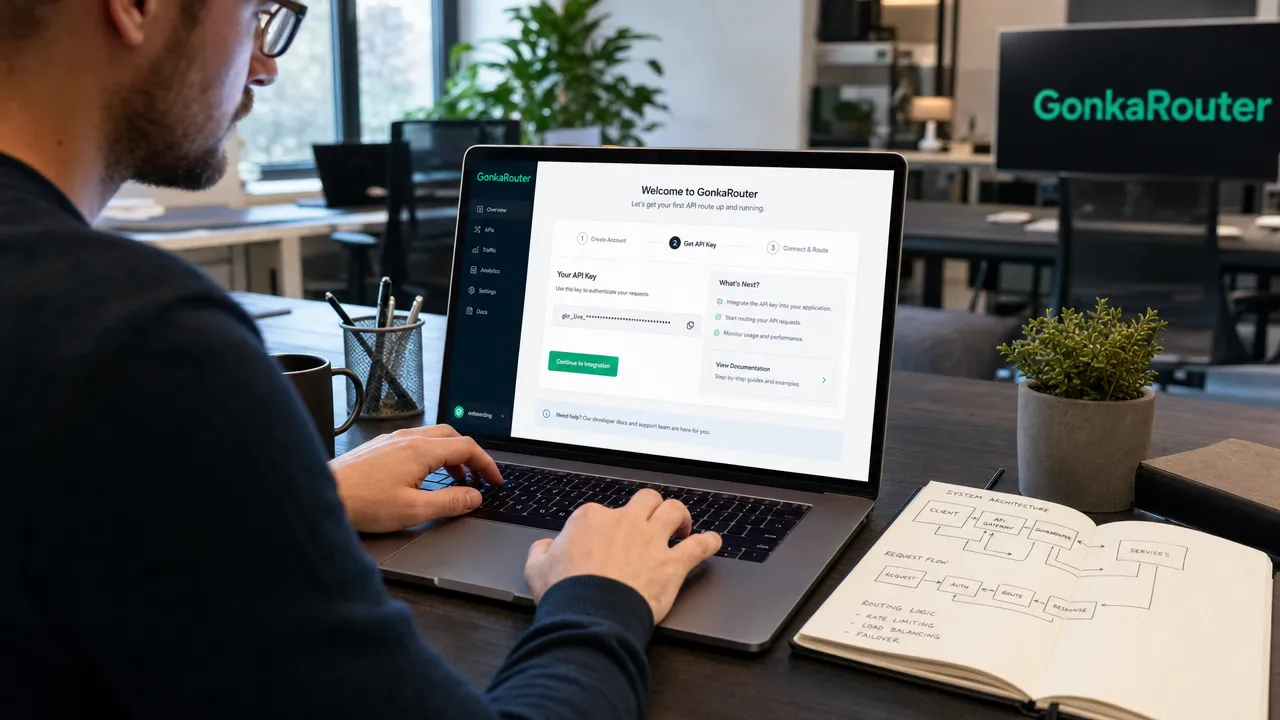
A practical setup flow looks like this:
Go to GonkaRouter and log in with email.
Receive the one-time 20 USDT trial credit for product usage after email login.
Get your API key.
Choose one of the currently supported models: MiniMax-M2.7, Kimi-K2.6, or GLM-5.2.
Change the API endpoint in your existing OpenAI-style or Anthropic-style integration where applicable.
Run test prompts and measure output quality, latency, and cost per task.
Integrate the route into your Agent, chatbot, workflow, or backend service.

GonkaRouter is especially relevant when your team wants an OpenAI compatible API cheap enough for repeated testing, but still needs a structured developer workflow. The goal is not to replace evaluation discipline. The goal is to make model testing and endpoint migration faster.
For cost-focused teams, the GonkaRouter article to compare API pricing options can support budget planning. For broader product updates and implementation guidance, the GonkaRouter blog is the natural place to continue research.
How get AI API options compare in 2026
Developers comparing AI API providers in 2026 should avoid choosing only by headline token price. A cheap AI API is useful only when it supports the models, formats, documentation, onboarding, and reliability profile your product needs.
The better comparison framework is practical:
Evaluation factor | Why it matters | GonkaRouter fit |
|---|---|---|
Supported models | Model fit determines output quality and workflow success | Focused access to MiniMax-M2.7, Kimi-K2.6, and GLM-5.2 |
API format | Migration speed affects engineering cost | OpenAI Compatible API and Anthropic Compatible API formats |
Token pricing | Agent calls can multiply cost | As low as $0.0004 / 1M tokens |
Onboarding | Teams need fast testing | Email-based login |
Trial access | Real prompts are better than abstract estimates | One-time 20 USDT trial credit after email login |
Integration pattern | Endpoint sprawl increases maintenance | Unified API and endpoint-first migration |
Product scope | Broad platforms can add complexity | Focused AI Gateway and AI Model Router positioning |
Market research also supports the broader importance of inference infrastructure. Research and Markets projects continued growth in the AI inference market, while Precedence Research tracks AI inference-as-a-service as a fast-growing category. These projections reinforce a simple developer reality: inference is becoming a core production cost, not just an experiment expense. For official market context, see the Research and Markets AI inference outlook and Precedence Research inference-as-a-service report.
GonkaRouter's differentiation is not "every model through one marketplace." Its strength is a focused router for supported models, low-friction email onboarding, pricing as low as $0.0004 / 1M tokens, and compatibility formats that reduce integration work.
Get AI access now with a focused API setup
A developer-ready "get ai" path should end with an API key, a tested model route, and working integration inside a real product. GonkaRouter makes that path direct for teams that want unified access to MiniMax-M2.7, Kimi-K2.6, and GLM-5.2 through OpenAI- and Anthropic-compatible formats.
Start with the simplest production-minded checklist:
Log in with email at GonkaRouter.
Use the one-time 20 USDT trial credit for API testing.
Get an API key.
Test MiniMax-M2.7, Kimi-K2.6, and GLM-5.2 against your real prompts.
Compare cost per completed task, not just output tokens.
Change the endpoint where your existing integration allows it.
Move the best-performing route into your Agent, chatbot, or product backend.
GonkaRouter is a practical option for developers who want to get AI API access without turning model experimentation into a multi-provider integration project. Its value is clear: one API for supported models, fast endpoint migration, focused inference access, and a cost structure designed for serious testing.