Developers choose ai models faster when they stop chasing a universal winner and start matching each workload to measurable latency, cost, quality, reliability, and integration targets.
The opinionated view is simple: the fastest team is not always the team using the most famous model. It is the team with a repeatable selection process, a small benchmark set, and an integration layer that lets engineers switch supported models without rewriting backend logic. Public leaderboards and provider announcements are useful signals, but production speed comes from task-specific proof.
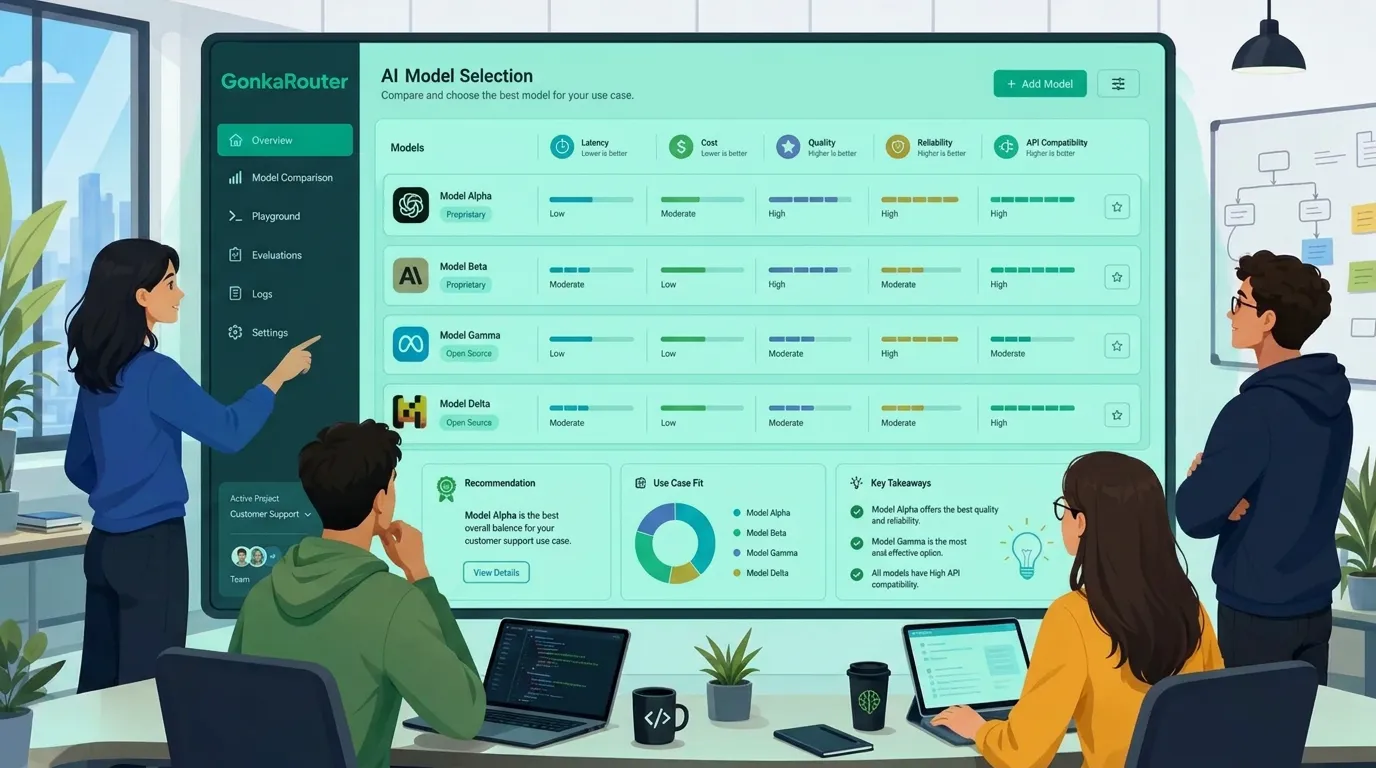
Why choosing ai models faster starts with task fit
The first mistake is treating ai models as interchangeable intelligence boxes. A support chatbot, code review assistant, long-document Q&A tool, content workflow, and AI Agent planner all create different pressure on the model.
A chatbot usually needs low latency, streaming stability, and predictable tone. A code-generation workflow needs instruction following, repository context handling, and structured output. An Agent API workflow needs reliable tool use, valid JSON, retry behavior, and cost control across many small calls. A data analysis workflow may prioritize reasoning and format accuracy over raw speed.
That is why "best AI model" is usually the wrong question. Better questions include:
Decision question | What it reveals |
|---|---|
What is the user-facing latency target? | Whether slower, deeper responses are acceptable. |
What is the cost per completed task? | Whether long outputs or retries make a model expensive in practice. |
Does the model follow formatting rules? | Whether it can support agents, automations, and structured workflows. |
Can the team change models without rewriting code? | Whether integration speed will hold up after launch. |
What happens when an API call fails? | Whether fallback and retry logic are needed. |
External searches such as openai api models, openai models list, list of openai models, o3 openai, anthropic claude model, claude3 5, claude 3.7 model, cloude 3.7, clause 3.7, claudwe, claude 3.7 sonnet and claude code anthropic, gemini model list, deepseek v3 base, depseek r1, deepseek-reasoner, deepseek ai model, deepseek owner, xai grok3, grok-3 model xai, groc3 ai, grook3 ai, groq com, groq models, aws bedrock models, perplexity ai models, meta ai llama 4, and llama technical report show how broad the market has become. They are useful for understanding developer search intent, but they should be treated as external market references unless a platform explicitly lists support.
For GonkaRouter, the current supported model list is limited to MiniMax-M2.7, Kimi-K2.6, and GLM-5.2.
How developers should score ai models before shipping
A practical benchmark beats a generic model comparison. AWS argues that teams should evaluate LLMs beyond vibes, with accuracy, latency, and cost considered against the actual task. The same pattern appears in broader model-selection guidance from sources such as AWS Machine Learning Blog and Dataiku: production teams need multi-dimensional evaluation, not one headline score.
A compact scorecard can be enough for a startup team:
Criterion | Suggested weight | What to measure |
|---|---|---|
Output quality | 30% | Accuracy, completeness, tone, instruction following. |
Latency | 20% | Time to first token, total response time, tail latency. |
Cost | 20% | Cost per completed task, not only cost per token. |
API compatibility | 10% | OpenAI Compatible API or Anthropic Compatible API format fit. |
Reliability | 10% | Error rate, streaming stability, retry behavior. |
Context and tools | 10% | Context fit, function calling, JSON validity. |
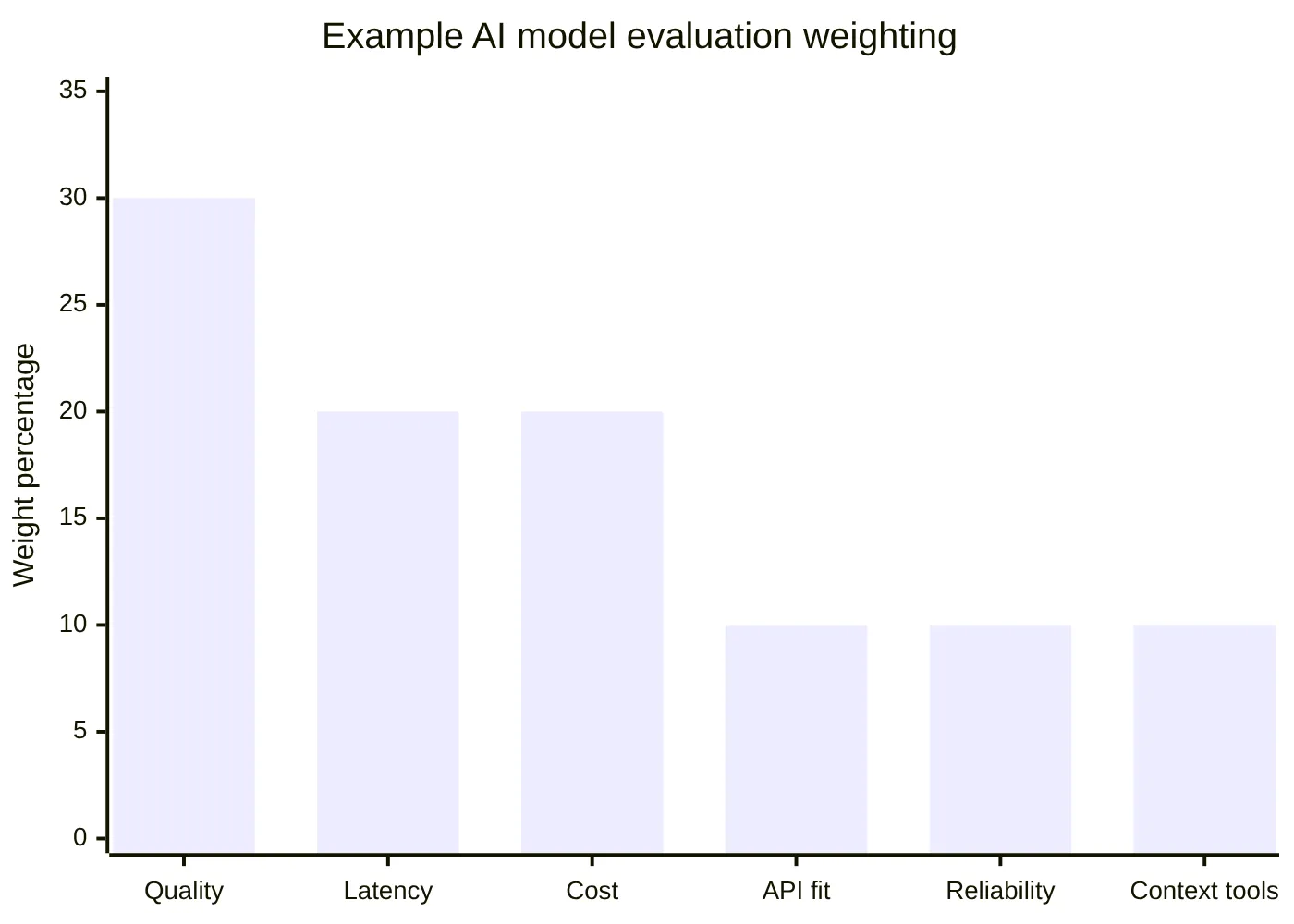
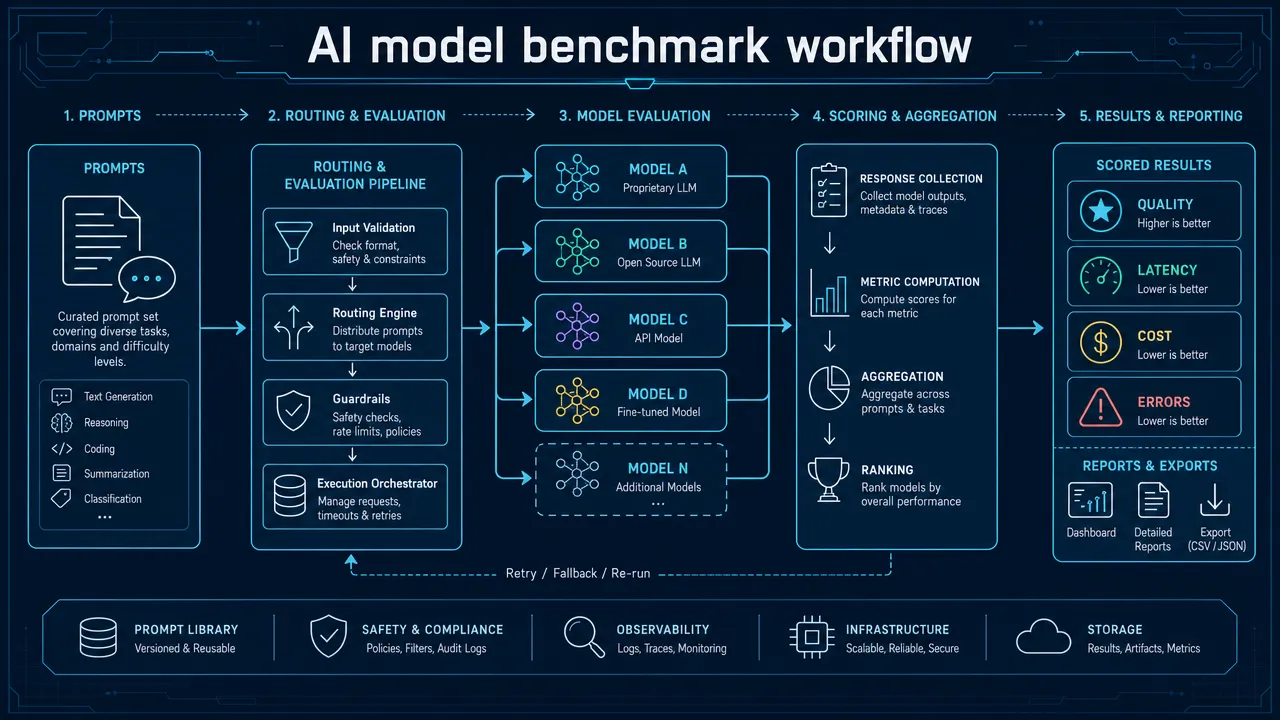
The key is to run the same prompt set across candidates. Include real user prompts, edge cases, failure-prone requests, and expected answer formats. Measure not only whether an answer looks good, but whether it helps the product complete the job.
For technical teams, model evaluation should also include privacy and governance review when sensitive user data is involved. Microsoft describes AI gateway capabilities such as centralized controls and policy management in its Azure API Management documentation, which is useful context for enterprise teams thinking about AI traffic as infrastructure.
When multiple ai models beat one default model
One model is enough when the product has a narrow task, stable traffic, and one candidate meets quality, latency, and cost targets. Many production systems, however, do not stay that simple.
AI Agents often make several model calls per user request: planning, tool selection, retrieval, summarization, validation, and final response. Routing every call to the same model can waste time and budget. A lighter model may handle classification or rewriting, while a stronger model may be reserved for harder reasoning or code generation.
Multiple ai models make sense when:
Simple tasks need speed and low cost.
Complex tasks need deeper reasoning.
Agent steps require different output formats.
The team wants A/B testing across model behavior.
The system needs fallback when an inference call fails.
Product managers need evidence before standardizing on one model.
This is also where confusion in the broader landscape matters. Groq models and groq com searches usually point to low-latency inference interest, while xai grok3 and grok-3 model xai refer to a different model family. DeepSeek R1, DeepSeek V3, deepseek-reasoner, Gemini, Llama, Perplexity, Claude, and OpenAI model queries are external context, not GonkaRouter availability claims.
The faster workflow is not "use more models." The faster workflow is "use only the models that pass your workload tests, and keep switching cheap."
How an AI Model Router simplifies ai models integration
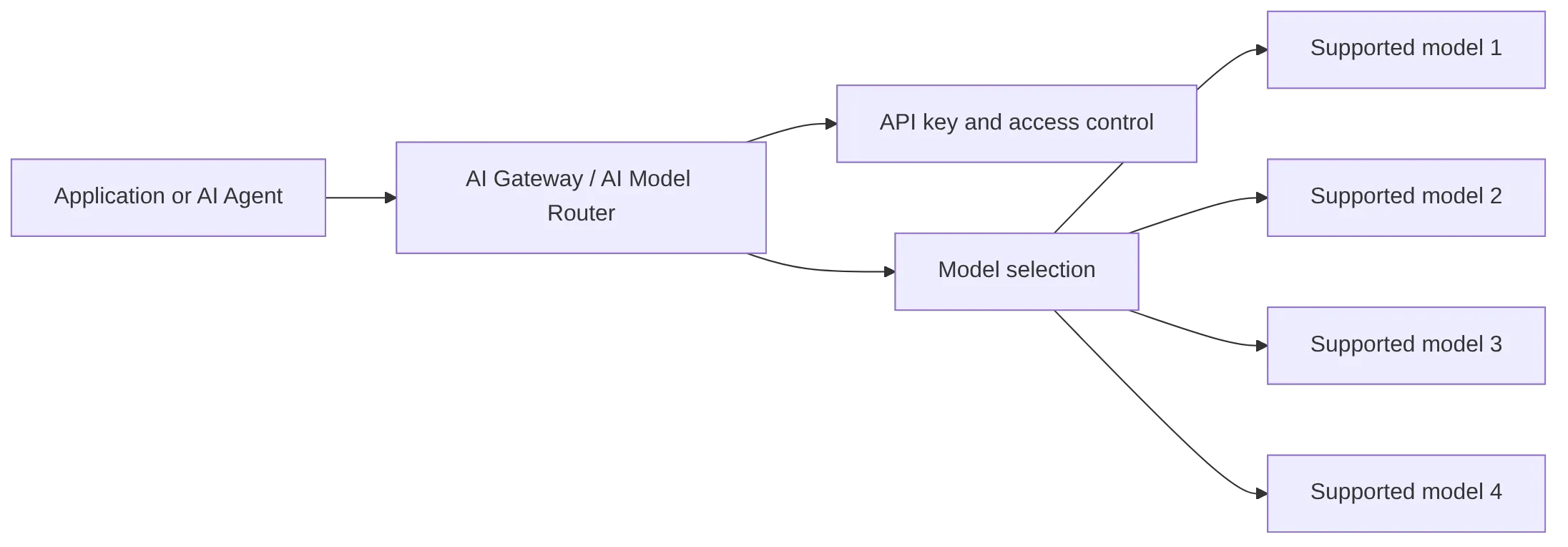
An AI Model Router is a developer infrastructure layer that sends inference requests to selected supported models through a unified access pattern. An AI Gateway is the broader middleware concept: it can centralize authentication, traffic control, policy, observability, and model access. MuleSoft gives a useful general definition of the category in its AI gateway guide.
The productivity value is integration control. Without a router, teams often manage separate API keys, SDK differences, endpoint formats, model naming rules, error behavior, and usage reporting. With a unified AI Inference API, the application can keep a cleaner boundary between product logic and model access.
Direct multi-provider integration | AI Model Router pattern |
|---|---|
Multiple endpoints and credentials | One integration surface for supported models |
Provider-specific request handling | Unified API format where supported |
Harder model switching | Change model configuration or endpoint pattern |
More repeated SDK work | Faster integration for supported workflows |
More application-level routing code | Cleaner routing layer for model selection |
For developers already using OpenAI-style or Anthropic-style request patterns, compatibility can reduce migration time. The important clarification is that OpenAI-compatible API format and Anthropic-compatible API format refer to integration style, not official OpenAI or official Anthropic model support.
For more category context from GonkaRouter, the article what is GonkaRouter explains the product as a single AI Model Router for developers. The related post on an OpenAI-compatible AI Model Router is also useful for teams evaluating endpoint-based migration.
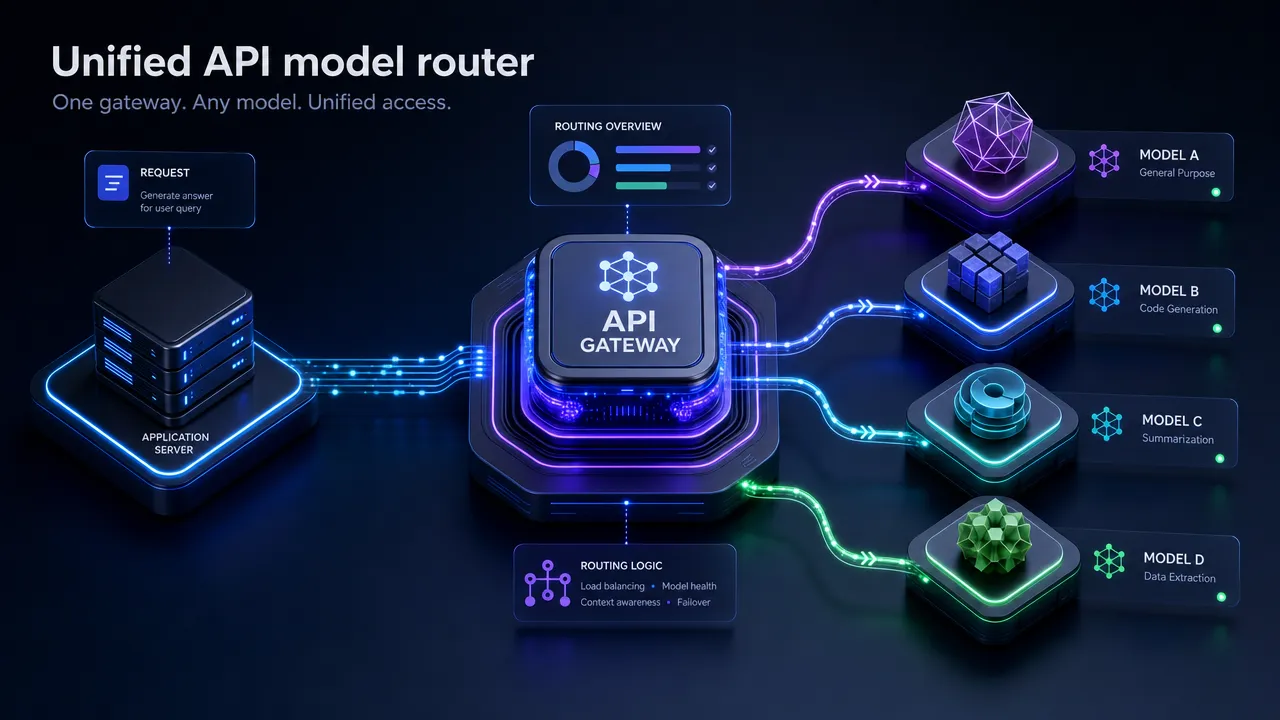
How GonkaRouter helps teams test supported ai models faster
GonkaRouter is an OpenAI- and Anthropic-compatible AI Gateway / AI Model Router for developers who want one API for its currently supported models. It is built on the Gonka decentralized AI compute network and is designed for fast endpoint-based integration.
The current supported models are listed on the supported AI models page:
MiniMax-M2.7 API
Kimi-K2.6 API
GLM-5.2 API
This supported list should be read narrowly. GonkaRouter does not need to be described as a marketplace, an all-provider catalog, or a way to access every major model. Its practical value is more focused: a Multi Model API for the models it currently supports, with OpenAI Compatible API and Anthropic Compatible API formats for faster developer adoption.
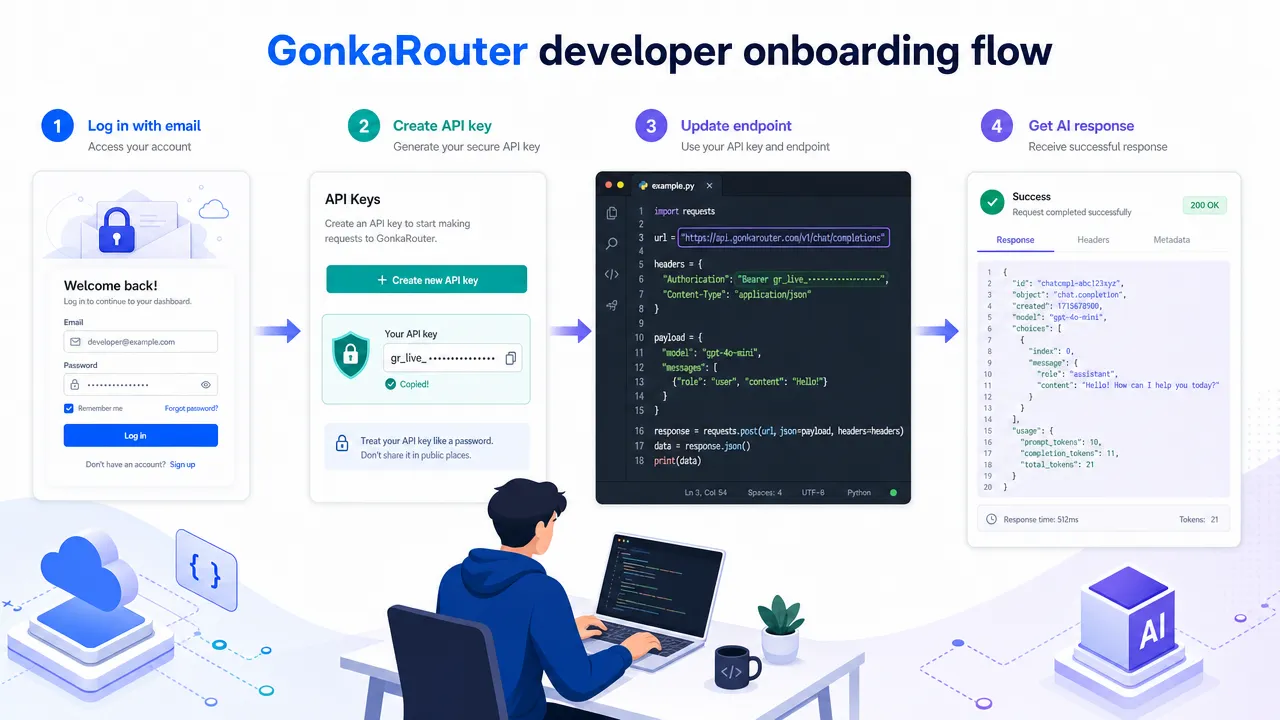
The onboarding flow is direct:

Token pricing is listed as low as $0.0004 / 1M tokens on GonkaRouter pricing. New users receive a one-time 20 USDT trial credit after logging in with email, which can be used for product testing. Developers can then use the GonkaRouter developer docs to get an API key, change the endpoint, and start testing supported models.
For teams building AI Agents, chatbots, content generation tools, code generation workflows, automated workflows, intelligent Q&A, data analysis, or enterprise AI applications, this reduces the most annoying part of model experimentation: repeated integration work. The one OpenAI-compatible API endpoint guide provides more context for endpoint-based setup, and the GonkaRouter tutorial is a natural next step for implementation.
The strong opinion is this: faster AI work is an infrastructure habit, not a model-name habit. Teams should benchmark ai models against their own tasks, keep external model lists in context, and avoid hard-coding product logic around one provider assumption. GonkaRouter fits teams that want to test MiniMax-M2.7, Kimi-K2.6, and GLM-5.2 through one compatible AI Inference API.
Start with a small benchmark, score the results, choose a default model, and keep a routing layer ready for the moment your product needs another supported option. That is how developers move faster without turning model selection into a permanent rewrite cycle.