An AI model router API can reduce integration friction, but it does not automatically reduce an LLM bill. The fast part is often changing an endpoint or consolidating a client interface. The hard part is deciding which requests deserve which model, limiting token growth, preventing duplicate attempts, and measuring outcomes that matter.
For software teams, the useful promise is not "instant savings." It is a cleaner control point. A unified LLM API or AI gateway can make it easier to apply and test cost policies across supported models. Savings happen only when the application changes the request mix, model policy, prompt design, output limits, retries, cache behavior, and measurement discipline.
What an AI Model Router API Actually Changes
An AI model router API sits between your application and one or more model inference services. At its simplest, it can offer a common endpoint, compatible request formats, and access to multiple supported models. That can reduce the number of SDKs, credentials, billing relationships, and client integrations your team needs to maintain.
This architectural role overlaps with terms such as AI gateway, LLM gateway, AI API gateway, model routing API, and multi model API. They are related concepts, but they should not be treated as interchangeable feature lists.
Term | What it usually means | What you should not assume |
|---|---|---|
Unified LLM API | One interface for reaching multiple models | Automatic model selection or complete feature parity |
AI gateway | An intermediary API layer between an app and inference | Caching, failover, or observability |
LLM routing platform | A product used to expose or select models | Lowest-cost routing or quality guarantees |
Multi provider LLM | A setup involving more than one provider | Consistent pricing, latency, or privacy terms |
AI provider aggregation | One account or interface for multiple sources | Transparent upstream behavior for every request |
Unified AI endpoint | A single base URL or endpoint pattern | Compatibility with every API method |
The phrase "one API for all AI models" is useful marketing shorthand, but engineering teams should interpret it carefully. A unified endpoint may simplify requests, yet it does not mean every model is available, every provider behavior is identical, or every model is appropriate for a production workload.
For an AI gateway developer, the practical value is reduced integration complexity. You can keep model identifiers, endpoint configuration, prompt templates, and selection rules in a narrower part of the codebase. That makes experiments easier to reverse and helps preserve portability.
However, the application still owns the decisions that affect cost. A gateway cannot determine whether a long document analysis needs a high-capability model, whether a short extraction task can use a different supported model, or whether a request should have been served from an application cache.
Why LLM Costs Rise Faster Than Request Counts
A monthly total is not a cost-control system. LLM expense is driven by more than request volume:
Input tokens, including system prompts, history, retrieval context, schemas, and tool definitions.
Output tokens, especially when completions are uncapped or unnecessarily verbose.
The selected model and its published billing rules.
Retries, timeouts, parse failures, and duplicate requests.
Cache hits that avoid inference entirely.
Other applicable product charges, depending on the service and workload.
A user may submit a short question while the application sends thousands of tokens behind the scenes. Chat history, retrieved documents, few-shot examples, JSON schemas, and repeated policy instructions can quietly inflate input volume.
Output growth creates the same problem. If a feature requests a long response but only displays the first few paragraphs, the application is paying for content it discards. Task-specific output caps, concise response instructions, and structured formats can help, but only if quality remains acceptable.
Retries are another hidden multiplier. A request that times out may have already been processed upstream. If a client, worker queue, and gateway each retry independently, a single user action can trigger several attempts. Classify errors before retrying, use bounded retries with backoff where appropriate, and record the final outcome.
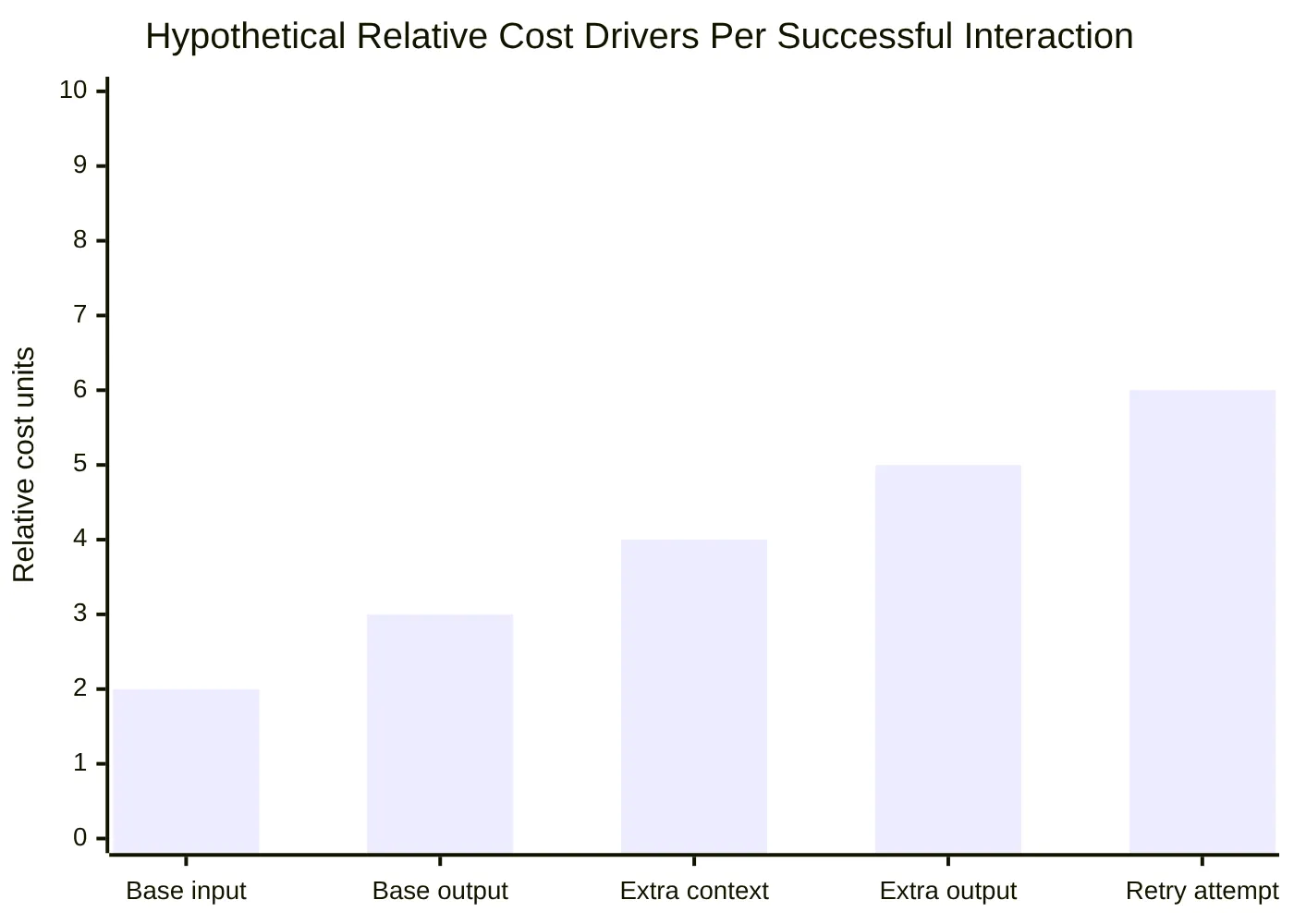
The following chart is hypothetical. It illustrates why a completed user interaction can accumulate cost from several independent sources.
Prompt caching can also matter, but it is not a universal gateway capability. OpenAI's prompt caching guidance distinguishes cached input from uncached input under its documented rules. Anthropic's prompt caching documentation describes cache writes and reads for its own capability.
Those are provider-specific behaviors. An AI gateway does not become a caching layer unless it explicitly documents and supports that function. Application-side response caching, semantic reuse, and retrieval caching remain separate design choices with their own correctness, privacy, and invalidation requirements.
Build a Conditional Cost-Control Policy
A credible cost-control framework starts with a simple principle: measure cost per successful outcome, not merely cost per request.
For each request class, track the request count, selected model, input tokens, output tokens, retry count, cache behavior, latency, errors, and quality outcome. Then compare changes against a defined baseline.
A useful decision model has six connected levers.
1. Classify the request mix
Separate workloads by what they actually require. For example:
Structured extraction and classification.
Retrieval-grounded answers.
Summarization.
Code generation.
Long-document analysis.
Agent or tool workflows.
Do not assume that every class needs the same model. A model suitable for short label extraction may be unsuitable for complex reasoning, long context, or strict structured output.
2. Select models based on acceptance criteria
Model choice is a quality decision before it is a pricing decision. Define the acceptance criteria for each workload:
Accuracy on representative examples.
JSON or schema validity.
Tool-calling behavior.
Context and output limits.
Latency tolerance.
Error and retry rate.
Human-review requirements.
A lower nominal token rate does not guarantee a lower operational cost. If a model creates more invalid outputs, more retries, or more manual review, it may increase the total cost of delivering a correct result.
3. Control input-token growth
Version prompts and measure them after every release. Remove duplicated instructions, limit chat history, retrieve only relevant evidence, and avoid sending tools or schemas that a request does not need.
This is often a more dependable early optimization than moving traffic to a different endpoint. An AI model router API may make model testing simpler, but it cannot fix prompt-construction bugs.
4. Set output boundaries
Set output limits that match the task. Ask for concise answers where appropriate, request structured fields instead of explanatory prose when the application needs fields, and watch for agent loops that repeatedly generate analysis or tool arguments.
5. Make retries explicit
Retry only errors that are likely to succeed later. Do not retry malformed requests unchanged. Prevent overlapping retry policies across the browser, API service, queue worker, and infrastructure layer. Log every attempt number, status category, and final result.
6. Keep caching outside the assumption set
Application-side caching can reduce calls when reuse is correct. For example, a versioned answer to a stable internal policy question may be reusable if the policy, permissions, and answer format have not changed.
Caching needs careful boundaries. Do not reuse personalized answers across users, do not cache sensitive material without an approved design, and do not treat semantic similarity as proof that two requests deserve the same response.
Use the AI Model Router API as an Integration Layer
The best architecture treats the gateway as one layer of a larger operating system for AI features.
Your application should own task classification, prompt construction, cache eligibility, output caps, user permissions, and evaluation criteria. The gateway or unified AI endpoint can provide a simplified connection to supported models. The model inference layer determines model behavior, limits, and service-specific terms.

This division of responsibility matters because compatibility is not behavioral equivalence. An OpenAI compatible API or Anthropic-compatible API may reduce migration work by accepting familiar request patterns. It does not automatically guarantee identical streaming, tool calls, error semantics, rate limits, response schemas, or model capabilities.
Test the exact production behaviors you need. That includes authentication, streaming, timeout behavior, JSON validity, tool calls, request cancellation, token reporting, and error handling.
For teams whose required models fit its verified live catalog, GonkaRouter is one candidate to evaluate. It is positioned as an OpenAI- and Anthropic-compatible AI gateway providing unified access to its supported models: MiniMax-M2.7, Kimi-K2.6, GLM-5.2, and DeepSeek-V4-Flash-0731.
That fit is intentionally narrow. Teams should avoid it if they require models outside that catalog, unverified provider features, or capabilities that have not been confirmed in current product information. OpenAI and Anthropic compatibility here refers to API-format compatibility, not access to official OpenAI or Anthropic models.
GonkaRouter states token pricing as low as $0.0004 per 1M tokens and offers new email-login users a one-time 20 USDT trial credit. Treat these details as items to verify on the live product before making an architecture or procurement decision. They are not evidence that your specific workload will cost less.
Measure Before You Expand Production Traffic
A good pilot is small, non-critical, and measurable. Choose a workload with representative prompt lengths and traffic patterns, but limited business risk.
Instrument at least these dimensions:
Measurement | Why it matters |
|---|---|
Feature or endpoint | Identifies which product behavior creates cost |
Tenant or cost center | Supports accountable usage attribution |
Model ID | Connects quality and spend to model choice |
Input and output tokens | Reveals prompt and completion growth |
Retry count | Detects duplicate work |
Cache result | Separates avoided calls from paid inference |
Latency and status | Exposes operational trade-offs |
Prompt version | Explains changes after releases |
Quality result | Prevents token savings from masking poorer outcomes |
Use a regression set that resembles production. Include normal requests, long-context requests, malformed inputs, structured-output tasks, timeout conditions, and common edge cases.
Then ask a more disciplined question than "Did the bill go down?":
Did cost per successful outcome improve without unacceptable changes in quality, reliability, latency, privacy posture, or engineering maintenance?
This approach also protects against lock-in. Keep prompts, model IDs, and routing policy in application configuration rather than embedding them throughout business logic. A multi provider AI API or AI provider aggregation layer can simplify access, but portability still depends on your own abstractions and test coverage.
The Fastest Savings Claim Is Usually the Wrong One
An AI model router API can be valuable because it creates a more manageable integration point for multi-model access. It may reduce client complexity and make controlled model experiments easier. But it does not independently shrink prompts, cap outputs, eliminate retries, create cache hits, or prove that a different model meets your quality bar.
The practical path is conditional:
Inventory request classes and required capabilities.
Verify the live model catalog and exact API compatibility.
Instrument tokens, retries, cache behavior, latency, and quality.
Test explicit model-selection rules against representative workloads.
Expand only when cost per successful outcome improves without unacceptable trade-offs.
Before adopting any LLM routing platform, verify live supported models, pricing, API documentation, data-handling terms, and operational limits. Then run a small, non-critical workload that matches your real requirements.