Get AI Models Into Production Without Vendor Chaos
For platform teams, vendor chaos usually means duplicated SDK integrations, credentials spread across services, inconsistent error handling, and no shared view of usage. A model gateway can centralize the request boundary, but it does not make different models behave the same or remove the need to operate a critical dependency.
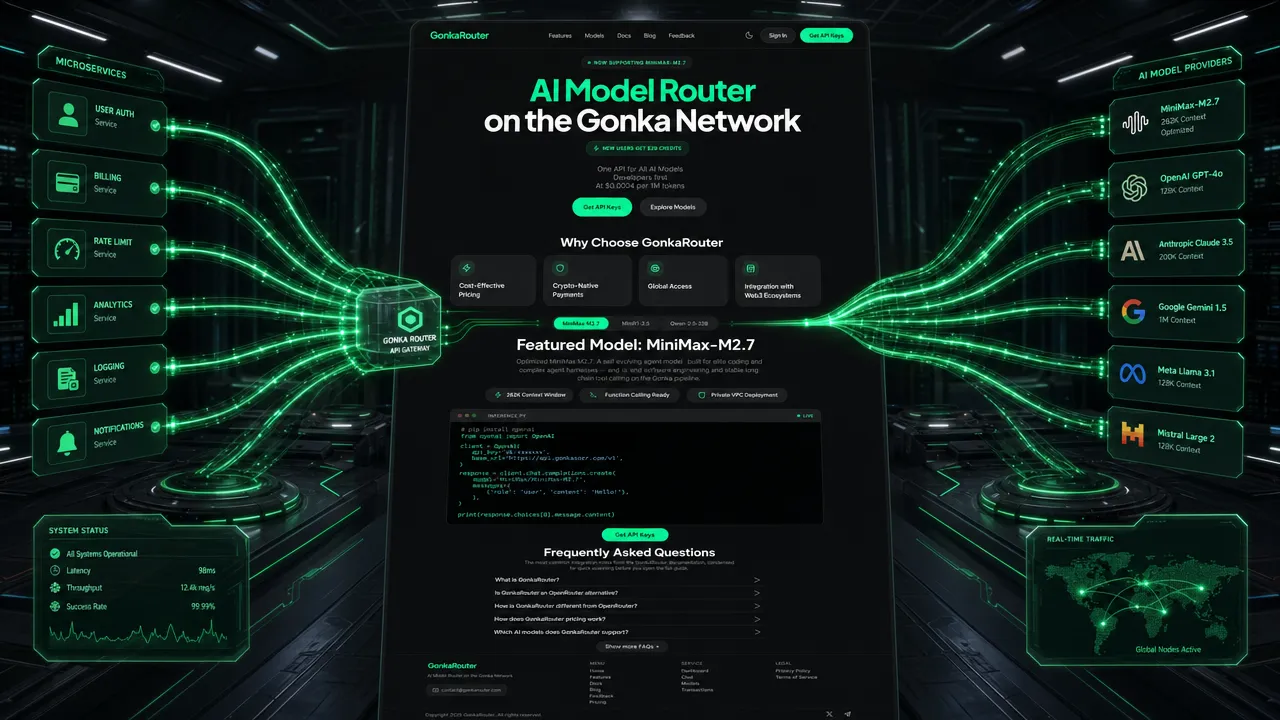
What a Shared Gateway Standardizes
A gateway can give applications one place to authenticate, send requests, and select among the models it supports. This reduces repeated transport code and makes endpoint or model changes easier to manage.
API compatibility describes request and response formats, not catalog breadth. GonkaRouter supports OpenAI-compatible and Anthropic-compatible formats and currently offers GLM-5.3-Flash, DeepSeek-V4-Flash-0731, and MiniMax-M2.7. It does not provide official OpenAI or Anthropic models. Check the current model catalog before selecting a route.
A shared endpoint does not automatically provide aliases, semantic routing, failover, tracing, or policy enforcement. Confirm which capabilities are documented for the service you use.
Reduce Integration Sprawl Without Hiding Differences
Keep provider-specific details behind a small client module. Store credentials server-side, set request deadlines, validate structured output, and log request IDs and usage metadata without retaining sensitive prompts by default. Pin model identifiers in configuration and test changes against representative prompts before rollout.
For agent systems, keep tool permissions, approval gates, memory, and idempotency in the application. A compatible API does not guarantee equivalent tool calling, streaming, context limits, or refusal behavior. Maintain route-specific tests for important tasks.
A gateway also becomes another dependency. Measure its latency, define a controlled bypass or rollback path, and decide which errors your application can safely retry. Do not assume that switching models is a safe fallback for a partially streamed response or an irreversible tool action.
Direct SDKs can be simpler for a small service with one stable provider. A gateway is more useful when several services need common request plumbing or access to a defined model set. Compare the maintenance saved with the cost and operational risk of the added hop.
Create a Model Access Contract Before You Add Vendors
The cleanest way to control integration sprawl is to define an application-level contract before choosing another provider. That contract should describe the messages your services send, the response fields they consume, how streaming events are parsed, and how errors are represented. It should also specify required behaviors such as JSON schema compliance, tool calling, cancellation, and token reporting. A shared client can implement this contract once, while model-specific adapters handle the differences that cannot be normalized safely.
Keep the contract deliberately smaller than any provider's complete SDK. If the application depends on every vendor-specific parameter, switching providers will still require a rewrite even when the HTTP format looks familiar. Use capability checks for optional features instead of assuming that every route accepts the same settings. Reject an unsupported combination before sending the request, and return a clear application error rather than silently dropping a parameter.
Configuration deserves the same discipline. Put the gateway base URL, model identifier, timeout, and output limit in versioned configuration. Keep secrets in a managed server-side store and issue separate keys for development, staging, and production when the service supports it. This makes access easier to rotate and lets operators identify which environment produced a request without embedding credentials in code.
Test Models as Distinct Runtime Dependencies
A common gateway format reduces transport work, but each model remains a distinct runtime dependency. Build a compact evaluation set from real application tasks: typical inputs, difficult edge cases, malformed requests, long contexts, and examples that require an exact schema. For each candidate route, record first-pass acceptance, time to first token, total latency, token usage, and the number of repair calls. The goal is not to crown a universal winner; it is to determine which route satisfies a specific workload contract.
Agent workflows need additional tests. Confirm that the model chooses only permitted tools, produces valid arguments, and behaves predictably when a tool returns an error. Enforce tool authorization outside the model. Make side-effecting operations idempotent, and require explicit approval for destructive or high-impact actions. These controls remain necessary whether the request goes directly to a vendor or through a gateway.
Roll out changes with a canary rather than replacing the model globally. Route a small, low-risk slice of traffic to the candidate, compare it with the existing path, and define rollback thresholds before the test starts. A useful threshold might combine schema failures, P95 latency, and cost per accepted task. If the route fails the contract, roll back through configuration instead of waiting for application changes.
Operate the Gateway as Shared Infrastructure
Once several services depend on one access layer, ownership must be explicit. Assign a team to maintain the client library, publish supported configurations, coordinate key rotation, and communicate model changes. Service teams should still own prompt quality, output validation, and business-level acceptance criteria. This division keeps the platform boundary useful without hiding responsibility for application behavior.
Create runbooks for authentication failures, rate limits, timeouts, and unavailable models. A retry is appropriate only for a transient error and only within a bounded deadline. Authentication failures, invalid parameters, and policy rejections require a configuration or request fix. Centralize retry ownership so an SDK, job queue, and application loop do not multiply the same request.
Finally, measure the gateway from the client side. Track availability and latency for the complete request path, not only the upstream model. Record model ID, request ID, token counts, attempt number, and validation result while minimizing stored prompt content. With that operational baseline, a team can add models without recreating credentials, adapters, and incident procedures for every service.
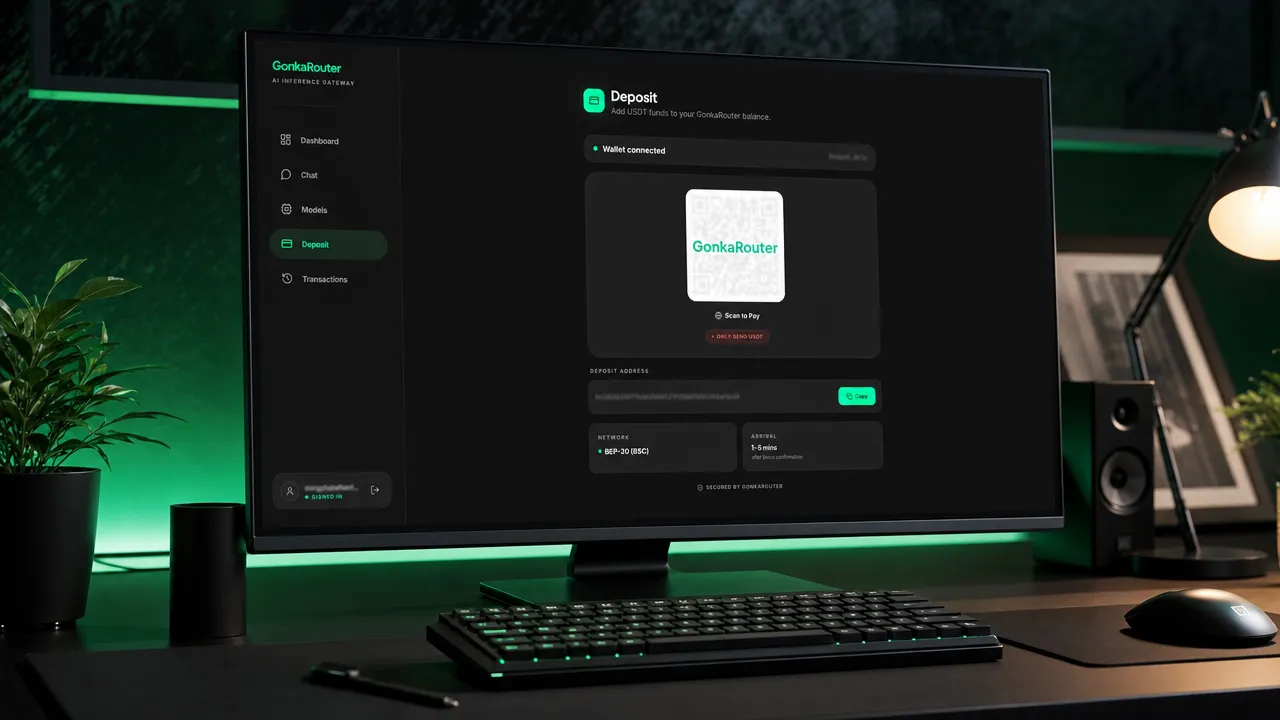
To evaluate GonkaRouter, review its supported models, create an API key through the official site, and benchmark the exact routes your application needs. Start with one low-risk workload and keep a rollback path while verifying output quality, latency, and cost.