A gateway can help reduce total AI spend across a model portfolio, but it does not change an upstream model’s token price on its own. Savings depend on how your application uses it: match workloads to tested models, bound retries, trim repeated context, and set token budgets. If requests simply pass through unchanged, adding a gateway will not lower the inference bill.
True LLM cost optimization happens when teams use an LLM gateway as a centralized enforcement point for architectural discipline. In early-stage prototypes, application services typically call a single provider SDK directly. In that fragmented pattern, operational concerns—such as verbose prompts, uncontrolled agent loops, uncoordinated retries, and over-provisioned frontier models—are scattered across microservices and remain largely invisible until billing spikes occur, as detailed in LLM serving architecture analyses.
By migrating from single-vendor lock-in to a multi-provider LLM strategy powered by a unified LLM API, engineering teams decouple their core business logic from underlying model deployments, a pattern outlined in LiteLLM client setup documentation. This separation of concerns allows developers to systematically reduce LLM costs across every model they integrate—not through magic discounts, but through five concrete engineering mechanisms:
Measuring cost per accepted task rather than raw token prices.
Matching model selection to specific workload requirements via standardized API schemas.
Enforcing application-side bounded retries and carefully tested fallback to prevent runaway spend during outages.
Applying application-side request caching only where it is deterministic, tenant-safe, and supported.
Implementing application-side token budgets and spend controls across users, tenants, and autonomous agents.
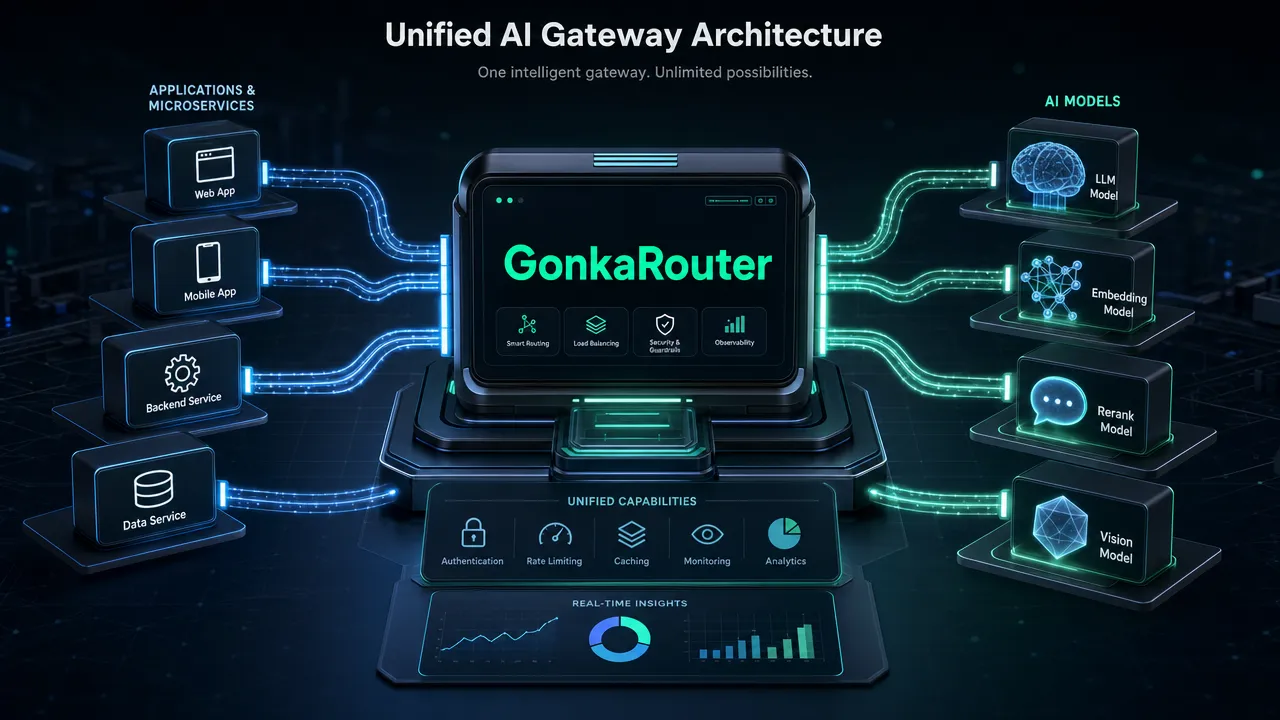
Why Cost per Accepted Task Matters
The most common financial trap in production AI infrastructure is optimizing solely for raw cost-per-million-tokens. Evaluating models strictly by their unit input and output prices ignores the downstream operational reality of how applications consume completions. As explained in our guide on how verified AI models prevent bad production picks, an effective LLM gateway architecture shifts the primary economic metric to Cost Per Accepted Task.
This metric captures the total financial expenditure required to produce a validated, successful business outcome:
Cost Per Accepted Task=∑(Input Tokens×Pin+Output Tokens×Pout+Retry & Validation Spend)Total Accepted Tasks\text{Cost Per Accepted Task} = \frac{\sum (\text{Input Tokens} \times P_{\text{in}} + \text{Output Tokens} \times P_{\text{out}} + \text{Retry \& Validation Spend})}{\text{Total Accepted Tasks}}Cost Per Accepted Task=Total Accepted Tasks∑(Input Tokens×Pin+Output Tokens×Pout+Retry & Validation Spend)
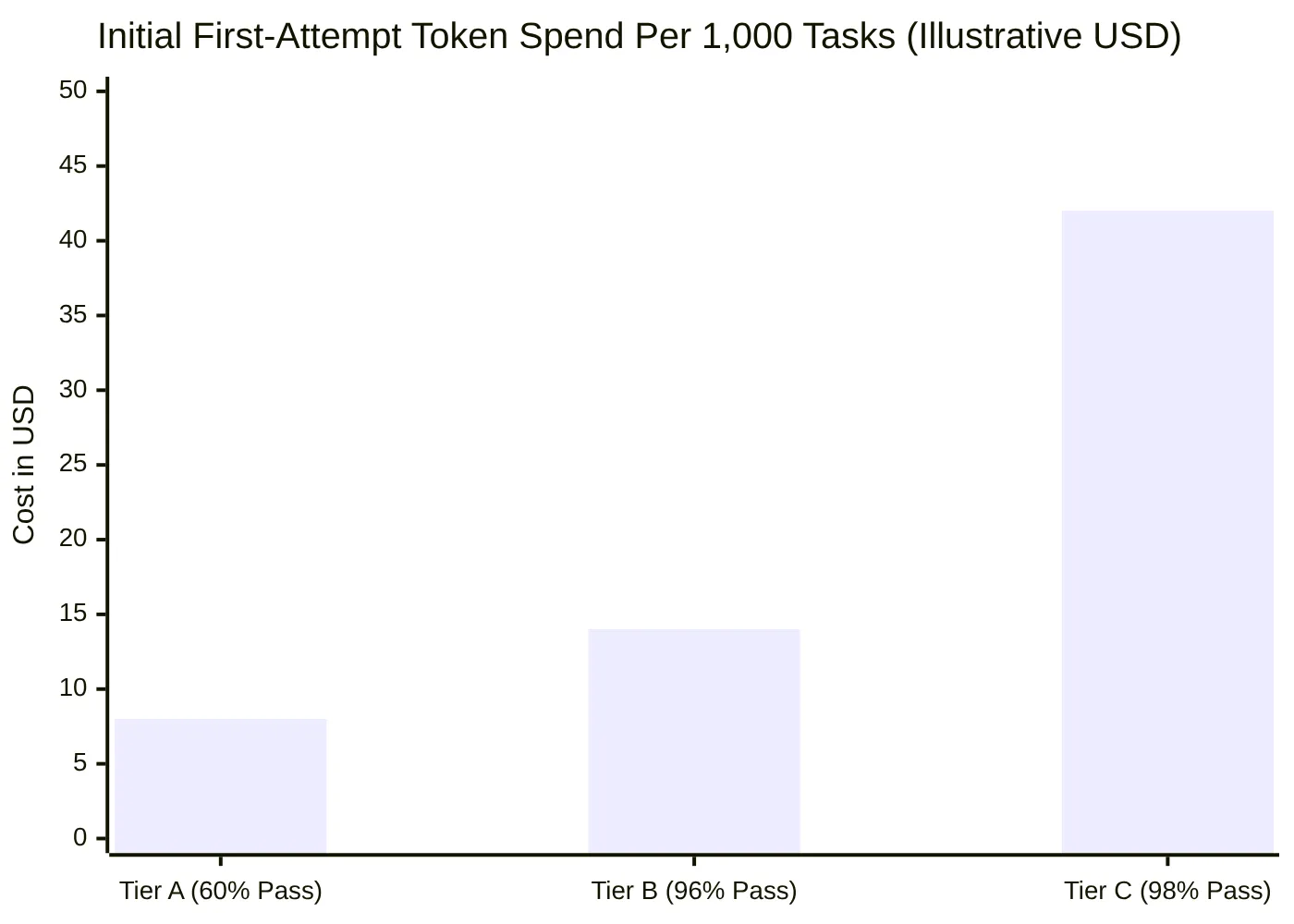
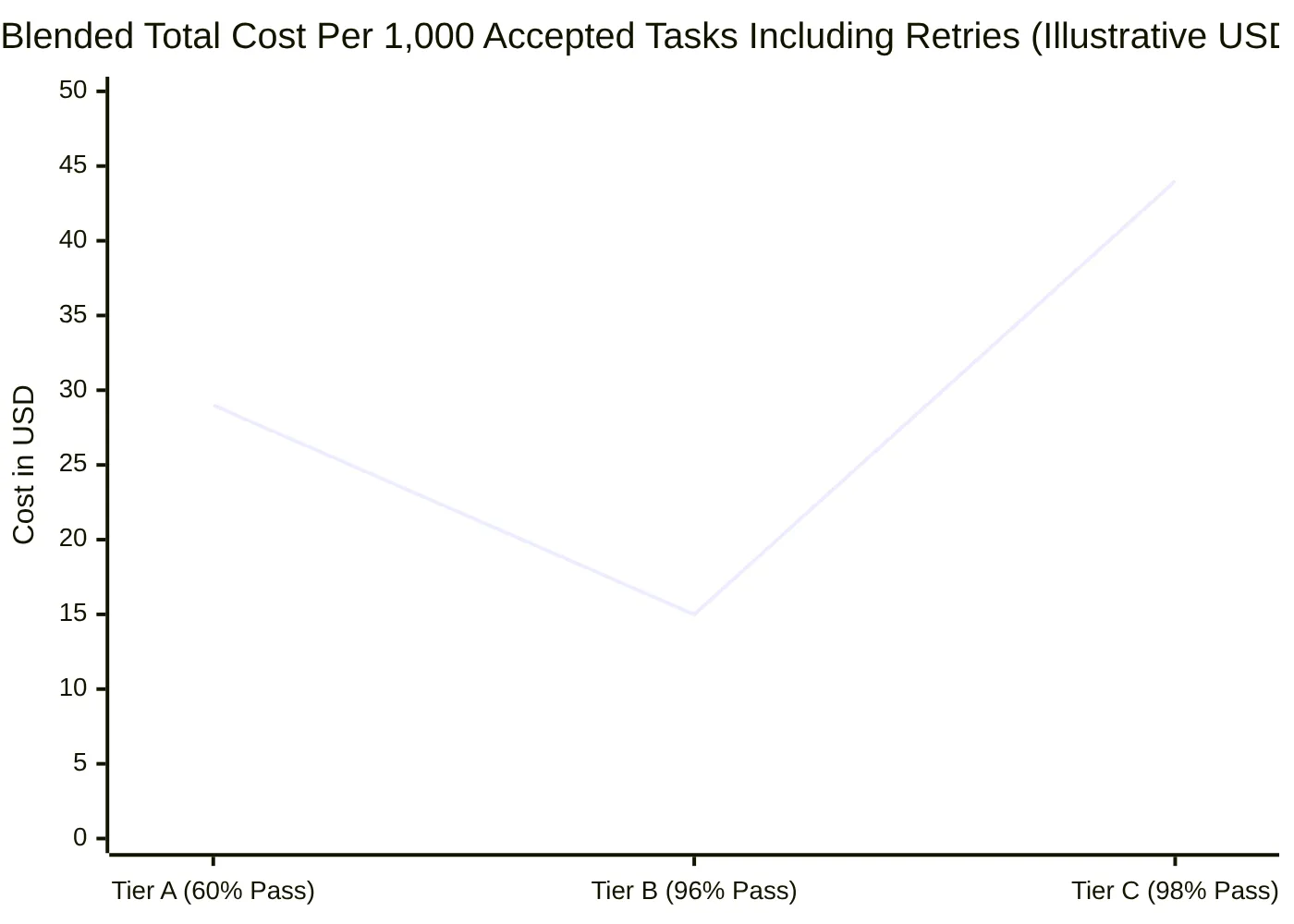
Why does this distinction matter? Consider a scenario where a team routes a complex JSON extraction or code-generation workflow to a low-priced model that lacks sufficient instruction-following capability. If that model costs less per token than an alternative, but fails schema validation repeatedly—requiring multiple retry loops, verbose repair prompts, and secondary evaluator calls—its actual cost per accepted task will frequently exceed that of a better-matched model that succeeds on the first attempt.
Several factors inflate the numerator in the cost-per-accepted-task equation:
Prompt and Context Bloat: Stuffing unpruned RAG documents or lengthy conversation histories into every call multiplies input token spend, as noted in standard API pricing documentation.
Output Validation Failures: Near-miss responses can create costly regeneration cycles, repair prompts, and debugging overhead. Track those failures in the same cost record as the original call.
Unbounded Reasoning and Verbosity: Models that generate excessive chain-of-thought tokens or conversational filler before delivering a structured payload drive up output token bills, where unit rates are often several times higher than input rates according to developer token pricing guides.
The following two charts illustrate how an illustrative model tier with a lower initial unit token cost can result in a higher total cost per 1,000 accepted tasks once validation failures, repair loops, and fallback escalations are accounted for.
Match Models to Workload Requirements
One of the highest-leverage ways an LLM routing platform helps reduce LLM costs is by ending the habit of sending every prompt to a single, expensive flagship model. Not every request requires deep multi-step reasoning. In a well-designed AI infrastructure stack, engineering teams classify their traffic into distinct workload tiers, each governed by explicit Service Level Objectives (SLOs) for accuracy, latency, and budget, a practice demonstrated in smart LLM routing architectures.
Workload Category | Typical Engineering Tasks | Recommended Model Profile | Escalation | Validation Signal |
|---|---|---|---|
High-Throughput & Low-Latency | Intent classification, entity extraction, boilerplate formatting, simple Q&A | Fast, high-efficiency flash or lightweight models with strict | JSON schema parse failure or confidence score below threshold |
Long-Context & Document Synthesis | Multi-document summarization, codebase indexing, contract analysis, deep RAG | Models optimized for extended model context stability and high recall | Missing citation checks or truncation warnings |
Complex Reasoning & Agentic Workflows | Multi-step planning, architectural code generation, tool-calling orchestration | High-capability reasoning models with strong instruction adherence | Unit test failure, linter errors, or tool-call syntax rejection |
Multilingual & Specialized Enterprise Tasks | Cross-language translation, structured report drafting, domain-specific synthesis | Bilingual or multilingual foundation models with strong technical alignment | Automated evaluator score or human-in-the-loop flag |
Historically, matching workloads to different providers meant maintaining multiple vendor SDKs, separate authentication flows, and incompatible message schemas. When developers search for how to switch between claude and gpt or how to route requests between llms, they are usually trying to solve this exact coupling problem without rewriting application code.
Using an openrouter alternative or a dedicated unified LLM API addresses this integration bottleneck through schema standardization. For example, GonkaRouter provides unified access to its catalog of currently supported AI models through OpenAI-compatible and Anthropic-compatible API formats, as detailed in our guide to using one OpenAI-compatible API endpoint.
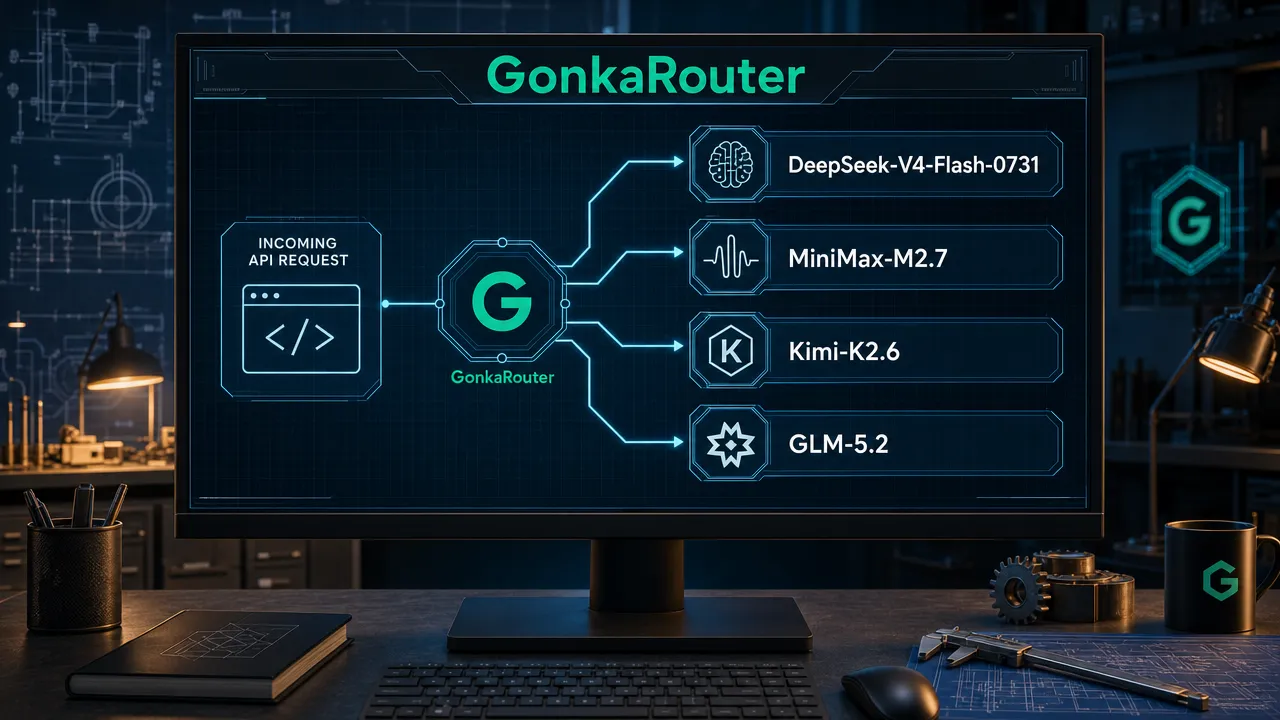
Architects must note the exact technical boundary here: API format compatibility means supported OpenAI-style or Anthropic-style clients can use the documented base URL, authentication, and request shape. It does not mean GonkaRouter provides official OpenAI or Anthropic models. GonkaRouter does not automatically select a model or provide application-level caching, fallback policy, or telemetry; the application must implement and verify those controls. Instead, GonkaRouter currently supports GLM-5.3-Flash, DeepSeek-V4-Flash-0731, and MiniMax-M2.7. Treat all three currently listed models as candidates rather than assigning capabilities from their names or marketing descriptions. Benchmark each one on the exact workload, prompt, schema, and latency target. Approve a model only after it meets the application's quality, safety, data, and cost thresholds.
Because these three models are accessible behind a unified OpenAI-compatible or Anthropic-compatible interface, teams can benchmark GLM-5.3-Flash, DeepSeek-V4-Flash-0731, and MiniMax-M2.7 against representative production tasks and assign the right model to each microservice simply by selecting a supported model ID in the request configuration.
Control Spend With Bounded Retries and Safe Caching
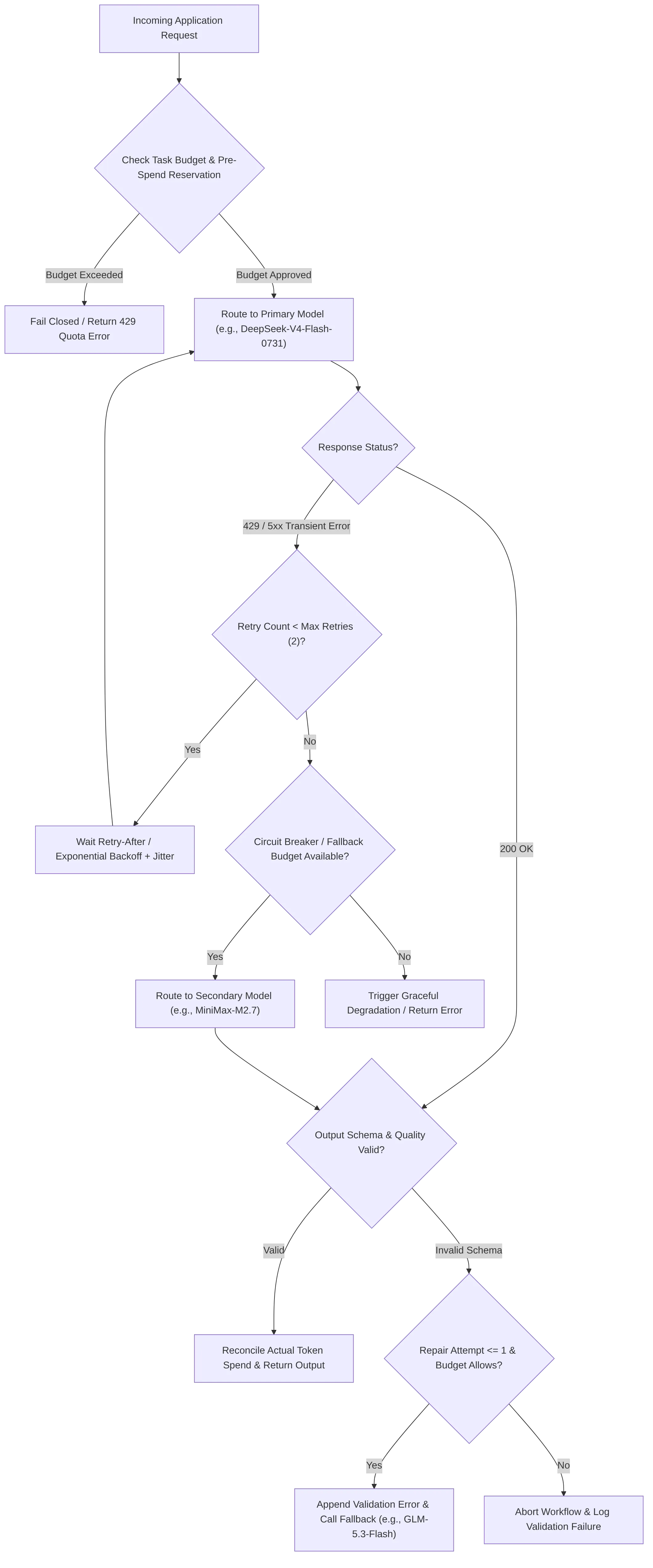
In distributed systems, transient network glitches, HTTP 429 rate limits, and provider 5xx errors are inevitable. However, how an LLM gateway or client middleware handles those failures determines whether an incident causes a minor delay or an expensive billing spike.
When building an LLM gateway for agents or an ai gateway for agents, naive retry logic is particularly hazardous. If an autonomous agent encounters a timeout or a malformed tool call halfway through a multi-step loop, an unbounded retry policy—or an SDK retry layered on top of an application-level retry—can multiply token consumption rapidly while re-sending large conversation contexts, a risk highlighted in API rate limit management best practices and LiteLLM proxy architecture guides.
As covered in our technical deep dive on how to route requests between LLMs smoothly and our intelligent model router failover guide, LLM failover and model fallback routing must never mean "try everything until something works." Application and middleware teams should enforce strict financial bounds around retries:
Error Classification: Only retry transient infrastructure errors (such as HTTP 429, 502, 503, or 504) on the same route. Never blindly retry HTTP 400 bad requests, context-length overflow errors, or semantic validation failures with the exact same prompt and parameters.
Strict Attempt Caps and Backoff: Limit retries to a hard maximum (typically 1 to 2 retries) using exponential backoff with jitter, while honoring upstream
Retry-Afterheaders.Retry Cost Envelopes: Before executing a retry or escalating via AI model failover to a secondary model, middleware should verify that the remaining task budget can absorb the worst-case token spend of the fallback attempt, as described in AI gateway anatomy specifications.
Circuit Breakers: If an endpoint exhibits sustained failure rates, open a circuit breaker to route traffic to an approved backup or fail gracefully rather than paying latency and token penalties on broken streams.
Applying Caching Only Where Safe and Supported
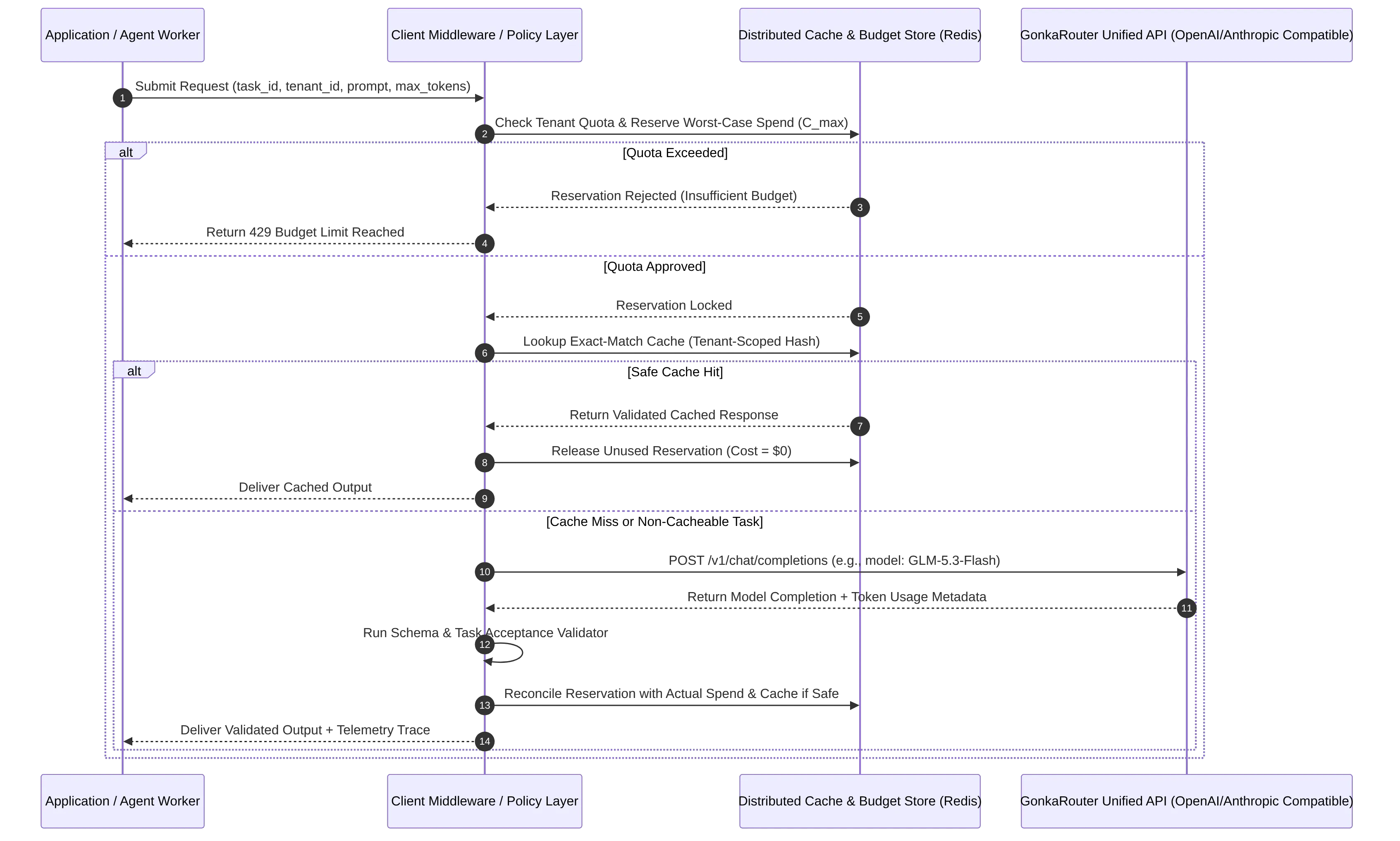
Caching is often presented as an effortless shortcut to cut inference spend, since a cache hit avoids upstream generation latency and token charges. However, in production environments, indiscriminate caching introduces serious risks, including cross-tenant data leakage, stale business logic, and invalid outputs. As we explain in our semantic routing and model fallback guide, caching should only be applied where it is architecturally safe for the workload and explicitly supported by your middleware layer or the underlying provider.
Exact-Match Request Caching: Hashes the normalized request payload—including exact model ID, prompt template version, system prompt, temperature, tool definitions, and tenant scope—and stores verified responses in a data store such as Redis, a pattern documented in LiteLLM routing and caching guides. This is safe for deterministic queries (
temperature = 0), static text classification, and repeatable documentation Q&A, but must be avoided for prompts containing PII, live customer records, or stateful agent actions.Semantic Caching: Uses vector embeddings to match similar requests within a strict similarity threshold. Because a slightly loose threshold can serve the wrong policy or product answer, semantic caching should be restricted to non-sensitive, high-volume public FAQ workloads.
Prefix and Component Caching: Where explicitly supported by an inference engine, prefix caching reuses static prompt prefixes across calls. Even when native prefix caching is not used, application teams can cache deterministic RAG retrieval chunks and tool outputs in their own middleware before invoking the model, as noted in LiteLLM core documentation.
Validation-Aware Storage: Never cache a response before it passes schema validation, and never cache a partially streamed response if a connection drops mid-stream.
Enforce Token Budgets and Measure Outcomes
To maintain predictable unit economics across every model, an LLM gateway architecture or application control plane must enforce multi-layered token budgets before and during execution, as outlined in LiteLLM budget and rate limit documentation. Relying solely on monthly billing alerts is insufficient for real-time control during high-concurrency traffic spikes.
Engineering teams should enforce financial guardrails across four boundaries:
Input Context Pruning: Enforce hard input token ceilings before dispatching requests. Strip redundant boilerplate from scraped payloads, summarize long chat histories, and limit RAG retrieval to top-ranking chunks.
Explicit Output Token Caps (
max_tokens): Always specify a realisticmax_tokenslimit tailored to the task so a malfunctioning prompt cannot generate thousands of unintended tokens.Optimistic Pre-Spend Budget Reservation: Before routing a request, application middleware can calculate the worst-case cost based on input tokens and
max_tokens:Cmax=(Tinput×Pinput)+(Tmax_output×Poutput)C_{\max} = (T_{\text{input}} \times P_{\text{input}}) + (T_{\text{max\_output}} \times P_{\text{output}})Cmax=(Tinput×Pinput)+(Tmax_output×Poutput)
By atomically reserving CmaxC_{\max}Cmax against the tenant or agent quota in Redis and reconciling the balance with actual token usage upon completion, teams prevent concurrent agent threads from simultaneously bypassing quota checks.
Per-Agent Loop Circuit Breakers: In a model router for agents, assign an overarching
workflow_idbudget and step limit, a practice supported in provider and tag budget routing frameworks. If an agent exceeds its step count or budget ceiling without resolving the task, the middleware terminates the loop safely.
Measurement and Cost Attribution
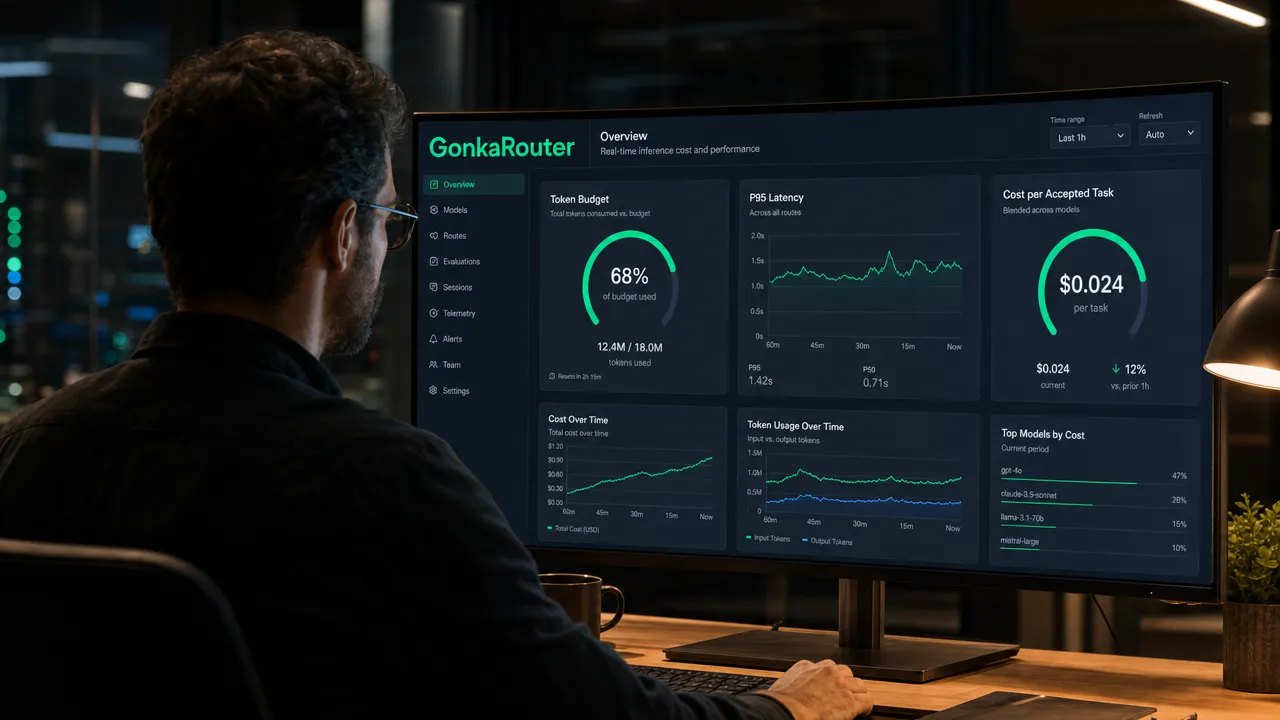
Cost optimization is a continuous verification loop. Rather than waiting for end-of-month finance spreadsheets, platform engineers should build LLM observability into their request middleware by tracking:
Cost Attribution Tags: Attach metadata (
tenant_id,feature_name,workflow_id,environment) to every call to measure spend by product feature.First-Attempt Acceptance Rate: Track the percentage of completions from
GLM-5.3-Flash,DeepSeek-V4-Flash-0731orMiniMax-M2.7that pass automated schema validation or unit tests without requiring a retry.Latency Distribution (P50 / P95 / P99) and TTFT: Verify that switching to a lower-cost model preserves interactive user experience thresholds.
Retry-Attributed Spend Percentage: Measure the share of tokens consumed by failed attempts and fallback escalations versus successful primary completions.
Evaluate GonkaRouter as a Unified API Layer
Building a cost-disciplined AI infrastructure stack starts with reducing the integration friction required to test, compare, and switch models across workloads.
GonkaRouter serves as a focused unified LLM API built on the Gonka decentralized GPU network. Rather than maintaining separate provider integrations, engineering teams can connect their application middleware to GonkaRouter using OpenAI-compatible or Anthropic-compatible API formats. While GonkaRouter does not provide official OpenAI or Anthropic models, and does not replace your application's custom business logic, its format compatibility lets you keep your existing SDKs and middleware policies—such as bounded retries, safe caching, token budgets, and telemetry—while routing workloads to its currently supported models:
GLM-5.3-Flash
DeepSeek-V4-Flash-0731
MiniMax-M2.7
GonkaRouter's published rate is usage-based and can change with network utilization, so use the live pricing page when estimating costs. The current catalog lists GLM-5.3-Flash, DeepSeek-V4-Flash-0731, and MiniMax-M2.7. Benchmark these routes against your own acceptance criteria, then compare cost per accepted task before moving production traffic. Review the current model specifications at the GonkaRouter supported models catalog, log in with your email to generate an API key, and benchmark GLM-5.3-Flash, DeepSeek-V4-Flash-0731, and MiniMax-M2.7 on your own production tasks through one API endpoint.