Why Routing Matters When You Use One AI Endpoint
A single endpoint can reduce the number of client integrations an application maintains. The harder question is how each request is assigned to a model and what the application does when that route is slow, unavailable, or unsuitable for the task.
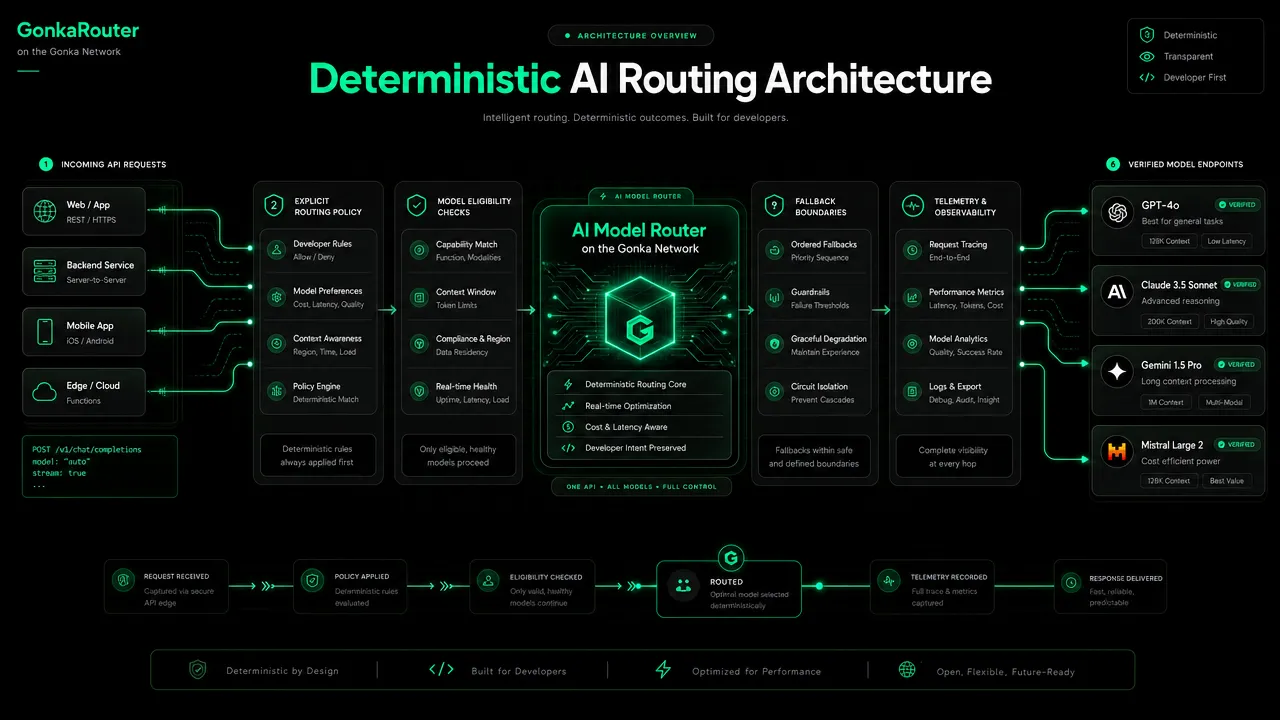
Do not equate a unified URL with automatic or intelligent routing. Routing may be a model choice made explicitly by the application, a configured policy, or a documented service feature. GonkaRouter provides OpenAI-compatible and Anthropic-compatible API formats for a defined catalog: GLM-5.3-Flash, DeepSeek-V4-Flash-0731, and MiniMax-M2.7. See the current catalog; format compatibility does not add other providers or official OpenAI/Anthropic models.
Make Route Selection Explicit
Start with the workload contract. Record required modalities, context size, tool use, output schema, data policy, latency target, and budget. Select only models that meet those requirements, then run the same representative prompts against each candidate. Compare accepted-task quality and total cost, including retries and repair calls, rather than token price alone.
For agents, keep routing decisions reviewable. A low-risk classification step may tolerate a different model than a tool call that can modify data. Validate tool arguments and structured outputs in the application. Do not change models mid-stream or retry an irreversible action without an explicit recovery contract.
Treat Failover as a Separate Feature
A fallback route is safe only when it has been tested for the same task, data policy, output schema, and side effects. Set a total deadline, cap retries, and distinguish transient network errors from authentication, validation, and policy errors. If a gateway does not document automatic failover, implement and own that behavior in the application.
A gateway is itself a dependency. Measure its contribution to latency, monitor errors at the client boundary, and retain a tested rollback option.
Design Routing as a Policy, Not a Guess
A production routing policy should be deterministic enough to explain after an incident. Begin with hard constraints: required modality, minimum context window, output format, tool support, data residency, and maximum latency. A model that fails any hard requirement should not enter the candidate set. Only then should the application compare softer goals such as cost, quality, or speed.
The simplest useful policy is often a lookup table maintained in configuration. A classification workload can point to one verified model, long-form synthesis to another, and code generation to a third. Version that table with the application, record the selected policy version on each request, and require review for changes. This approach is less fashionable than opaque semantic routing, but it is easier to test, audit, and roll back.
If routing depends on prompt content, keep the decision bounded. Use metadata or a small classifier to assign the request to a known workload class, then select from routes already approved for that class. Do not send sensitive prompt text to an additional classification service without assessing the data path. Record only the routing signals needed for operations and avoid placing raw customer content in general analytics logs.
Build an Evaluation Gate for Every Route
Before a model becomes eligible, test it against representative examples and failure cases. For structured tasks, validate the response with the same parser and schema used in production. For retrieval-assisted answers, verify citation behavior and handling of missing evidence. For agents, check tool selection, argument validity, permission boundaries, and behavior after tool errors. A route is approved for a workload only when it meets explicit thresholds.
Re-run the gate when the model identifier, prompt template, SDK, or endpoint behavior changes. Model aliases can move to a new snapshot, and a compatible API can still produce a different streaming sequence or tool-call shape. Pin exact identifiers when available and schedule regression tests for critical workflows. Treat a model change like a dependency upgrade rather than a copy edit in configuration.
Cost should be evaluated per accepted task. Include the original call, any repair prompts, retries, and tool overhead. A fast inexpensive model may be ideal for extraction yet poor for a planning step that repeatedly fails validation. Routing earns its keep by matching a verified route to a defined task, not by sending all requests to the model with the lowest published token rate.
Bound Retries and Recovery Paths
Routing policy and failure policy are separate. First classify the error. Invalid credentials, unsupported model IDs, context-limit violations, and malformed requests should stop immediately. Rate limits and temporary upstream failures may justify a retry with exponential backoff, jitter, and a total deadline. Give retry ownership to one layer so a client library and background worker do not multiply attempts.
Fallback needs an explicit compatibility contract. The alternate model must pass the same schema and safety tests, accept the required context, and comply with the same data rules. It must also be safe to repeat the task. Never retry an irreversible tool action merely because the response timed out; use idempotency keys and reconcile state first.
Operate the router with clear signals. Capture the workload class, selected model, policy version, attempt count, latency, token usage, validation outcome, and final task status. Use these fields to compare policy changes and identify a route that is cheap per call but expensive after repair. Client-side monitoring should cover the complete path because a unified endpoint adds its own network and service dependency.
With explicit requirements, route-specific tests, and bounded recovery, one endpoint becomes a useful control point. Without those controls, it is only a shorter URL.
Teams evaluating GonkaRouter can review the API overview and supported models, then test a representative workload before moving production traffic.