Why GonkaRouter simplifies AI model access for developers
Building AI applications rarely means calling only one model forever. AI Agents, chatbots, content generation systems, code generation tools, automated workflows, intelligent Q&A products, and enterprise AI applications often need different model capabilities for different tasks. A product team may want to test Kimi for one workflow, Qwen for another, and MiniMax for another, while still keeping the application architecture simple.
The problem is that direct model integration creates unnecessary complexity. Developers often need to manage multiple provider accounts, API keys, SDKs, request formats, response schemas, billing systems, usage dashboards, and model-switching logic. Over time, this becomes a maintenance burden. Every new model provider can introduce another integration path, another error-handling pattern, and another place where application logic has to change.
GonkaRouter is designed to reduce that friction. It gives developers a single OpenAI-compatible API endpoint for multi-model API access, so teams can route requests to multiple AI models through one unified interface. Instead of rebuilding application logic for every provider, developers can log in with email, get an API key, update the API endpoint, and start testing supported models through GonkaRouter.
For developers and technical teams, the core value is straightforward:
Developer challenge | GonkaRouter approach |
|---|---|
Multiple provider APIs | One single API endpoint |
Different request formats | OpenAI Compatible API pattern |
Separate model integrations | Unified model routing |
Fragmented usage tracking | Transparent per-token pricing |
Subscription pressure | No monthly subscriptions |
Slow model experimentation | Multi-model API access through one AI Gateway |
What GonkaRouter is and how the Gonka Network supports it
GonkaRouter is an AI model router built on the Gonka Network. It acts as a developer-facing AI Gateway that provides one OpenAI-compatible API endpoint for accessing multiple AI models through a unified API.
In practical terms, GonkaRouter helps developers avoid managing every model provider directly. Instead of maintaining separate integrations for Kimi API, Qwen API, MiniMax API, and other model ecosystems, teams can use GonkaRouter as a single AI Inference API layer.
GonkaRouter is built around several confirmed product principles:
It is an AI model router.
It is built on the Gonka Network.
It provides a single OpenAI-compatible API endpoint.
It supports multi-model API access.
It routes requests to supported AI model ecosystems such as Kimi, Qwen, MiniMax, and more.
It offers transparent per-token pricing.
It has no monthly subscriptions.
Developers can start by logging in with email, getting an API key, and updating the API endpoint.
The official model catalog currently shows supported models including Kimi-K2.6, Qwen3-235B-A22B-Instruct-2507-FP8, and MiniMax-M2.7. This makes GonkaRouter useful for teams that want model optionality without turning their backend into a collection of provider-specific adapters.
How GonkaRouter relates to the Gonka Network
The Gonka Network is the infrastructure foundation behind GonkaRouter. Gonka connects globally distributed GPU resources and supports open, low-cost AI inference services. GonkaRouter sits on top of that network as the developer-facing product layer.
This matters because developers get an API-first experience without having to manage the underlying infrastructure directly. Teams do not need to operate GPU resources, coordinate distributed infrastructure, or understand the low-level network mechanics to use GonkaRouter. They interact with the AI Gateway through an API endpoint, while GonkaRouter handles unified model access on top of the Gonka Network.
The result is a cleaner separation:
Layer | What it does |
|---|---|
Gonka Network | Connects distributed GPU resources for AI inference infrastructure |
GonkaRouter | Provides the developer-facing AI model router and OpenAI-compatible API endpoint |
Developer application | Calls supported AI models through a unified API |
Why developers use GonkaRouter for multi-model API access
GonkaRouter is designed for developers who want a practical way to connect applications to multiple models without building and maintaining separate provider integrations. This is especially useful for startup teams, AI product managers, Agent developers, Web3 project teams, and enterprise technical teams that need a simpler path from prototype to production.
GonkaRouter provides one OpenAI-compatible API endpoint
OpenAI-compatible APIs have become a practical standard in AI application development because many SDKs, frameworks, and engineering teams already understand the request and response pattern. Public technical references such as Google Gemini's OpenAI compatibility documentation and BentoML's guide to OpenAI-compatible APIs also show the broader market trend toward familiar OpenAI-style interfaces.
GonkaRouter follows this developer-first direction by providing an OpenAI-compatible API endpoint. For teams with an existing OpenAI-style integration, this can reduce migration effort because the workflow is closer to updating endpoint configuration than rebuilding the full integration.
That helps with:
Easier migration from existing OpenAI-style applications.
Lower engineering overhead.
Faster testing across supported models.
Simpler deployment for AI Agents and automated workflows.
More consistent API patterns across model experiments.
GonkaRouter is also positioned as an OpenAI- and Anthropic-compatible AI Gateway. Developers should still check the latest product documentation and dashboard details for exact endpoint behavior and supported API features, but the core product direction is unified access through a familiar API pattern.
GonkaRouter routes requests to multiple AI models
Modern AI products often need more than one model. A chatbot may use one model for general conversation, an Agent API workflow may use another model for structured reasoning, and a code generation product may test several models before choosing the best fit for a specific task.
GonkaRouter gives developers one interface for model ecosystems such as Kimi, Qwen, MiniMax, and more. Teams can explore Kimi, Qwen, and MiniMax models through the supported models page instead of managing each model integration separately.
This is where unified model routing becomes valuable. Developers can centralize model access through one AI Gateway and reduce the amount of provider-specific code inside the application.
Key benefits include:
Easier model switching.
Less provider maintenance.
More flexibility for different AI tasks.
Faster experimentation across model ecosystems.
Reduced dependency on provider-specific integration logic.
A simpler Multi Model API layer for product teams.
GonkaRouter offers transparent per-token pricing
Pricing visibility matters when an application makes many model calls. AI Agents, workflow automation systems, content generation pipelines, test environments, intelligent Q&A products, and data analysis tools can generate high token volume quickly.
GonkaRouter offers transparent per-token pricing, with listed token pricing as low as $0.0004 / 1M tokens on supported models. The token pricing on supported models should be checked regularly because token prices may dynamically adjust based on Gonka Network utilization.
GonkaRouter also gives new users a one-time 20 USDT trial credit after login for API testing. This should be understood only as trial credit for testing API usage, supported models, and integration behavior.
Pricing element | GonkaRouter positioning |
|---|---|
Token pricing | As low as $0.0004 / 1M tokens on supported models |
Pricing model | Transparent per-token pricing |
Subscriptions | No monthly subscriptions |
Trial credit | One-time 20 USDT trial credit after login for API testing |
Pricing updates | Token prices may dynamically adjust based on Gonka Network utilization |
GonkaRouter has no monthly subscriptions
For many teams, usage-based access is easier to evaluate than a platform commitment. GonkaRouter has no monthly subscriptions, which makes it practical for prototypes, proof-of-concept work, model evaluation, and production workloads where usage may vary month to month.
This is useful for:
Startup teams validating product ideas.
Agent developers testing repeated model calls.
Enterprise teams running controlled pilots.
AI product managers comparing model performance across tasks.
Developers who want pricing visibility without subscription overhead.
The combination of transparent per-token pricing and no monthly subscriptions makes GonkaRouter a flexible AI Inference API option for teams that want to pay attention to usage from the beginning.
GonkaRouter supports AI Agents and developer workflows
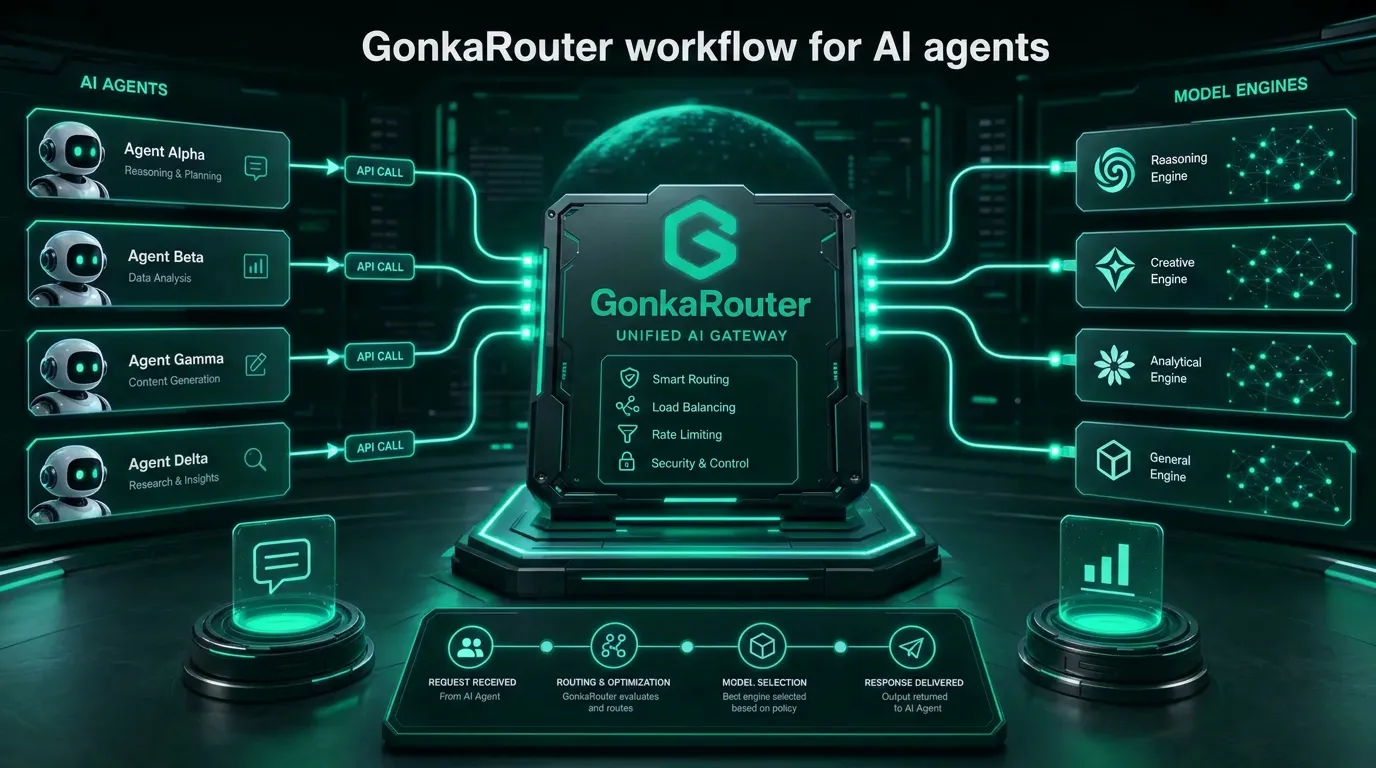
GonkaRouter is especially relevant for AI Agent API workflows. Agents often make repeated model calls, use multi-step reasoning, depend on stable endpoint behavior, and need flexibility when different models perform better for different tasks.
Common use cases include:
AI Agents.
Chatbots.
Content generation.
Code generation.
Enterprise AI applications.
Automated workflows.
Intelligent Q&A.
Data analysis.
Agent API backends.
Multi Model API experimentation.
How GonkaRouter works in a developer workflow
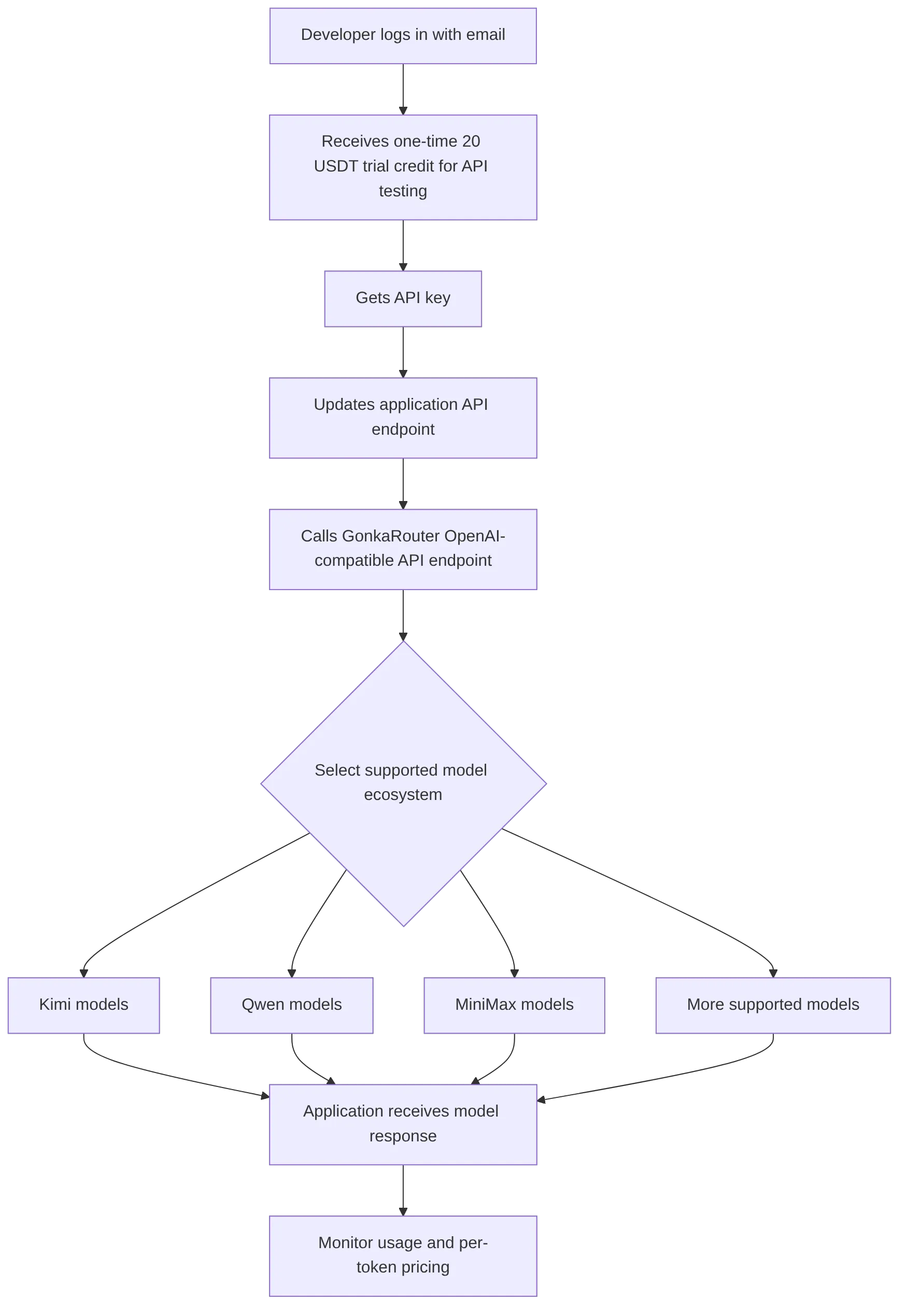
GonkaRouter is designed to be simple to evaluate. The typical setup flow has five steps.
GonkaRouter setup step 1: Log in with email
Developers start with email-based login. This lowers the registration barrier and makes it easier for global developer teams to test the product without a complex onboarding process.
After login, new users receive a one-time 20 USDT trial credit for API testing. This credit is intended for trying API calls, supported models, and integration behavior.
GonkaRouter setup step 2: Get an API key
After logging in, developers get an API key for application access. The key is used by the application when calling GonkaRouter as the AI Gateway layer.
This simplifies credential management compared with maintaining multiple provider-specific keys across different model ecosystems.
GonkaRouter setup step 3: Update the API endpoint
The main integration step is updating the application's API endpoint to GonkaRouter. Because GonkaRouter provides an OpenAI-compatible API endpoint, teams using OpenAI-style clients or request patterns can often adapt their configuration more easily than they could with a full provider-by-provider rewrite.
Developers should use the latest dashboard or documentation details when configuring the exact endpoint and supported request parameters.
GonkaRouter setup step 4: Call supported AI models
Once the endpoint and API key are configured, the application can call supported AI models through GonkaRouter. Developers can test model ecosystems such as Kimi API, Qwen API, and MiniMax API workflows from the same unified access layer.
This is useful when different tasks require different model behavior. For example, one model may be tested for content generation, another for intelligent Q&A, and another for code generation.
GonkaRouter setup step 5: Monitor usage and pricing
Developers should monitor usage with transparent per-token pricing. GonkaRouter lists token pricing as low as $0.0004 / 1M tokens on supported models, with the important note that pricing may dynamically adjust based on Gonka Network utilization.
This gives teams a clearer way to understand API usage as they move from testing into production workloads.
Setup step | Developer action | Outcome |
|---|---|---|
1 | Log in with email | Account access with low onboarding friction |
2 | Receive trial credit | One-time 20 USDT trial credit for API testing |
3 | Get API key | Application authentication through GonkaRouter |
4 | Update API endpoint | Connect existing workflow to the OpenAI-compatible API endpoint |
5 | Call supported models | Use multi-model API access through one router |
6 | Monitor usage | Track transparent per-token pricing |
GonkaRouter vs direct model APIs and OpenRouter alternatives
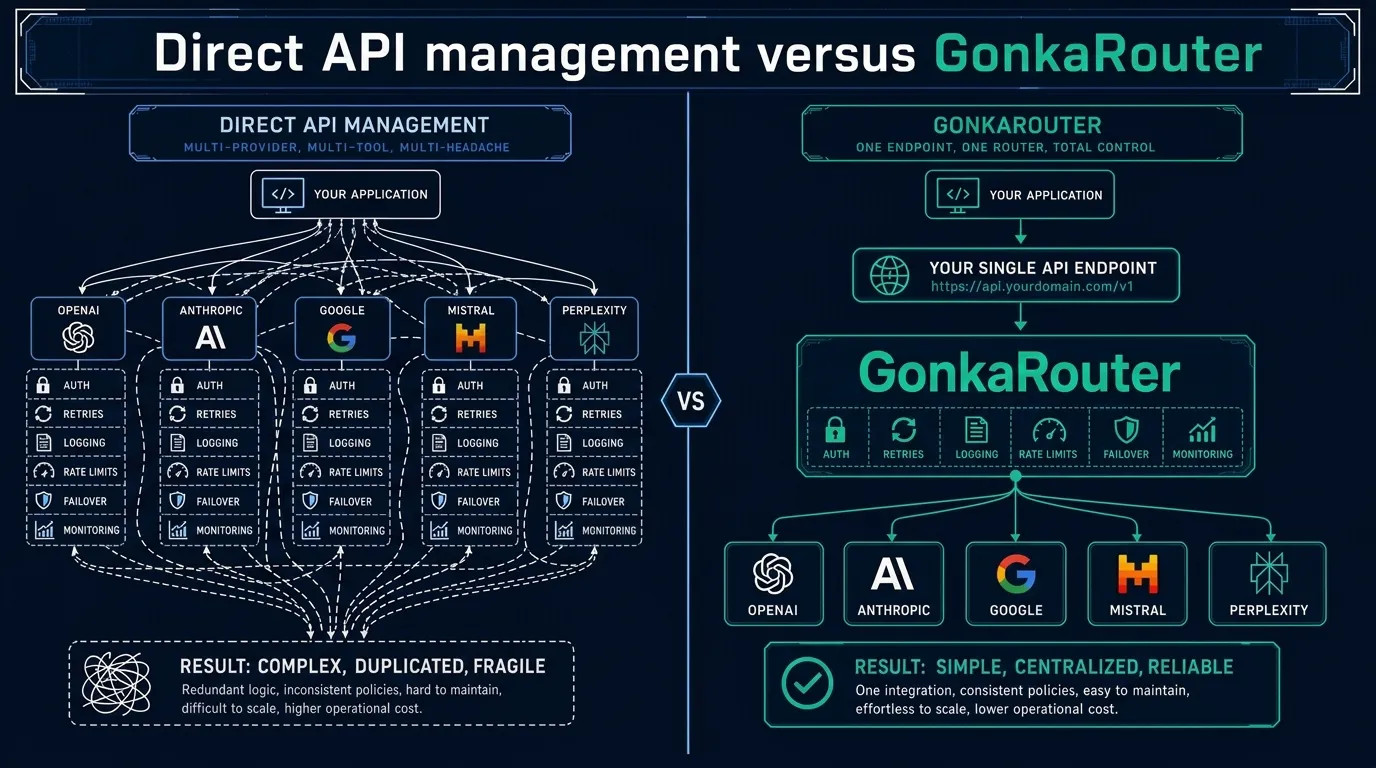
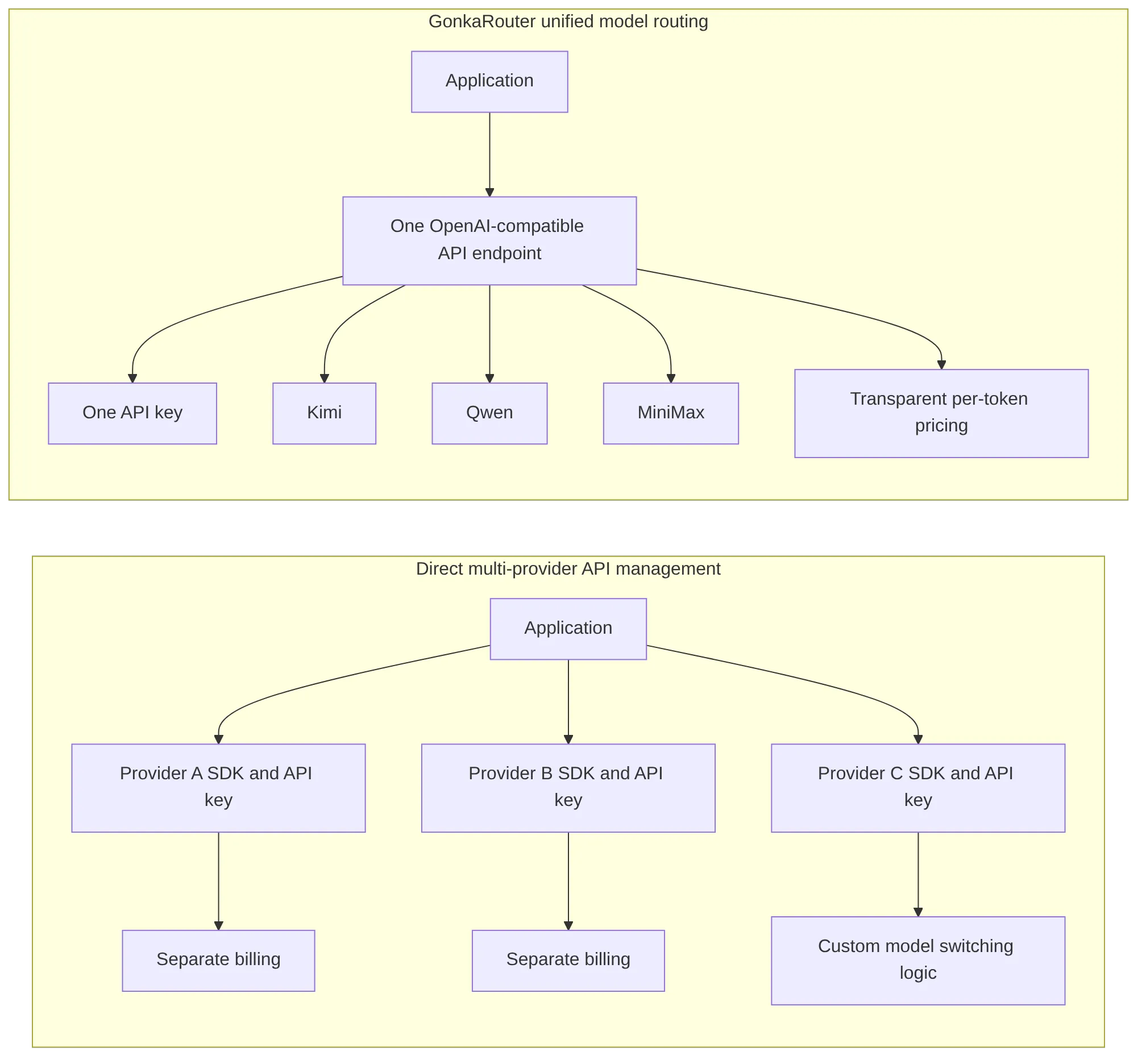
Developers evaluating GonkaRouter are usually comparing it against two options: managing multiple model APIs directly or using another AI model router. The direct API path gives teams provider-level control, but it also increases engineering work. Every provider can add a new key, endpoint, schema, billing system, model naming convention, and failure mode.
GonkaRouter takes the AI Gateway approach: one API endpoint, one API key, OpenAI-compatible integration, multi-model routing, and transparent per-token pricing.
Dimension | Managing multiple model APIs directly | GonkaRouter |
|---|---|---|
API keys | Separate keys for each provider | One GonkaRouter API key |
Endpoint management | Multiple provider endpoints | One OpenAI-compatible API endpoint |
Request formats | Different schemas and SDKs | OpenAI Compatible API pattern |
Billing | Separate billing systems | Transparent per-token pricing |
Model switching | Requires adapters or logic changes | Easier experimentation through unified model routing |
Maintenance | Higher engineering overhead | Reduced integration maintenance |
Agent workflows | More complex provider selection | Better fit for AI Agent API workflows |
Onboarding | Multiple accounts and approvals | Email login, API key, endpoint update |
Subscription model | Varies by provider | No monthly subscriptions |
Is GonkaRouter an OpenRouter alternative?
GonkaRouter can be considered an OpenRouter alternative for developers evaluating OpenAI-compatible AI model routers. Both sit in the broader category of AI Gateways and model routing platforms, where the goal is to help developers access multiple models through a unified interface.
The safer comparison is category-level rather than claim-based. GonkaRouter differentiates through its Gonka Network foundation, transparent per-token pricing, no monthly subscriptions, email-based login, and support for model ecosystems such as Kimi, Qwen, MiniMax, and more.
Developers comparing AI model routers should evaluate:
Supported models.
API compatibility requirements.
Pricing model.
Endpoint configuration.
Usage monitoring needs.
Agent workflow requirements.
Onboarding flow.
Fit with existing application architecture.
GonkaRouter is not positioned as a replacement for every possible router use case. It is best understood as a developer-first AI model router for teams that want a single OpenAI-compatible API endpoint, multi-model API access, transparent per-token pricing, and no monthly subscriptions.
Start building with GonkaRouter for one API endpoint
GonkaRouter gives developers a simpler way to access multiple AI models. Instead of managing separate provider APIs, different SDKs, multiple billing systems, and custom model-switching logic, teams can use one AI Gateway built on the Gonka Network.
The product message is simple: one API for all models. GonkaRouter provides a single OpenAI-compatible API endpoint for multi-model API access across supported ecosystems such as Kimi, Qwen, MiniMax, and more. It supports AI Agents, chatbots, content generation, code generation, enterprise AI applications, automated workflows, intelligent Q&A, and data analysis.
For teams evaluating Gonka Router, the next step is practical:
Log in with email.
Get an API key.
Use the one-time 20 USDT trial credit for API testing.
Explore the supported AI models.
Update your application endpoint.
Start testing unified model routing through GonkaRouter.
Review transparent per-token pricing as usage grows.
If your team needs an OpenAI-compatible API endpoint, a Multi Model API, an AI Agent API layer, or a simpler AI Inference API for production workflows, GonkaRouter provides a focused path: one endpoint, multiple models, transparent pricing, and no monthly subscriptions.