An open-source LLM gateway improves observability by concentrating multi-model request evidence at a single, controllable boundary between applications and model providers.
When an application calls several providers through separate SDKs, critical facts become fragmented: the selected model, route decision, retries, token usage, latency, and error details may live in different services and dashboards. An open-source LLM gateway deployment does not make models inherently transparent, but it gives platform teams a consistent place to capture and correlate those signals.
Build a single observability boundary
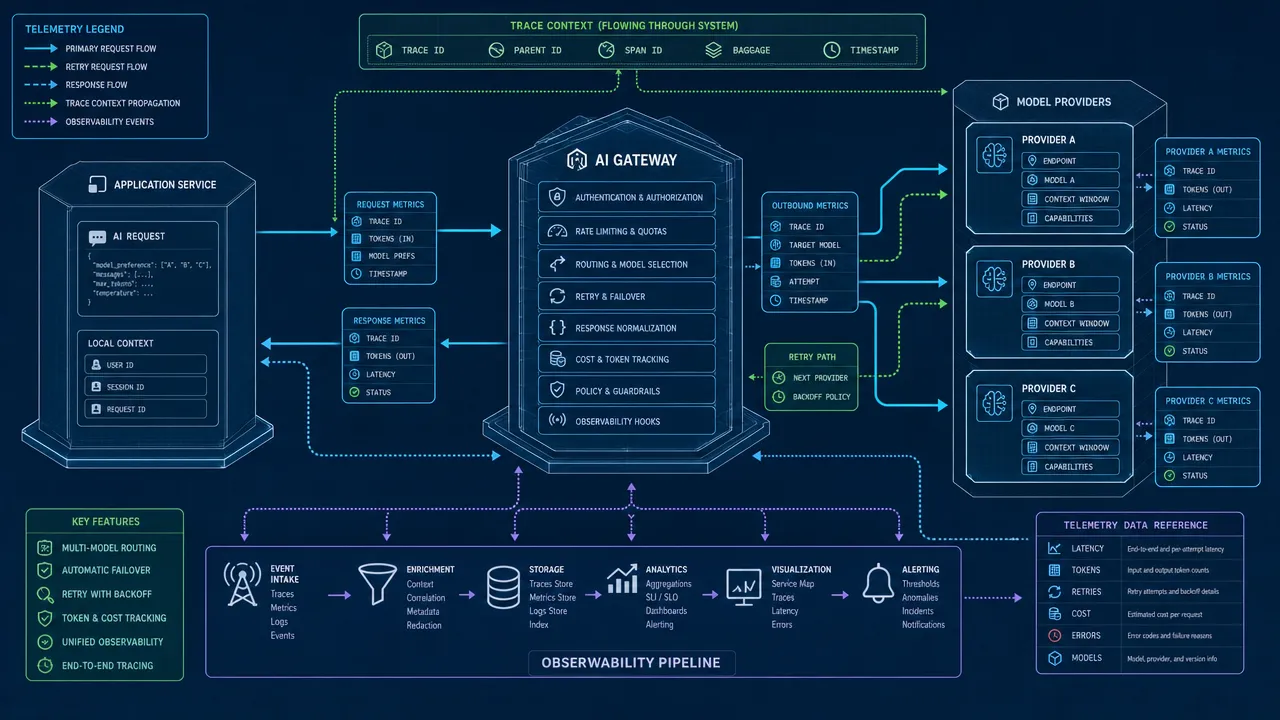
An LLM gateway is an intermediary data-plane layer that receives a model request, applies configured controls, selects an eligible upstream route, and returns the response. Depending on the implementation, it may also handle authentication, quotas, caching, protocol translation, logging, and policy enforcement.
This placement matters because the gateway sees both the request intent and the execution outcome. Rather than asking every application team to normalize provider telemetry independently, a shared gateway can emit a consistent event envelope.
A practical event record often includes:
Signal | Why it matters |
|---|---|
| Connects gateway activity to the full application workflow. |
Requested and resolved model | Shows whether the intended route matched the model that served traffic. |
Provider and deployment | Identifies the actual upstream endpoint. |
Route and policy version | Explains why a routing choice, quota decision, or fallback occurred. |
Retry and fallback chain | Reveals hidden reliability and cost overhead. |
Input, output, and cached tokens | Supports usage analysis when the provider returns these values. |
TTFT and total duration | Separates streaming responsiveness from end-to-end completion time. |
Provider request ID and error code | Preserves evidence for incident analysis and provider support cases. |
The gateway belongs in a broader ai infrastructure stack, alongside application services, agent runtimes, retrieval systems, tool executors, providers, observability storage, and evaluation workflows. It should not replace application-level authorization, output validation, or quality measurement.
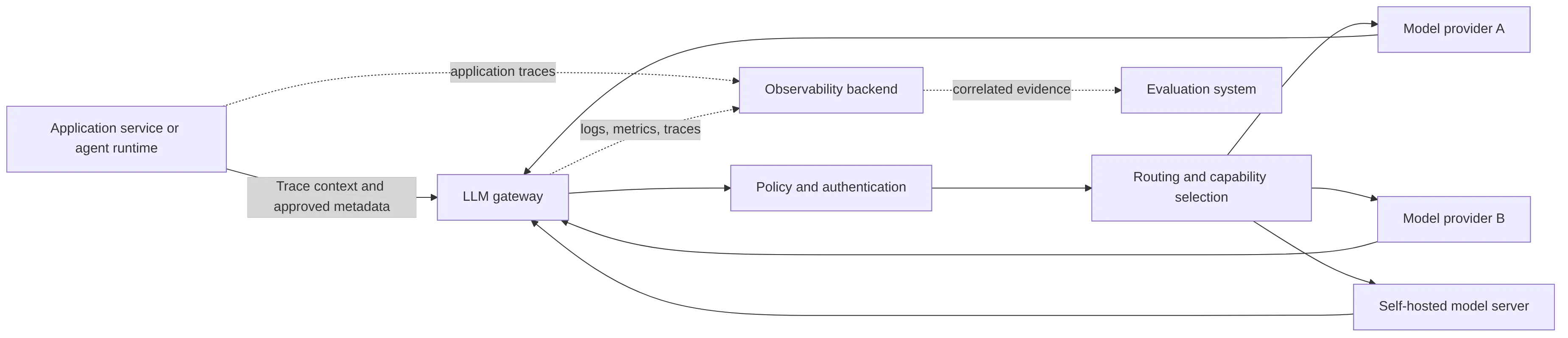
This llm gateway architecture improves diagnosis because route selection is no longer implicit in scattered client code. Teams can answer operational questions with evidence: which provider handled the request, whether a health failover occurred, and how much latency came from retries rather than inference.
For a deeper explanation of the router layer itself, see AI model router API explained.
Use traces and metrics alongside logs
Useful llm observability is not equivalent to storing prompts and completions. Raw content can be sensitive, expensive to retain, and difficult to govern. In many production incidents, structured metadata provides enough diagnostic evidence without retaining user text.
A layered telemetry design works best:
Logs retain discrete events, such as a throttling response, route change, or fallback reason.
Metrics aggregate trends, including request rate, p95 latency, first-token latency, cache-hit ratio, and retry-adjusted cost.
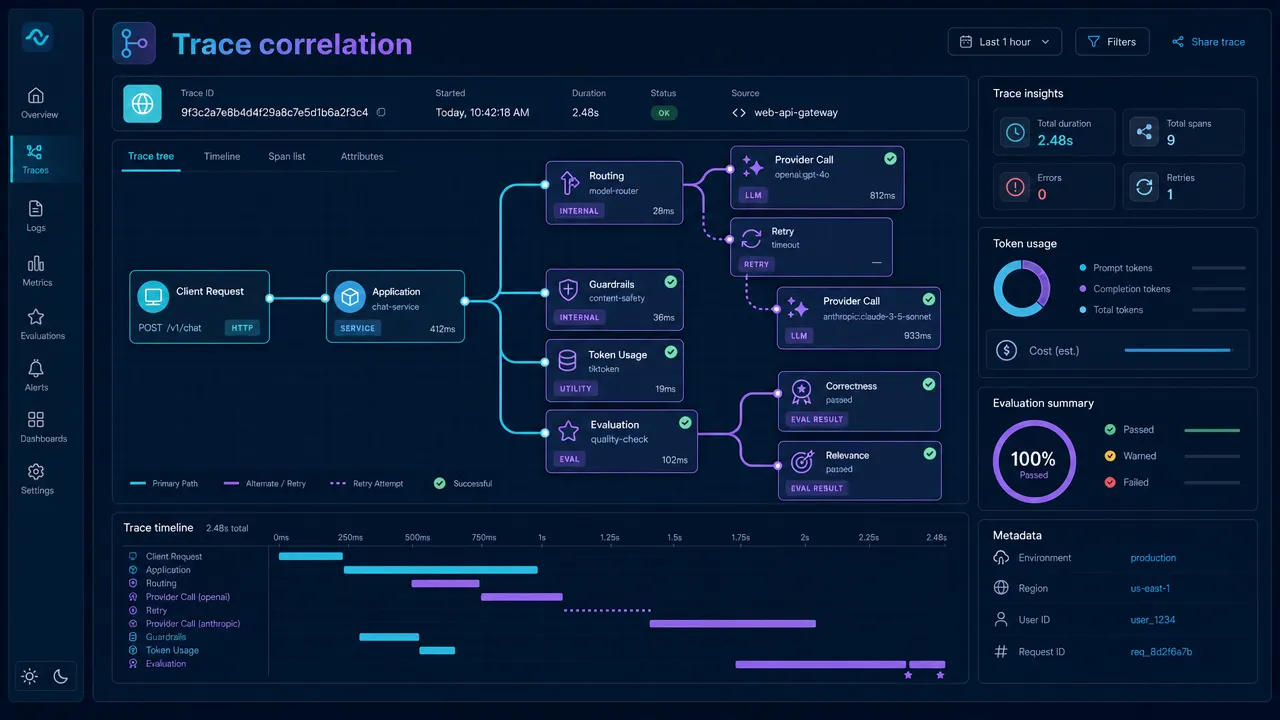
Traces preserve causality across application processing, gateway decisions, retrieval, tool calls, and model requests.
Evaluations determine whether a technically successful response completed the user's task correctly.
OpenTelemetry provides a useful vendor-neutral foundation for traces and metrics. Its GenAI semantic conventions are still evolving, so production teams should version their internal schema and avoid tightly coupling every dashboard to experimental attribute names. Refer to the OpenTelemetry semantic conventions for the current specification direction.
A gateway should propagate W3C trace context and preserve an application-generated request ID. That lets a trace show the complete timeline:
The application constructs a prompt or agent action.
The gateway authenticates the caller and evaluates route policy.
The gateway calls an upstream model endpoint.
A retry, cache response, or fallback happens if necessary.
The application validates the output or invokes a tool.
An evaluation event records whether the task actually succeeded.
HTTP 200 alone is not a useful success definition. A request may return successfully after multiple retries, use an expensive fallback, emit invalid structured output, or fail user acceptance criteria.
Understand what self-hosting changes for data control
The principal advantage of ai gateway open source software is control over the gateway environment. A self-hosted deployment can let teams choose where the runtime executes, where telemetry is exported, how logs are retained, and which enrichment or redaction rules apply before data leaves their environment.
For example, a platform team might add middleware that:
Validates cost-center metadata from trusted backend identities.
Hashes user identifiers before telemetry export.
Removes authorization headers and secret-like values.
Adds prompt-template version and agent-step fields.
Enforces an allowlist of models by workload.
Routes logs to an internal OpenTelemetry-compatible backend.
This control has limits. Self-hosting the gateway does not alter the handling of prompts by an upstream provider. The provider, model endpoint, network path, and any external tools remain part of the data flow. It also does not make OpenAI-compatible interfaces behaviorally identical across models. Streaming behavior, tool calls, structured outputs, usage fields, and error formats still require route-level tests.
The distinction is especially important when planning migrations. OpenAI-compatible endpoints do not guarantee portability explains why transport compatibility should be treated separately from operational and behavioral compatibility.
An open-source deployment also creates an ownership obligation. The team operating it must manage availability, autoscaling, upgrades, credential rotation, vulnerability patching, backups, telemetry storage, incident response, and gateway SLOs. More control is valuable only when the organization can sustain that responsibility.
Compare self-hosted, direct, and managed access
The best approach depends on the number of providers, governance requirements, and platform maturity.
Approach | Observability outcome | Strength | Trade-off |
|---|---|---|---|
Direct provider SDKs | Distributed across applications and provider consoles | Full access to native provider features | Repeated instrumentation and inconsistent metadata |
Managed gateway | Centralized for traffic that uses the service | Fast adoption with lower operational burden | Less control over runtime and telemetry boundaries |
Open-source or self-hosted gateway | Centralized and exportable under team control | Custom middleware, routing, retention, and integrations | Highest infrastructure and on-call responsibility |
Direct SDKs can be the right choice for a prototype using one provider and advanced native capabilities. A managed gateway may fit teams that need centralized routing quickly but do not want to run another production service.
An open-source LLM gateway option becomes more compelling when a platform team needs private-network placement, custom chargeback dimensions, internal telemetry exporters, or organization-specific routing controls. AI control planes for LLM gateway decisions provides useful context for separating the live data plane from policies, credentials, and route configuration.
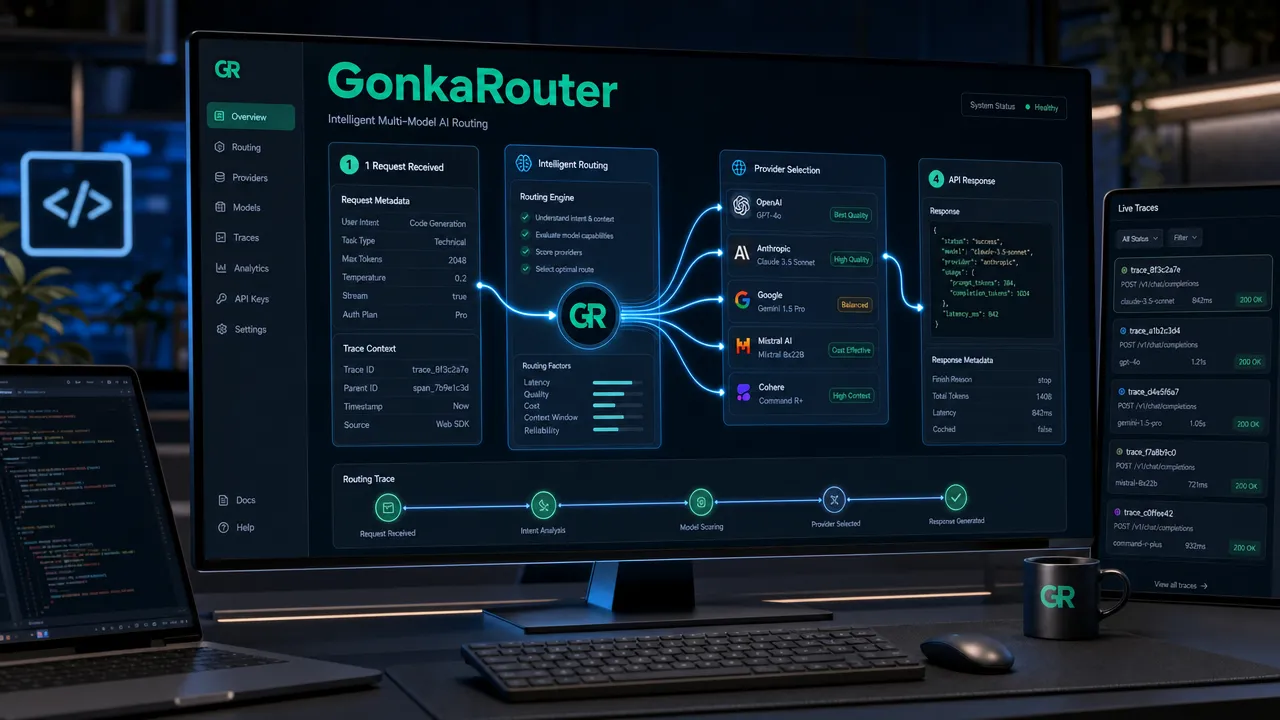
GonkaRouter is one concrete model-router example for teams using OpenAI-compatible or Anthropic-compatible request formats. Its multi-model API approach can reduce client integration variance, but teams should still validate every selected model for the features their workloads require.
Instrument the gateway without leaking sensitive data
Start with metadata that supports operations without capturing content by default. Record request IDs, trace IDs, tenant or project IDs, feature names, model selection, route version, latency, usage, retry count, fallback reasons, and a cost classification.
Avoid logging API keys, bearer tokens, session secrets, raw database records, retrieved documents, unredacted tool arguments, and complete prompts or outputs by default. Use explicit debugging modes with narrow sampling, short retention, access controls, and redaction before export.
A generic OpenAI-compatible request can pass safe metadata and trace context like this:
bash 复制代码

Treat token and cost values as accounting evidence, not unquestionable truth. Providers can price input, cached input, output, retries, and model variants differently. Preserve whether a value is provider-reported, gateway-estimated, or internally allocated, then reconcile it against provider billing.
Finally, test fallback routes as product behavior, not just infrastructure behavior. A fallback model may change tool reliability, response quality, safety behavior, latency, and data path. API portability and controlled model migrations is a useful reminder that reversible, tested changes are safer than assuming models are drop-in substitutes.
An open-source LLM gateway deployment succeeds when it creates reliable, privacy-aware evidence across the full AI request lifecycle while remaining a well-operated part of the platform.
Review GonkaRouter's current model catalog and test the selected routes with your own telemetry and data-handling requirements before moving production traffic.