Cloudflare's move to unify Workers AI and AI Gateway reflects a larger infrastructure shift. AI teams no longer need only a model endpoint. They need a consistent way to manage how requests are routed, measured, secured, and handled when conditions change.
For teams evaluating an llm gateway open source approach, the important question is not simply whether one endpoint can reach multiple models. It is whether the architecture gives the team the right balance of operational control, implementation speed, and responsibility.
Cloudflare documents its unified path as combining inference access with operational functions such as analytics, logging, caching, rate limiting, retries, and model fallback. Cloudflare's AI Gateway overview and its Workers AI and AI Gateway unification announcement show why AI control planes are becoming a practical production requirement.
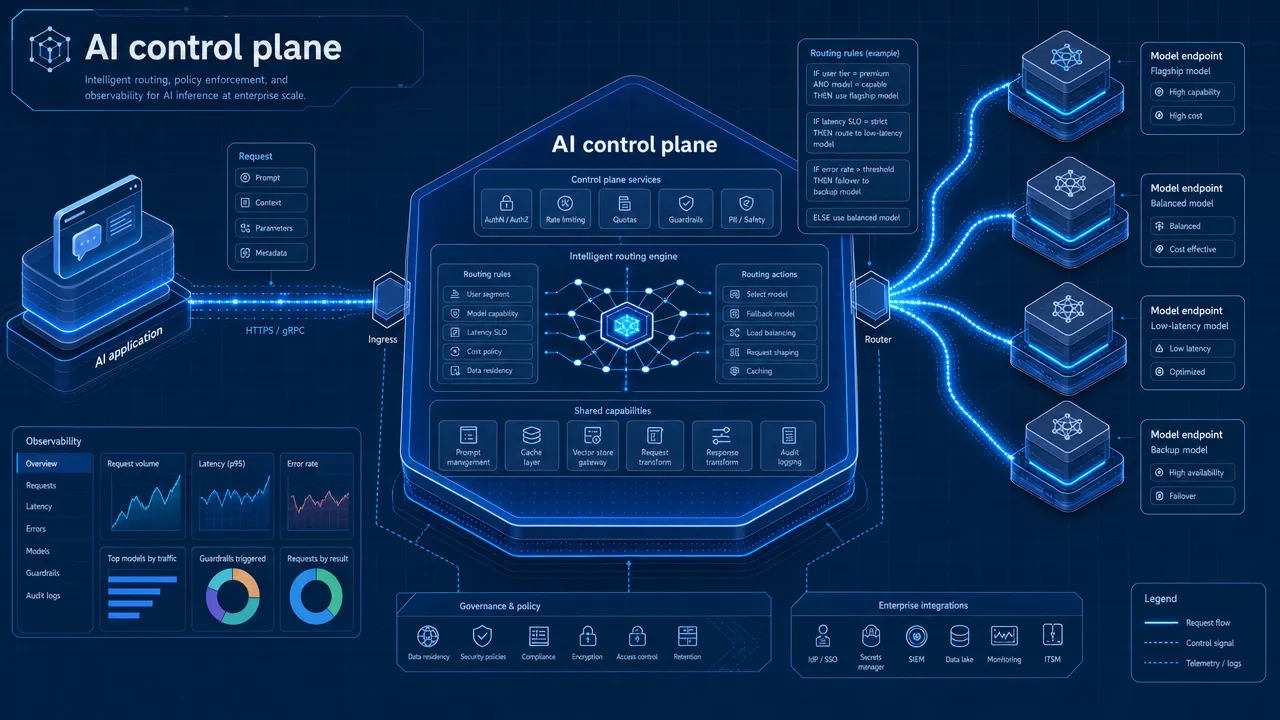
Why llm gateway open source decisions now include control planes
An LLM gateway is a layer between an application and model-serving endpoints. It can normalize requests, handle authentication, apply routing rules, record telemetry, and help manage reliability behavior.
An AI control plane is broader. It is the policy and configuration layer that determines how AI traffic should operate. This can include routing decisions, credentials, limits, logging settings, budgets, and fallback policies. The data plane then applies those rules to live inference requests and streaming responses.
Cloudflare's product direction is notable because it brings model access and inference traffic management closer together. This does not mean every model or provider is interchangeable. Model behavior, availability, context limits, data policies, and API features remain specific to each implementation.
Still, centralizing operational controls helps teams answer production questions that scattered SDK integrations make difficult:
Which model route handled this request?
What was the latency and error outcome?
Did the request trigger a retry or fallback?
Which application feature, tenant, or Agent step created the usage?
What changed after a routing or policy update?
Can developers change an endpoint without rewriting integration logic across the product?
For early-stage products using one model endpoint, direct integration can be appropriate. As teams add Agents, automated workflows, multiple model options, customer tenants, or global traffic, a gateway becomes less about convenience and more about operational consistency.
Llm gateway open source versus managed AI gateway ownership
An ai gateway open source deployment gives a team direct control over its gateway software and environment. LiteLLM, for example, documents an open-source proxy approach with a unified interface, routing and fallback logic, budgets, authentication, and load balancing. LiteLLM's official repository and Proxy quick-start documentation describe this self-operated model.
A managed gateway shifts more operational work to the platform provider. Cloudflare AI Gateway is one example of a managed service that documents logging, analytics, caching, request retries, rate limits, and fallback capabilities.
Decision factor | Open-source or self-operated gateway | Managed AI gateway |
|---|---|---|
Deployment | Your team operates the environment | The provider operates the platform |
Customization | Often deeper, depending on the software and team expertise | Limited to documented configuration options |
Operational burden | Your team owns upgrades, scaling, monitoring, and security patching | More platform operations are handled by the provider |
Control | Greater control over deployment boundaries and integrations | Greater convenience within the provider's feature set |
Time to launch | Can require more setup and platform engineering | Often faster to adopt |
Best fit | Teams with strong infrastructure needs or private deployment requirements | Teams that need centralized controls quickly |
Neither approach is universally better. A self-operated gateway can be a strong choice when private networking, customized policies, or deployment control are priorities. A managed service can be a stronger fit when a team wants to reduce infrastructure overhead and focus on application delivery.
The practical lesson is simple: open source changes who owns the work. It does not remove the need for availability planning, secure key management, telemetry, upgrades, and incident response.
Llm gateway open source architecture in the AI infrastructure stack
A well-designed llm gateway architecture sits between the application or Agent layer and inference endpoints. It should not be confused with a model host, an observability platform, or an orchestration framework, although these layers frequently connect.
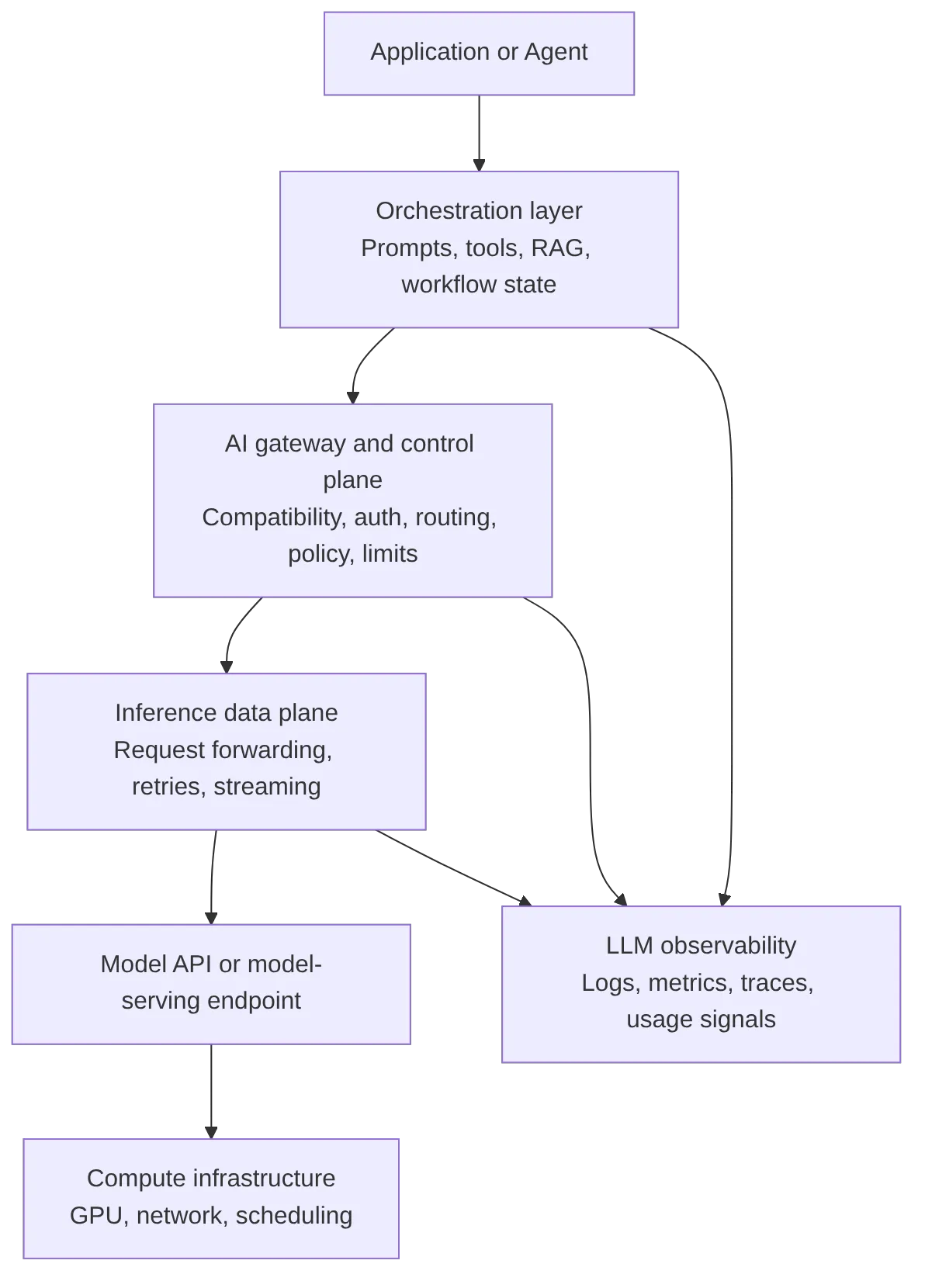
This ai gateway architecture separates two related concerns:
Layer | Main responsibility |
|---|---|
Control plane | Defines routing, policies, credentials, limits, and telemetry configuration |
Data plane | Processes live requests, responses, retries, cache checks, and upstream calls |
Gateway or proxy | Receives and forwards requests while applying selected controls |
Router | Chooses an eligible model, endpoint, or provider route |
Observability system | Captures operational and quality signals |
Model-serving layer | Runs or exposes model inference |
Compute layer | Provides GPU capacity, networking, and scheduling |
This distinction matters because a gateway does not automatically provide every control-plane capability. Some products may offer routing but not detailed evaluation workflows. Others may include logs and analytics but not the custom deployment options required by enterprise teams. Features such as semantic caching, data loss prevention, guardrails, or detailed compliance controls should always be verified individually.
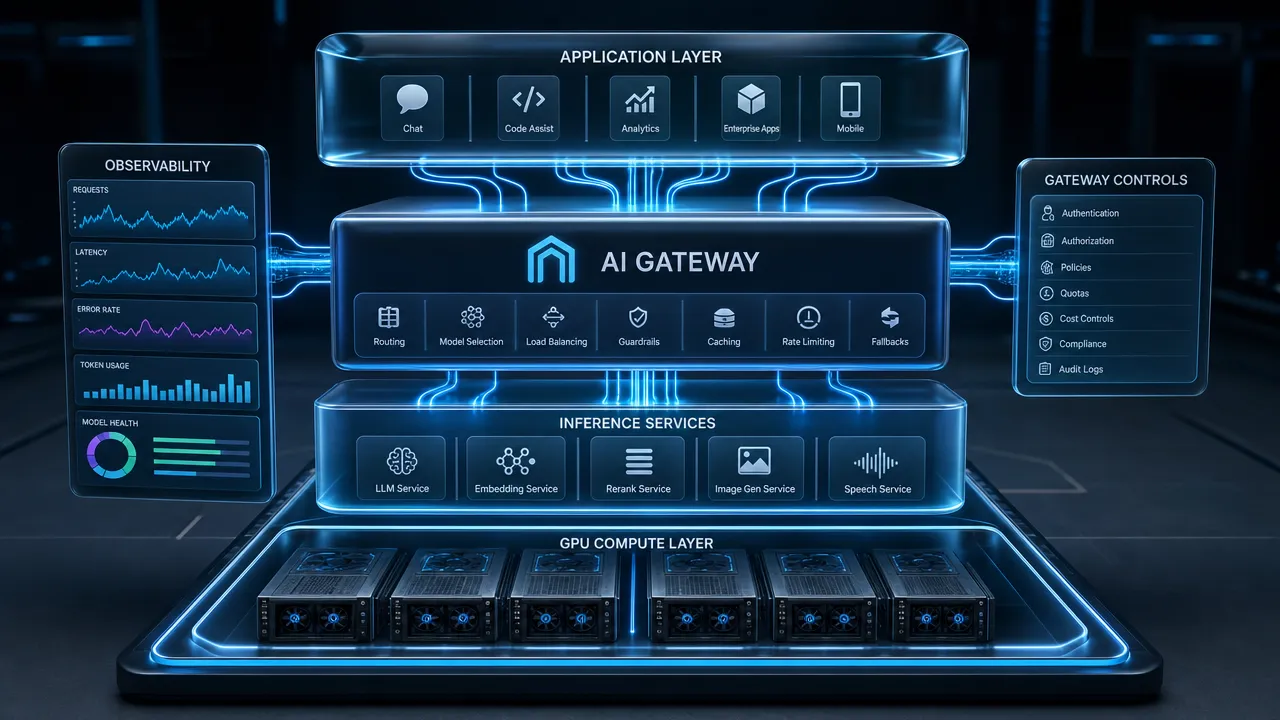
Llm gateway open source and llm observability requirements
A gateway strategy without llm observability creates a blind spot. A request returning a successful status code does not necessarily mean the product experience succeeded.
For production AI applications, teams should be able to inspect at least the following signals:
Signal category | Useful measurements |
|---|---|
Traffic | Request volume, concurrency, tenant, application feature, Agent step |
Performance | Total latency, first-token latency, upstream latency, queue time |
Reliability | Error type, timeout, retry count, fallback activation |
Usage | Input tokens, output tokens, selected model, cache result |
Routing | Route decision, rule version, endpoint choice, failover path |
Quality | Structured-output validity, tool completion, user feedback, evaluation result |
Governance | API-key identity, policy event, access decision, logging configuration |
Cloudflare's documented AI Gateway functions illustrate the type of controls teams increasingly expect at this layer: analytics, logging, caching, rate limiting, retries, and model fallback. However, fallback should be treated carefully. A fallback can improve availability while producing a different quality level, output format, or behavior.
A reliable policy should define:
Which errors are eligible for retry.
How many retries are allowed before failing.
Which workloads can use a fallback route.
Whether fallback output can meet the same JSON, tool-calling, latency, and quality requirements.
How route changes are evaluated before broad release.
Which request metadata must be retained for debugging.
For Agent developers, this is especially important. A single user task can cause multiple inference calls for planning, retrieval, tool selection, summarization, and final response generation. Trace IDs, per-step budgets, and explicit timeout rules make these workflows much easier to operate.
Llm gateway open source choices for a practical AI infrastructure stack
The modern ai infrastructure stack is not a single tool. It is a set of connected layers, each with a distinct job. A practical gateway strategy centralizes what should be shared across applications without pretending that all models behave the same way.
For many teams, the decision flow looks like this:
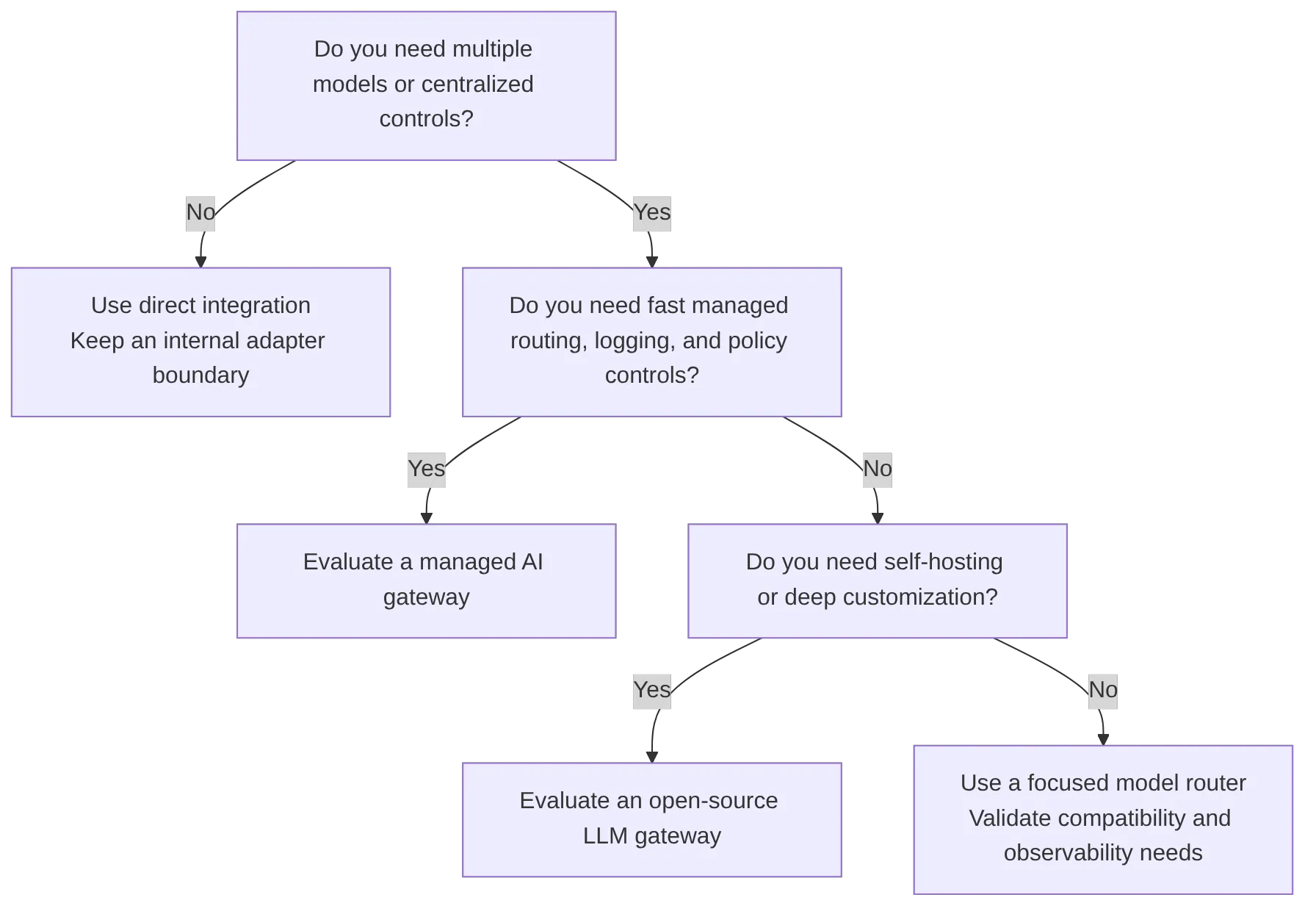
A focused model router can be particularly useful when a team wants a unified integration surface for a defined set of supported models, rather than a broad infrastructure platform.
GonkaRouter fits this focused role as an AI Model Router and AI Inference API. Developers can use one API for the currently supported MiniMax-M2.7, Kimi-K2.6, and GLM-5.2 models. Its OpenAI-compatible API and Anthropic-compatible API refer to API format compatibility, not access to official OpenAI or Anthropic models.
For teams seeking a lower-friction implementation path, GonkaRouter supports endpoint-based integration. Developers can review its OpenAI-compatible API endpoint approach, obtain an API key, and test supported models in an Agent or product workflow.
The practical advantages are straightforward:
One API for MiniMax-M2.7, Kimi-K2.6, and GLM-5.2.
OpenAI Compatible API and Anthropic Compatible API formats.
Faster integration by changing the API endpoint.
Email-based login for accessibility.
Pricing as low as $0.0004 per 1M tokens.
A one-time 20 USDT trial credit for new users after email login, intended for product usage.
A developer-oriented path for chatbots, AI Agents, code generation, content workflows, and automated applications.
For additional context on the product's unified access model, see the unified LLM API platform overview and the guide to using a unified model router API.
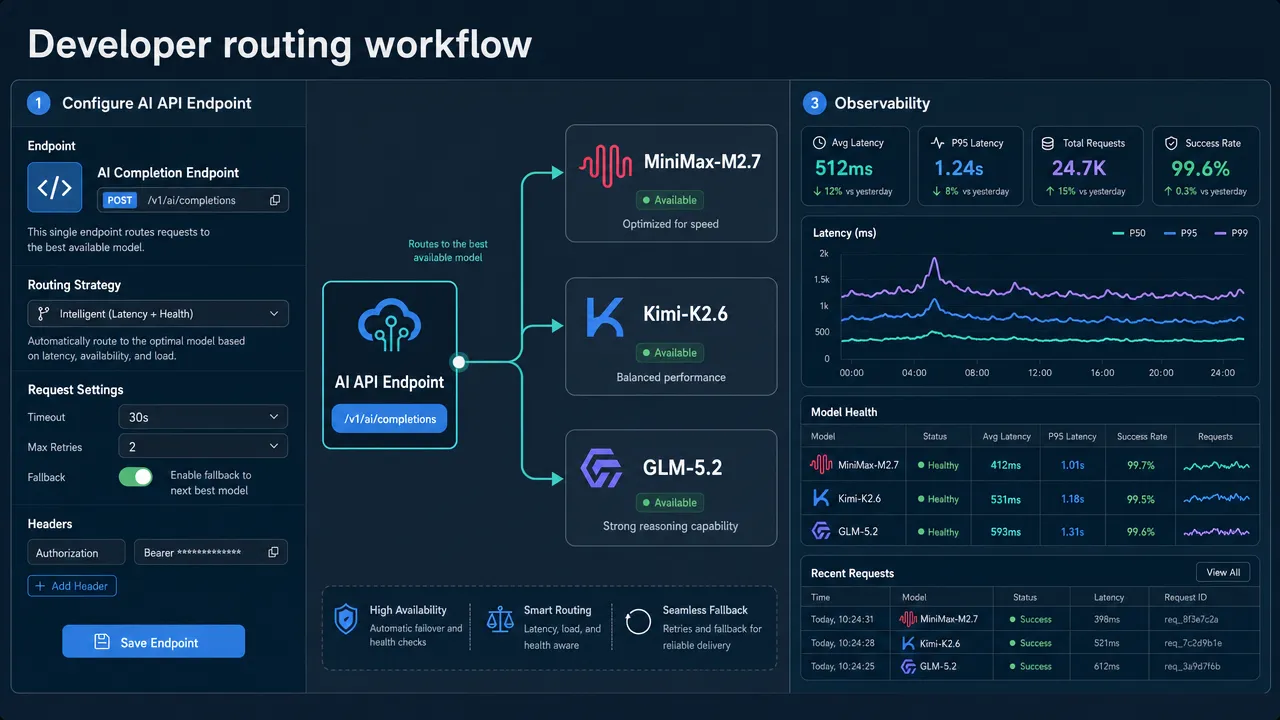
Cloudflare's convergence of Workers AI and AI Gateway is a clear signal: AI traffic management is becoming a core part of application infrastructure. The best response is not to assume every team needs a complex platform on day one. It is to build a portable integration boundary, centralize the controls that matter, and choose the level of operational ownership that fits the workload.
If you need a focused unified API path for supported models, log in to GonkaRouter with email, get an API key, and test MiniMax-M2.7, Kimi-K2.6, and GLM-5.2 in your product or Agent application.