GonkaRouter gives developers one OpenAI- and Anthropic-compatible AI Model Router for accessing multiple AI models through a unified API, reducing integration work, model-switching friction, and inference cost.
Built on the Gonka decentralized AI compute network, GonkaRouter is designed for AI developers, agent builders, startup teams, product managers, Web3 project teams, and enterprise technical teams that need practical AI infrastructure rather than another isolated model endpoint. Instead of maintaining separate APIs for every model ecosystem, teams can route requests through one AI Gateway, test different models, and move faster from prototype to production.
How GonkaRouter solves multi-model API integration
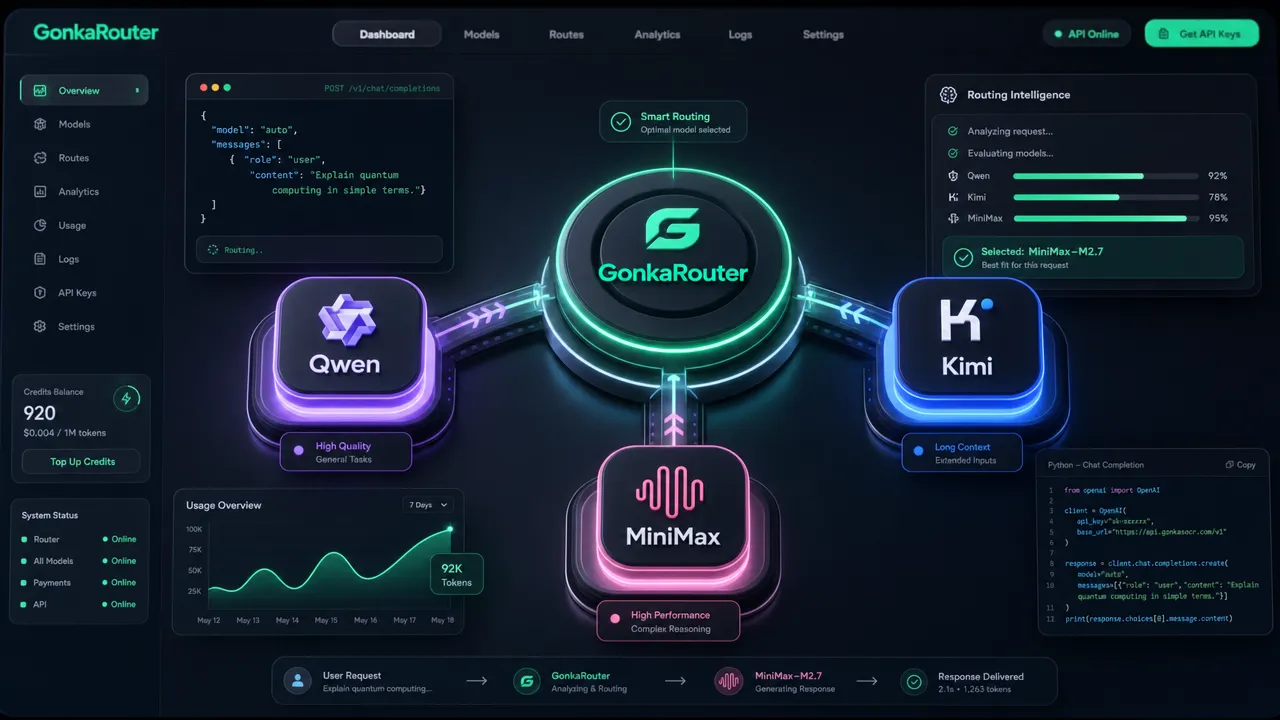
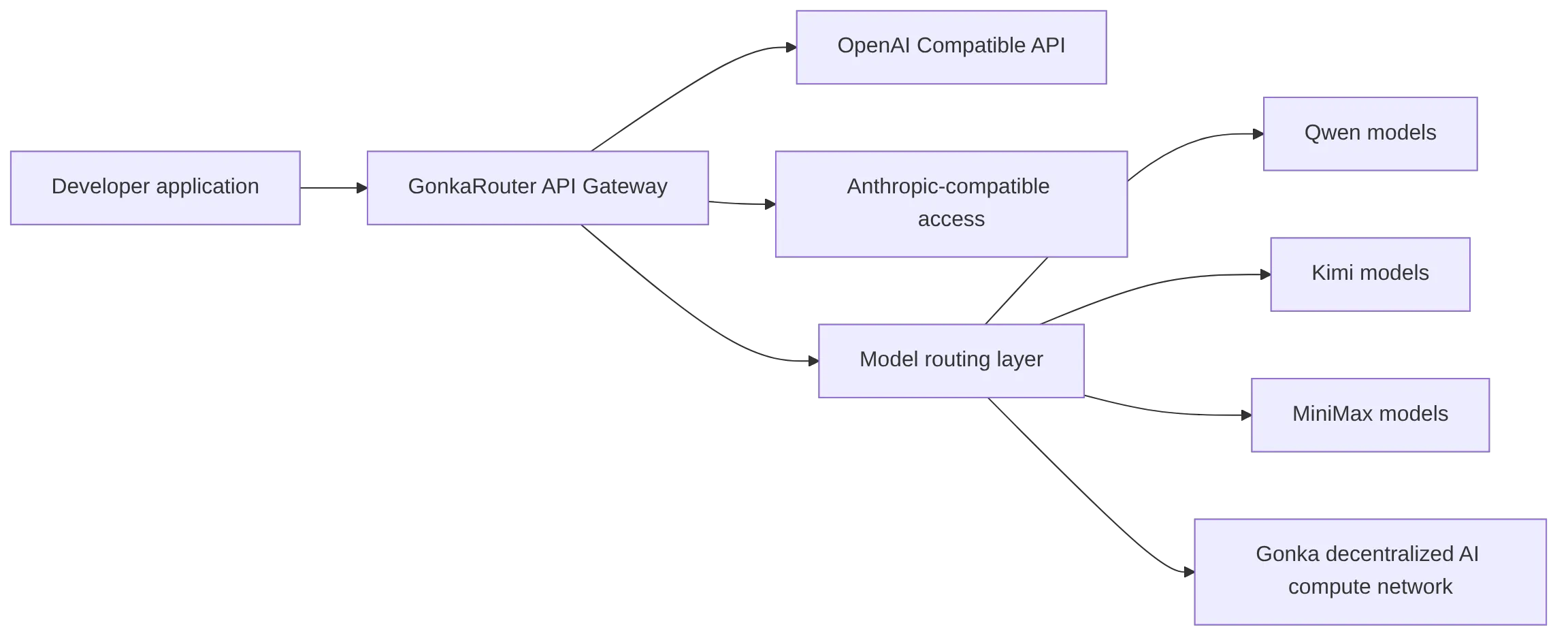
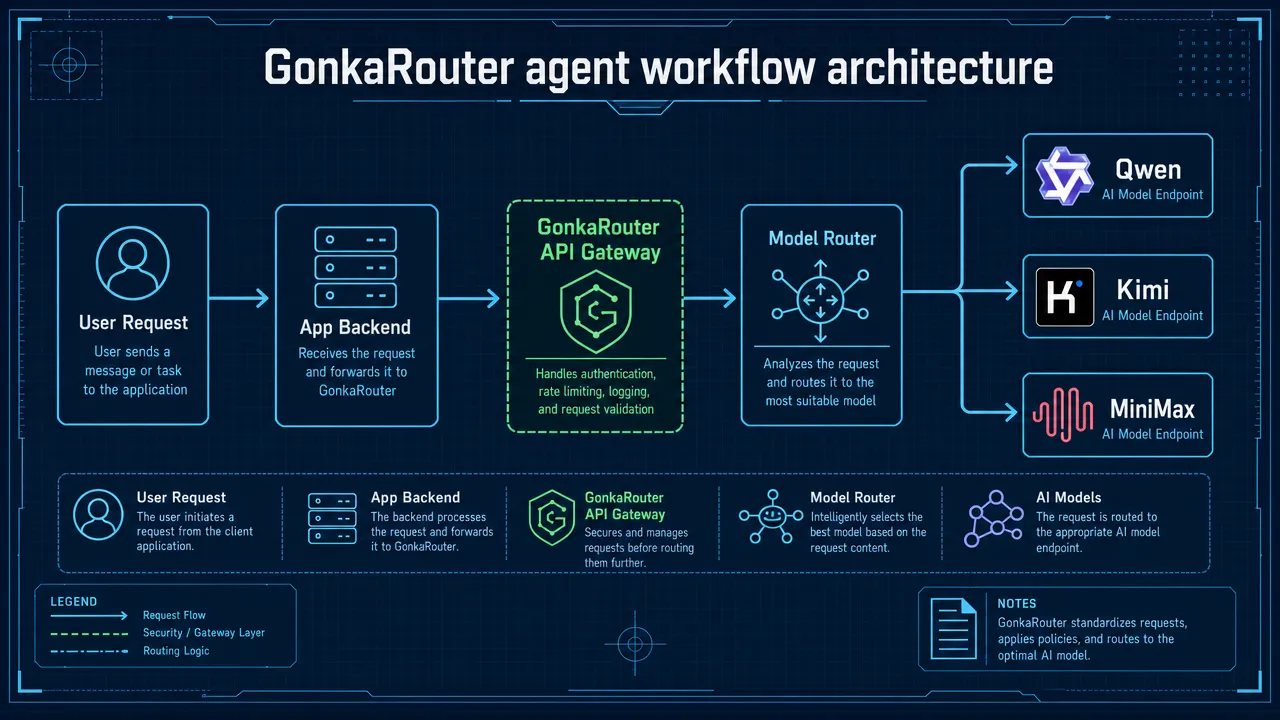
GonkaRouter works as an AI Model Router between your application and multiple model ecosystems. Your app sends requests to the GonkaRouter API layer, and the router provides unified access to supported models such as Qwen, Kimi, and MiniMax.
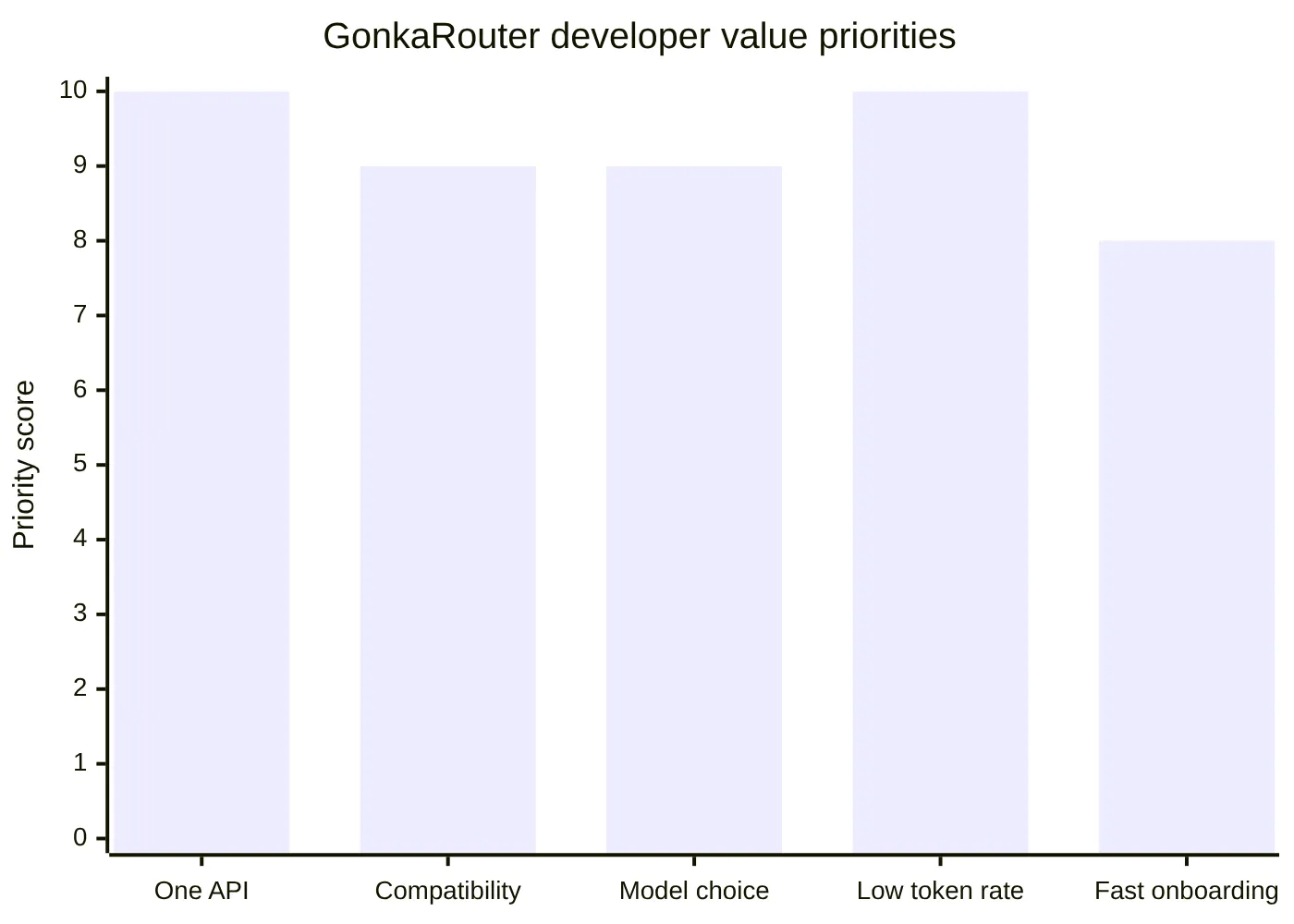
For developers, the value is straightforward: one API for all models. A chatbot, agent workflow, content engine, or enterprise AI application can use one integration layer instead of maintaining different keys, endpoints, request formats, and model-specific provider logic.
Developer problem | GonkaRouter capability | Practical result |
|---|---|---|
Multiple model integrations | One Multi Model API | Less SDK and endpoint maintenance |
Hard model switching | Unified model routing | Faster testing across Qwen, Kimi, and MiniMax |
Migration friction | OpenAI Compatible API | Existing OpenAI-style projects can start by changing the API Endpoint |
High development cost | Low-cost AI Inference API | More room for prototyping and production workloads |
Slow onboarding | Email-based login | Broader access for global developer teams |
Limited testing budget | One-time 20 USDT trial credit after logging in with email | Easier first model evaluation |
According to IBM, an AI Gateway is middleware used to integrate and manage AI tools and models. GonkaRouter fits this category by giving developers a unified control layer for model access, compatibility, and inference routing. For a broader definition of the category, see IBM's guide to AI gateways.
Why GonkaRouter compatibility matters for developers
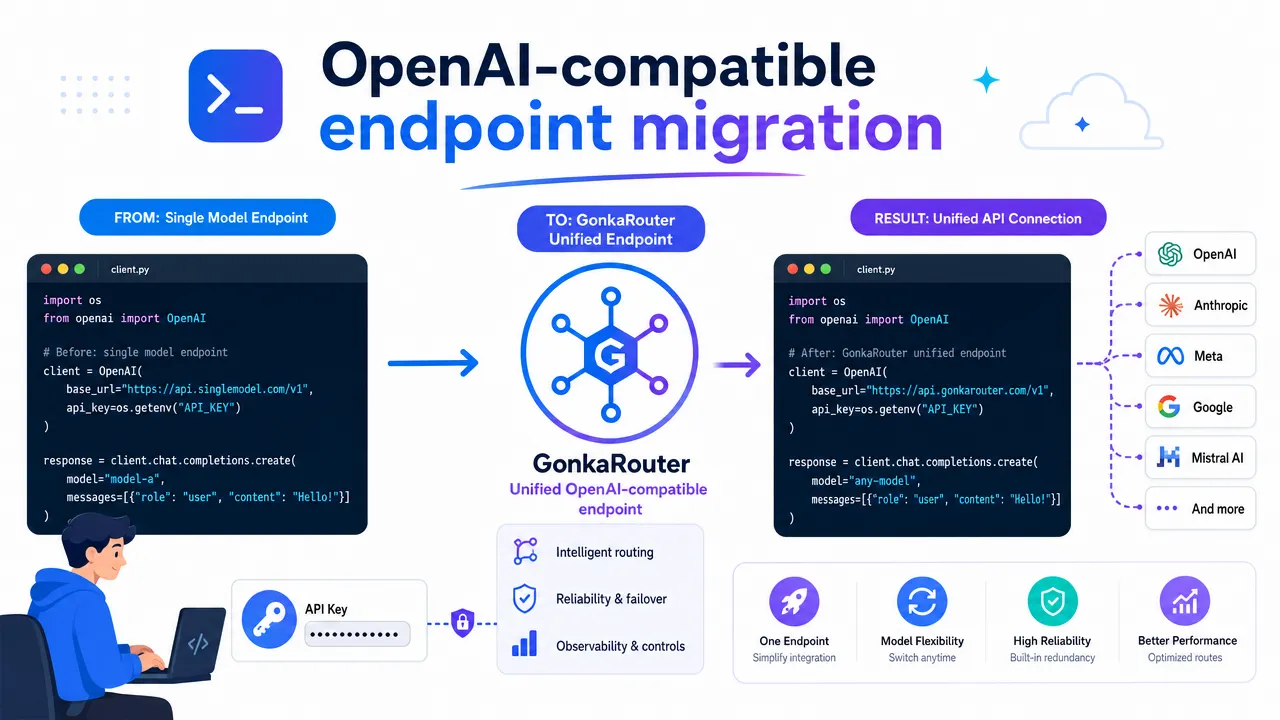
GonkaRouter is positioned as both an OpenAI Compatible API and an Anthropic-compatible AI Gateway. That matters because many AI products, agent frameworks, and backend services already use OpenAI-style or Anthropic-style request patterns.
In many OpenAI-compatible projects, integration starts with three changes:
Replace the API Endpoint.
Use the GonkaRouter API key.
Select a supported model name.
This endpoint-first migration pattern helps teams avoid rewriting application logic. An AI agent can keep its orchestration layer, a chatbot can keep its conversation workflow, and an enterprise backend can keep its internal service structure while testing new model options through GonkaRouter.
For developers building with OpenAI-style clients, this makes GonkaRouter useful as:
An AI Inference API for product backends.
A Multi Model API for experimentation.
An Agent API layer for routing different agent steps.
An AI Gateway for centralizing model calls.
A low-friction path to Qwen API, Kimi API, and MiniMax API access.
GonkaRouter is especially relevant when an application needs more than one model behavior. For example, an agent may use one model for planning, another for summarization, and another for code-related output. A direct provider-by-provider setup increases maintenance overhead, while a unified AI Model Router keeps the routing layer cleaner.
GonkaRouter supported models and pricing
GonkaRouter supports mainstream model ecosystems including Qwen, Kimi, and MiniMax. The public supported AI models page lists examples such as Qwen3-235B-A22B-Instruct, Kimi-K2.6, and MiniMax-M2.7.
That model coverage helps developers build flexible AI applications without locking every workflow to one model family. Teams can test different model strengths for chat, reasoning, content generation, code generation, workflow automation, intelligent Q&A, and data analysis.
Model ecosystem | Example use cases | GonkaRouter SEO-relevant access pattern |
|---|---|---|
Qwen | Multilingual chat, code generation, reasoning workflows | Use GonkaRouter as a Qwen API access layer |
Kimi | Long-context tasks, agent workflows, document Q&A | Use GonkaRouter as a Kimi API access layer |
MiniMax | Chatbots, content generation, interactive applications | Use GonkaRouter as a MiniMax API access layer |
Pricing is another core differentiator. The official GonkaRouter pricing page states token pricing as low as $0.0004 / 1M tokens. New users also receive a one-time 20 USDT trial credit after logging in with email, making it easier to test real prompts before integrating GonkaRouter into a product or agent workflow.
Pricing and model availability can change, so teams should confirm the latest details on the official pricing and models pages before production rollout.
How GonkaRouter fits agent, chatbot, and workflow use cases
GonkaRouter is best understood as developer infrastructure. It is not the agent frontend, not the chatbot UI, and not the model itself. It sits between application logic and model execution, giving developers a unified inference layer.
For AI agents, GonkaRouter can serve as an Agent API layer. Agent systems often make many model calls: planning, tool selection, function output interpretation, summarization, memory compression, and final response generation. A Multi Model API helps developers test which model works best for each step.
For chatbots, GonkaRouter provides one OpenAI Compatible API for routing conversational traffic through supported model ecosystems. Teams can prototype with the trial credit, compare model behavior, and optimize for cost or response quality.
For enterprise AI applications, GonkaRouter reduces provider integration overhead. Instead of every internal team connecting directly to separate model APIs, a shared AI Gateway can simplify access patterns and make model switching easier.
Use case | Why GonkaRouter helps | Suggested first step |
|---|---|---|
AI agents | Route planning, summarization, and task-specific calls through one API | Test an agent prompt with Qwen, Kimi, or MiniMax |
Chatbots | Use one AI Inference API for conversational workloads | Build a simple chat request through GonkaRouter |
Content generation | Compare models for drafting, rewriting, and classification | Use trial credit for workflow tests |
Code generation | Test code-capable models through one router | Evaluate output quality by model |
Automated workflows | Centralize API credentials and model calls | Add GonkaRouter to a backend job or automation flow |
Enterprise Q&A | Use different models for retrieval-augmented responses | Test document Q&A prompts through the router |
GonkaRouter also supports global developers and Web3 payment scenarios, which can be useful for distributed teams that need broad onboarding and flexible payment support. The core message remains developer-focused: log in with email, receive the one-time 20 USDT trial credit, get an API key, and change the endpoint to start testing models.
Why GonkaRouter is a practical AI Gateway choice
GonkaRouter differentiates through a focused combination of compatibility, model access, onboarding, and cost. It does not need to be framed as a generic AI tool. Its strongest position is as an OpenAI- and Anthropic-compatible AI Model Router built on the Gonka Network for low-cost multi-model inference.
Developers should consider GonkaRouter when they need:
One API to access multiple leading AI models.
OpenAI Compatible API support for faster migration.
Anthropic-compatible access for Anthropic-style workflows.
Qwen API, Kimi API, and MiniMax API access through a unified interface.
Token pricing as low as $0.0004 / 1M tokens.
Email-based login with a one-time 20 USDT trial credit.
A developer-first AI Gateway for agents, chatbots, workflow automation, and enterprise AI apps.
GonkaRouter's privacy policy notes that the service processes API requests and related service data, and that API usage may be logged for performance monitoring and abuse prevention. Teams handling confidential or regulated data should review the relevant policies before sending sensitive prompts or production traffic.
For ongoing updates, developers can also follow the GonkaRouter blog, check the latest supported AI models, and review GonkaRouter pricing before scaling usage.
The fastest path to evaluation is simple: log in with email, claim the one-time 20 USDT trial credit, get an API key, select a model, and route your first AI inference request through GonkaRouter.