An LLM gateway architecture scales AI systems more safely by moving provider access, routing policy, credentials, quotas, and telemetry out of individual applications and into a shared control layer.
That separation matters as teams add services, tenants, agent workflows, and multiple model endpoints. Without it, each application tends to reimplement authentication, retry behavior, budget checks, and provider-specific error handling. The result is inconsistent behavior and a growing operational surface area.
Create a safer boundary between applications and model providers
An LLM gateway sits between application code and inference endpoints. Applications submit a normalized request to the gateway, and the gateway authenticates the caller, applies policies, selects an approved route, and forwards the request to a model provider or self-hosted endpoint.
This boundary is more than a convenience wrapper around an API. It is where teams can enforce rules consistently:
Map callers to tenants, applications, teams, or API keys.
Restrict access to approved model aliases and capabilities.
Apply request and token-based rate limits.
Keep upstream credentials in a secret manager rather than in browser clients or application configuration.
Record request IDs, route decisions, usage, retry counts, and latency.
Reject unsupported parameters before they reach an upstream service.
An open-source LLM gateway option gives engineering teams direct control over deployment topology, network boundaries, extensions, and configuration. Projects such as LiteLLM and Envoy AI Gateway show how a gateway can centralize routing, quotas, tracing, and compatible API endpoints. The trade-off is clear: the team also owns upgrades, capacity planning, security patches, availability, and incident response.
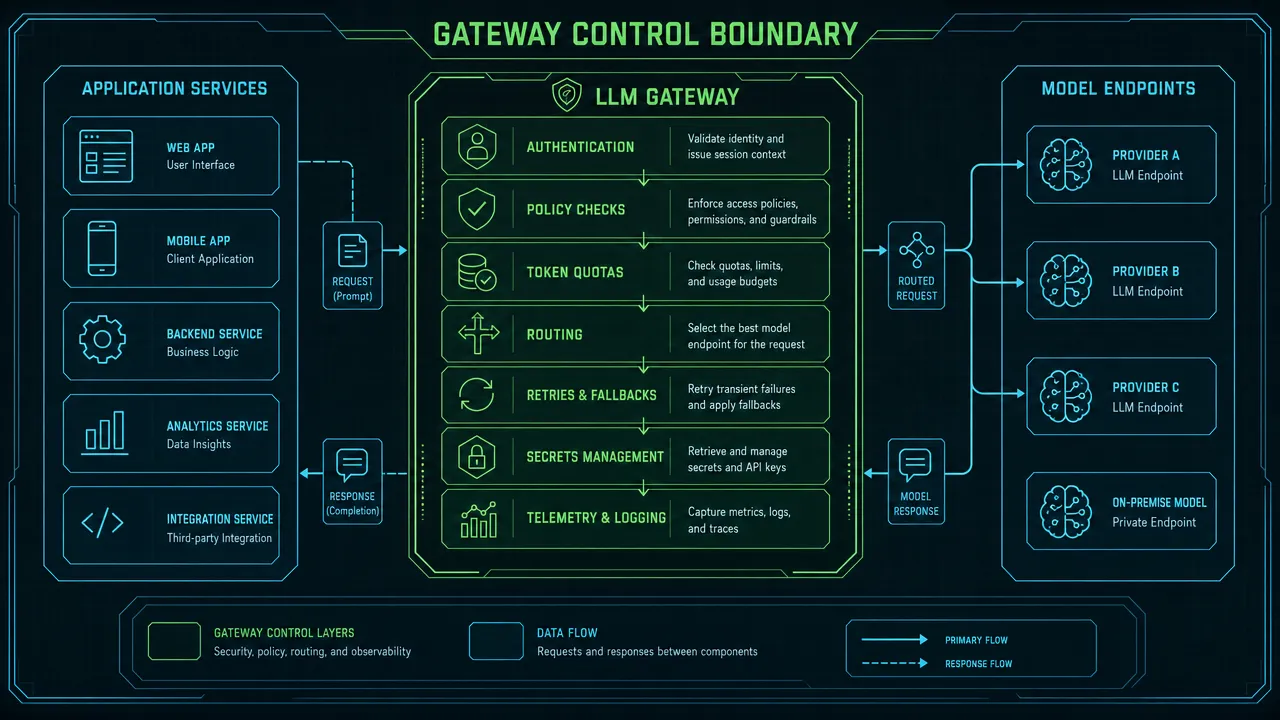
A gateway should not be confused with every adjacent AI component.
Component | Primary role | What it does not replace |
|---|---|---|
Provider SDK | Connects an app to a specific provider | Central policy and multi-route governance |
Conventional API gateway | Handles general HTTP traffic controls | Token awareness, model routing, streaming transformations |
Model router | Chooses a model or deployment | Authentication, spend attribution, and telemetry controls |
AI proxy | Forwards requests to upstream endpoints | A full control plane and quality evaluation workflow |
LLM observability platform | Stores and analyzes traces and metrics | Runtime enforcement of gateway policy |
An OpenAI-compatible interface reduces integration friction, but it does not make models equivalent. Tool calling, context windows, structured outputs, modalities, parameter support, latency, and output quality must still be validated per route. That distinction is explored in Why OpenAI-Compatible Endpoints Alone Don't Solve Multi-Model Infrastructure.
Separate the data plane from the control plane
A resilient open-source LLM gateway architecture separates the request-serving data plane from the control plane that defines how requests should be handled.
The data plane must be fast, available, and deterministic. It performs live authentication, rate enforcement, cache checks, route selection, request transformation, and response streaming. The control plane stores versioned route rules, model aliases, credential references, policy settings, and rollout state.
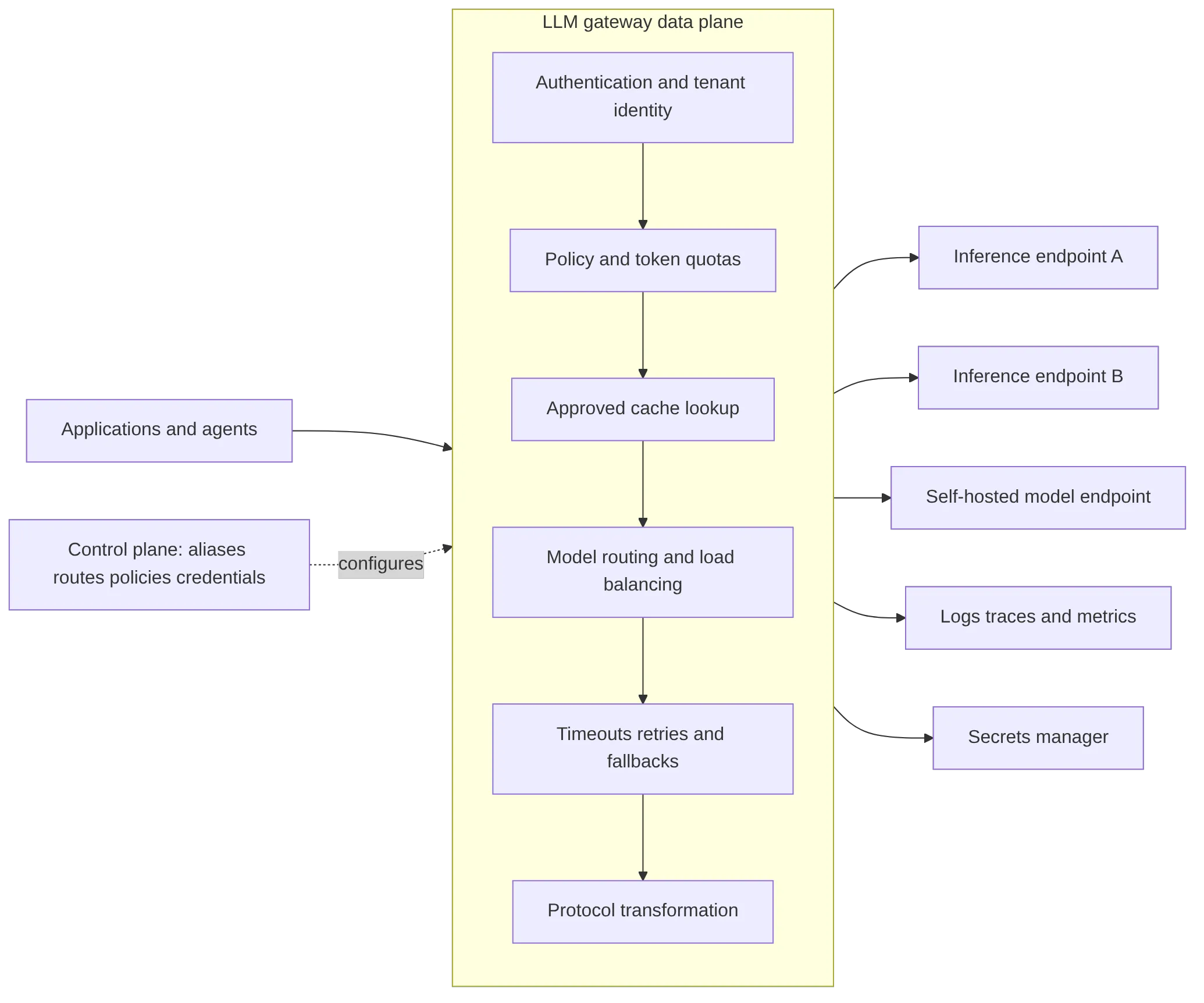
Logical aliases are central to this design. An application can request chat-default rather than hard-coding a provider model identifier. The alias resolves only to routes that meet the request contract, such as required context length, tool support, data classification, and latency objective.
For example, an application can send an OpenAI-compatible request to a gateway endpoint:
curl "$LLM_GATEWAY_URL/v1/chat/completions" -H "Authorization: Bearer $GATEWAY_API_KEY" -H "Content-Type: application/json" -d '{"model":"chat-default","messages":[{"role":"user","content":"Summarize this incident report in three bullets."}],"temperature":0.2}'
The alias should be versioned, reviewed, observable, and reversible. A route update is production policy, not merely a configuration edit.
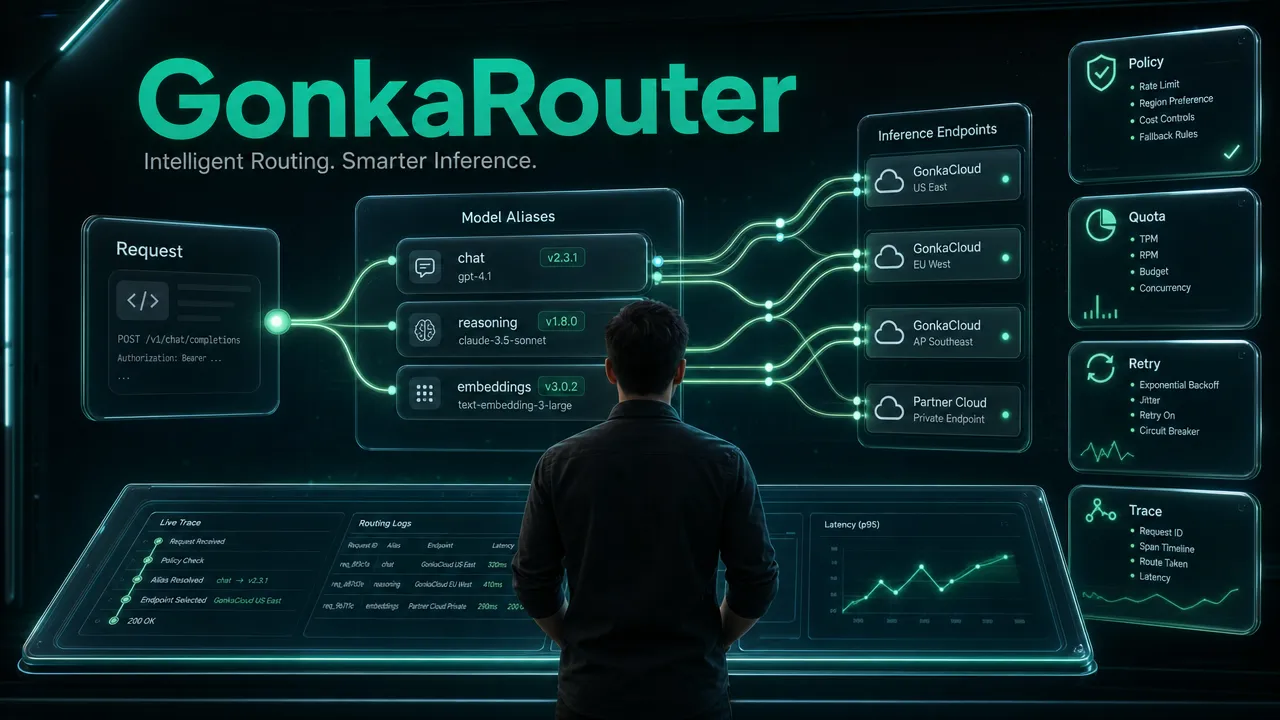
For a practical example of a unified endpoint approach, GonkaRouter offers a single OpenAI-compatible API endpoint for supported model ecosystems. That kind of abstraction can simplify client integration, but teams should still establish route-specific tests for the features their workloads require.
Make reliability and cost governance measurable
Reliability depends on bounded, contract-aware recovery rather than indiscriminate retries. A gateway should retry only temporary failures such as timeouts or throttling, retain the original end-to-end deadline, and use exponential backoff with jitter. When a provider sends a Retry-After header, honoring it is generally preferable to guessing a delay. OpenAI's rate-limit guidance provides a useful reference for this pattern.
Fallbacks require stricter controls. A backup model is eligible only when it has been evaluated for the same task contract. An HTTP 200 response does not prove that returned JSON matches the schema, tool arguments are valid, or output quality remains acceptable.
A sensible fallback policy checks:
Input and output modality compatibility.
Context-window requirements.
Structured output and tool-calling behavior.
Data processing and residency constraints.
Cost ceilings and remaining quota.
Quality evaluations for representative production tasks.
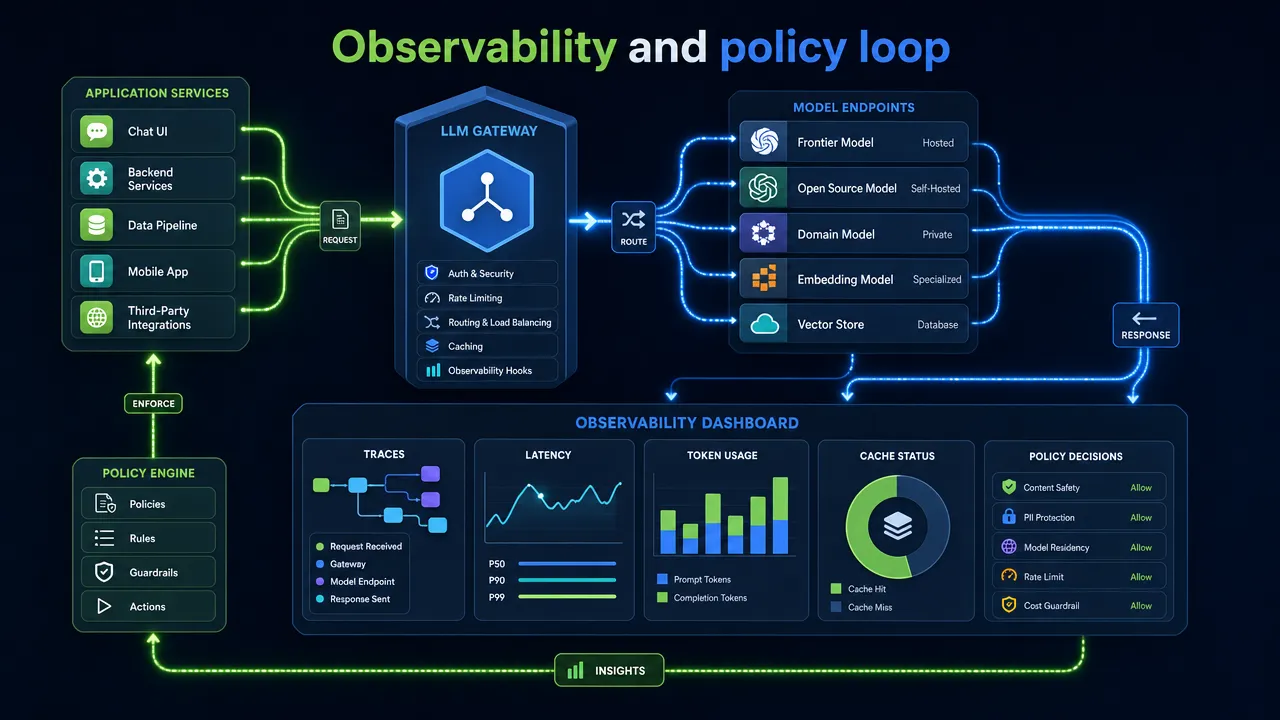
The same gateway controls support cost governance. Attribute token use, latency, cache status, route selection, and retry attempts to a tenant or application. Enforce both request and token quotas because a low request count can still produce unexpectedly large usage.
For telemetry, export structured logs, metrics, and traces to the existing observability stack. The OpenTelemetry GenAI semantic conventions provide a standard direction for instrumenting AI operations. Avoid retaining full prompts and completions by default. These payloads can include proprietary code, customer information, or incident details, so use redaction, retention limits, access controls, and documented logging policies.
Choose the right operating model for your AI infrastructure stack
The best operating model depends on the constraints of the wider ai infrastructure stack, not just the number of available models.
Operating model | Strong fit | Primary responsibility |
|---|---|---|
Direct provider integration | One application, one stable provider, low operational complexity | Application team manages credentials, retries, and provider changes |
Self-hosted gateway | Private networking, custom policy, deployment control | Platform team operates runtime, scaling, upgrades, and recovery |
Managed gateway | Teams prioritizing speed of adoption and reduced platform operations | Team configures policies while accepting service limits and platform dependency |
A self-hosted ai gateway open source deployment is compelling when traffic must remain within a private network, when organizations need custom policy code, or when gateway behavior must integrate deeply with existing identity and observability systems. It also requires a mature operating model: highly available instances, health checks, circuit breakers, configuration versioning, secret rotation, and tested rollback procedures.
Managed platforms reduce that operational work, but teams should confirm identity integration, regional processing requirements, configuration exportability, retention behavior, and the ability to reproduce route policies elsewhere. Portability matters because gateway configuration can become a critical dependency.
The control-plane implications are especially important as AI systems mature. Cloudflare Is Unifying Workers AI and AI Gateway: Why AI Control Planes Are Becoming Essential offers related context on why centralized controls increasingly belong in the AI platform layer.
Operate the gateway without creating a new failure domain
A gateway improves consistency only when it is operated as production infrastructure. It adds a network hop, a configuration surface, and a potential dependency, so teams should deliberately control blast radius.
Start with a narrow deployment path:
Place one workload behind a normalized endpoint or compatible proxy.
Store gateway and provider credentials in a secrets manager.
Define model aliases and route eligibility rules.
Emit request IDs, traces, token metrics, and application-level attribution.
Add quotas, bounded retries, and tested fallback pairs.
Roll out policy changes gradually with clear rollback conditions.
Assign retry ownership to one layer. When applications, gateway middleware, and provider SDKs all retry independently, a small upstream outage can turn into retry multiplication. Preserve deadlines across layers, and make agent operations idempotent when a retry could repeat a side effect.
Routing can become more sophisticated after the basic controls are stable. Semantic Routing LLM and Model Fallback Guide provides useful context for matching fallback decisions to task intent and route constraints rather than treating every available model as interchangeable.
An LLM gateway is not mandatory for every application. A low-volume service with one stable provider may be better served by direct integration. But once multiple services, model routes, tenants, or policy requirements are involved, a carefully operated gateway creates a safer interface between application logic and fast-changing AI infrastructure.
Explore GonkaRouter's current model catalog, then validate each route against your workload, policy, and observability requirements.