GLM-5.3-Flash should be treated as a controlled model migration, not a drop-in model-name replacement. This GLM-5.3-Flash migration guide starts with provider verification, compares real workload outcomes, and preserves a tested path back to the current configuration.
The release is a meaningful news hook, but the operational details still need careful sourcing. Z.AI documents GLM-5.3-Flash as a native multimodal model in the GLM-5 family, while its public announcement describes a 1M-token context window. LLM Stats reports an August 26, 2026 publication date, API access, and pricing of $0.15 per 1M input tokens, $0.03 per 1M cached input tokens, and $0.50 per 1M output tokens through its own API. Those price, availability, context, and benchmark details are source-reported information, not independent confirmation of a production contract for every provider route.
One boundary matters immediately: GonkaRouter currently lists GLM-5.2, not GLM-5.3-Flash. Do not assume GLM-5.3-Flash is available through GonkaRouter, has a planned availability date, behaves like GLM-5.2, or can be migrated automatically through the gateway.
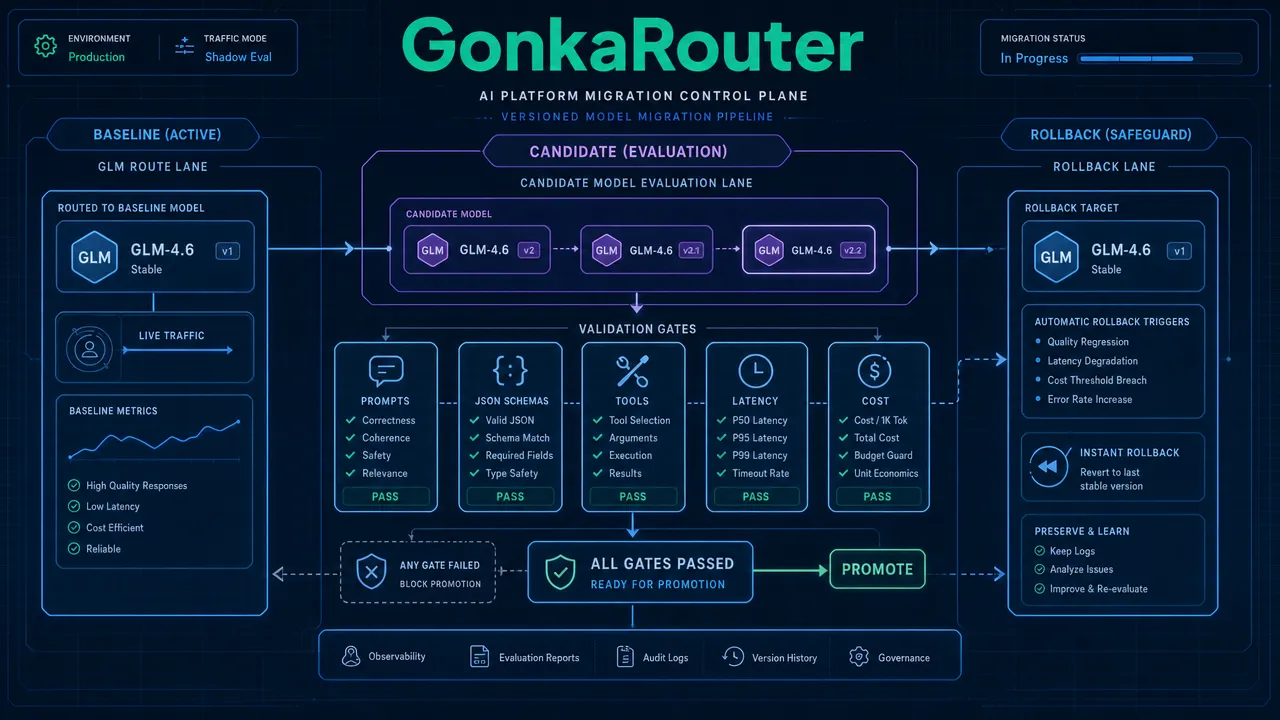
Why a GLM-5.3-Flash migration guide starts with availability and behavior verification
A compatible API format can reduce client-side rewriting, but it does not establish behavioral or operational compatibility. A successful request can still produce a weaker answer, malformed JSON, a different tool choice, or an unacceptable latency profile.
Before touching production traffic, confirm all of the following with the intended provider's live documentation and account-level configuration:
Verification area | What to record | Why it matters |
|---|---|---|
Exact model ID | Pinned identifier, aliases, and deprecation policy | A marketing name is not necessarily a stable API identifier. |
Provider route | Direct API, managed host, or self-hosted deployment | Model behavior, pricing, limits, and regions can differ by route. |
API surface | Chat, streaming, tool use, structured output, and multimodal inputs | Native multimodality does not prove every endpoint accepts every input type. |
Context and output limits | Effective request capacity and output reservation | A nominal context window is not the same as usable production capacity. |
Rate limits | Requests, tokens, concurrency, and error behavior | Quotas can affect retries, throughput, and user experience. |
Usage accounting | Input, output, and cached-input rules | Listed token prices do not equal cost per successful task. |
Z.AI's official model materials identify GLM-5.3-Flash as part of the GLM-5 series and direct developers toward Z.AI API services through its official Hugging Face model page. That is useful confirmation of the model's official presence. It does not confirm the exact API model ID, tool-calling contract, JSON Schema support, output cap, rate limits, or pricing for the route your team plans to use.
This distinction is especially important for teams moving from GLM-5.2. Prompt phrasing, system-message priority, output verbosity, refusal patterns, token accounting, and stream events can change even when the request body still parses correctly.
For a deeper infrastructure perspective, see OpenAI-compatible endpoints and model portability. Format compatibility is valuable, but it does not replace workload-specific validation.
What changed and why GLM API users should care
The strongest reason to evaluate a new model version is not a headline benchmark. It is the possibility that the candidate performs better for a specific production task while maintaining acceptable reliability, latency, and economics.
Z.AI positions GLM-5.3-Flash as a native multimodal GLM-5 model. Its public announcement also describes a 1M-token context window and a 320B-A18B architecture. Those claims make long-context and multimodal testing relevant, but they do not eliminate the need for endpoint-specific evaluation.
LLM Stats also reports benchmark comparisons against GLM-5.2, including self-reported DeepSWE and AutomationBench figures. Treat these as directional research signals. They do not prove that your code review workflow, RAG assistant, extraction pipeline, or agentic tool loop will improve.
The migration risks are usually behavioral rather than syntactic:
Prompt interpretation: The candidate may follow constraints differently or prioritize instructions in another way.
Long-context retention: A large advertised context window may still show weaker retrieval, instruction retention, or latency at realistic request sizes.
Structured outputs: Valid JSON can still contain missing fields, wrong data types, invented enum values, or incorrect business data.
Tool calls: Tool selection, argument formats, call order, retries, and stop behavior may differ by model and provider.
Streaming: First-token timing, chunk order, cancellation, completion signals, and usage events require direct tests.
Cost: Lower token rates can be offset by longer outputs, more retries, parser repairs, or more human review.
Use a common scorecard rather than a single metric. The most useful unit is often cost per accepted task, not cost per token.
Cost per successful task=All attempt costs+review and remediation costsAccepted successful tasks\text{Cost per successful task} = \frac{\text{All attempt costs} + \text{review and remediation costs}}{\text{Accepted successful tasks}} Cost per successful task=Accepted successful tasksAll attempt costs+review and remediation costs
A route with lower per-token pricing can still cost more if it produces longer outputs or requires repeated repair prompts.
GLM-5.3-Flash Migration Guide: Technical Checklist
Start with a frozen baseline. Capture the current model, provider, prompt version, tool definitions, retrieval configuration, output schema, retry policy, and production metrics before testing the candidate.
1. Inventory the current workload
Create an inventory for each model-backed feature. Include its risk level and its downstream effects.
Workload | Key migration risk | Minimum test requirement |
|---|---|---|
RAG assistant | Unsupported claims or missed evidence | Grounded-answer and citation-validity fixtures |
Data extraction | Incorrect critical fields | Schema validation and field-level accuracy tests |
Classification | Misrouting edge cases | Macro F1, false-routing, and abstention tests |
Code generation | Build failures or unsafe changes | Build, unit-test, static-analysis, and reviewer checks |
Tool-using agent | Invalid or unauthorized actions | Tool selection, argument validation, ordering, and idempotency tests |
Customer chat | Tone, policy, and latency regressions | Multi-turn fixtures, policy outcomes, P95 latency, and human review |
Separate high-risk workflows from low-risk workflows. Customer-facing decisions, system-of-record extraction, code changes, and irreversible agent actions should not be the first canary cohort.
2. Build a versioned prompt regression suite
A regression suite should reflect real traffic rather than only clean demo prompts. Include routine requests, historical failures, ambiguous cases, long-context inputs, priority languages, and adversarial formatting cases.
Store each fixture with:
Prompt template version.
System and user messages.
Retrieval corpus version and retrieved passages.
Tool schema version.
Expected output contract.
Baseline result and candidate result.
Model ID, provider, endpoint, test date, and parameters.
Evaluate both routes against the same fixtures. Do not compare last month's baseline with today's candidate under different prompt templates, retrieval results, or concurrency levels.
3. Validate structured outputs beyond JSON parsing
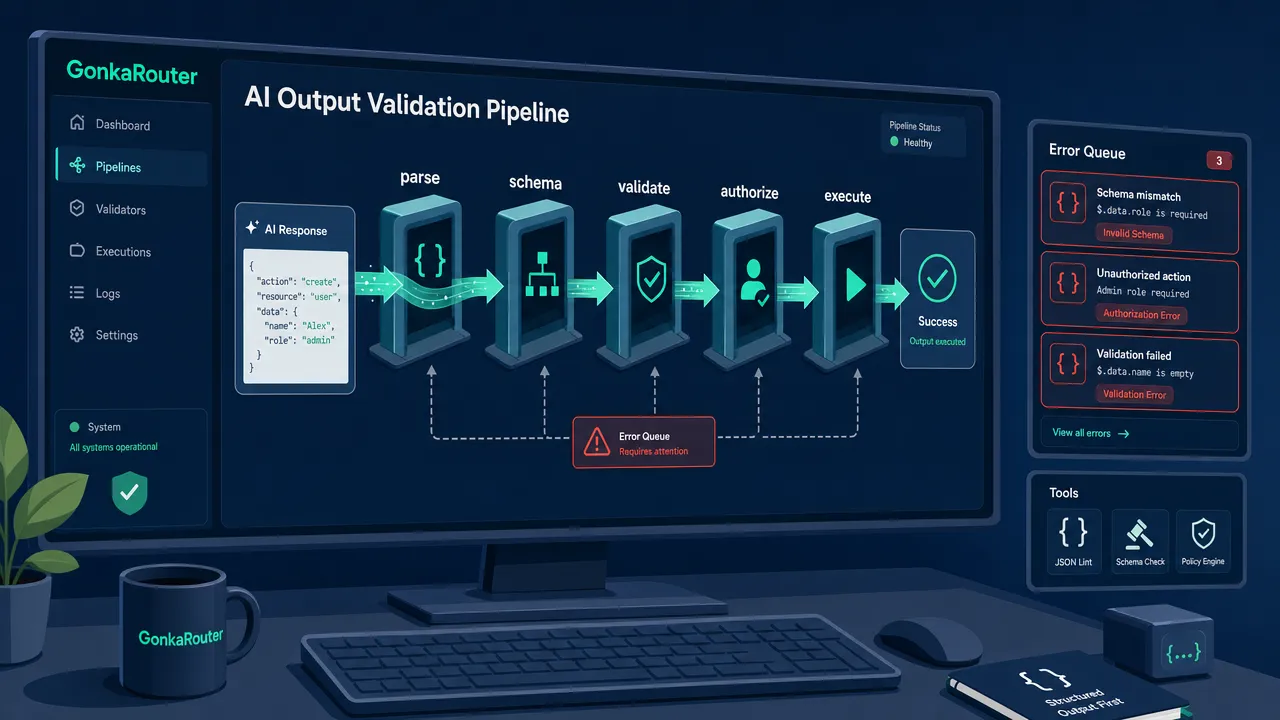
For automation workflows, a parsed JSON object is only the first gate. A response should pass all of these checks before downstream execution:
The API request succeeds.
The output parses.
The output validates against the deployed JSON Schema.
Required fields are present and correctly typed.
Enum values, dates, units, and numeric formats are valid.
Semantic values match the source material or expected business rule.
Any tool call is authorized and safe to execute.
OpenAI's structured outputs guidance offers a useful general distinction between structured text and tool/function interactions. It is not evidence that a GLM-5.3-Flash route supports identical strict-schema behavior. Keep application-side parsing and validation in place regardless of the provider.
Use a bounded repair loop for recoverable formatting failures. Do not retry indefinitely, and never execute guessed tool arguments after a parsing failure.
4. Test tool use as an application contract
Do not assume that an OpenAI-compatible request format guarantees equivalent function-calling behavior. Test the full loop:
Does the model choose an allowed tool?
Does it select the right tool for the task?
Are argument names, types, ranges, and enums valid?
Does it preserve authorization context?
Does it call tools in a safe sequence?
Does it stop after receiving a sufficient tool result?
Can your application safely handle duplicates, timeouts, and cancellation?
For agentic workloads, irreversible actions should remain behind explicit application authorization. The model can propose an action, but the application should validate permissions, idempotency, and business rules before execution.
5. Measure latency, reliability, and real economics
Record metrics by workload, context-size tier, language, model ID, provider, and rollout cohort.
Dimension | Metrics to capture |
|---|---|
Quality | Task success, accuracy, rubric score, critical-error rate, grounded-answer rate |
Structured output | Parse rate, schema-valid rate, required-field accuracy, repair rate |
Tool use | Tool selection accuracy, argument validation pass rate, duplicate-call rate |
Performance | P50, P95, P99 latency, time to first token, stream completion time |
Reliability | Timeout rate, 429 rate, 5xx rate, retry rate, cancellation behavior |
Cost | Input tokens, output tokens, cached input if verified, cost per request, cost per successful task |
Roll out GLM-5.3-Flash with measurable stop conditions
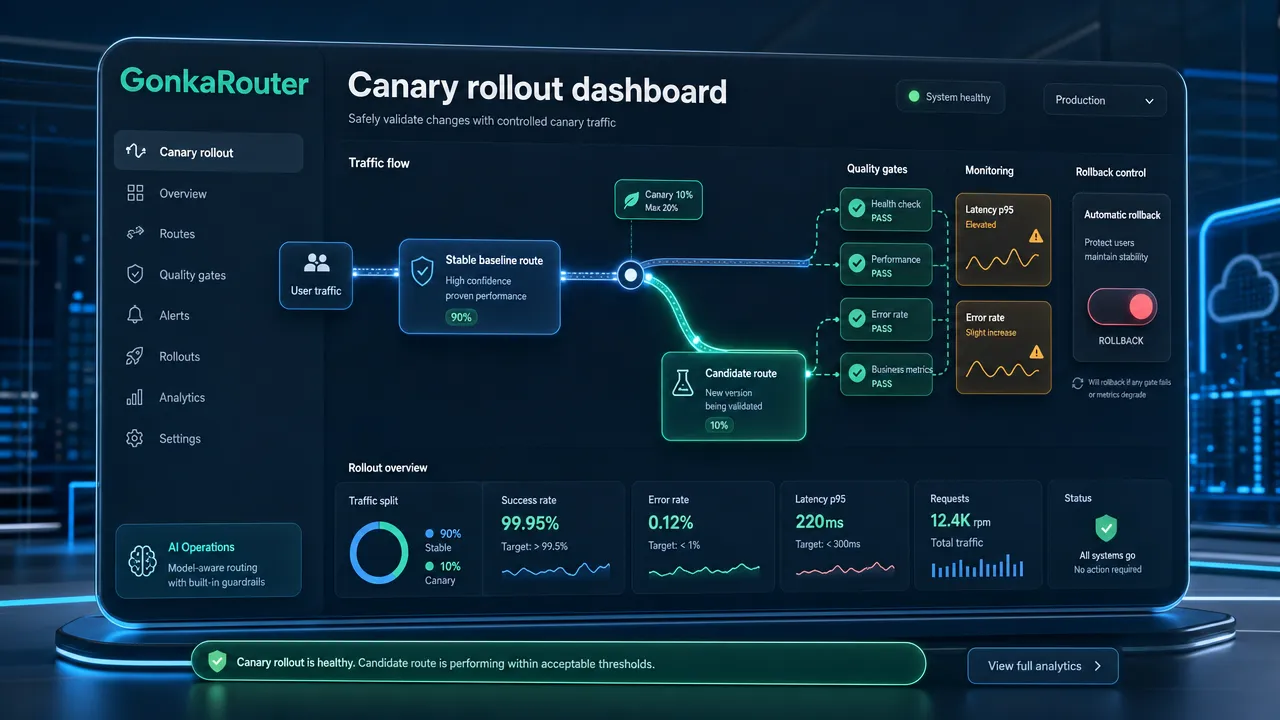
A staged rollout turns uncertainty into a controlled operational decision. Start with offline testing, then move through shadow traffic, an internal pilot, and a low-risk canary. Expand only after each stage meets the gates agreed in advance.
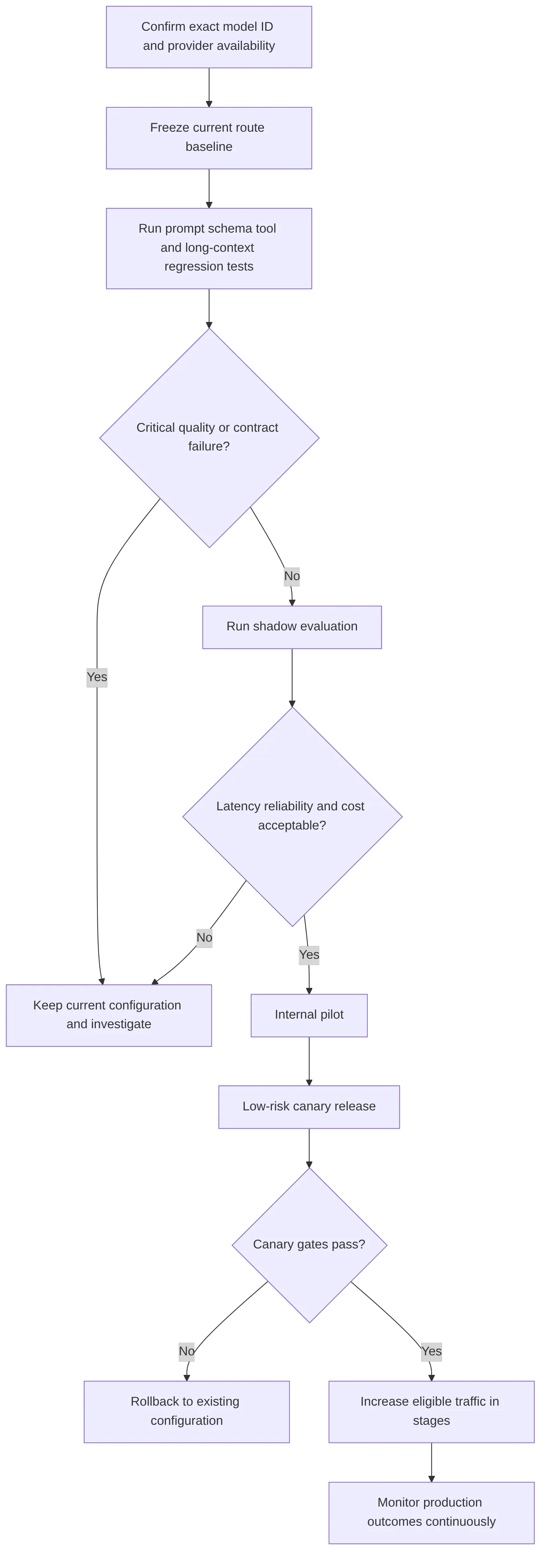
Define rollback criteria before the first live request. Avoid vague conditions such as "quality feels worse." Use measurable thresholds tied to the current production baseline.
Examples include:
Material decline in task success for a priority workflow.
Schema-validation failures above the accepted ceiling.
Invalid, duplicate, or unauthorized tool actions.
Sustained deterioration in P95 or P99 latency.
Increased timeout, provider-error, or rate-limit rates.
Higher cost per successful task than the approved tolerance.
Reduced grounded-answer quality in RAG workflows.
A policy-critical safety failure or unacceptable customer impact.
When a trigger fires, stop traffic expansion immediately. Return eligible requests to the tested existing configuration, preserve traces and version metadata, classify the failure, and retest offline before another canary.
A rollback plan should be explicit. Do not rely on assumed routing, failover, or fallback behavior from any gateway or provider. Your team must implement and test the route change, or rely only on capabilities that the relevant platform explicitly documents.
For implementation patterns around controlled request handling, route requests between LLMs offers useful context. The essential rule remains the same: routing policy and fallback behavior must be tested for the actual application configuration.
GonkaRouter provides a limited compatibility context, not a GLM-5.3-Flash destination claim
GonkaRouter is an OpenAI-compatible and Anthropic-compatible AI Gateway and AI Model Router built for the Gonka Network. Here, compatibility means request and response format compatibility. It does not mean access to official OpenAI or Anthropic models, support for every provider-native parameter, or identical behavior across models.
GonkaRouter currently lists these models:
MiniMax-M2.7
Kimi-K2.6
GLM-5.2
DeepSeek-V4-Flash-0731
Its listed token pricing is $0.0004 per 1 million tokens, and new users receive a one-time 20 USDT trial credit after email login.
However, GonkaRouter currently lists GLM-5.2, not GLM-5.3-Flash. Teams should not budget for, schedule, or architect a GLM-5.3-Flash migration through GonkaRouter without verifying the live supported-model catalog and current documentation first.
For teams evaluating currently listed options, choose AI models using workload tests is a practical complement to this migration discipline. The correct choice depends on measured task quality, structured-output reliability, latency, and operating cost, not a model-family name alone.
GLM-5.3-Flash migration guide FAQs
Is GLM-5.3-Flash available through GonkaRouter?
No verified evidence establishes that availability. GonkaRouter currently lists GLM-5.2, not GLM-5.3-Flash. Check its live supported-model catalog and documentation before planning any use of GLM-5.3-Flash through the platform.
Does an API-compatible format guarantee identical behavior?
No. API compatibility addresses request and response formats. It does not guarantee equivalent prompt following, context handling, tool behavior, structured outputs, streaming, token accounting, latency, or rate limits.
How should a team test structured outputs?
Test JSON parsing, JSON Schema validation, required fields, optional fields, enums, null handling, date and numeric normalization, Unicode, and semantic correctness. For tool calls, validate selected tools, arguments, ordering, authorization, and safe failure behavior.
Which metrics should trigger rollback?
Use workload-specific thresholds based on the existing route. Typical triggers include task-success decline, schema failures, unsafe tool calls, worse P95 or P99 latency, increased errors, higher cost per successful task, RAG grounding regressions, and customer-impact signals.
Is token price enough to choose a migration path?
No. Compare full task economics. Lower token pricing can be outweighed by longer outputs, retries, malformed structured responses, failed tool calls, lower task success, or human remediation.
How should teams interpret LLM Stats pricing and benchmark figures?
Treat them as LLM Stats-reported figures. Validate the current model ID, provider route, billing units, benchmark methodology, API behavior, and account-level availability before making architecture or procurement decisions.
A responsible GLM-5.3-Flash migration guide is an evidence-led operating process: verify availability, preserve the baseline, test behavior against real workloads, release gradually, and retain a proven rollback route. Review GonkaRouter's live supported-model catalog, documentation, and pricing. If its currently listed models fit the workload, test a small, non-critical workload before making a production decision.