OpenAI-compatible endpoints reduce integration work, but they do not operate a multi-model system. They standardize part of the transport contract: client initialization, request shapes, and familiar chat-completion patterns. They do not make models behave alike, validate agent outputs, decide safe fallback paths, or reveal the cost of a failed workflow.
The trend signal is clear. The HackerNoon article "Local LLMs Need More Than OpenAI-Compatible Endpoints", published on 2026-06-16, focused on streaming behavior, tool calls, and image or file inputs. Its central point holds beyond local serving: endpoint names alone are not an operating model.
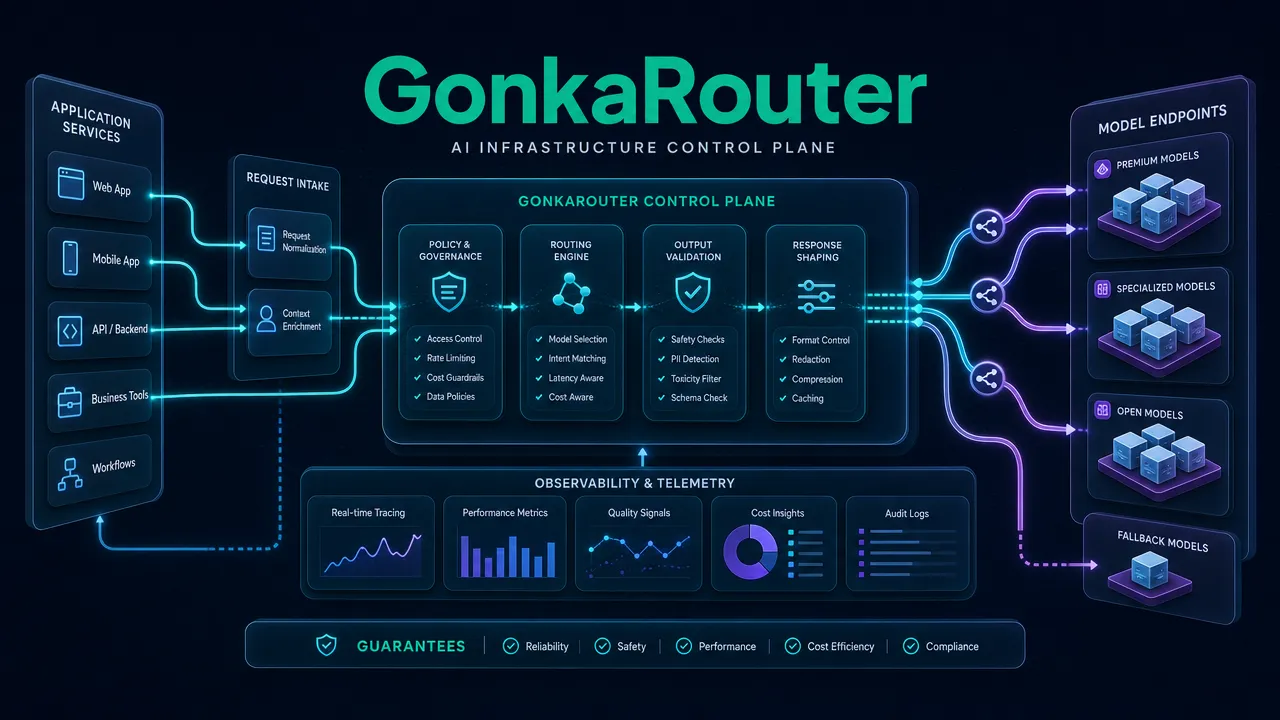
Why An LLM Gateway Needs More Than API Compatibility
An OpenAI-compatible API is useful. It can let a team keep an existing SDK, switch a base endpoint, and preserve parts of a request pipeline. That is meaningful transport portability.
However, compatibility does not guarantee provider portability, model portability, semantic portability, or operational portability.
Portability layer | What it solves | What it does not prove |
|---|---|---|
Transport portability | Requests can use a familiar API pattern. | Parameters have identical meaning. |
Provider portability | An app can connect to more than one service. | All models or features are available. |
Model portability | A workload can move between models. | Outputs remain equally useful. |
Semantic portability | Results meet the same task-quality threshold. | The same prompt gets equivalent behavior. |
Operational portability | Monitoring, budgets, policies, and recovery rules move with the workload. | A compatible endpoint supplies those controls. |
First-party documentation makes the distinction concrete. Anthropic documents cases in which its OpenAI SDK compatibility layer ignores or transforms fields. It specifically notes limitations around strict function-calling behavior, audio input, prompt caching, and system or developer-message handling. Anthropic's compatibility documentation also directs teams that need guaranteed schema conformance toward native Structured Outputs capabilities.
Google takes a similarly cautious position: its Gemini OpenAI library support documentation describes compatibility as beta while feature coverage expands.
That does not make compatibility a poor choice. It makes it a boundary that requires testing.
A practical rule is simple: treat an OpenAI-compatible endpoint as a way to send a request, not as evidence that a multi provider LLM workflow is ready for production.
How An LLM Gateway Handles Behavioral And Protocol Differences
The most expensive failures often happen after an API request returns HTTP 200. A response may still break an application because it contains invalid JSON, selects the wrong tool, uses an unexpected streaming event, or fails to preserve required context.
This is where an LLM gateway architecture becomes more than a proxy.
Concern | Why compatibility is insufficient | Production control needed |
|---|---|---|
Tool calling | Models can interpret schemas differently. | Validate tool name, arguments, and authorization before execution. |
Structured output | A JSON-looking response may not meet the required schema. | Enforce schema validation and bounded repair attempts. |
Streaming | Chunk order, event names, and completion signals can differ. | Test parsers and interruption handling by route. |
Model context | Context limits and role handling vary by model. | Estimate input size and route only to eligible models. |
Multimodal requests | Image, audio, and file support are route-specific. | Maintain a verified capability registry. |
Error handling | Rate limits and error objects differ between services. | Classify failures before retrying or changing routes. |
This is particularly important for a model router for agents. An agent does not make one isolated completion call. It may plan, retrieve information, choose a tool, execute an action, validate a result, and produce a final response. Every step can have a different quality threshold and failure mode.
For example, a tool selection step should not silently fall back to a route that has not passed the same argument-validation tests. A failed schema check is not always a reason to retry or switch models. It may be a prompt, configuration, or policy issue that needs a controlled error instead.
Teams exploring practical routing patterns should separate request normalization from output validation. Normalization makes the request portable. Validation makes the workflow dependable.
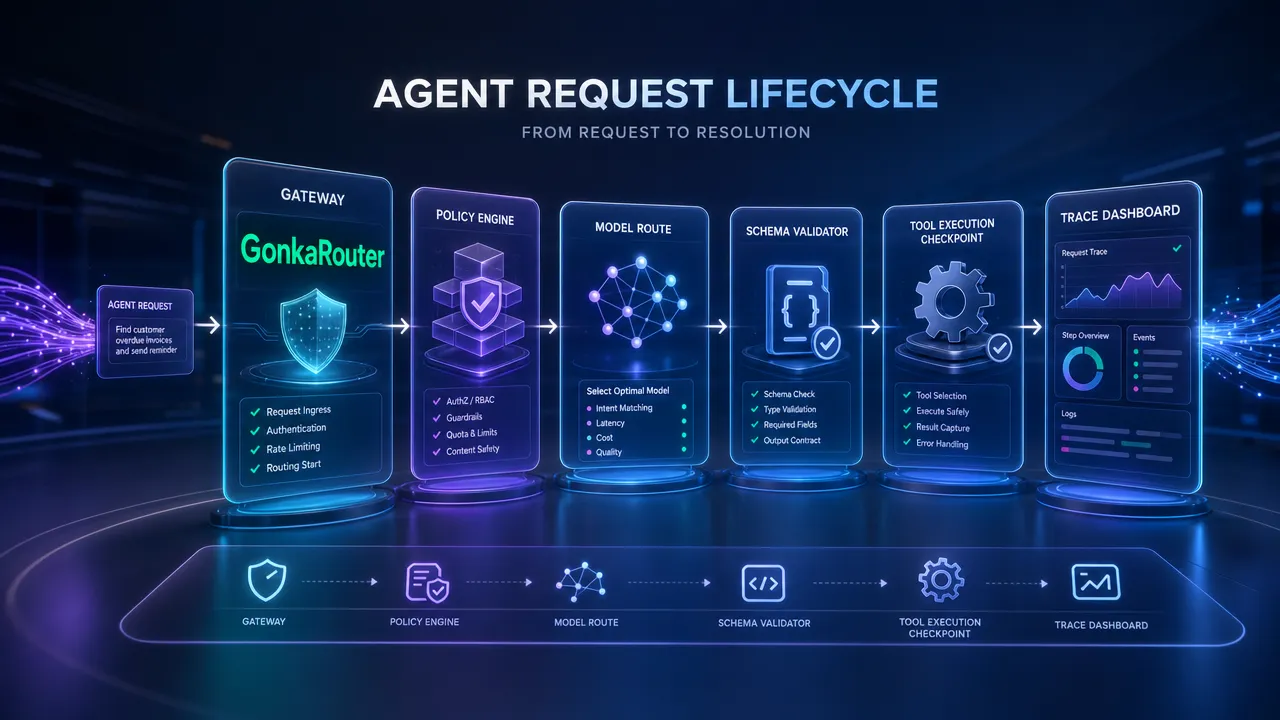
Which LLM Gateway Controls Make Routing Safe
Routing is a policy decision, not merely a model-ID substitution. A capable AI routing engine evaluates whether a route is eligible before it sends traffic, then records what occurred afterward.
API7 documents multi-LLM routing and automatic fallback as explicit gateway configuration. Perplexity documents routing across underlying deployments with health, latency, capacity, weighted traffic distribution, retries, and failover conditions. Those examples illustrate the key architectural point: routing and resilience sit above endpoint compatibility.

The following terms should remain distinct.
Pattern | When it happens | Goal | Main risk |
|---|---|---|---|
Retry | After a transient failure | Recover on the same route. | Excess latency and repeated spend. |
Model fallback routing | After an eligible failure or invalid result | Complete a task through an approved alternative. | Output or safety behavior changes. |
LLM failover | When a route or deployment is unhealthy | Protect service availability. | Sending work to an untested alternative. |
LLM load balancing | Before a failure occurs | Spread work across healthy capacity. | Inconsistent behavior across routes. |
Semantic routing LLM | Before model selection | Select by task meaning, domain, or complexity. | Misclassification. |
Semantic routing can be useful, but it should not be mystical. A classifier, embedding signal, task label, or explicit agent-step tag can help distinguish a brief classification request from long-form analysis or tool use. The route decision remains a hypothesis that needs evaluation data.
For a deeper discussion of these trade-offs, the GonkaRouter team has published a guide on designing semantic route policies and recovery paths. The useful takeaway is not that every system needs dynamic routing. It is that each fallback must be intentional, eligible, and measured.
How An LLM Gateway Improves Cost And Observability
LLM cost optimization is not the same as selecting the lowest headline token price. The lowest-cost route per token can become the most expensive route per successful task when it produces invalid output, repeated retries, excessively long completions, or agent loops.
OpenAI's pricing documentation distinguishes input, cached input, output, and some tool-related costs. Its model comparison documentation also shows that rate limits vary by model. Both are reminders that a cost model needs more than one number.
Track these metrics by route, model version, application feature, and agent step:
Input and output token counts.
Completion and time-to-first-token latency.
Retry, fallback, and failover frequency.
Structured-output validity rate.
Tool-call validation and execution success.
Cost per request.
Cost per validated output.
Cost per successful task.
Prompt-template and policy versions.
OpenTelemetry's GenAI semantic conventions reinforce this direction. AI observability requires traces that explain the request's model route, latency, input and output characteristics, and agent context. An HTTP status code alone cannot tell an engineering team whether the model satisfied the workflow contract.
A practical multi-model evaluation loop looks like this:
Define the task and required output contract.
Create representative prompts, including edge cases.
Test each eligible model route with the same dataset.
Record quality, validity, latency, and cost.
Set explicit routing and fallback rules.
Re-run evaluations when prompts, policies, or models change.
This workflow also helps teams answer how to switch between Claude and GPT responsibly. The answer is not simply changing an endpoint. It is retesting role semantics, structured output, tools, streaming, cost, and operational limits for the specific workload.
Where An LLM Gateway Fits In A Multi-Model Stack
A unified LLM API can be enough when a team is experimenting with supported models and needs to reduce SDK churn. A broader LLM gateway becomes more relevant as applications add multiple teams, agent workflows, shared credentials, budget controls, and consistent tracing.
Architecture choice | Best fit | Important trade-off |
|---|---|---|
Direct provider integration | One stable provider and reliance on native features. | Integration and operations remain distributed across services. |
OpenAI-compatible endpoint | Early migration or experimentation with supported routes. | Does not ensure feature or behavior parity. |
Unified LLM API | Reducing endpoint and SDK sprawl. | Feature coverage still requires verification. |
LLM gateway | Shared access, policy, telemetry, and operational boundaries. | Capabilities vary by implementation. |
LLM routing platform | Explicit routing, resilience, and evaluation workflows. | Requires ongoing policy ownership and testing. |
Self-managed serving | Workloads needing controlled infrastructure operation. | The team owns scaling, security, monitoring, and recovery. |
Local serving is a useful example. vLLM documents an OpenAI-compatible server, which can reduce application-side integration effort, but teams still need to manage runtime support, GPU capacity, networking, security configuration, model updates, and observability.
That is why the 2026-06-16 HackerNoon discussion matters. Local and hybrid deployments can benefit from a familiar interface, but the deployment still needs a control model around capability checks, data-route eligibility, recovery, and measurement.
GonkaRouter is relevant in this category as an AI Model Router built for the Gonka Network. Its website shows an OpenAI-compatible endpoint, lists DeepSeek-V4-Flash, MiniMax-M2.7, and Kimi-K2.6 as featured models, and displays Function Calling, Private VPC Deployment, and Web3 Ecosystem Integration. Those facts establish a possible integration surface, not automatic proof of routing logic, failover behavior, cost advantages, compliance status, or support for arbitrary local models.
Teams evaluating an AI gateway should therefore verify their requirements directly:
Evaluation area | Questions to ask |
|---|---|
Compatibility | Which fields are supported, transformed, ignored, or rejected? |
Capabilities | Which models support required context, tools, schemas, and modalities? |
Reliability | Which errors trigger retry, fallback, or a controlled failure? |
Governance | Which data is retained, masked, sampled, or excluded from logs? |
Observability | Can each request be traced through route choice, retries, and validation? |
Cost | Can the team measure cost per successful task rather than per token? |
Agents | Are tool calls validated before side effects occur? |
Why An LLM Gateway Must Be Treated As A Control Boundary
An LLM gateway is most valuable when it gives teams a stable application boundary while model behavior, infrastructure conditions, and task requirements change. Compatibility lowers adoption friction. It does not remove the engineering work required to operate a multi-model system safely.
The production standard should be straightforward:
Use compatible APIs to reduce integration friction.
Keep a verified capability record for every route.
Validate outputs before tools or downstream workflows act on them.
Treat model fallback routing as a tested policy, not an emergency shortcut.
Measure quality, reliability, and cost together.
Keep route decisions observable and reversible.
The strongest multi-model infrastructure does not promise that every model is interchangeable. It makes differences visible, measurable, and manageable.