An AI model router API gives developer applications one controlled API layer for sending inference requests to supported AI models, reducing integration work, simplifying model switching, and keeping AI traffic easier to manage.
For teams building AI Agents, chatbots, content tools, code assistants, workflow automation, or enterprise AI applications, direct model integration can quickly become messy. Each model or provider may require a different endpoint, schema, key, SDK, billing setup, and error-handling pattern. An AI model router API solves that by acting as middleware between your application and the models you are allowed to call.
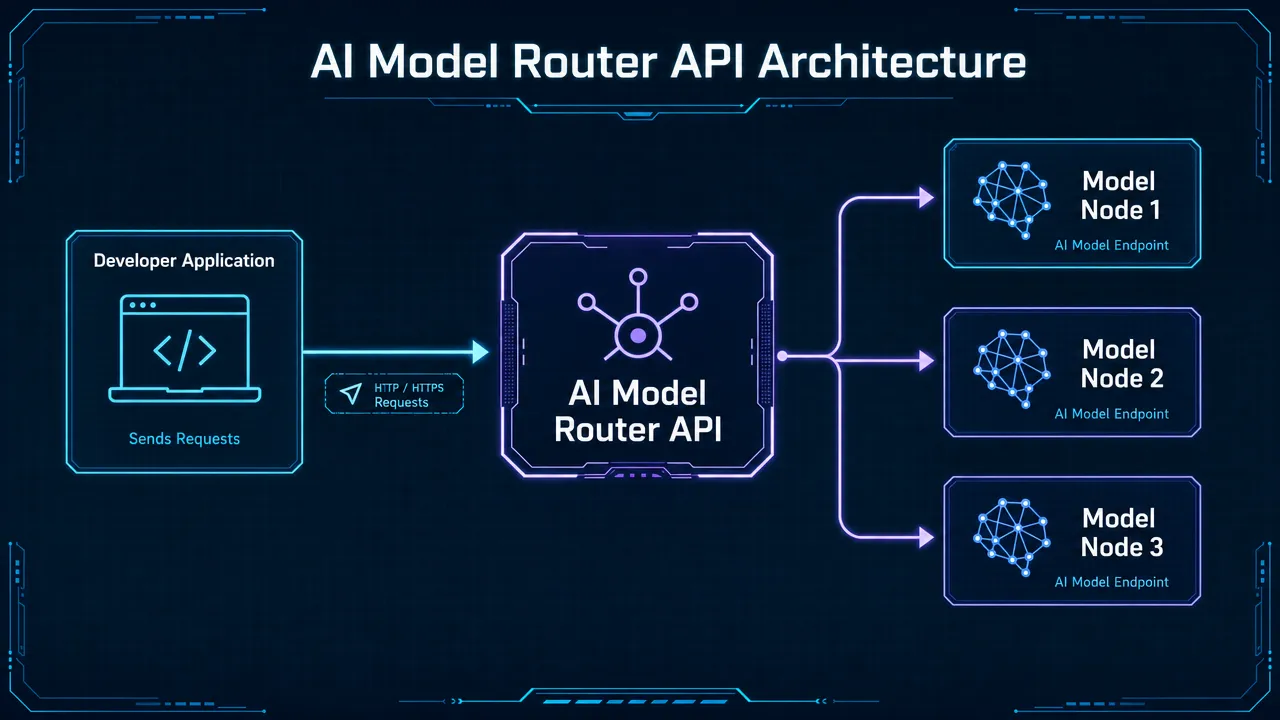
How an AI model router API creates one unified endpoint for supported models
An AI model router API is an infrastructure layer that receives AI inference requests through a unified AI endpoint, authenticates the request, routes it to a selected supported model, and returns a normalized response to the application.
In practical terms, it combines several related concepts:
Term | What it means | Main emphasis |
|---|---|---|
AI model router API | Routes inference requests to supported models through one API layer. | Model selection and forwarding. |
unified LLM API | Gives developers one API interface for multiple model calls. | One schema and one integration path. |
AI gateway | Controls AI traffic, keys, usage, routing, and policies. | Infrastructure control point. |
LLM gateway | A gateway designed specifically for language model traffic. | LLM access and governance. |
multi model API | Lets developers call more than one supported model. | Model access and switching. |
multi provider AI API | Aggregates access across providers. | Provider aggregation. |
The search phrase "one API for all AI models" is common in the market, but it should be interpreted carefully. For GonkaRouter, the accurate claim is one API for currently supported models: MiniMax-M2.7, Kimi-K2.6, and GLM-5.2.
Developers can learn more about the product positioning on the GonkaRouter AI Model Router page. For a related brand explainer, the article what is GonkaRouter gives more context on how the service is designed for developer access.
How an AI model router API differs from an AI gateway and unified LLM API
An AI model router API, AI gateway, LLM gateway, and unified LLM API often overlap, but they are not identical.
A router answers: "Which supported model should receive this request?"
A gateway answers: "How should AI traffic be authenticated, controlled, tracked, and managed?"
A unified API answers: "How can developers use one interface instead of many?"
A multi provider LLM or ai provider aggregation layer emphasizes access across different providers. A multi model API emphasizes access to more than one model, whether those models come from one infrastructure layer or multiple providers.

Microsoft describes model routing as a way to route prompts to suitable models in real time in its Azure AI Model Router documentation. That broader category helps explain why model routing API patterns matter: they separate application logic from model access logic.
For teams already using familiar request patterns, OpenAI-compatible API format and Anthropic-compatible API format support can reduce migration effort. This means compatibility with API formats, not official access to OpenAI or Anthropic models. GonkaRouter's confirmed supported models are MiniMax-M2.7, Kimi-K2.6, and GLM-5.2 only.
For more details on endpoint-style integration, see the GonkaRouter guide on an OpenAI-compatible API endpoint.
How an AI model router API works from request to response
An AI model router API sits between a developer application and supported AI models. The application sends a request to the router instead of calling each model through separate integration code.
A typical workflow looks like this:
The developer application sends a request to a unified AI endpoint.
The AI gateway layer validates the API key and account permissions.
The router selects or forwards the request to a supported model.
The request format may be adapted to the target model.
The selected model executes inference.
The router normalizes the response.
The application receives a consistent output format.
Usage details, token counts, latency, and status may be tracked depending on the platform.
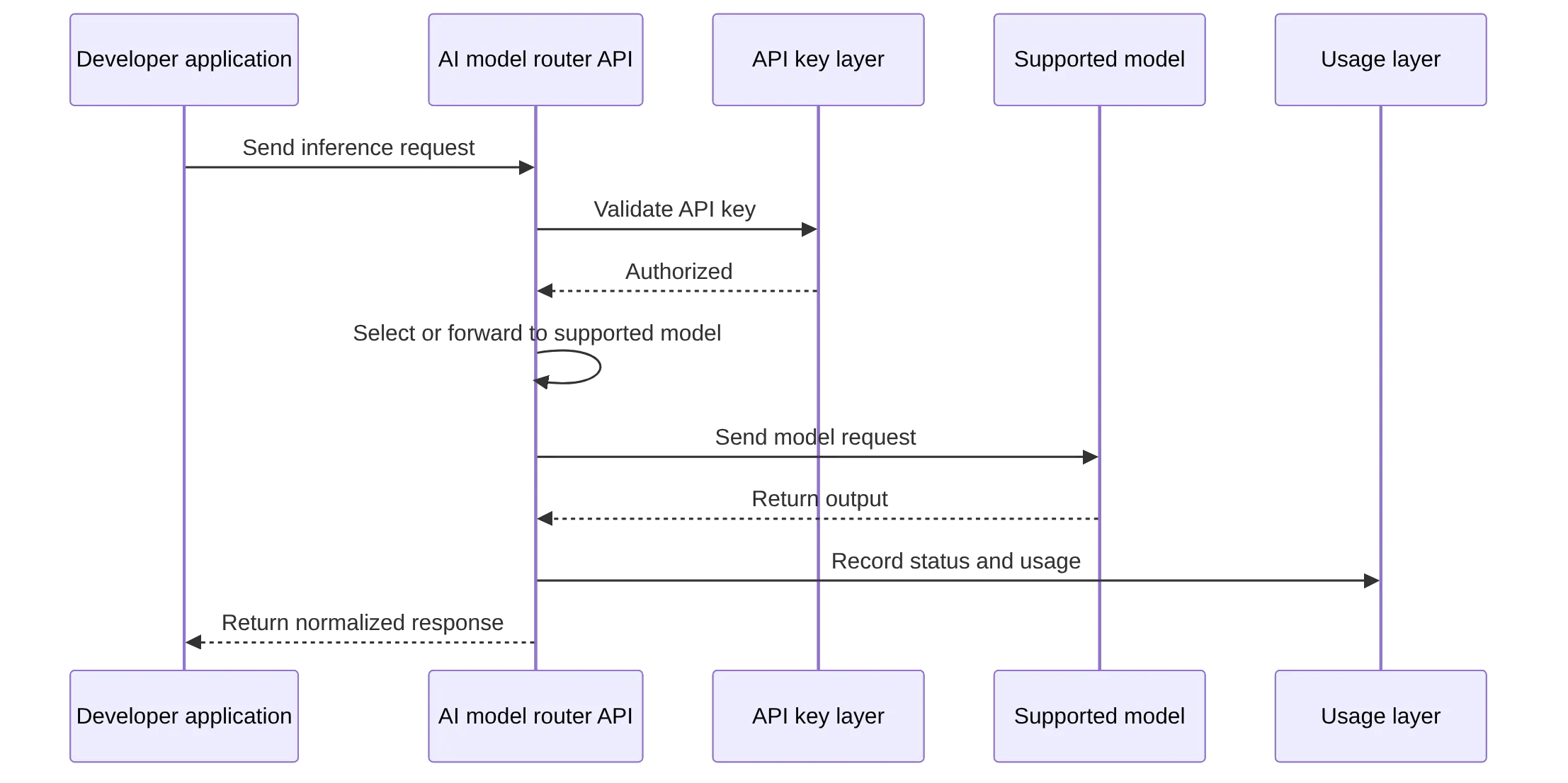
The most important practical benefit is integration efficiency. Instead of rewriting provider-specific logic every time you test a supported model, you can keep a stable application integration and change the model ID or endpoint configuration where supported.
For GonkaRouter, the intended integration path is fast: log in with email, get an API key, choose a supported model, and change only the API endpoint. The GonkaRouter tutorial is the natural next step for developers who want to move from concept to implementation.
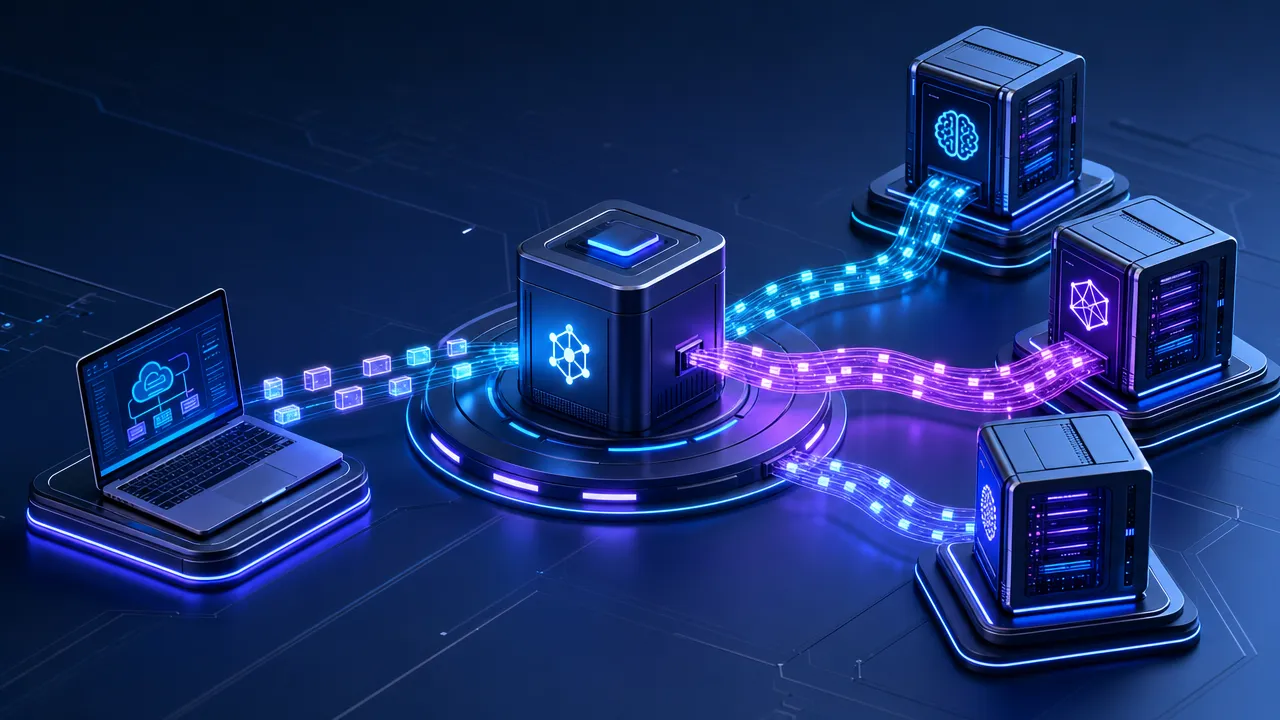
Why an AI model router API matters for developers and AI agents
Developers use an AI model router API because direct model integration becomes hard to maintain as products grow. AI Agents make this problem even more visible because agents may perform planning, tool selection, summarization, validation, code generation, and final answer generation across many repeated calls.
Developer pain point | Why it slows teams down | How a model routing API helps |
|---|---|---|
Complex model integration | Each model path can require different request logic. | A unified endpoint reduces duplicate work. |
Multiple API keys and formats | Teams spend time managing access and schemas. | An AI API gateway centralizes the access layer. |
Slow model testing | Switching models may require code changes. | A multi model API makes supported-model testing easier. |
Agent workflow complexity | Agents call models repeatedly across steps. | A router can become the Agent API layer. |
Reliability design | Failures and rate limits need consistent handling. | Gateway patterns can centralize error handling. |
Cost visibility | Teams need to understand inference usage. | Usage tracking supports better model decisions. |
For startups, the value is speed: test model fit before hardcoding the architecture. For enterprise technical teams, the value is cleaner governance and fewer scattered integrations. For Web3 project teams, global access and compatible payment scenarios can make AI inference easier to connect to product workflows.
Common use cases include:
AI Agents that call MiniMax-M2.7, Kimi-K2.6, or GLM-5.2 for different workflow steps.
Chatbots that need fast iteration across supported models.
Content generation pipelines for drafting, summarizing, and rewriting.
Code generation tasks that require structured output.
Automated workflows such as ticket summarization or report analysis.
Intelligent Q&A systems that compare supported model behavior on retrieved context.
Enterprise AI applications that need a cleaner API boundary.
For teams comparing model outputs, the GonkaRouter article on how to choose AI models faster can support the evaluation process.
What to look for in an AI model router API before integrating
A strong AI model router API should reduce application complexity without hiding important technical details from developers. Before integrating any LLM routing platform or AI gateway developer solution, evaluate the following capabilities.
Capability | Why it matters |
|---|---|
Unified AI endpoint | Reduces endpoint sprawl and repeated integration work. |
OpenAI-compatible API format | Helps teams reuse familiar OpenAI-style patterns. |
Anthropic-compatible API format | Helps teams using Messages-style workflows where supported. |
API key management | Keeps access controlled through a central gateway. |
Supported model clarity | Prevents incorrect assumptions about model availability. |
Usage visibility | Helps teams track tokens and request volume. |
Pricing transparency | Supports better inference planning. |
Documentation | Reduces integration time for developers. |
Agent workflow support | Makes repeated model calls easier to standardize. |
For GonkaRouter specifically, the confirmed capabilities include OpenAI-compatible API format, Anthropic-compatible API format, unified access to currently supported models, email-based login, fast endpoint-change integration, and token pricing as low as $0.0004 / 1M tokens.
New users receive a one-time 20 USDT trial credit after logging in with email. This is a product usage credit for API testing, designed to help developers try MiniMax-M2.7, Kimi-K2.6, and GLM-5.2 before integrating into an application or Agent workflow.
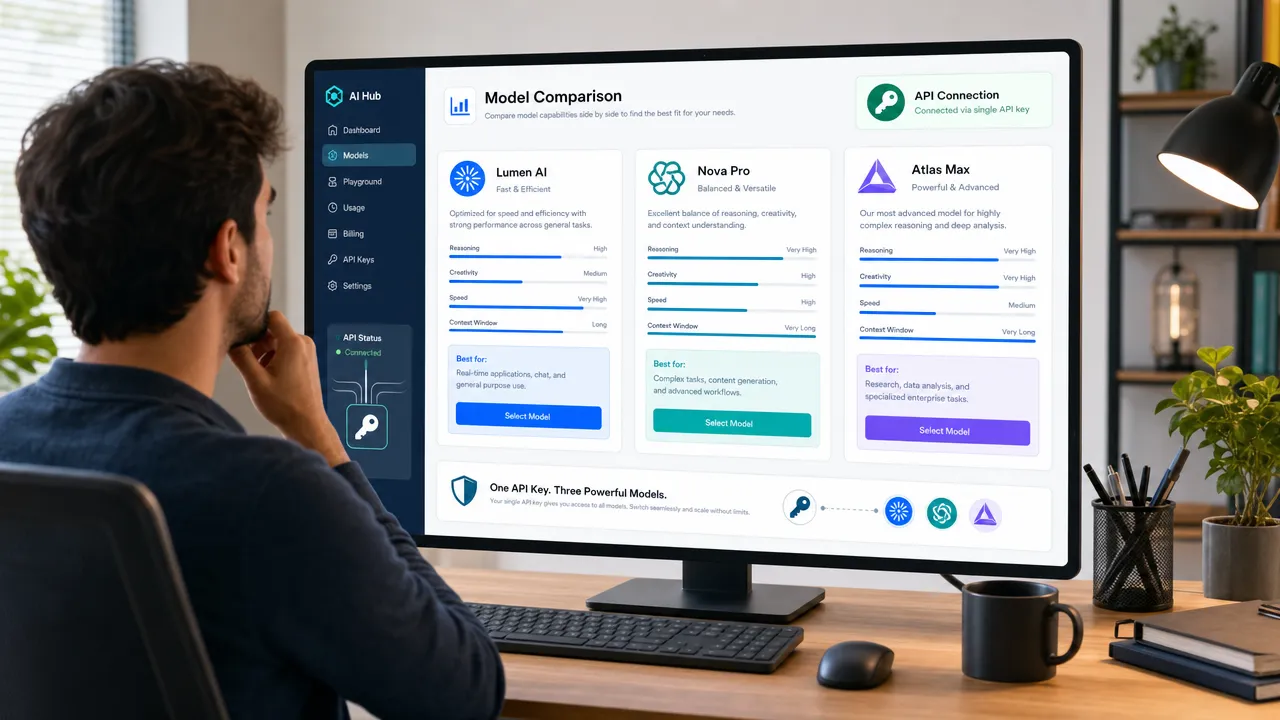
How GonkaRouter fits the AI model router API category
GonkaRouter is an OpenAI- and Anthropic-compatible AI Gateway / AI Model Router that provides developers with multi-model inference access through a unified API for its currently supported models.
It is built on the Gonka decentralized AI compute network, which connects globally distributed GPU resources to provide low-cost AI inference services. GonkaRouter is the developer entry point for this infrastructure: developers can log in with email, get an API key, change the endpoint, and test supported models through a familiar compatible API surface.
GonkaRouter currently supports only these models:
Supported model | Access term | Example use cases |
|---|---|---|
MiniMax-M2.7 | MiniMax-M2.7 API, MiniMax API | Chatbots, content generation, workflow automation. |
Kimi-K2.6 | Kimi-K2.6 API, Kimi API | AI Agents, summarization, structured writing, Q&A. |
GLM-5.2 | GLM-5.2 API, GLM API | Code generation, data analysis, enterprise AI tasks. |
The positioning is focused rather than marketplace-style. GonkaRouter should be understood as one API for currently supported models, not as access to every model provider or every model ecosystem.
The fastest path to testing is:
Log in or register with email.
Get your API key.
Use the one-time 20 USDT trial credit.
Choose MiniMax-M2.7, Kimi-K2.6, or GLM-5.2.
Change the API endpoint in your application.
Send your first request.
Compare output quality, latency, and token usage for your real workflow.
For broader reading, the unified model router API guide expands on how a unified inference layer supports developer teams. You can also browse the GonkaRouter blog for related AI gateway and model integration resources.
An AI model router API is valuable because it turns fragmented model access into a cleaner developer workflow. GonkaRouter applies that pattern to MiniMax-M2.7, Kimi-K2.6, and GLM-5.2 with OpenAI-compatible and Anthropic-compatible API formats, email-based onboarding, endpoint-change integration, and pricing as low as $0.0004 / 1M tokens.
Log in with email, get your API key, and use your 20 USDT trial credit to test supported models through GonkaRouter's unified API.