A GPT-6 Astra API migration should be a controlled release process, not a blind endpoint swap. New-model announcements can justify fresh testing, but production adoption should begin only after your team has isolated provider-specific behavior, frozen a reproducible evaluation suite, versioned every prompt and schema, and proven that a rollback route works.
According to LLM Stats' GPT-6 Astra listing, a model called GPT-6 Astra is associated with OpenAI. However, the release details reported there were not independently verified for this report, and the page's listed September 2026 release date conflicts with the research environment's October 2025 date. Treat the announcement as a useful news hook, not as sufficient deployment evidence. Verify current official documentation before making a production decision.
Why a GPT-6 Astra API migration needs a portable boundary before production
A familiar request format can reduce integration work. It cannot prove that two model routes behave the same way.
That distinction matters because an application rarely depends on only one completion field. It may depend on instruction handling, token budgeting, streaming deltas, structured-output reliability, tool-call arguments, retry behavior, error taxonomy, and safety outcomes. A route that accepts your existing messages payload can still break a downstream parser, change an agent's tool-selection behavior, or exceed a latency budget.
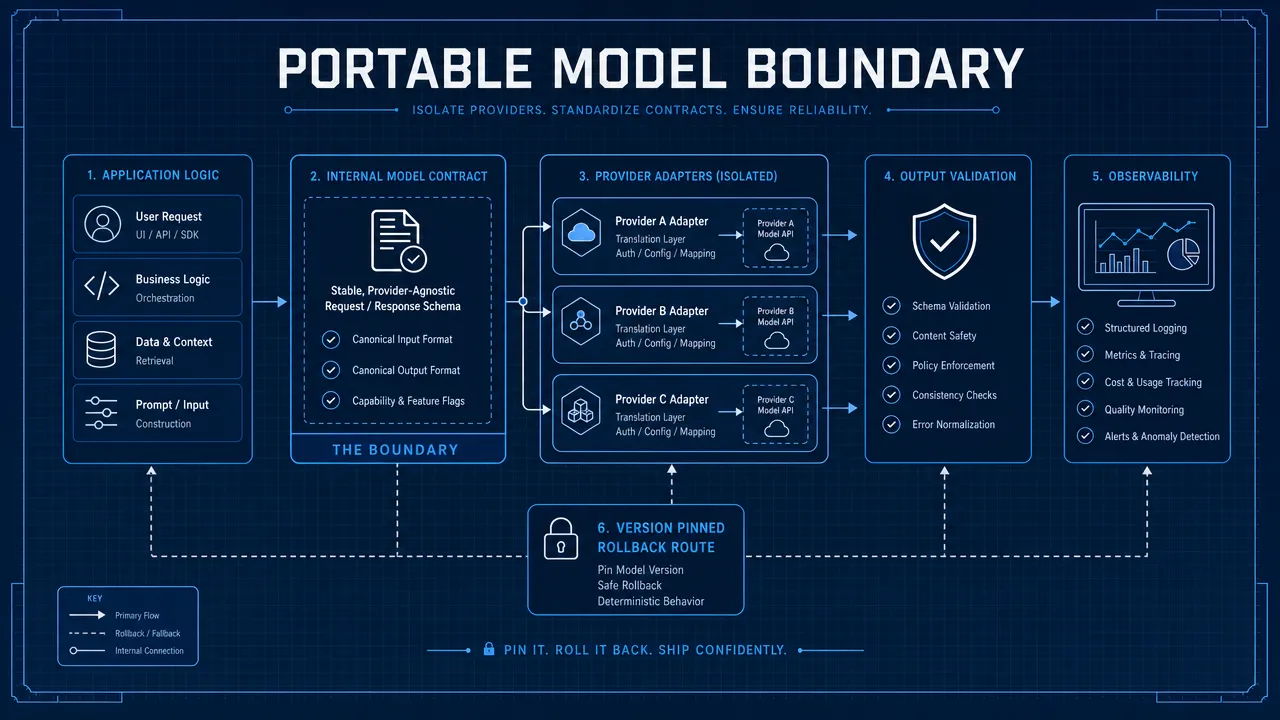
Compatibility is transport-level, not behavioral parity
"OpenAI-compatible" and "Anthropic-compatible" describe request and response format compatibility. They do not establish model availability, feature parity, or equivalent outputs.
For example, documented API differences can affect:
Message roles and instruction precedence.
Streaming event names, ordering, and termination signals.
Tool-call IDs, argument fragments, and parallel-call behavior.
Structured-output support and accepted JSON Schema subsets.
Token usage fields, context-overflow behavior, and billing measurements.
Error objects, retryable status codes, and rate-limit signals.
OpenAI's guidance on function calling and structured outputs shows why tool and schema behavior must be verified for a specific route and configuration. Anthropic's API versioning guidance and streaming documentation make the same broader point: API behavior is a contract, not a checkbox.
A portable architecture does not pretend every provider is interchangeable. Instead, it gives your application an internal contract for common needs and confines route-specific translation to adapters.

This is an architecture pattern, not a claim that any provider or gateway automatically validates outputs, routes traffic, or performs failover.
Test the hidden breakpoints before changing traffic
Consider a document-extraction workflow. The model response may look like valid JSON, but the downstream system needs exact fields, correct types, valid enumerations, and no invented values. A migration can fail even when the response appears reasonable to a human reviewer.
Test the entire workflow, including:
Contract area | What to verify | Failure to catch |
|---|---|---|
Instructions | Conflicting system, developer, and user instructions | Critical constraints are ignored |
Streaming | Partial chunks, cancellation, disconnects, end markers | Parser hangs or drops content |
Tools | Call selection, argument validity, duplicate calls | Side effects occur twice |
Structured output | JSON parsing and external schema validation | Valid-looking but unusable objects |
Errors | Timeouts, rate limits, policy blocks, context overflows | Retries multiply or failures leak to users |
Usage | Input, output, cached usage, retry counts | Cost analysis misses failed attempts |
Safety | Refusal and escalation behavior for the workload | Fallback changes approved controls |
The goal is controlled portability, not lowest-common-denominator abstraction. Keep native features when they create meaningful value, but place them behind a documented capability flag and a route-specific adapter.
For a deeper treatment of this distinction, see why OpenAI-compatible endpoints do not guarantee portability.
Build a reproducible evaluation harness before the GPT-6 Astra API migration
A benchmark headline is not a deployment decision. LLM Stats reports GPT-6 Astra benchmark information, but teams should not treat third-party reported results as proof that the model will improve their own workflows.
The better question is simple: does the candidate improve successful task outcomes under the exact conditions your product uses?
Start with a versioned golden dataset. Pull from sanitized historical requests, known production failures, expert-written edge cases, adversarial inputs, long-context samples, unavailable-tool cases, and policy-sensitive scenarios. Then run the incumbent and candidate configurations against the same immutable inputs.
Each evaluation record should capture:
Exact model identifier and route.
Adapter version.
Prompt template and prompt version.
Tool definitions and toolset version.
Required output schema and schema version.
Retrieval configuration, when applicable.
Generation parameters, timeout, and retry policy.
Evaluator logic and rubric version.
Timestamp, request classification, and redacted trace metadata.
OpenAI's evaluation best practices recommend defining objectives, datasets, metrics, comparisons, and continuous testing. That principle applies whether you build an internal harness or use a provider's evaluation tooling.
Measure accepted outcomes, not attractive responses
A fluent response is not necessarily a successful result. Measure the business outcome at the end of the workflow.
Useful evaluation metrics include:
Measurement category | Practical metric |
|---|---|
Quality | Task pass rate, critical-error count, expert rubric score |
Structure | JSON parse rate, schema-validity rate, required-field completeness |
Tools | Valid tool arguments, correct tool selection, duplicate-call rate |
Reliability | Timeout rate, API error rate, stream-completion rate, retry rate |
Latency | Time to first token, total model duration, end-to-end workflow duration |
Cost | Cost per accepted successful task, including retries and human repair |
Safety | Unsafe-action attempts, policy outcomes, human escalation rate |
Human review is often necessary for nuanced writing, summarization, and complex decisions. When using reviewers, compare outputs blindly where feasible. Do not reveal which route produced the result until after scoring. That helps prevent novelty bias from becoming a launch decision.
Define rollout and rollback criteria before the GPT-6 Astra API migration starts
A candidate should not reach customer-critical traffic because it passed a demo. It should advance through pre-approved gates.
The safest rollout path moves from controlled evidence to controlled exposure:
Baseline the incumbent. Measure current quality, reliability, latency, and accepted-task cost.
Run offline evaluations. Require contract tests plus golden-dataset results.
Shadow test where feasible. Process sanitized or consented copies without returning candidate output to users and without triggering live side effects.
Pilot a non-critical workload. Use a clearly limited cohort, feature flag, or asynchronous internal task.
Expand gradually. Increase by task type or approved cohort only after results remain within defined tolerances.
Keep rollback ready. Preserve an immutable, tested configuration for the incumbent route.
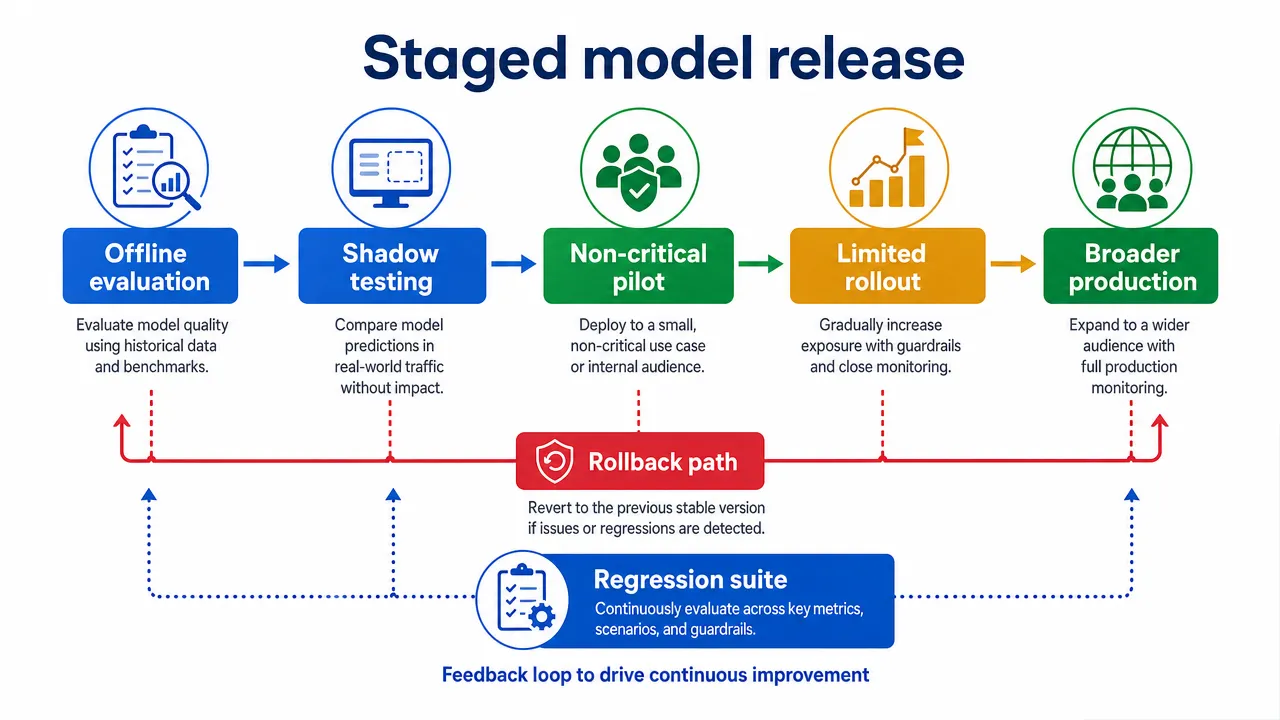
Do not publish generic universal thresholds. A low-risk tagging task and a high-impact financial workflow deserve very different gates. What matters is that the thresholds exist before the candidate results are reviewed.
Use explicit stop conditions
A rollback is safest when it is pre-decided and technically routine. Pause expansion or return to the tested fallback when you see:
A material decline in task quality versus the baseline.
Rising critical errors, hallucinations, or unsafe workflow behavior.
A meaningful increase in malformed JSON or invalid tool arguments.
More stream interruptions, timeouts, API failures, or rate-limit events.
Latency beyond the workload's defined budget.
Unexpected cost variance after accounting for retries, context replay, and repairs.
A privacy, security, legal, or governance concern.
Missing telemetry that prevents safe incident diagnosis.
A fallback must be evaluated for the same workload. It is not safe to improvise a substitute model in the middle of an incident, particularly when the workflow uses tools, schemas, or high-impact actions.
NIST's AI Risk Management Framework and Generative AI Profile provide useful lifecycle-oriented guidance for documenting risks and controls. They are governance references, not product certifications.
Keep provider-specific capabilities useful and contained
The strongest abstraction layer is not the one with the fewest fields. It is the one that makes differences visible, testable, and owned.
Use a canonical internal request for broadly shared requirements: messages, instructions, response schema, tool definitions, timeout budget, trace context, and expected output type. Then maintain a capability matrix for every route and model configuration.
A practical capability matrix should mark each item as supported, unsupported, restricted, or unverified:
Accepted content and message types.
Streaming behavior and cancellation semantics.
Structured-output mode and schema constraints.
Tool calling, parallelism, and result-message format.
Generation controls and usage reporting.
Error and rate-limit behavior.
Approved workload categories.
Known incompatibilities.
Tested fallback eligibility.
Evidence source and test date.
Provider-specific features can remain available through deliberately narrow escape hatches. For example, a route-specific tool-streaming feature might live in one adapter and one well-tested workflow rather than spreading through every service in your codebase.
This approach prevents two costly outcomes at once: business logic becoming tightly coupled to a provider, and useful capabilities being erased in the name of portability.
Where GonkaRouter fits in a portability strategy
A compatible gateway can be one integration boundary beneath an application-owned model contract. It can help teams avoid repeating request-format integration work for a documented supported-model catalog, while the application still owns evaluation, validation, observability, workload eligibility, and rollback decisions.
GonkaRouter describes itself as an OpenAI- and Anthropic-compatible AI Gateway / AI Model Router built for the Gonka Network. Its unified API endpoint is available through that link. Its currently listed models are MiniMax-M2.7, Kimi-K2.6, GLM-5.2, and DeepSeek-V4-Flash-0731. Listed token pricing is $0.0004 per 1 million tokens, and new users receive a one-time 20 USDT trial credit after email login.
Two boundaries are important:
OpenAI-compatible and Anthropic-compatible refer to request and response format compatibility only.
Compatibility does not mean access to official OpenAI or Anthropic models, and it must not be read as support for GPT-6 Astra.
A gateway also does not remove the need for live documentation review, feature testing, data-handling review, and incident planning. Teams evaluating a migration boundary can read more about where an OpenAI-compatible gateway fits in a migration, then review the current privacy policy and terms of service before routing sensitive workloads.
FAQs about GPT-6 Astra API migration and portability
Is a GPT-6 Astra API migration a drop-in change?
No. Familiar payload shapes do not guarantee equivalent instruction handling, streaming, structured outputs, tool calls, errors, safety outcomes, or billing behavior. Treat it as a contract and operational change.
What does API compatibility actually mean?
It usually means a service accepts or returns a similar API format. It does not prove access to the same official models, support for every feature, or identical model behavior.
How should teams test a new LLM before production?
Use a versioned golden dataset, explicit acceptance criteria, automated schema and tool validation, blinded human review where appropriate, and measurement of quality, reliability, latency, safety, and cost per accepted task.
What should trigger a model rollback?
Predefined triggers should include material quality regressions, invalid structured outputs, tool failures, reliability declines, latency overruns, unexpected cost variance, and any privacy, security, legal, or governance concern.
Can an AI gateway support an API portability strategy?
Yes, as one controlled integration boundary. It can reduce repeated format-level integration work for documented routes, but it does not replace route-specific testing, output validation, security review, or rollback ownership.
The safest GPT-6 Astra API migration is the one your team can measure, pause, and roll back. According to LLM Stats, GPT-6 Astra is a model worth monitoring, but no third-party listing should outrank evidence from your own reproducible evaluations and current official documentation. Review GonkaRouter's live supported-model catalog, documentation, and pricing, then test a small non-critical workload before considering broader use.