Open-source AI gateways reduce vendor lock-in by moving model access, routing policy, credentials, and telemetry out of individual applications and into a controlled shared layer. That separation gives platform teams a practical way to change approved providers or deployment targets without rewriting every service that calls a model.
A common API is useful, but it is not a portability guarantee. An OpenAI-compatible client can often send requests to another provider, as Google's OpenAI compatibility guidance demonstrates. Yet tool calling, structured output behavior, streaming events, tokenization, embeddings, safety controls, and latency profiles can still differ materially.
Isolate provider dependencies behind a stable application contract
An open-source LLM gateway deployment creates a provider-neutral boundary between application code and model endpoints. Applications send requests to one internal endpoint. The gateway handles provider adapters, authentication, policy enforcement, and route selection before forwarding traffic to commercial APIs, cloud platforms, or self-hosted inference.
This is a stronger architecture than embedding a provider SDK throughout every microservice. Instead of updating endpoint URLs, API keys, retry logic, and error handling across many repositories, teams make a controlled policy change at the gateway.
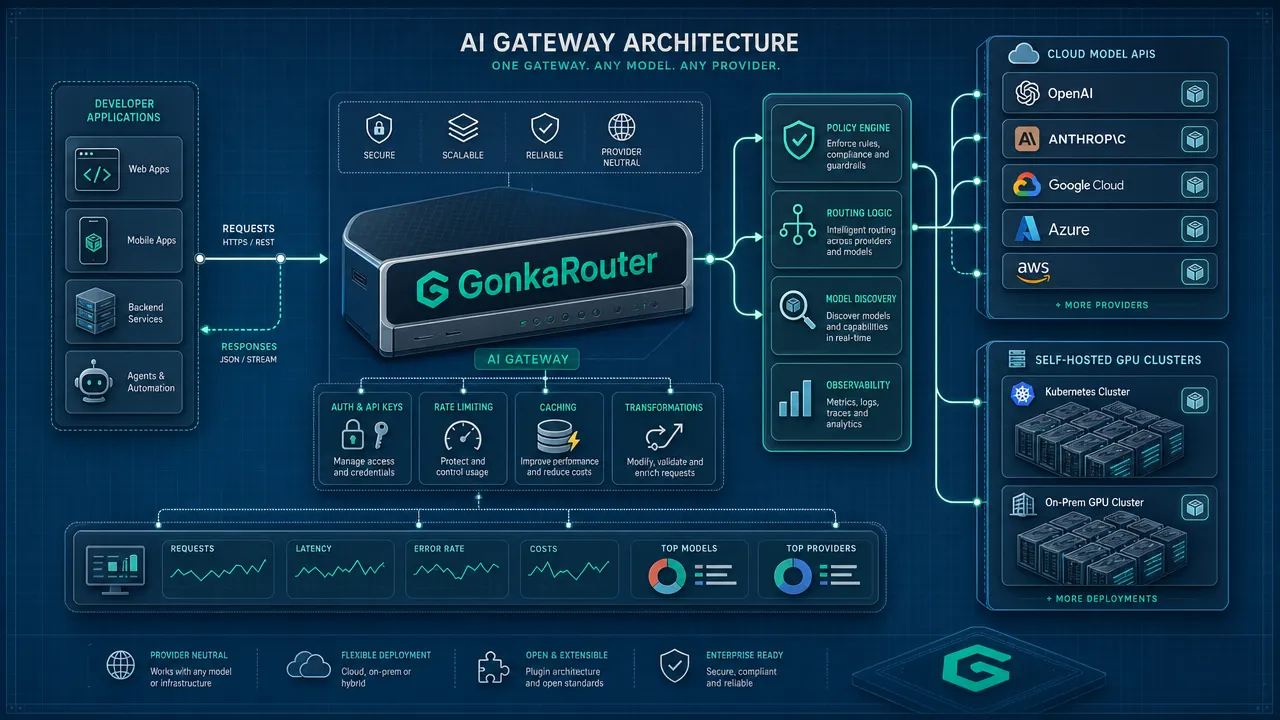
The boundary should be intentionally narrow. A portable application client targets a logical model route, such as model-router/default, rather than a provider model identifier. Platform engineers can then map that route to a versioned policy-approved destination.
python 复制代码

This pattern reduces API and operational coupling. It does not mean every workload can safely move to every model. Treat the gateway route as an abstraction with a contract that must be tested.
Keep routing policy in a clear control plane
A resilient open-source LLM gateway architecture separates configuration and governance from latency-sensitive request processing. The control plane stores versioned route definitions, credentials, data rules, budgets, and allowlists. The data plane applies those policies to live traffic.
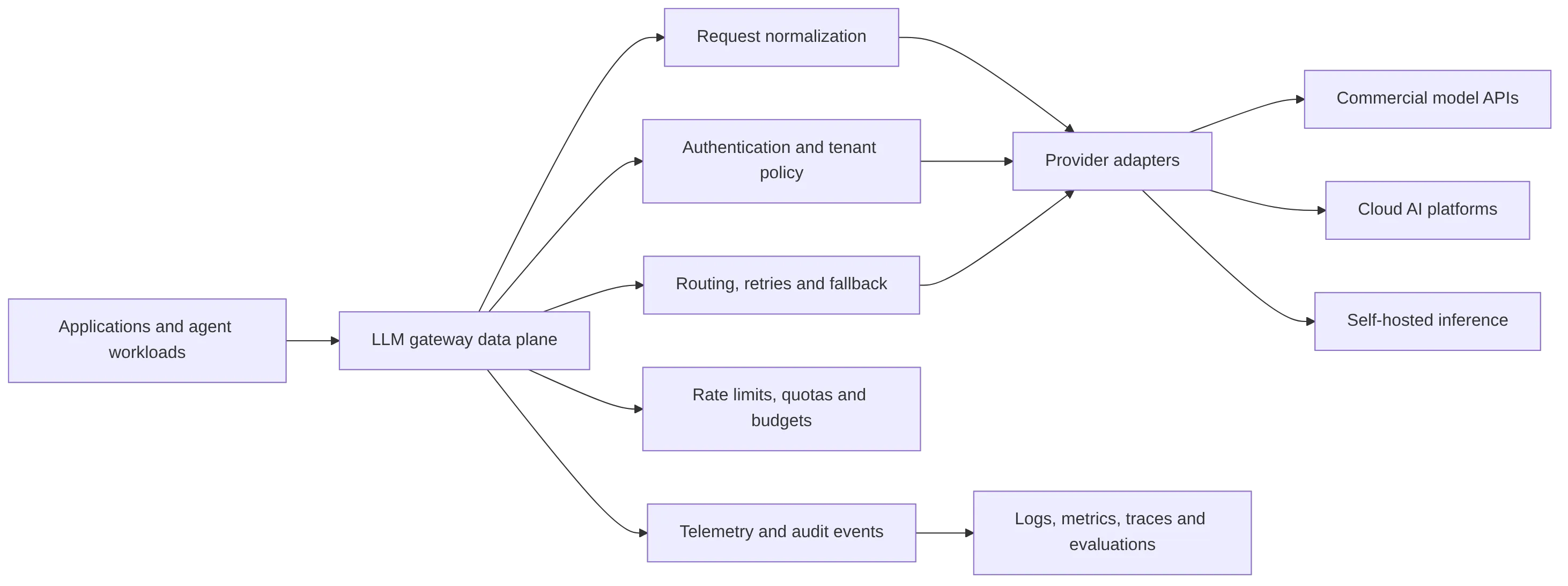
The gateway can combine several functions that otherwise become scattered across applications:
Layer | Responsibility | Lock-in reduction |
|---|---|---|
Request normalization | Exposes a stable client-facing schema | Limits provider-specific SDK usage |
Provider adapters | Translates requests and selected responses | Contains upstream API differences |
Routing policy | Selects eligible providers and models | Centralizes migration and rollout decisions |
Usage controls | Applies quotas, rate limits, and budgets | Standardizes tenant governance |
Telemetry | Records route decisions and outcomes | Keeps operational data exportable |
Projects such as LiteLLM document capabilities including a unified interface, routing, retries, fallback, virtual keys, budgets, and spend tracking. Envoy AI Gateway documents an OpenAI-compatible endpoint, provider fallback, and usage-aware controls. Those capabilities are valuable, but teams should verify behavior under their own traffic patterns rather than assuming feature parity.
The distinction between a generic API gateway and an AI gateway also matters. A traditional API gateway can enforce TLS, authentication, and HTTP rate limiting. An AI gateway adds model-aware concerns such as token accounting, route eligibility, prompt and response metadata, provider error normalization, and streaming behavior. It still does not replace an identity provider, an evaluation system, an agent runtime, or a model-serving platform.
For a deeper discussion of the limits of format compatibility, see Why OpenAI-Compatible Endpoints Alone Don't Solve Multi-Model Infrastructure.
Preserve workload semantics when switching routes
The primary value of an open-source LLM gateway strategy is controlled optionality, not indiscriminate model swapping. A route should only include models that meet the workload's requirements for quality, schema adherence, latency, cost, region, and data handling.
For example, an incident summarization route may accept multiple chat models after regression testing. A route that drives production database actions through tools needs much stricter validation. Model output is untrusted input, particularly when it can influence downstream systems. OWASP identifies prompt injection and excessive agency as important application risks in its LLM application security guidance.
A practical route record should include:
Approved model versions and providers.
Input data classification and permitted regions.
Tool calling and structured-output requirements.
Maximum latency and retry budget.
Fallback order and conditions.
Evaluation suite version and acceptance threshold.
Rollback target.
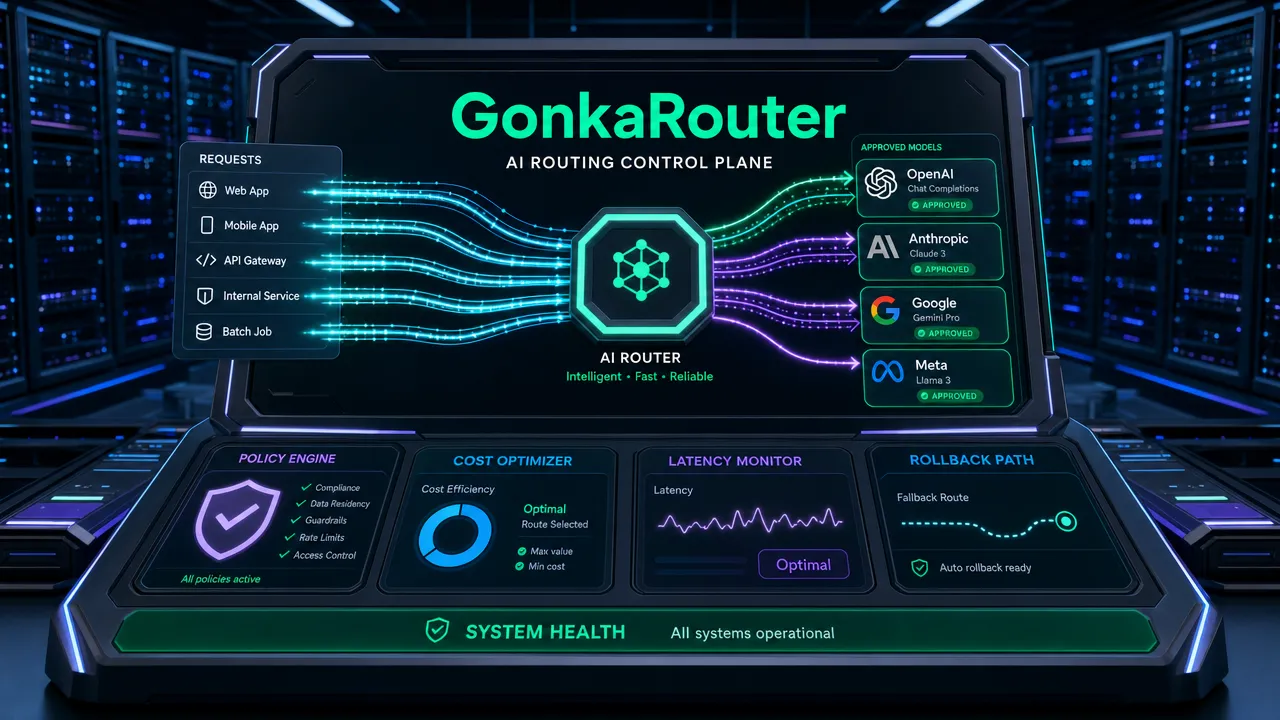
Embeddings deserve special care. Vectors generated by one embedding model occupy a model-specific space. Replacing that model can require re-indexing and relevance testing. The same caution applies to provider-native assistants, proprietary prompt caching, multimodal inputs, structured-output enforcement, and safety features.
A gateway should make these differences visible through capability records, not hide them behind a lowest-common-denominator interface.
Plan for observability and security ownership
An open-source LLM gateway deployment shifts operational ownership to the adopting team. That is often the correct trade-off for private networking, custom policy, or tighter data controls. It also means the team owns scaling, availability, upgrades, vulnerability response, secrets, and incident handling.
Effective llm observability should tie every model call to the workload and policy decision that produced it. At minimum, record the model and version, provider, route-policy version, tenant, input and output tokens, latency, time to first token, cache result, retry history, fallback outcome, and error class.
OpenTelemetry's GenAI semantic conventions provide a useful foundation for consistently exporting spans, metrics, and events. Standard telemetry reduces the risk that valuable traces and cost records become trapped in one provider dashboard.
The most informative cost metric is cost per quality-passing task. Token price alone misses expensive failures, including invalid JSON, repeated repair prompts, context replay during fallback, or unnecessary agent tool loops.
Security controls should include server-side key storage, scoped workload identity where supported, tenant isolation, model allowlists, egress restrictions, request-size limits, log redaction, secret rotation, and explicit retention policies. A gateway becomes part of the trust boundary because it processes prompts, outputs, and telemetry.
For an applied security perspective, How AI Gateways Keep API Keys Away from Autonomous Agents explains why applications should avoid exposing upstream provider credentials directly to agent workloads.
Migrate one measured workload at a time
Adopt an open-source LLM gateway solution incrementally. Start with a reversible internal workflow, retain the current provider route as the default, and compare outcomes before moving critical traffic.
Migration stage | Practical action | Required evidence |
|---|---|---|
Establish the client boundary | Point one service to the gateway endpoint | No application behavior regression |
Shadow traffic | Send duplicated nonproduction requests | Comparable quality and schema validity |
Canary routing | Move a small percentage of eligible traffic | Bounded errors, latency, and cost |
Controlled fallback | Test provider failures and rollback | No retry loops or data-routing violations |
Production expansion | Add routes by workload class | Passing evaluations and operational readiness |
bash 复制代码

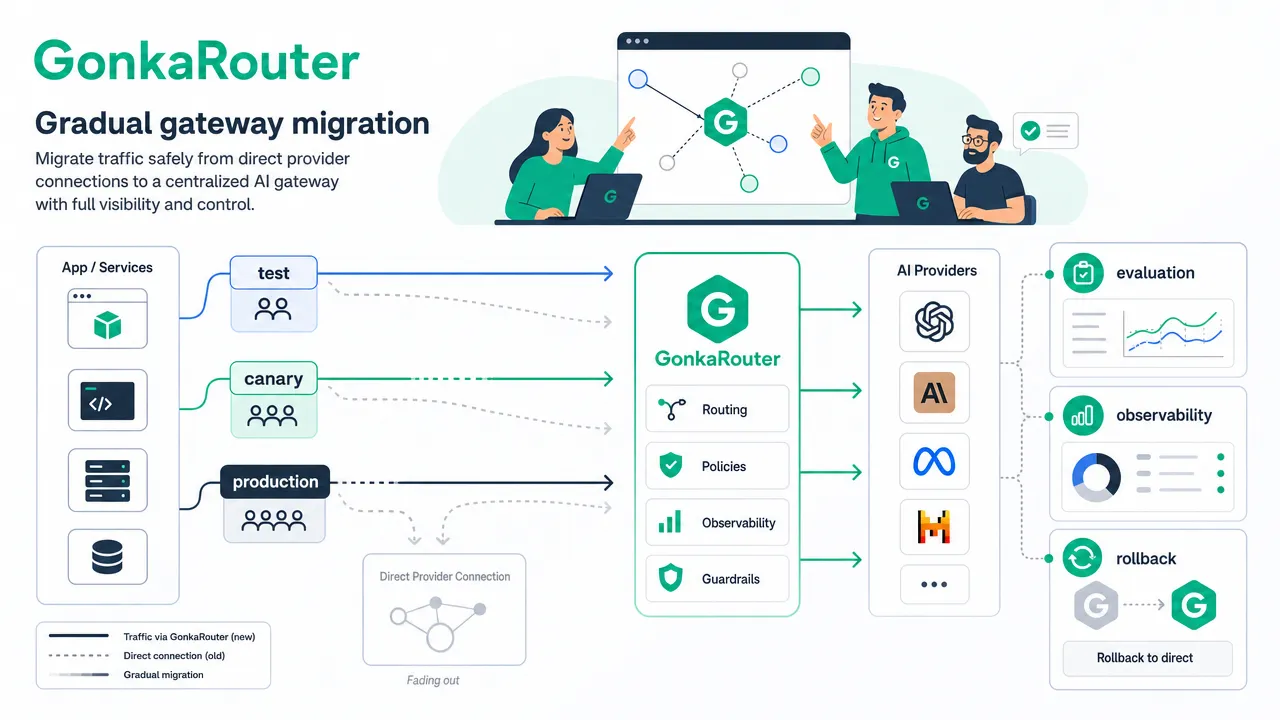
Open source does not automatically make an AI infrastructure stack portable. It gives teams more control over the boundary where portability is enforced. The durable anti-lock-in practice is a gateway combined with versioned routing policy, workload-specific evaluations, explicit data-routing rules, exportable telemetry, and documented exit procedures.
Teams evaluating a unified access layer can also review GonkaRouter's discussion of enterprise multi-provider routing and why AI control planes are becoming essential.
To compare a managed multi-model path, review GonkaRouter's current model catalog and test portability with your own prompts, schemas, and failure cases.