Autonomous agents should request model access, not hold long-lived model-provider credentials. That distinction is central to secure agentic AI infrastructure. An agent can plan, retrieve data, interpret tool outputs, and retry tasks, which creates more opportunities for unsafe inputs or compromised components to influence behavior.
A safer pattern places the upstream API key in a trusted server-side boundary. The agent calls an internal backend with a restricted identity, while the backend retrieves the provider credential at runtime and forwards approved inference traffic through a gateway or router. Managed secret services are designed for this purpose: keeping secrets out of application code and retrieving them only when needed. See the guidance from AWS Secrets Manager and Google Cloud Secret Manager.
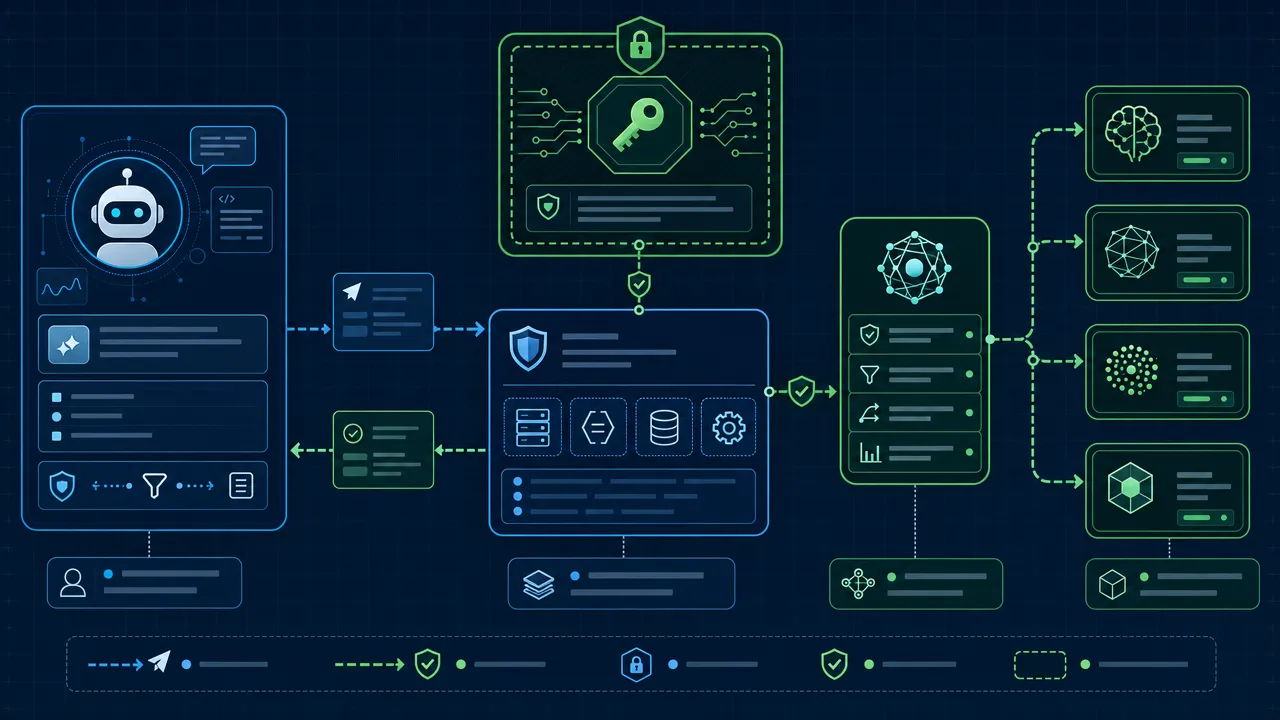
Agentic AI infrastructure starts with a trusted credential boundary
The most useful rule is simple: keep raw provider keys outside every agent-reachable context. That includes prompts, agent memory, browser bundles, repository files, tool outputs, environment dumps, and broadly accessible runtime configuration.
Instead, separate responsibilities:
Layer | Responsibility | Credential rule |
|---|---|---|
Agent runtime | Planning, reasoning, state, and proposed actions | Never receives the upstream model key |
Trusted backend | Authenticates workloads, validates requests, and applies application policy | Uses a restricted service identity |
Secret manager | Stores and retrieves sensitive credentials at runtime | Keeps long-lived secrets out of code |
AI gateway or router | Provides the controlled path to model inference | Receives approved requests from the backend |
Model endpoint | Processes authorized inference requests | Does not expose credentials back to the agent |
This architecture reduces the number of systems that handle a long-lived credential. It also makes it easier to separate development, staging, and production workloads, rather than relying on one shared key with a wide blast radius.
Where available, use workload identity or short-lived access tokens instead of embedded static credentials. Google Cloud Workload Identity Federation describes how workloads can exchange a trusted identity for short-lived access, reducing the need to distribute persistent service-account keys.
A gateway is useful here because it creates a consistent inference boundary. But it is not a replacement for identity management, secret storage, secure deployment, runtime hardening, or incident response.
Agentic AI infrastructure faces additional agent-specific key risks
A standard backend usually follows a predictable request path. An autonomous agent can process untrusted documents, user messages, retrieved content, tool responses, plugins, and multi-step workflow state. Those inputs can influence what the agent asks the application to do next.
That makes prompt injection and unsafe tool use especially important. OWASP identifies prompt injection as a major risk for LLM applications, while Microsoft's prompt injection guidance emphasizes treating untrusted content as potentially hostile before actions are executed.
Common failure modes include:
Risk | Example | Safer design response |
|---|---|---|
Hard-coded API keys | A key is committed to an agent repository | Store it in a secret manager and rotate immediately after exposure |
Browser-side secrets | A web agent app ships a model key in JavaScript | Let the browser call your backend, not the model provider directly |
Prompt or memory leakage | A credential appears in an instruction, tool result, or retrieved file | Never place secrets in model context |
Shared environment keys | Development and production use the same credential | Separate identities, scopes, and environments |
Compromised tool access | A plugin can read environment variables or files | Keep secrets outside the agent runtime and sandbox tools |
Runaway loops | An agent retries inference repeatedly | Add application-side limits, timeouts, and bounded retries |
GitHub secret scanning exists because API keys and tokens are frequently exposed through commits and repository history. If a key leaks, routing future traffic through a gateway does not undo the exposure. Rotate the key, review where it appeared, and investigate associated usage.
The same principle applies to prompts. A model context is a data-processing surface, not a secret vault. Never put a provider key in a system prompt, tool description, retrieval document, or agent memory.
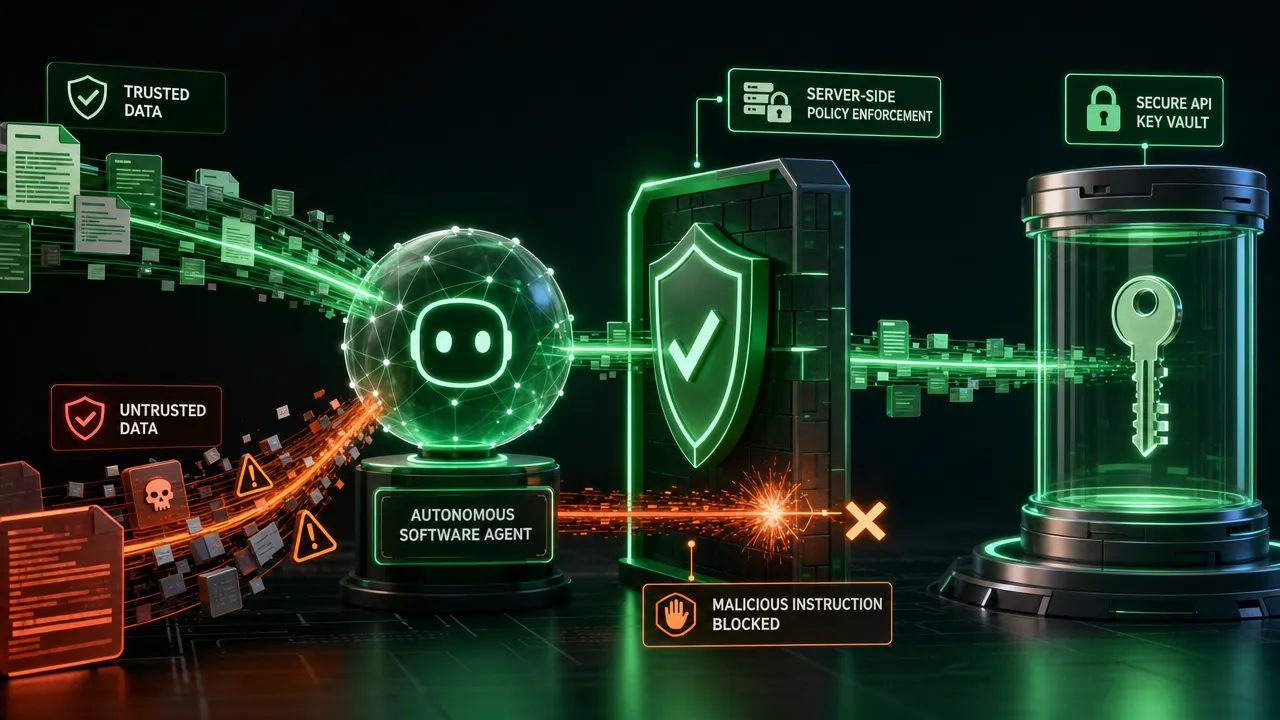
Agentic AI infrastructure needs an AI gateway for agent workloads
An AI gateway for agent workloads can act as the controlled path between an application backend and model inference. The agent submits an inference request to the backend. The backend verifies the workload, validates the request, retrieves the upstream credential within a protected environment, and sends approved traffic to the gateway or model router.

In this reference architecture, the gateway is a policy point, not a magical security layer. Depending on the platform and configuration, AI gateways may support controls such as request limits, token quotas, authorization rules, telemetry, and content controls. Azure API Management's AI gateway documentation provides examples of these capability categories.
For an agent workflow, the backend should validate more than the model request itself. It should check:
Which workload is calling.
Which model and endpoint are permitted.
Whether the request fits expected schemas and size limits.
Whether tool-related data includes a disallowed destination or sensitive information.
Whether the workflow has reached a retry or token-use threshold.
Whether a high-impact action requires human approval.
Treat model-generated tool intent as an untrusted proposal. The model may suggest an action, but deterministic application logic must decide whether the action is authorized.
Agentic AI infrastructure is broader than an inference layer
An AI inference layer for agents is essential, but it is only one part of production-ready agentic AI infrastructure. A durable stack separates inference access from orchestration, tool permissions, state management, and operational visibility.
Infrastructure layer | What it does | Key-isolation relevance |
|---|---|---|
Agent orchestration | Plans tasks and manages multi-step execution | Should not contain broad provider secrets |
Identity and access | Identifies users, services, and workloads | Enables least-privilege access and revocation |
Tool-control layer | Validates tool calls and external actions | Prevents model output from becoming automatic authorization |
Inference and routing | Sends approved requests to supported models | Centralizes model access and integration logic |
State and retrieval | Stores conversation and task context | Must not become an accidental secret store |
Observability | Captures traces, errors, latency, and usage | Supports diagnosis without logging credentials |
Deployment security | Protects containers, networks, and runtime configuration | Limits access to mounted secrets and internal services |
This is why an AI gateway should not be described as a complete agent operations platform. It can centralize model traffic, but it does not automatically secure tool permissions, prevent every prompt injection attempt, or replace human review for high-impact actions.
The phrase agentic cloud 2026 is best treated as a planning lens, not a guaranteed market outcome. As teams move agent workflows into production, they will likely place more emphasis on identity boundaries, policy enforcement, observability, resilience, and cost per completed task. Those are practical engineering needs, not a reason to overstate what any single layer can provide.
Agentic AI infrastructure can use GonkaRouter for focused model access
For teams building a multi-model API for AI agents, GonkaRouter can serve as a unified inference-access layer in the application backend. It is an AI Gateway and AI Model Router with OpenAI-compatible and Anthropic-compatible API formats.
GonkaRouter currently provides one API for these supported models only:
Currently supported model | Relevant API term | Example evaluation use |
|---|---|---|
MiniMax-M2.7 | MiniMax-M2.7 API | Chatbots, content generation, workflow tasks |
Kimi-K2.6 | Kimi-K2.6 API | Agent workflows, Q&A, structured prompts |
GLM-5.2 | GLM-5.2 API | Code generation, data analysis, automation |
This focused scope matters. OpenAI-compatible and Anthropic-compatible describe API-format compatibility. They do not mean access to official OpenAI or Anthropic models.
For GonkaRouter for AI agents, the recommended implementation pattern remains the same: keep the API key in a trusted backend environment, not in client code, prompts, or agent-readable files. The agent can request inference through your application control plane, while GonkaRouter provides the unified model-access path for the currently supported models.
Developers can review one OpenAI-compatible API endpoint for multiple AI models, explore the unified model router API guide, and compare the architectural role of an inference layer and AI gateway for agents.
GonkaRouter supports email-based login, token pricing as low as $0.0004 per 1M tokens, and a one-time 20 USDT trial credit after email login for product testing. Before production use, verify current model availability, pricing, request behavior, and documentation for your workload.
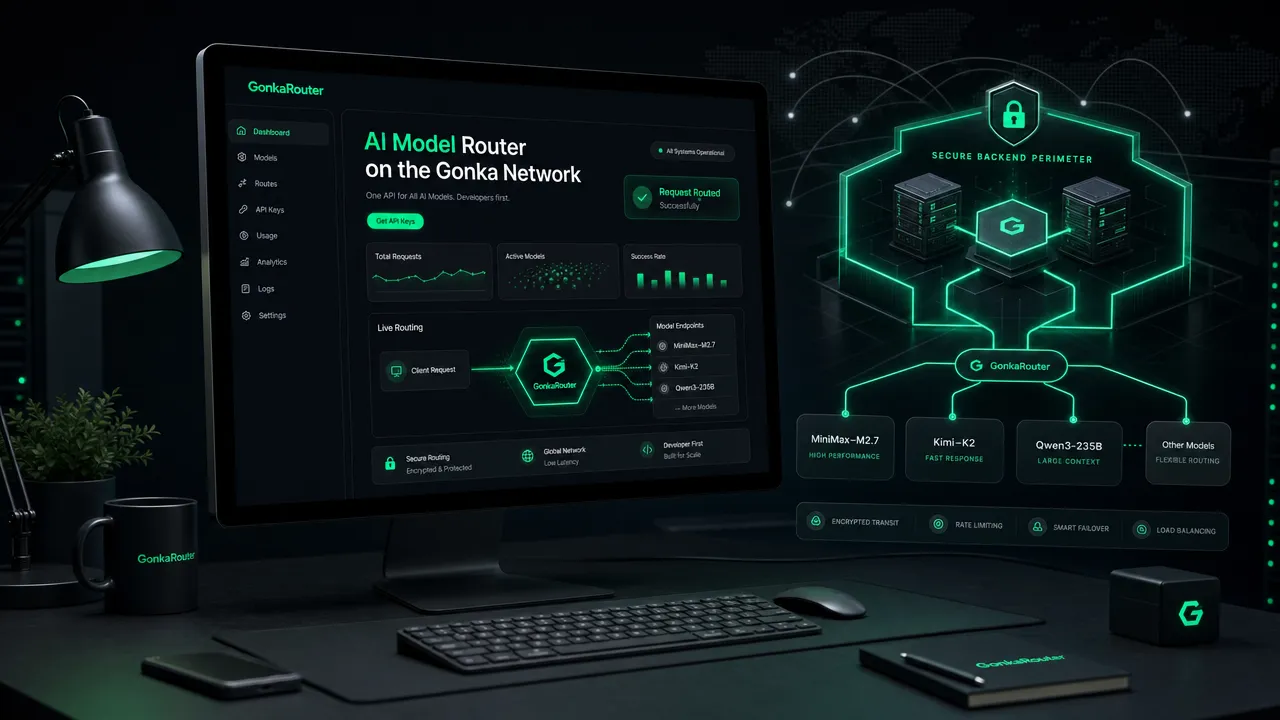
Agentic AI infrastructure production checklist
Before expanding an autonomous workflow, use this checklist:
Remove long-lived provider keys from repositories, browser code, prompts, agent memory, and tool-accessible files.
Store secrets in a managed secret service and retrieve them only in a trusted backend.
Use scoped workload identities or short-lived credentials where the platform supports them.
Separate credentials and policies for development, staging, and production.
Require server-side validation for every tool call, destination, and sensitive action.
Allowlist the models and endpoints appropriate for each workload.
Set application-side timeouts, retry limits, and safe termination conditions.
Redact authorization values and unnecessary sensitive content from logs.
Monitor request volume, token usage, failures, and policy events.
Rotate credentials promptly after suspected exposure and review the incident.
Require human approval for actions with material external impact.
The core lesson is straightforward: autonomous agents should never need to possess the upstream model-provider key. Let the agent request work, let the backend authorize it, and let a controlled inference boundary handle model access. That approach will not eliminate every agent security risk, but it materially reduces credential exposure while keeping model integration more manageable.