AI agents need both model execution and model-access control once their workflows become multi-step, tool-enabled, and operationally important. In practical terms, agentic AI infrastructure needs an inference function to generate outputs and a gateway function to keep requests portable, manageable, and easier to operate.
A prototype can often begin with a direct AI Inference API. But an agent that repeatedly calls models, passes results to external tools, and serves multiple users quickly exposes the gaps in a direct-only integration. The right architecture separates what the agent does from how it reaches a model.
Why agentic AI infrastructure needs separate execution and control functions
An AI agent is not a single prompt-response interaction. It may interpret a request, retrieve context, call a model, request a tool action, validate the result, and make follow-up model calls before returning an outcome. Anthropic's guidance on building effective AI agents describes this combination of models, tools, and orchestration.
That repeated loop is why agentic AI infrastructure has more operational requirements than a basic chatbot:
Sequential latency: Each model and tool call adds to end-to-end response time.
Failure handling: A timeout, invalid tool argument, or unavailable endpoint can interrupt the run.
Cost visibility: Multi-step reasoning and changing context sizes can multiply token usage.
Integration consistency: Provider-specific request formats can spread through the application codebase.
Traceability: Developers need to connect an agent's model calls, tool calls, errors, and final action.
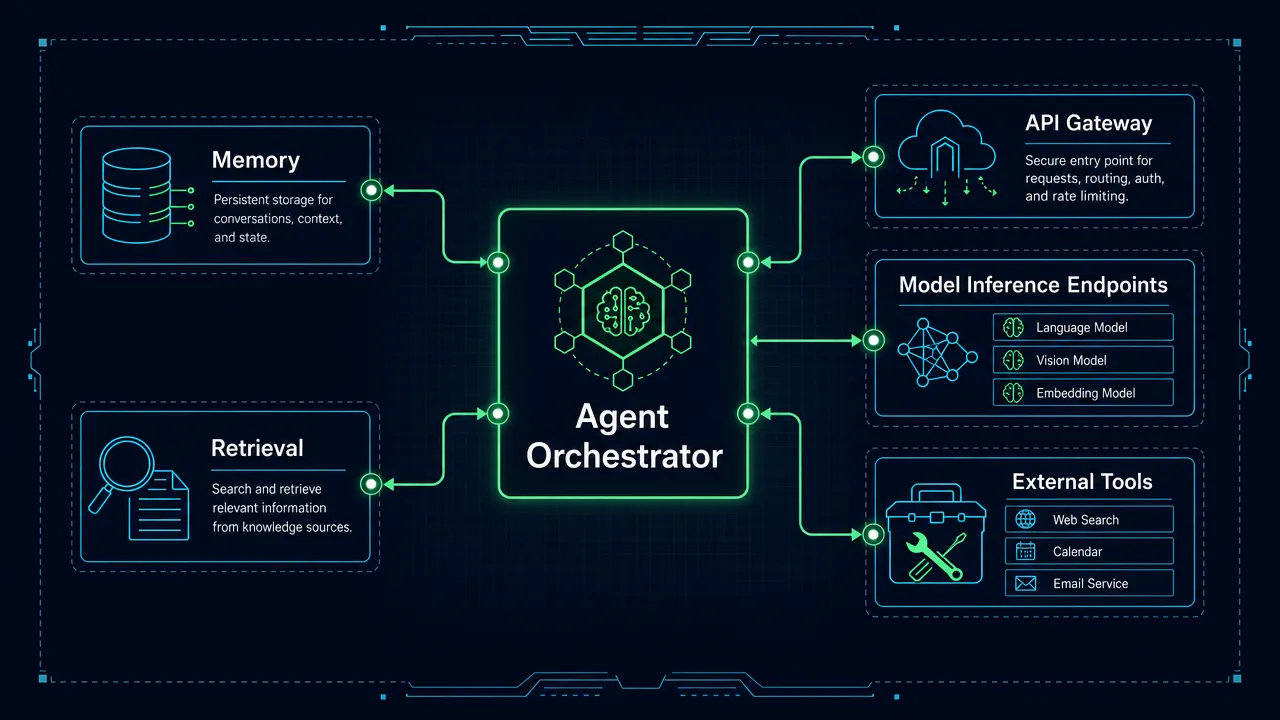
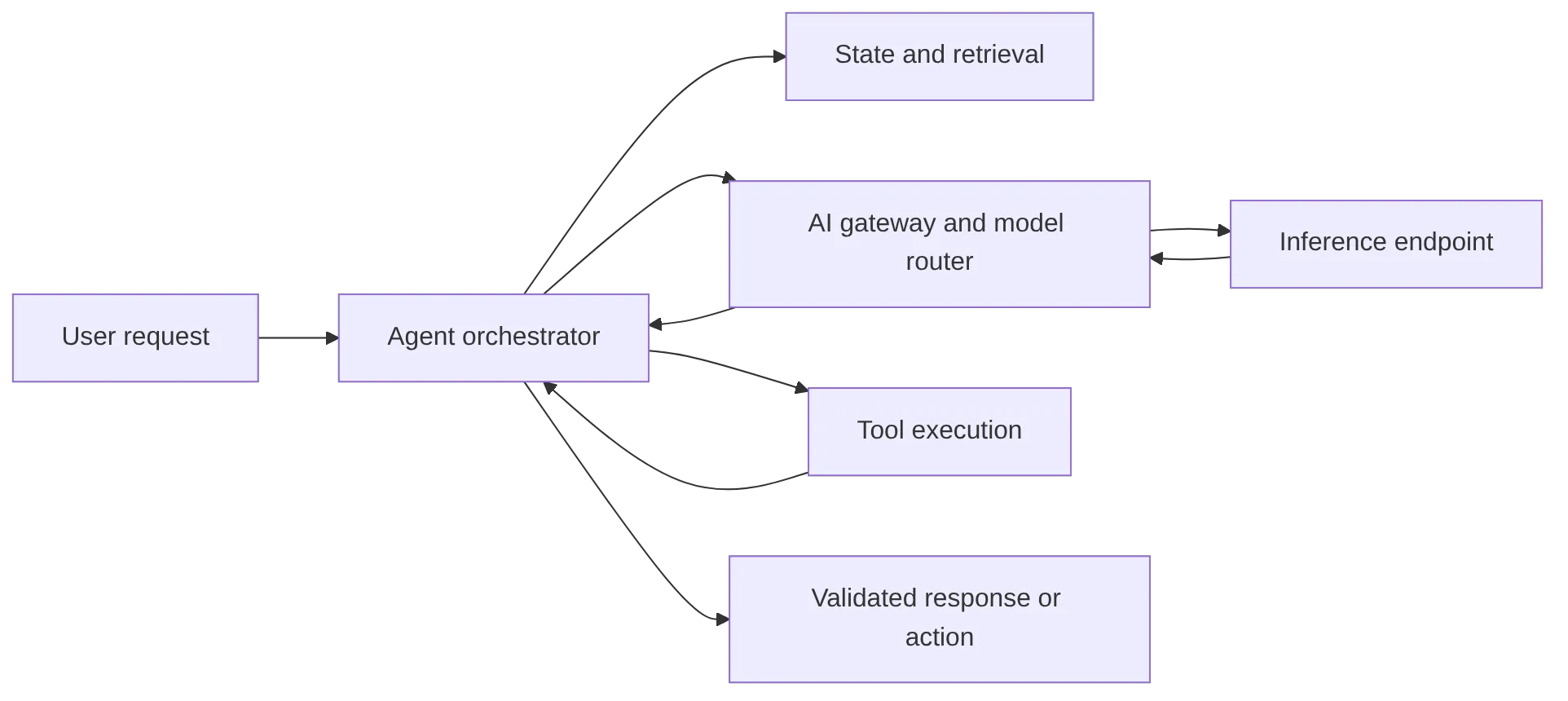
The key distinction is simple: the inference endpoint produces tokens, while the gateway manages the application-facing path to that endpoint.
How agentic AI infrastructure uses an AI inference layer for agents
An AI inference layer for agents executes model requests. It includes the systems and capacity needed to receive prompts, process tokens, run model workloads, and return outputs. In self-managed environments, this can involve GPU capacity, batching, queues, concurrency management, model versions, and serving software such as vLLM or NVIDIA Triton Inference Server.
For many teams, a hosted AI Inference API provides the same essential function without operating model-serving infrastructure directly. This is the practical meaning of model-as-a-service for agents: the agent calls a hosted endpoint instead of managing model weights, server deployment, and hardware scheduling.
Inference-layer responsibility | Why it matters to an agent |
|---|---|
Token generation | Produces planning, classification, summarization, and response outputs |
Capacity management | Helps handle concurrent agent requests |
Queues and batching | Affects response time and throughput under load |
Model serving | Makes supported models available through an endpoint |
Runtime configuration | Can affect output behavior, latency, and stability |
An inference layer alone can be enough when a team has one narrow workflow, one stable model path, and sufficient engineering ownership for retries, telemetry, credentials, and migration logic.
It does not automatically provide those controls. Direct integration leaves the application responsible for request normalization, API-key management, agent traces, budget rules, and a plan for endpoint or model changes.
Where agentic AI infrastructure benefits from an AI gateway for agent workloads
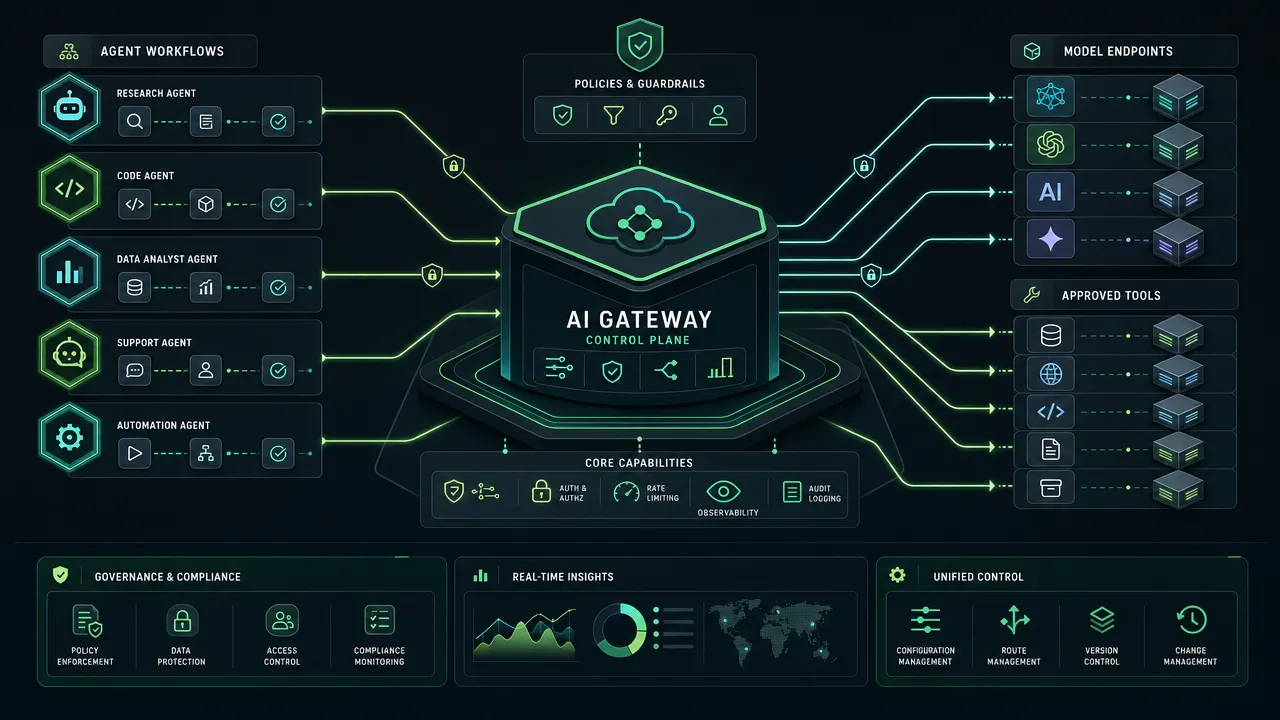
An AI gateway for agent workloads is an API-facing control layer between the agent application and model endpoints. Gateway capabilities differ by product, but common functions include authentication, routing, request normalization, rate limiting, monitoring, caching, and retries. See the documented approaches from Cloudflare AI Gateway and Kong AI Gateway.
For agent developers, the gateway creates a cleaner boundary:
Gateway function | Agent-development value |
|---|---|
Common API surface | Reduces provider-specific logic in orchestration code |
Request normalization | Simplifies use of familiar message and response patterns |
Model routing | Separates model selection from core agent behavior |
Usage controls | Helps teams manage repeated agent calls |
Centralized credentials | Avoids exposing provider credentials across services |
Logging and telemetry where available | Supports debugging across agent workflows |
A gateway is not an inference engine. It does not create GPU capacity, execute tokens by itself, or guarantee the availability of the underlying model endpoint. It also does not replace agent orchestration, tool permissions, evaluation, or approval workflows.
Tool calling makes this boundary especially important. Models can request a function call, but the application must validate arguments, execute only permitted actions, and return results to the model. The function-calling documentation makes clear that applications remain responsible for that execution loop.
Choosing agentic AI infrastructure: inference only, gateway only, or both
The best choice depends on operational complexity, not on whether a team wants a particular label in its stack.
Architecture choice | Best fit | Main tradeoff |
|---|---|---|
Inference only | Early prototype or self-hosted single-model workflow | Application team owns abstraction and operational controls |
Gateway over hosted inference | Teams that need a common integration boundary | Still depends on reliable underlying inference capacity |
Combined architecture | Production agents with tools, multiple workflows, and shared access | Requires clearer system ownership |
Phased approach | Startups validating a use case while protecting future portability | Needs an internal model-client boundary from day one |
A useful rule is to count the sources of complexity. When an agent has repeated calls, tool loops, multiple services, shared credentials, reliability requirements, or usage governance needs, it benefits from both functions.
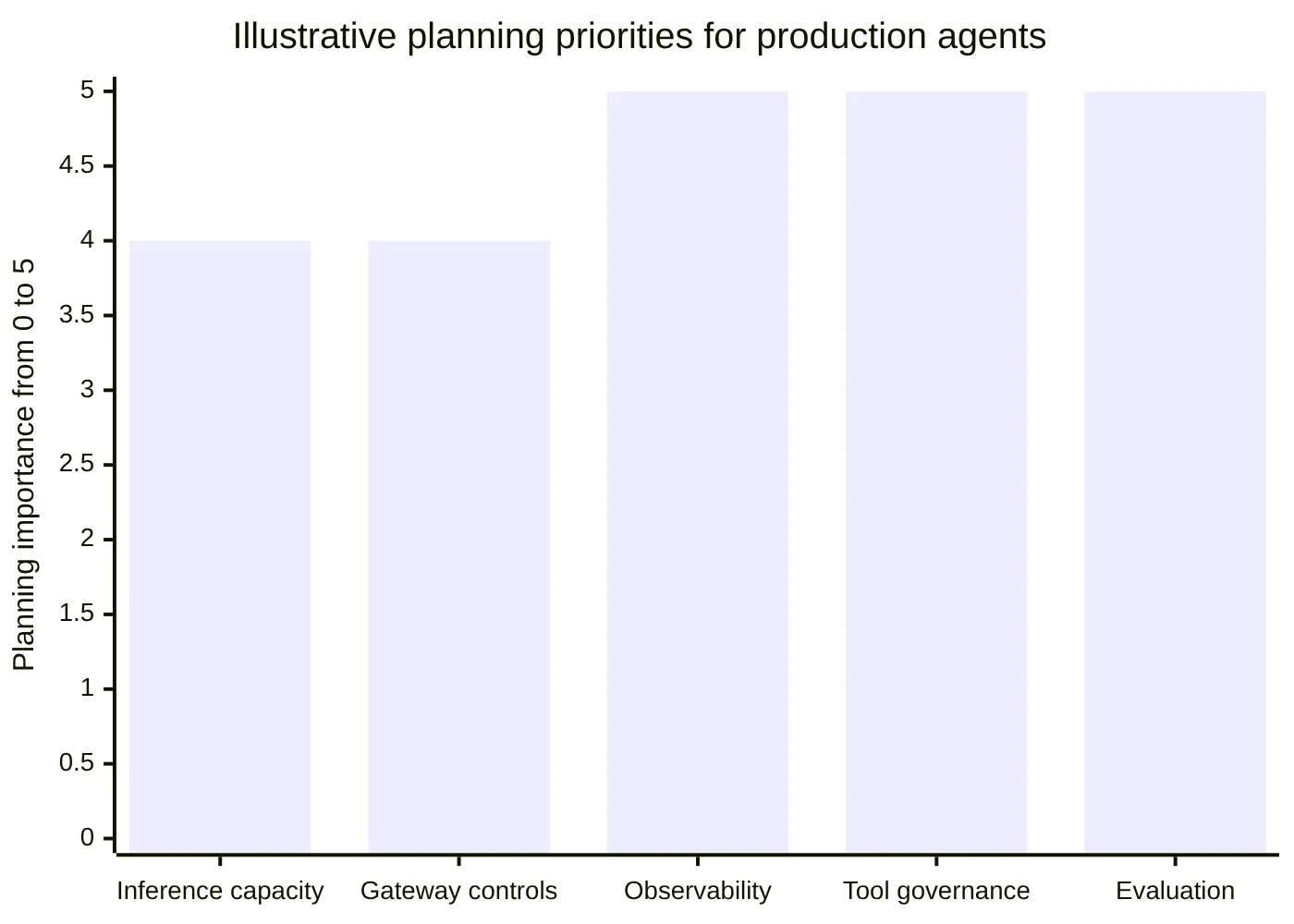
This chart is a planning illustration, not market data. It highlights a practical point: stronger inference alone does not solve tool authorization, workflow recovery, or debugging.
An agent operations platform can sit above these layers. It may provide traces, evaluations, monitoring, and governance across full agent runs. OpenTelemetry provides a widely used framework for collecting traces, metrics, and logs, but teams should still design their own agent-level events and success criteria.
How GonkaRouter fits agentic AI infrastructure for developers
For developers who need a focused multi-model API for AI agents, GonkaRouter is positioned as an AI Gateway and AI Model Router. Its unified API currently provides access to MiniMax-M2.7, Kimi-K2.6, and GLM-5.2 only.
GonkaRouter supports OpenAI Compatible API and Anthropic Compatible API formats. That compatibility refers to request and response formats, not access to official OpenAI or Anthropic models. This distinction matters when designing integrations, testing tool behavior, and documenting supported features.
The platform can be relevant when an agent team wants one endpoint-based integration path for the currently supported models:
Supported model access | Practical keyword reference |
|---|---|
MiniMax-M2.7 | MiniMax API and MiniMax-M2.7 API |
Kimi-K2.6 | Kimi API and Kimi-K2.6 API |
GLM-5.2 | GLM API and GLM-5.2 API |
GonkaRouter is built on the Gonka decentralized AI compute network and offers token pricing as low as $0.0004 per 1M tokens. Developers can log in with email, receive a one-time 20 USDT trial credit for product usage, get an API key, and test supported models before integrating them into an agent application.
For product context, see the platform's explanation of its unified API approach, its guide to developer model-routing concepts, and its overview of the developer-focused routing service.
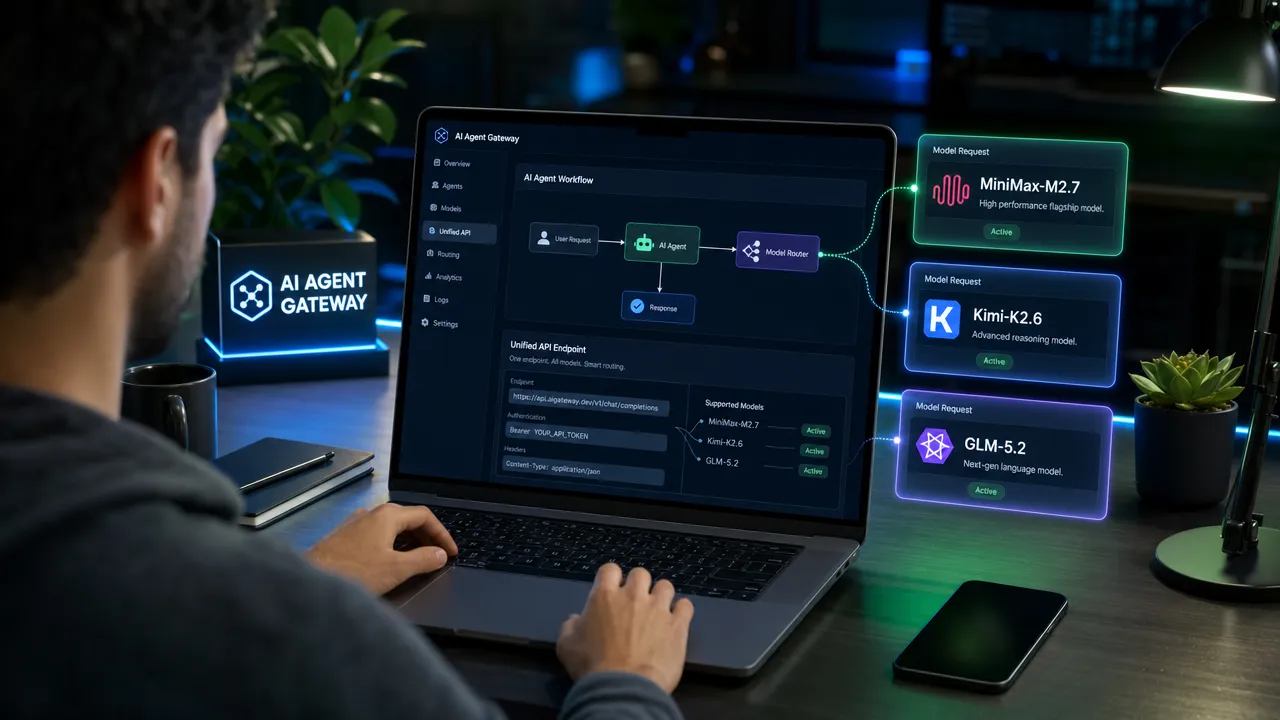
GonkaRouter for AI agents is most useful as a model-access boundary, not as a replacement for application-owned agent logic. Teams should continue to own tool validation, permission scopes, retry limits, durable workflow state, and evaluation.
Before placing business-critical workloads into production, verify the current endpoint details, model IDs, streaming support, rate limits, privacy terms, logging behavior, and support process through the available GonkaRouter blog resources.
What agentic AI infrastructure should prepare for in agentic cloud 2026
The agentic cloud 2026 outlook points toward more agent workloads that are measurable, controlled, and recoverable. This is a scenario-based planning view, not a guaranteed forecast. Still, as tool-using agents become more common, infrastructure choices will increasingly be shaped by reliability, governance, and operational visibility rather than raw model access alone.
A durable architecture should keep these responsibilities separate:
Orchestration: The application decides the workflow and validates actions.
Inference: Model infrastructure executes requests and returns outputs.
Gateway control: A routing boundary standardizes access to supported model endpoints.
Operations: Traces, evaluations, alerts, and policies help teams improve runs over time.
The practical answer is clear. A simple agent may need only hosted inference access and a small internal adapter. A production agent usually needs inference capability plus a gateway or routing layer, whether those functions come from separate systems or one integrated stack.
Use an AI Model Router when you need a clean path to compare or select among supported models. Use an AI gateway when your agent workloads require consistent integration and centralized controls. Use both functions when the agent's failures, costs, tool actions, and reliability are too important to leave scattered across application code.