Early AI prototypes often begin with a single model endpoint and one API key. That approach can work for a narrow use case. But production systems change the equation. Teams add AI Agents, automated workflows, chat experiences, evaluation pipelines, and multiple model options. At that point, model access stops being simple application glue code and becomes an infrastructure decision.
This is why the conversation around LiteLLM and Oracle Generative AI matters. They represent two different patterns: a configurable gateway layer and a managed cloud AI platform. Neither pattern is universally right, but both reflect the same shift: organizations increasingly need a stable boundary between applications and changing model choices.
Why an AI model router API is becoming infrastructure
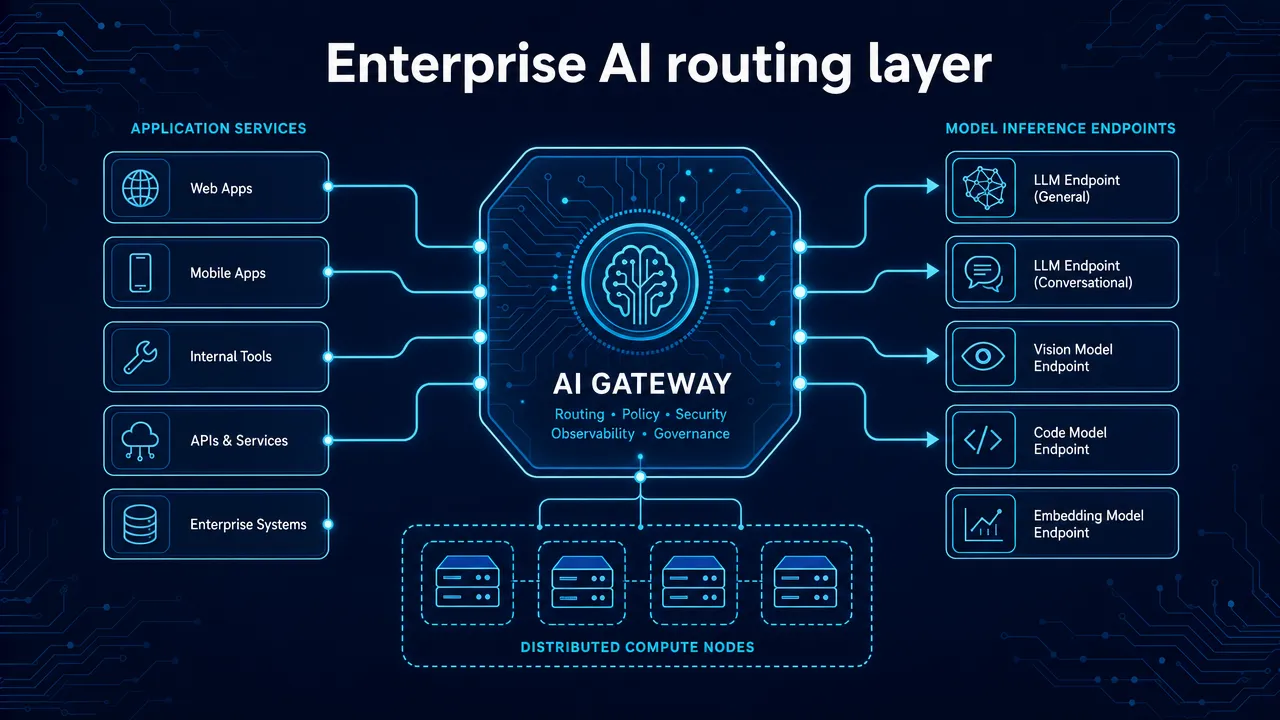
An AI model router API sits between an application and one or more model endpoints. At its most basic, it provides a consistent request surface so developers do not need to embed different SDKs, authentication patterns, request schemas, and error-handling logic across every product.
That distinction matters. A router does not automatically imply intelligent model selection, automatic failover, policy controls, or cost optimization. Those are separate capabilities that must be verified platform by platform.
Still, the architectural value is clear. A unified layer can help teams separate their product logic from the details of individual model integrations. This is increasingly useful as AI moves from isolated experiments into broader operational use. McKinsey reports that 88 percent of surveyed organizations use AI in at least one business function, while only about one-third have started scaling AI across the enterprise. McKinsey's State of AI research suggests that adoption is advancing faster than repeatable production operating models.
For developers, the practical question is not whether every workload needs a gateway. It is whether maintaining direct integrations is still the simplest and most reliable approach.
Situation | Direct integration can fit | A unified layer becomes worth evaluating |
|---|---|---|
Model usage | One stable model and provider | Multiple models or regular model evaluation |
Product architecture | One application with limited AI calls | Several products, teams, Agents, or workflows |
Maintenance | Provider-native features are essential | Multiple SDKs and endpoint conventions create overhead |
Migration | Model choice is unlikely to change | Model switching and regression testing are expected |
Operations | Each product can own its own credentials and retries | Teams need a consistent model-access boundary |
AI model router API patterns: LiteLLM and Oracle
LiteLLM and Oracle Generative AI are often mentioned in the same broad infrastructure conversation, but they represent different categories.
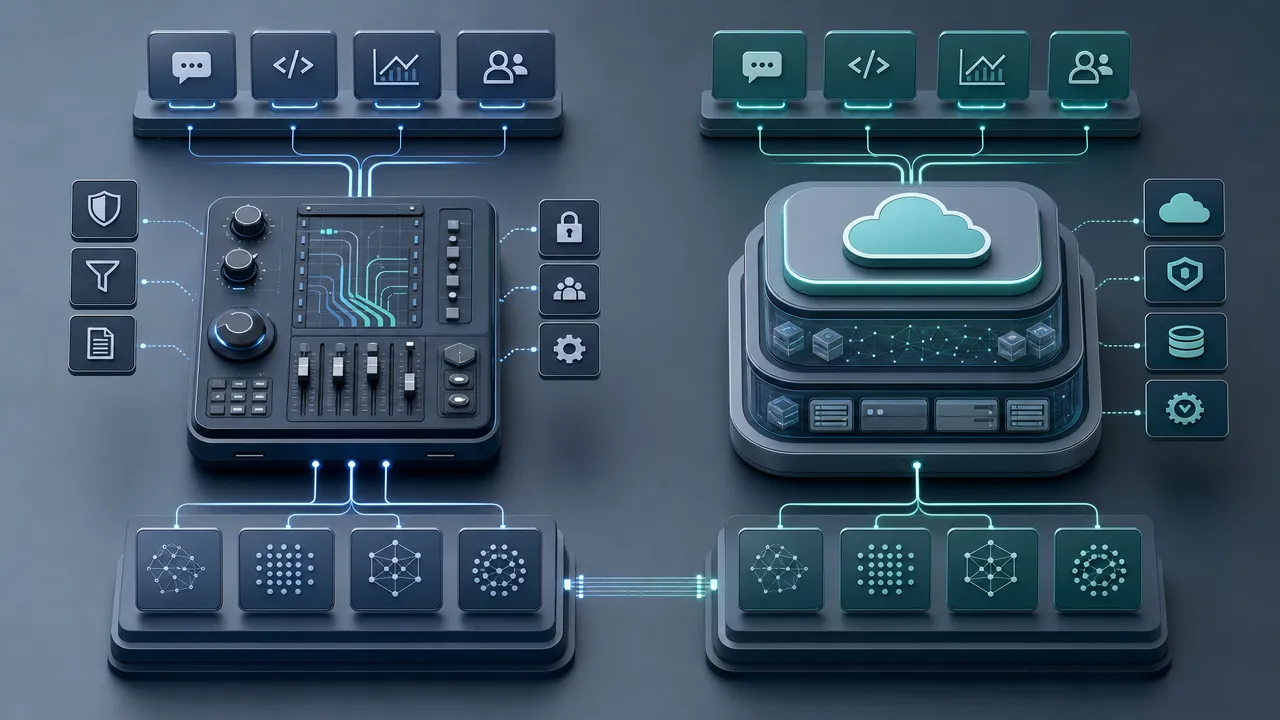
LiteLLM illustrates the programmable gateway pattern. Its open-source proxy approach provides a common interface for accessing a broad range of providers, while allowing organizations to configure and operate a shared control layer. Its documented capabilities include OpenAI-style API access, load balancing, virtual keys, budgets, and usage-related controls. The core idea is that the organization can centralize the model access layer instead of repeating integration work across applications.
Oracle Generative AI illustrates the managed cloud-platform pattern. It combines generative AI capabilities with the wider OCI environment, including cloud identity, networking, endpoints, governance-oriented controls, and agent-building support. It is not best understood as a neutral, cross-cloud routing layer. Instead, it is a managed platform choice for organizations building within a cloud ecosystem.
The difference is important:
A programmable gateway emphasizes abstraction and configuration.
A cloud AI platform emphasizes managed infrastructure and cloud integration.
An inference platform emphasizes model serving and performance delivery.
A hosted aggregator emphasizes fast access to multiple available model options.
These categories overlap, but they are not interchangeable. Teams should avoid feature-by-feature comparisons unless capabilities, data handling, service limits, and commercial terms have been reviewed on the same date.
AI model router API benefits and limits for developers
A well-chosen AI model router API can simplify the integration boundary, but it does not remove the need for engineering discipline. A unified LLM API makes requests more consistent. It does not make model behavior identical.
For example, models can differ in output quality, latency, context handling, structured-output behavior, tool-call formatting, refusal behavior, and error modes. API-format compatibility can lower migration effort, but compatibility is not a guarantee of complete feature parity.
This is especially important for AI Agents. A single user request may trigger several model calls for planning, retrieval synthesis, tool interpretation, validation, and final response generation. In this context, token cost alone is not enough. Teams should measure cost per completed task, error recovery, response consistency, and workflow latency.
A practical evaluation checklist should include:
Request compatibility: Confirm supported endpoints, streaming behavior, parameters, and response formats.
Output quality: Test models with real prompts, real workflows, and representative evaluation data.
Latency: Measure end-to-end task completion, not only first-token response.
Failure handling: Test timeouts, malformed outputs, retries, and downstream recovery.
Data handling: Review the full processing path, logging practices, retention terms, and access controls.
Operational ownership: Determine who owns monitoring, upgrades, credential rotation, and incident response.
A router can reduce duplicated integration work. It cannot replace workload-specific testing.
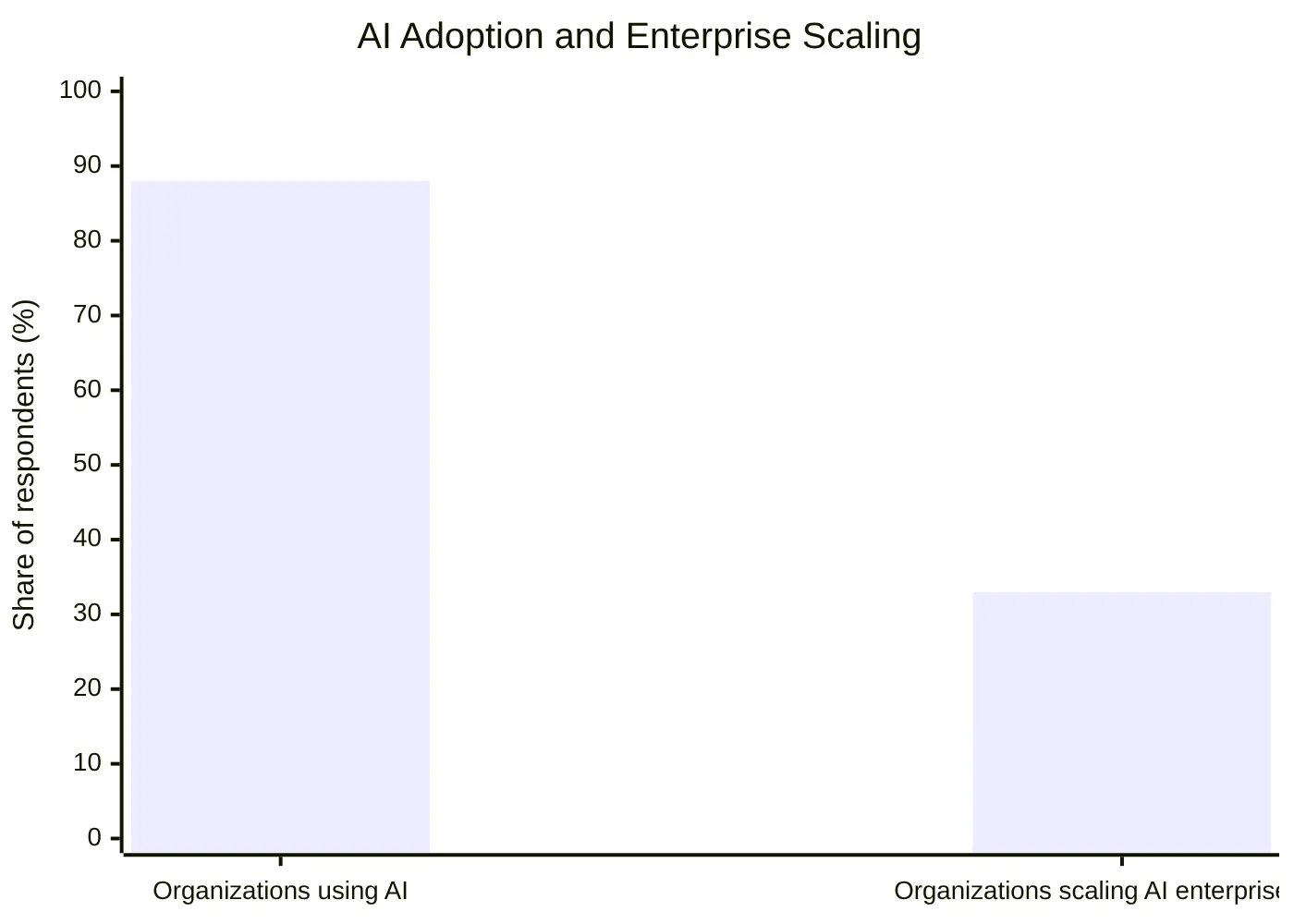
The chart reflects McKinsey's reported survey figures and should be read as adoption context, not as proof that every organization needs an AI gateway.
AI model router API options for focused model access
For teams that want a focused multi model API rather than a broad marketplace-style catalog, GonkaRouter provides one unified access point for its currently supported models:
MiniMax-M2.7
Kimi-K2.6
GLM-5.2
GonkaRouter is an AI Gateway and AI Model Router built on the Gonka decentralized AI compute network. It supports OpenAI-compatible and Anthropic-compatible API formats. This refers to API-format compatibility only. It does not mean access to official OpenAI or Anthropic models.
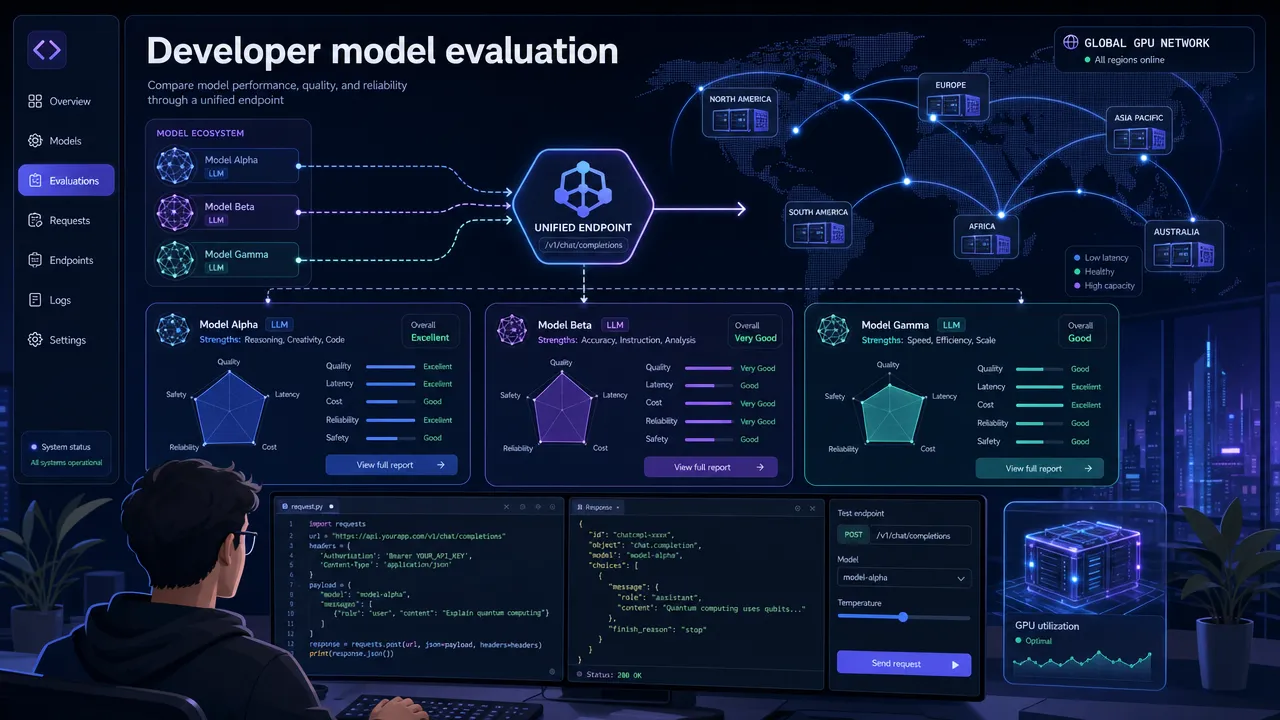
For compatible applications, developers can begin by changing the API endpoint, using a GonkaRouter API key, and selecting one of the supported models. The goal is to reduce the integration work involved in testing MiniMax-M2.7, Kimi-K2.6, and GLM-5.2 across product scenarios such as AI Agents, chatbots, code generation, automated workflows, content generation, intelligent Q&A, and data analysis.
For more technical context, review the endpoint integration overview, the explanation of the underlying distributed compute context, and the model access guide.
GonkaRouter offers email-based onboarding. New users receive a one-time 20 USDT trial credit after logging in with email. Token pricing is as low as $0.0004 per 1M tokens. Developers should validate actual output quality, latency, and workload cost with their own prompts before moving a production workflow forward.
Choosing an AI model router API without overpromising
The strongest architecture decisions are narrow, testable, and based on the workload at hand. A company using one stable provider and relying on provider-native features may be better served by direct integration. A company evaluating multiple models, maintaining several AI products, or building Agent workflows may benefit from a unified AI endpoint.
The key is to avoid treating broad category labels as guarantees. An AI gateway may or may not include routing automation, budgets, analytics, observability, policy controls, or failover. An OpenAI Compatible API may simplify familiar request patterns, but it does not guarantee access to official OpenAI models or full API-feature parity.
For a focused evaluation of supported models, the next path is straightforward:
Log in with email.
Receive the one-time 20 USDT trial credit.
Get an API key.
Update the endpoint in a compatible application.
Test MiniMax-M2.7, Kimi-K2.6, and GLM-5.2 with production-like tasks.
Compare task quality, latency, failures, and total usage cost.
Review the privacy policy and service terms before production deployment.
Enterprise AI infrastructure is not defined by how many model names a platform can list. It is defined by whether the integration boundary, operating model, and evaluation process fit the work being done. A focused AI model router API can make that evaluation faster, provided teams remain precise about supported models, compatibility boundaries, and real-world performance.