Engineering teams use an LLM gateway to turn fragmented model integrations into a controlled API boundary for routing, reliability, cost management, and governance.
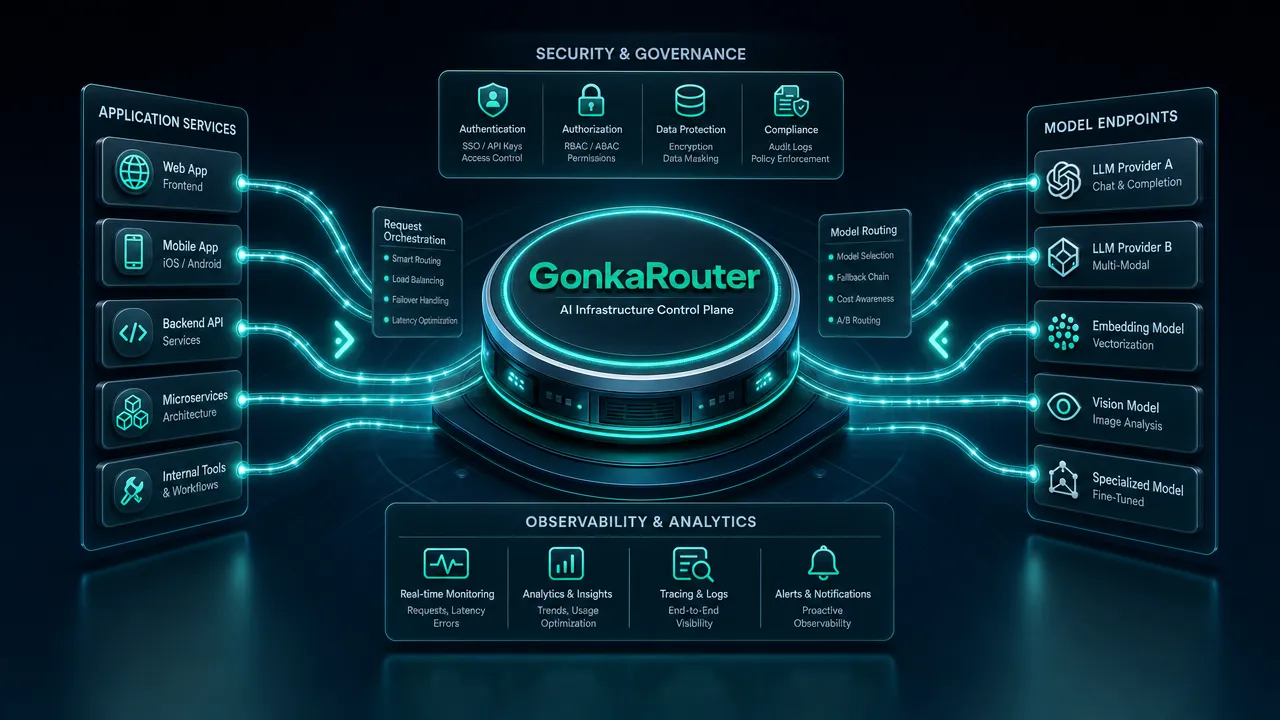
Create a controlled boundary for model access
An llm gateway sits between an application and one or more model-serving endpoints. Instead of embedding provider SDKs, API keys, model IDs, retry logic, and billing instrumentation throughout every service, applications call a unified LLM API while the gateway manages upstream differences.
This pattern is often called an AI gateway, model routing API, AI provider aggregation layer, or model router. The labels overlap, but the responsibilities are distinct:
Component | Primary responsibility |
|---|---|
LLM gateway | Authentication, policy, request normalization, routing, limits, logging, and usage metering |
Model router | Chooses an eligible model, provider, deployment, or region |
Inference platform | Executes models on managed or self-hosted infrastructure |
Agent framework | Coordinates planning, tools, state, memory, and execution |
Observability platform | Captures traces, latency, token use, errors, and evaluation signals |
A gateway does not replace an agent runtime or model host. It creates a reusable control layer around inference traffic. LiteLLM's proxy architecture and Kong AI Gateway documentation describe this pattern as a policy and traffic-management layer for AI requests.
For example, an internal alias such as model-router/default can remain stable in application code while the platform team changes the approved upstream route. This makes it easier to route requests between LLMs without a repository-wide rewrite.
Centralize reliability and cost controls
The initial motivation is usually integration simplicity. The production motivation is operational control.
A multi-provider LLM environment has different authentication methods, API schemas, model capabilities, rate limits, pricing models, streaming behavior, context windows, and error formats. A gateway centralizes those concerns and supports several high-value controls:
LLM failover for pre-approved timeout, rate-limit, and selected server-error conditions.
LLM load balancing across equivalent deployments or providers.
LLM cost optimization through budgets, token-aware quotas, caching, and route-level attribution.
LLM observability with traces, token counts, route selections, retry events, and latency metrics.
Model fallback routing for resilient low-risk workloads.
Credential isolation so upstream provider keys are not distributed across every application or agent.
Policy enforcement for model allowlists, tenant limits, regions, and data classes.
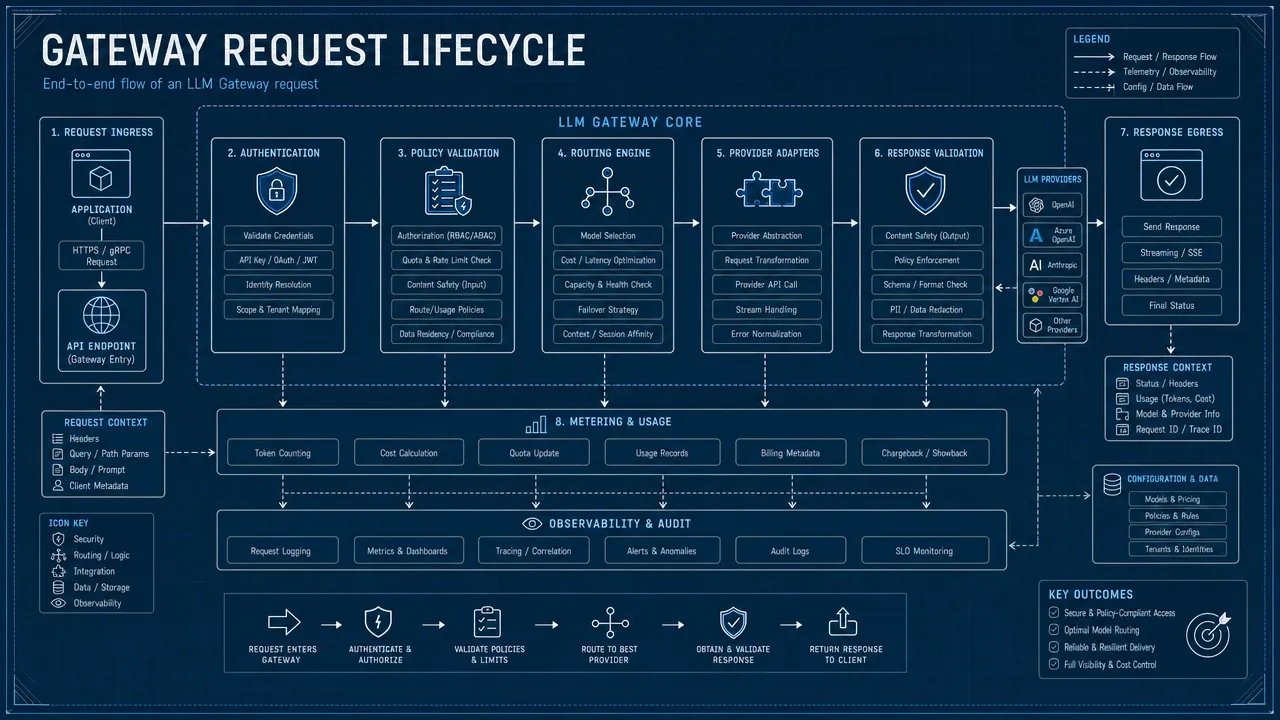
A practical request path looks like this:

A gateway should evaluate eligibility before optimization. A low-cost route is not eligible if it lacks required tool calling, exceeds data-handling restrictions, cannot support the needed context length, or has not passed structured-output tests.
The useful metric is not merely token price. Teams should track cost per accepted task:
Cost per accepted task=cost of initial attempts, retries, fallbacks, and repairsquality-accepted task completions\text{Cost per accepted task} = \frac{\text{cost of initial attempts, retries, fallbacks, and repairs}} {\text{quality-accepted task completions}} Cost per accepted task=quality-accepted task completionscost of initial attempts, retries, fallbacks, and repairs
That calculation helps teams reduce LLM costs without accidentally routing critical work to a model that creates invalid JSON, weak tool calls, or repeated remediation work.
Support routing, fallback, and agent workloads safely
An AI routing engine can use deterministic rules, dynamic signals, or both. Start with rules that engineers can inspect and test before introducing intelligent model routing or semantic routing LLM classifiers.
Routing strategy | Useful signal | Typical use case |
|---|---|---|
Static routing | Fixed model alias | Stable production workflow |
Context-aware routing | Input length and output reserve | RAG, coding, or long conversations |
Cost-aware routing | Estimated token usage and budget | High-volume summarization |
Latency-aware routing | Recent response time and queue state | Interactive applications |
Weighted routing | Configured deployment weights | Canaries and capacity balancing |
Semantic routing LLM | Intent, domain, or task complexity | Diverse assistant workloads |
Escalation routing | Validation failure or confidence signal | Extraction and review pipelines |
Fallback routing | Retryable upstream failure | Resilience-critical paths |
For agent systems, route selection should follow the agent step rather than a single global default. Intent classification may prioritize speed and cost, while tool calling needs proven schema adherence. Planning may need stronger reasoning behavior, and final-response generation may prioritize user-facing quality.
This makes an llm gateway for agents particularly useful. It gives every agent call a consistent identity, budget, trace ID, route history, and policy check while the agent framework retains ownership of tools, state, idempotency, and stop conditions.
Never silently fail over an irreversible tool action to an untested model. A fallback route can differ in tool argument quality, safety behavior, output structure, context capacity, or data-processing path.
For implementation guidance, see GonkaRouter's articles on semantic routing and model fallback and how to route requests between LLMs smoothly.
Know what a gateway cannot standardize
An OpenAI-compatible endpoint is useful transport compatibility, not behavioral equivalence. A client may send the same request shape to multiple providers, but models can still differ materially in:
Tool calling and function argument validity.
Structured-output and JSON schema behavior.
Streaming events and time-to-first-token behavior.
Context limits and token accounting.
Image, audio, video, or multimodal support.
Safety controls and refusal behavior.
Cache controls, reasoning settings, and provider-specific parameters.
That distinction matters when teams need to switch between Claude and GPT, evaluate Groq models, use AWS Bedrock models, or combine hosted and open-weight deployments. A model family name alone does not establish the same deployment, version, API feature set, or regional availability.
A capability matrix should define every approved route:
Capability | Example validation |
|---|---|
Context capacity | Long-input test with reserved output tokens |
Tool calling | Schema-valid arguments across representative tasks |
Structured output | JSON validation and repair-rate measurement |
Streaming | Event order, cancellation, and timeout tests |
Safety and policy | Approved behavior for the workload |
Fallback safety | Equivalent tests for alternate routes |
This is why OpenAI-compatible endpoints alone do not solve multi-model infrastructure. Compatibility reduces integration work, but it does not remove the need for route testing and explicit policy.
Decide when a gateway is worth operating
A direct provider integration is often best for a narrow, stable workload that depends heavily on native features. It has fewer hops, fewer components, and less abstraction mismatch.
An LLM gateway becomes more compelling when several applications, teams, tenants, or agents need shared infrastructure controls.
Situation | Sensible starting approach |
|---|---|
Prototype | Direct provider integration, configurable model ID, hard spend cap |
Startup with production traffic | Thin internal model client or managed gateway |
Multi-team platform | Unified LLM API with shared budgets, tracing, and policy |
Agent-heavy product | AI gateway for agents with step-level routing and idempotency |
Regulated environment | Governed or self-hosted LLM gateway with strict logging controls |
High-volume workload | Token-aware rate limits, caching, queues, and cost-quality measurement |
Self-hosted options can suit teams that require private networking, custom adapters, or a hybrid stack containing both external APIs and private inference. However, an open-source LLM gateway deployment also creates operational work: high availability, secret rotation, database state, cache isolation, upgrades, monitoring, and incident response.
Managed routing layers reduce that burden but require scrutiny of data paths, retention, export options, availability design, and pricing mechanics. The right choice is not automatically the cheapest LLM API or an openrouter alternative cheap enough for a single benchmark. It is the architecture that delivers acceptable quality, reliability, policy compliance, and cost per successful task.
A focused routing product such as GonkaRouter can be one option for teams evaluating a compatible model-access layer. Evaluate any provider or router against documented capabilities rather than assuming that provider aggregation automatically includes failover, BYOK, observability, or governance.
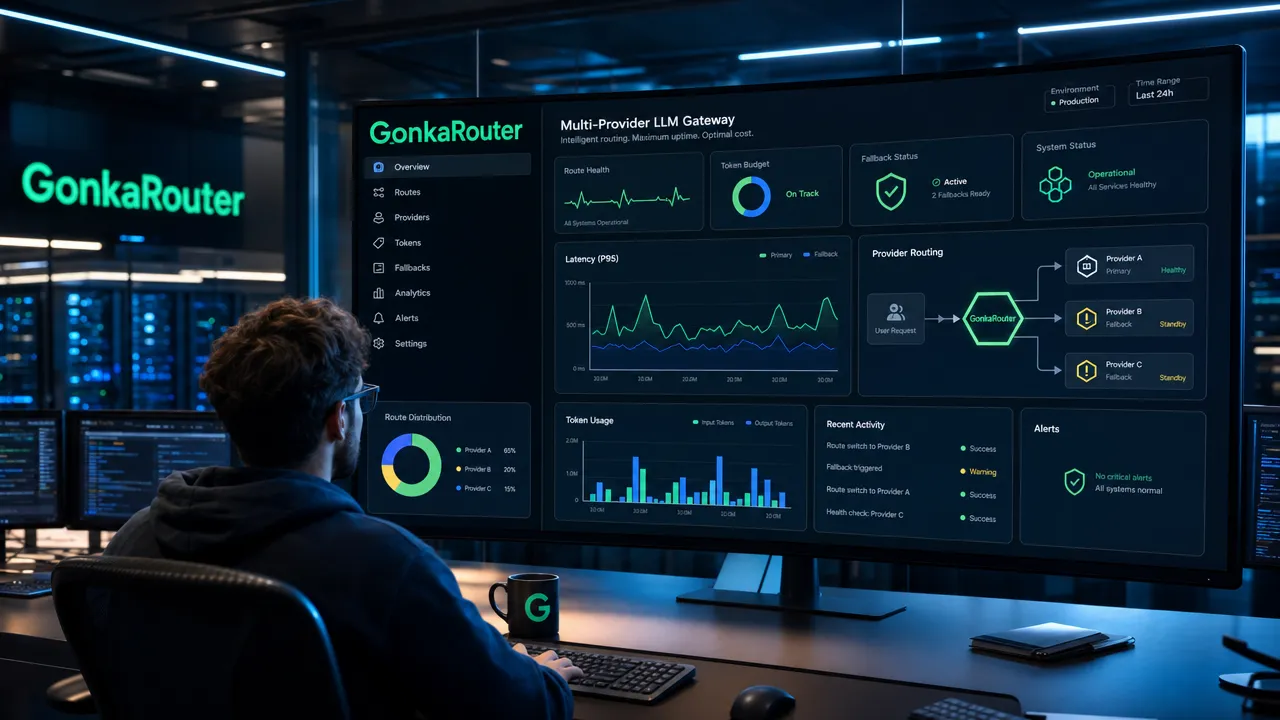
Questions to answer before adoption
The most useful procurement and architecture questions are concrete:
Which models and providers are actually approved for each workload?
What errors are retryable, and which errors must return immediately?
Can fallback models pass the same tool-use and structured-output tests?
How are spend, tokens, retries, and cache hits attributed to a tenant or feature?
What prompts, completions, and metadata are logged, redacted, or retained?
Can the gateway expose route decisions and telemetry to existing observability tools?
Is there a tested bypass or rollback path if the gateway itself is unavailable?
The durable value of an LLM gateway is not that it promises every model through one endpoint. It gives teams a stable, observable, and governable boundary so model choices can evolve without turning every application integration into infrastructure debt.
Teams considering a managed option can review GonkaRouter's current model catalog and validate one representative workload before committing production traffic.