Amazon SageMaker AI's move toward OpenAI-compatible APIs for real-time inference endpoints is more than a convenience update. It is evidence that familiar API contracts are becoming an increasingly common de facto integration pattern for AI infrastructure.
AWS documents an OpenAI-style /openai/v1/chat/completions path for eligible SageMaker AI real-time endpoints. Developers using the OpenAI SDK, LangChain, or Strands Agents can reuse established workflows by changing endpoint configuration rather than rebuilding a provider-specific client. That does not make every AI API identical, but it does reduce friction at a critical layer of the stack.
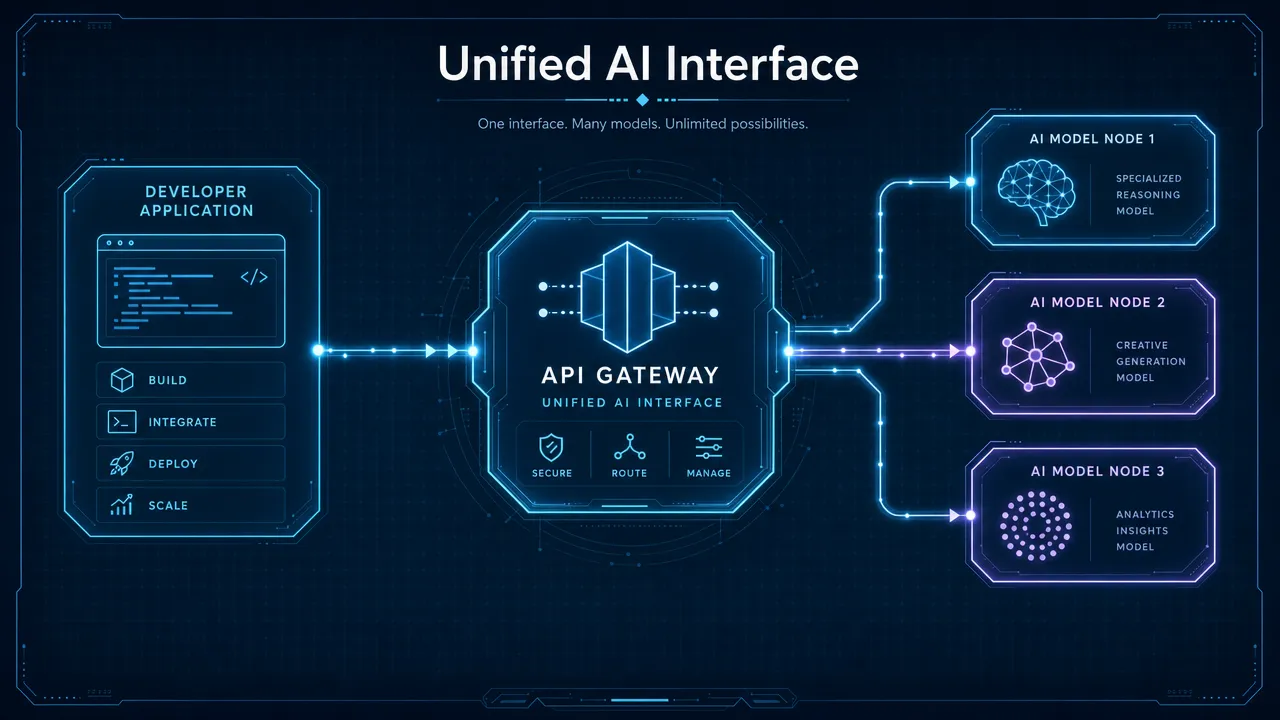
Why the GonkaRouter API reflects a broader interface shift
The strategic value of API compatibility is not that one format becomes a legally defined global standard. It is that developers already have tooling, testing practices, prompt pipelines, and application code shaped around familiar interfaces.
When an infrastructure provider accepts an OpenAI-style request format, teams may be able to preserve more of their existing work:
SDK configuration and client initialization.
Chat message structures and generation settings.
Streaming response handling.
Logging, tracing, and retry wrappers.
Agent-framework adapters.
Evaluation workflows and test prompts.
AWS's announcement should be read with an important qualifier. Its documented compatibility applies to SageMaker AI real-time inference endpoints, not every AWS AI service or every possible OpenAI API surface. Still, the direction is clear: familiar interfaces reduce switching costs.
The AWS announcement on OpenAI-compatible SageMaker AI endpoints and its technical documentation both reinforce this practical message. The endpoint becomes part of the developer experience, not merely a transport detail.
For teams building applications around a focused set of supported models, the GonkaRouter API follows the same architectural principle. It provides one API for MiniMax-M2.7, Kimi-K2.6, and GLM-5.2, while supporting OpenAI-compatible and Anthropic-compatible API formats.
What the GonkaRouter API compatibility model means
An OpenAI-compatible AI gateway accepts a defined portion of an OpenAI-style API contract. In practical terms, that can let a developer reuse a familiar client pattern and update the endpoint configuration. It does not mean the gateway provides official OpenAI models.
The same distinction applies to an Anthropic-compatible AI gateway. Anthropic-compatible access refers to compatibility with an Anthropic-style API format. It does not mean official Anthropic models are available.
This separation between interface and model availability matters. A compatible API is an integration layer. The model catalog, supported endpoints, parameter behavior, streaming events, authentication, rate limits, and output capabilities still need to be validated for the specific service.
Concept | What it means | What it does not mean |
|---|---|---|
OpenAI Compatible API | A provider supports an OpenAI-style request and response format for documented operations. | Official OpenAI model access or universal endpoint parity. |
Anthropic Compatible API | A provider supports an Anthropic-style API format for documented operations. | Official Anthropic model access or identical feature behavior. |
AI Model Router | A model-access layer that directs requests to selected supported models. | An agent runtime that manages tools, memory, or permissions. |
Multi Model API | One API layer for more than one supported model. | Access to every provider or every model ecosystem. |
For a deeper explanation of this category, see what an AI model router API is and how it works.
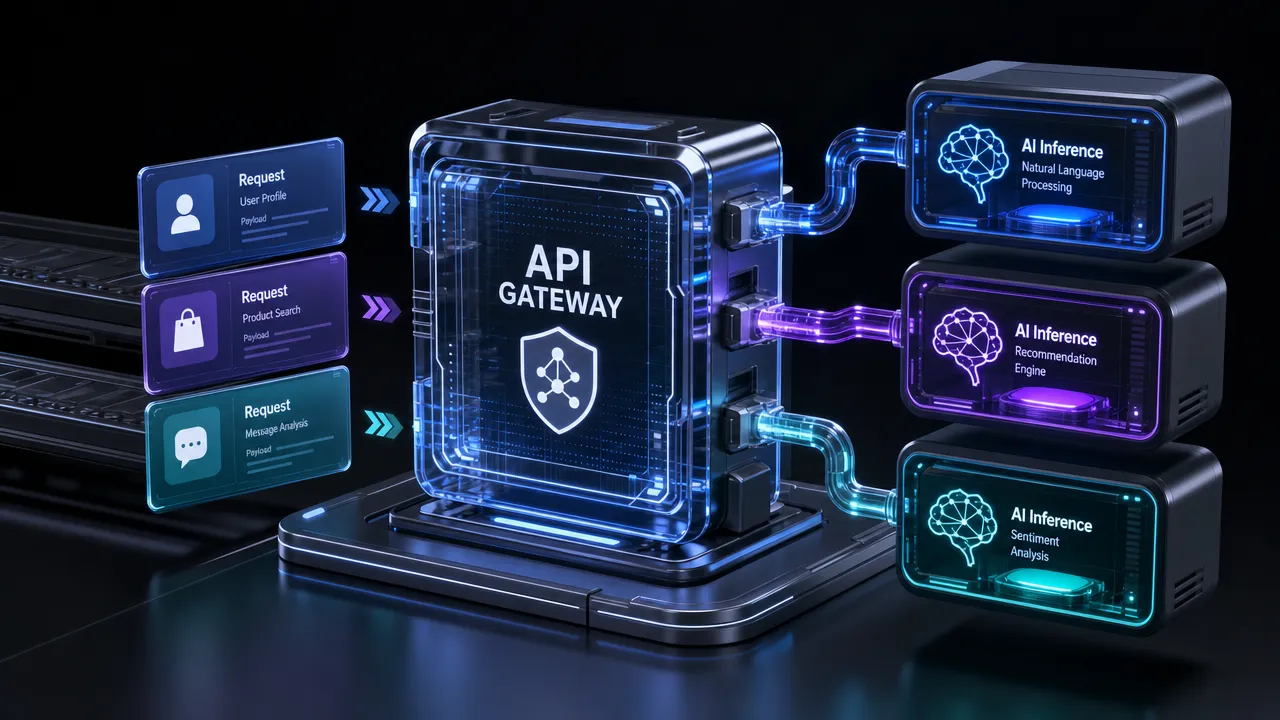
Why the GonkaRouter API matters for agent applications
An AI gateway for agent applications can simplify model access, but it does not replace agent engineering. An agent application still owns task planning, memory, permission checks, tool execution, output validation, and user experience.
The difference is that a unified interface can keep provider-specific transport details from spreading across the rest of the application. That is useful when a single user request triggers multiple model interactions, tool loops, retrieval steps, validation prompts, retries, or streamed output.
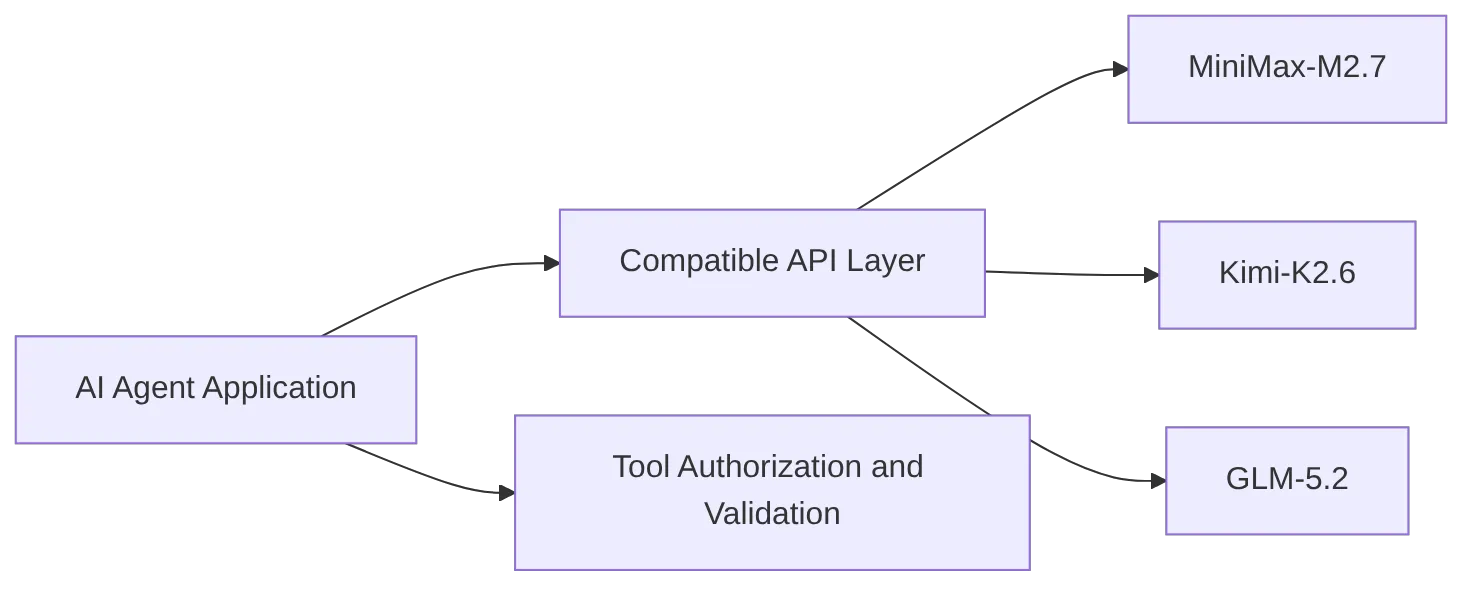
The GonkaRouter API is positioned as that focused model-access layer. Developers can evaluate MiniMax-M2.7 API, Kimi-K2.6 API, and GLM-5.2 API access through one unified integration path instead of maintaining separate application-side clients for each supported model.
This can be relevant for:
AI Agents that need consistent model-call plumbing.
Chatbots with model evaluation requirements.
Content-generation workflows.
Code-generation features.
Automated workflows and intelligent Q&A systems.
Enterprise AI applications that need a cleaner separation between application logic and inference access.
A common interface does not eliminate production risk. Before routing live traffic, teams should test their own prompts and workflows for output quality, formatting, latency, streaming behavior where applicable, error handling, and token usage. The right decision is workload-specific, not based on compatibility labels alone.
For a practical onboarding perspective, review this guide to getting started with a multi-provider LLM gateway.
How the GonkaRouter API supports focused model evaluation
The appeal of a multi-model API for developers is not unlimited model access. It is the ability to test an explicitly defined model set without rebuilding the integration layer every time.
GonkaRouter currently supports only these models:
Supported model | Relevant evaluation focus |
|---|---|
MiniMax-M2.7 | Test against your product prompts, output formats, and workflow requirements. |
Kimi-K2.6 | Evaluate fit for agent tasks, chat experiences, or application-specific reasoning flows. |
GLM-5.2 | Compare response behavior and consistency within your own use cases. |
This clear scope is important. GonkaRouter should be evaluated as an AI Model Router for these three supported models, not as a marketplace or a universal catalog.
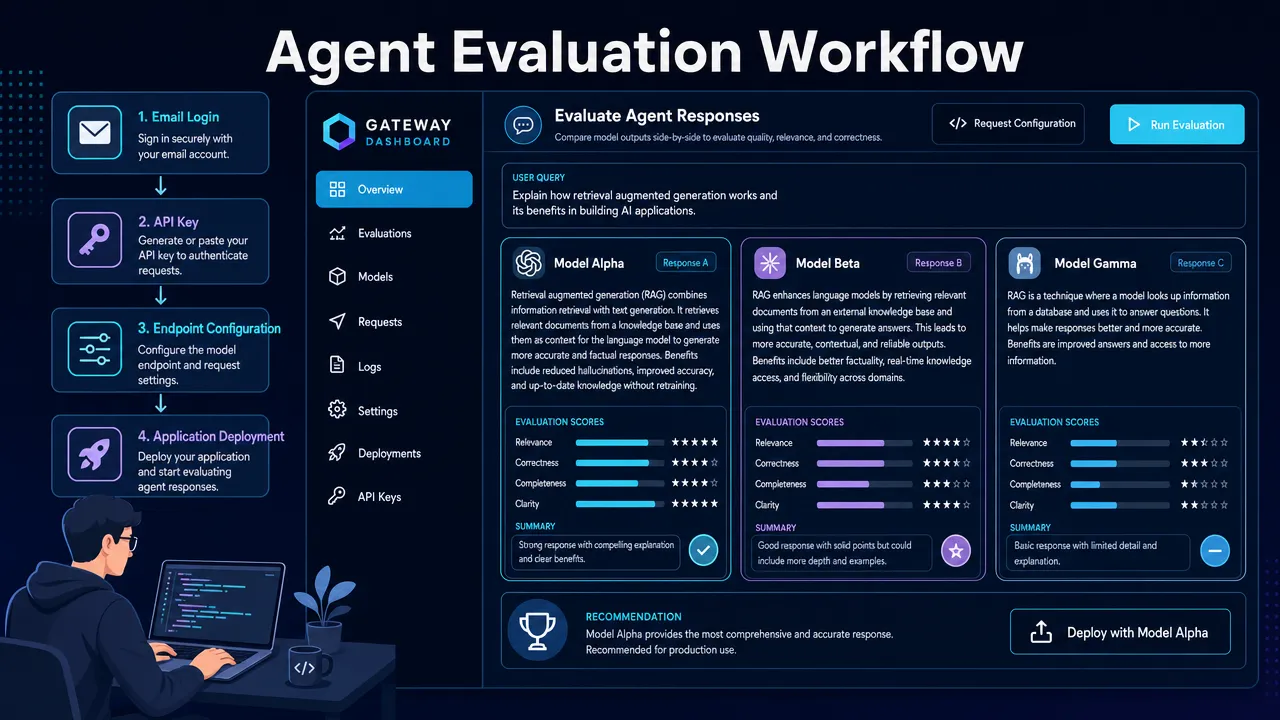
The implementation path is designed to be direct:
Log in or register with email.
Receive a one-time 20 USDT trial credit for product usage testing.
Get an API key.
Configure the compatible endpoint where applicable.
Test the supported models with real prompts and evaluation criteria.
Integrate the selected model into a product or Agent application.
Pricing is listed as low as $0.0004 per 1M tokens. That number is useful for early planning, but it should not be treated as the full cost of an AI workflow. Completed-task cost can also depend on prompt length, response length, retries, multi-step agent loops, and the model selected for a specific task.
What developers should validate before using the GonkaRouter API in production
Compatibility is a strong starting point, not a substitute for technical due diligence. An OpenAI Compatible API or Anthropic Compatible API can reduce integration work, yet developers should confirm the exact behavior that their application needs.
Use this checklist during evaluation:
Validation area | Questions to ask |
|---|---|
Model selection | Which of the three supported models fits the task and quality target? |
Request format | Which OpenAI-compatible or Anthropic-compatible format best fits the existing application? |
Output handling | Does the application correctly process the response structure it receives? |
Streaming | Does the specific workflow require streaming, and has it been tested end to end? |
Tool workflows | Does the application independently validate and authorize every tool action? |
Error handling | Are timeout, retry, and fallback behaviors defined in the application? |
Cost monitoring | Are input, output, retries, and multi-step task usage measured? |
Security review | Have the service terms and data-handling information been reviewed? |
The GonkaRouter privacy policy and terms of service are appropriate starting points for teams performing a service review.
The broader lesson from SageMaker's compatible endpoint is simple. AI infrastructure is increasingly competing on how little integration work it asks developers to redo. Familiar formats can make experimentation and migration easier, especially for teams already operating OpenAI-style or Anthropic-style application code.
The GonkaRouter API gives developers one practical next step
For developers who want a focused OpenAI-compatible AI gateway and Anthropic-compatible AI gateway for three defined models, GonkaRouter provides a straightforward evaluation path.
Use one API to test MiniMax-M2.7, Kimi-K2.6, and GLM-5.2. Keep application logic separate from the model-access layer. Validate behavior with real workloads before deployment. Then choose the supported model that best fits the product requirement.
Explore the developer platform to log in with email, obtain an API key, claim the one-time 20 USDT trial credit for testing, and begin evaluating the supported models in your product or Agent workflow.