Amazon Bedrock migrations succeed when teams treat them as contract, behavior, and operations changes rather than simple endpoint swaps. An OpenAI-compatible gateway can create a cleaner application boundary, but it cannot prove model parity or replace workload-specific validation.
On June 10, 2026, AWS published its announcement of a model-to-model migration assessment in AWS Transform for generative AI applications moving toward Amazon Bedrock. As described in the AWS announcement, the capability scans a codebase, identifies AI SDKs and models, gathers constraints, proposes model mappings, and produces migration guidance and a runbook.
That is useful decision support. It is not evidence of a fully automated rewrite, test, approval, and deployment process. The lasting lesson for AI infrastructure teams is straightforward: portability begins with an explicit interface boundary, then succeeds or fails on testing, governance, and rollback discipline.
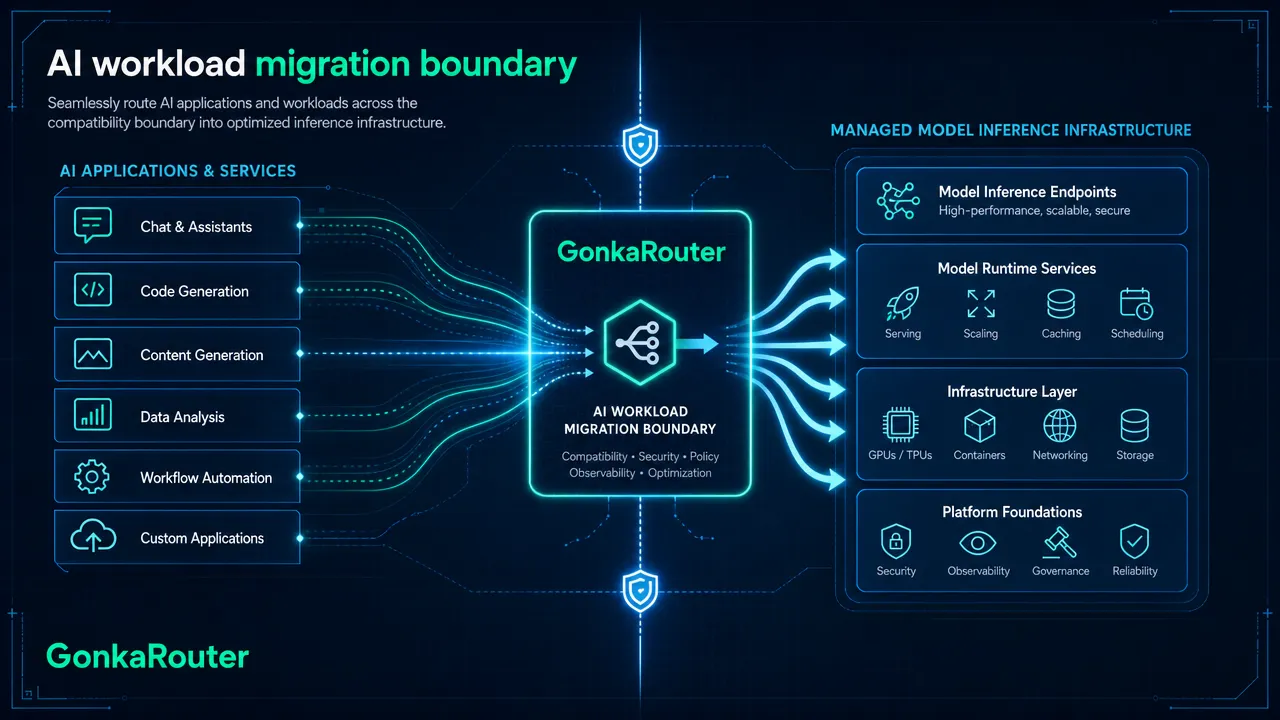
Why GonkaRouter API belongs behind a deliberate migration boundary
A migration assessment can reveal where a codebase depends on a provider. It cannot make the resulting target model respond, stream, call tools, or enforce output schemas exactly like the source. That distinction defines where an OpenAI-compatible AI gateway can help.
The most resilient pattern is to make application code call a stable internal interface. Behind that interface, a provider adapter, managed inference service, or gateway can handle provider-specific differences. The application still owns its prompts, task evaluations, authorization rules, agent state, and acceptance criteria.
AWS documents two primary inference approaches in Bedrock:
The provider-neutral Converse and ConverseStream APIs, which provide a more consistent conversational interface across supported models.
Model-specific runtime APIs, which can expose parameters or capabilities that a normalized API does not.
Neither route is universally better. A unified interface can reduce integration variation. A model-specific call can be necessary when a workload relies on unique model behavior. Teams should decide at the workload level rather than attempting to standardize every use case prematurely.
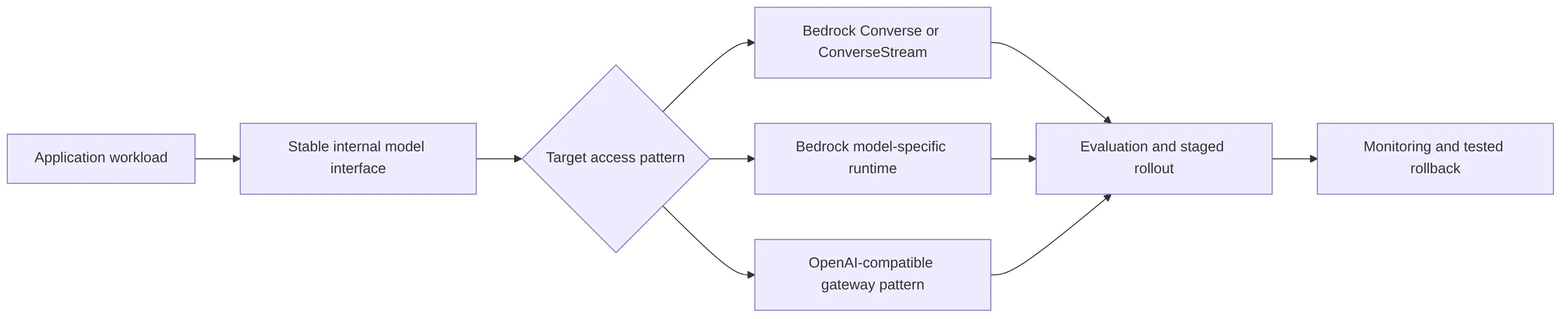
The practical value of a gateway is therefore integration containment. It can limit the number of services that need to understand different SDKs, credentials, request objects, and error conventions. It does not make different model families interchangeable.
Migration concern | What a compatibility boundary can reduce | What the application team must still own |
|---|---|---|
Request schema | Repeated provider-specific client code | Field mapping and contract tests |
Model selection | Hard-coded model IDs throughout services | Selection policy and quality criteria |
Streaming | Client integration variation | Event ordering, disconnect, and retry tests |
Tool calling | Some request-format churn | Tool authorization, validation, and loop limits |
Observability | Centralized request path potential | Trace correlation and incident response |
Fallbacks | A defined routing location | Safe conditions for switching routes |
For teams comparing router patterns, What is an AI model router for developers? provides useful category context. The important architectural rule remains unchanged: keep a direct, tested fallback path for every production-critical workload.
How GonkaRouter API changes the integration discussion, not the Bedrock target
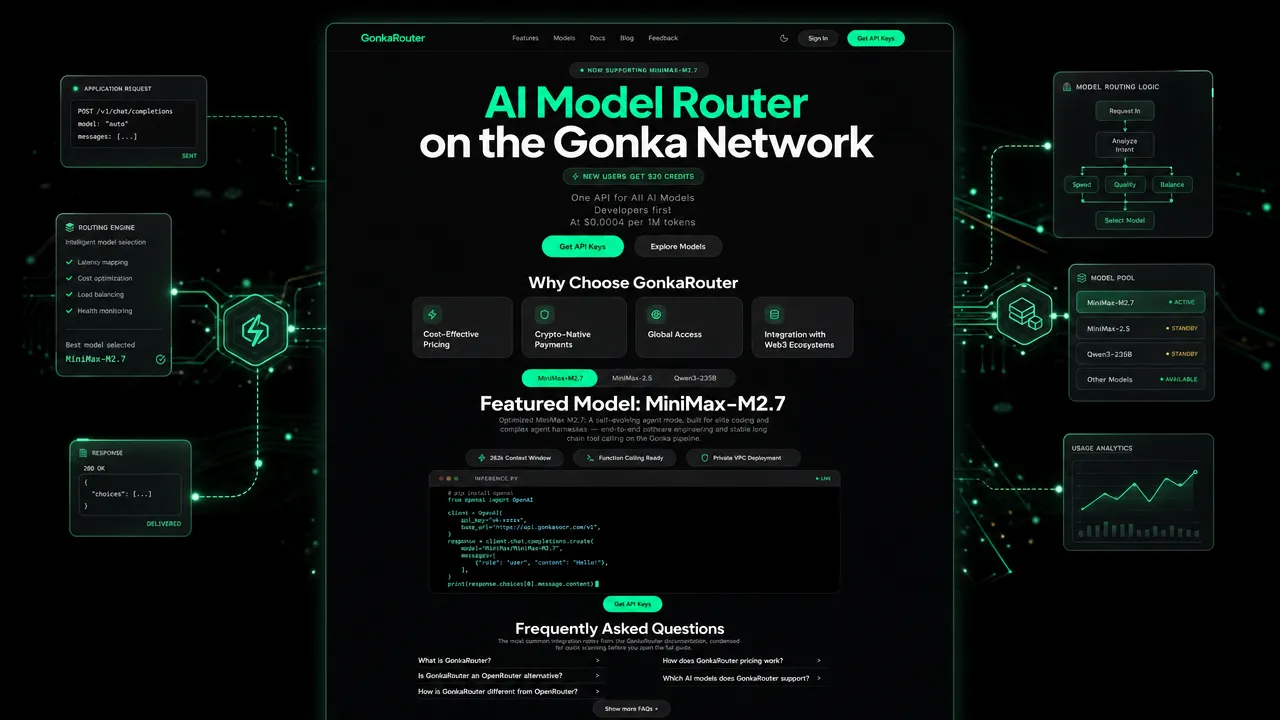
GonkaRouter is an AI Model Router built for the Gonka Network. Its website shows an OpenAI-compatible endpoint and lists DeepSeek-V4-Flash, MiniMax-M2.7, and Kimi-K2.6 as featured models. It also displays Function Calling, Private VPC Deployment, and Web3 Ecosystem Integration.
Those are bounded product facts. They do not establish an Amazon Bedrock integration, AWS Transform integration, Bedrock model access, or a replacement for AWS migration tooling.
The GonkaRouter API is relevant to a Bedrock migration conversation only as an example of the gateway boundary discussed above. A team might use an OpenAI-style application contract to reduce direct coupling in some services, while independently choosing Amazon Bedrock for other workloads. That is an architectural option, not a documented joint implementation.
A narrow validation checklist matters more than an attractive compatibility label:
Question | Why it matters before adoption |
|---|---|
Which OpenAI-style API surface is supported? | Chat Completions and Responses are different contracts. |
Which fields are accepted, transformed, or omitted? | Unsupported fields can create quiet behavior changes. |
How do streaming events behave? | UI rendering and agent control loops often depend on event order. |
How does Function Calling behave per model? | Tool schemas, IDs, error paths, and result submission require testing. |
What does Private VPC Deployment cover? | Teams need topology, responsibility, region, and operational details. |
How are usage, errors, and request IDs exposed? | Production operations depend on traceable evidence. |
The OpenAI-compatible API endpoint guide is a relevant product resource for developers evaluating endpoint-based integration. It should be read alongside direct validation of current API behavior, limits, data handling, and operational requirements.
Where GonkaRouter API compatibility ends for tools, agents, and model behavior
Compatibility is a request-contract claim, not a behavioral-equivalence claim. That boundary becomes especially important for agent systems.
An OpenAI-compatible AI gateway generally accepts an OpenAI-style request and response shape. An Anthropic-compatible AI gateway generally accepts an Anthropic Messages-style contract. These interfaces differ in message structure, content blocks, tool conventions, and response semantics. Neither label guarantees support for every API surface or every provider-specific feature.
For example, OpenAI's Chat Completions reference describes a messages-oriented interface, while the Responses migration guide describes a newer agent-oriented interface with different primitives. Anthropic's Messages API has its own content-block conventions. A translation layer must be tested against the precise contract an application uses.
Test area | What to verify |
|---|---|
Messages and instructions | Role handling, system instruction placement, multipart content |
Streaming | Delta format, event order, completion signal, partial response recovery |
Structured output | JSON validity, schema adherence, malformed-output handling |
Tool calls | Schema conversion, tool IDs, arguments, result placement, parallel calls |
Errors | Status codes, retryability, rate-limit handling, request IDs |
Token and context limits | Model-specific counting, truncation behavior, output limits |
Safety controls | Refusal behavior, policy enforcement, escalation paths |
This also clarifies the secondary model keywords. MiniMax-M2.7 API and Kimi-K2.6 API are independently documented model topics, and both appear in GonkaRouter's verified featured-model list. GLM-5.2 API is also independently documented, but it is not in the approved verified GonkaRouter model facts for this article. It should not be presented as a GonkaRouter-supported model.
For an AI gateway for agent applications, the critical control plane stays inside the application:
Validate model-generated tool arguments before execution.
Enforce authorization for every consequential tool action.
Limit retries, recursion, and total agent steps.
Log tool-call outcomes with model and prompt-version context.
Test failure scenarios before enabling fallback routes.
A router can reduce integration repetition. It cannot safely authorize a payment, modify an account, or decide that an agent loop has become unsafe on behalf of the application team.
How GonkaRouter API fits a multi-model API for developers evaluation framework
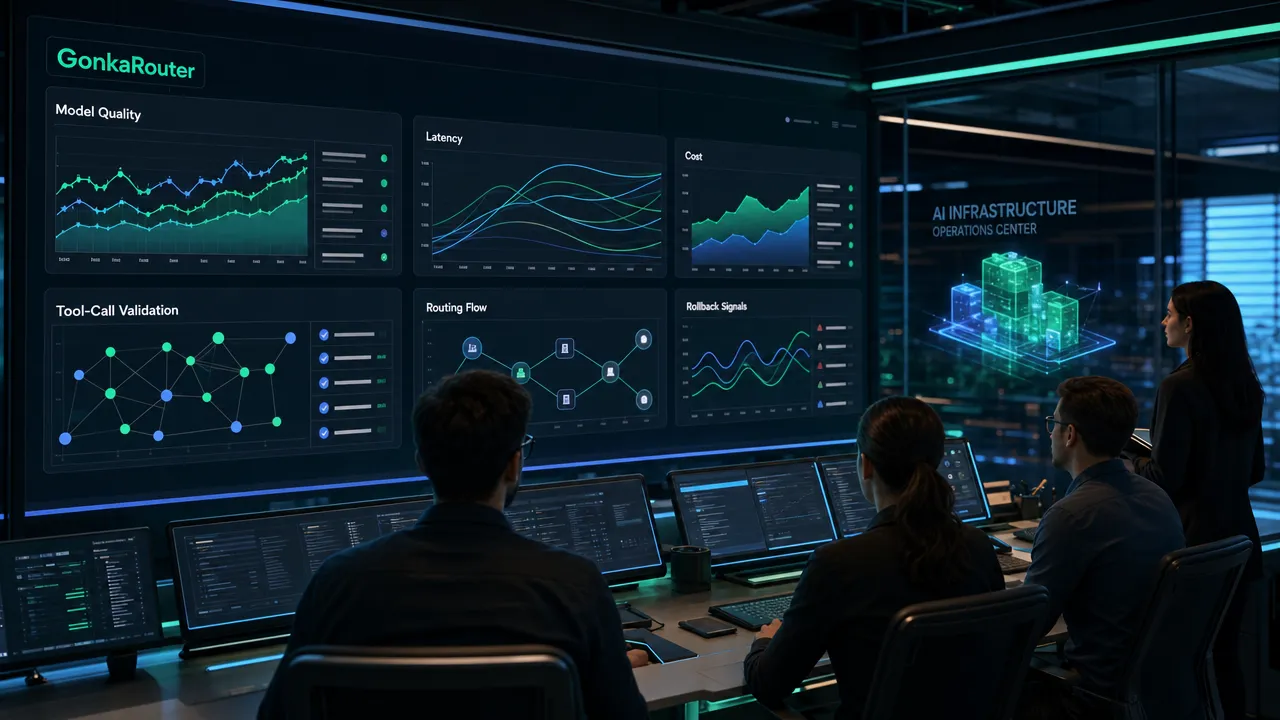
A multi-model API for developers should be evaluated as operating infrastructure, not simply as a model catalog. The relevant question is whether the architecture lets engineers change models without losing control of quality, security, cost, or incident response.
Amazon Bedrock offers production controls that matter in this evaluation, including IAM authorization, VPC interface endpoints, invocation logging, model evaluations, and lifecycle states. A gateway pattern should be measured against the same operational expectations, even when it is not part of a Bedrock deployment.
Evaluation category | Evidence to collect | Decision failure to avoid |
|---|---|---|
Portability | Field-level API mapping and regression tests | Assuming a familiar SDK guarantees feature parity |
Quality | Task-specific datasets and human review | Selecting models from general reputation alone |
Reliability | Error rate, timeout rate, stream completion rate | Treating successful HTTP responses as successful tasks |
Tool use | Valid-call rate and safe tool-result processing | Allowing malformed arguments into production tools |
Cost | Cost per completed task, including retries | Optimizing token cost while ignoring agent-loop volume |
Observability | Model ID, prompt version, request ID, tool outcomes | Losing incident evidence after centralizing access |
Exit path | Direct route or alternate adapter tested in advance | Creating a gateway dependency with no contingency |
A concise benchmark is usually more valuable than a broad comparison. Run sanitized real prompts and edge cases through a source route and a proposed target route. Score correctness, output format, task completion, latency, retry count, and cost per successful task. Preserve prompt versions and model identifiers so results remain reproducible.
The GonkaRouter developer tutorial can serve as a practical starting point for teams that decide to test the product. Production decisions should still follow a sandbox-to-canary process and confirm the current product contract directly.
How GonkaRouter API supports a staged migration mindset without replacing validation
AWS Transform's June 10, 2026 announcement points toward a healthier migration process: discover dependencies, clarify constraints, map candidates, estimate implications, and create an execution plan. Teams should add an independent verification loop around that plan.

A practical rollout sequence looks like this:
Phase | Required output |
|---|---|
Discovery | Inventory of SDKs, model IDs, prompts, tools, and data paths |
Assessment | Migration backlog with owners, risk ratings, and candidate mappings |
Contract testing | Verified request, streaming, error, and tool-call behavior |
Evaluation | Measured task quality, safety, latency, and cost |
Security review | IAM, logging, network path, data retention, and access decisions |
Canary | Predefined cohort, stop conditions, and tested rollback |
Operations | Dashboards, lifecycle monitoring, incident runbooks, and change control |
The strongest opinion is not that every team needs a gateway. It is that every team needs a boundary it can test. Direct Bedrock integration may be the right answer for workloads that require AWS-native controls or model-specific APIs. An internal adapter may fit organizations that want complete control of their translation layer. GonkaRouter API may be relevant where its verified OpenAI-compatible interface and featured model set match a team's tested requirements.
Before sending sensitive production traffic through any third party, review its privacy policy and terms of service, then confirm current security, logging, retention, VPC deployment, and support details directly.
Amazon Bedrock migration is ultimately an evidence exercise. AWS Transform can accelerate discovery and planning. A compatibility layer can reduce application coupling. Neither removes the need to validate the exact API surface, model behavior, tool safety, operational controls, and rollback route that a real workload requires.