When a major AI laboratory announces a new frontier release or high-speed variant, engineering channels immediately fill with benchmark screenshots and calls to migrate production traffic. Industry launch signals across the ecosystem—such as OpenAI's updates on GPT-6 Sol and Luna, Anthropic's ongoing releases on the Anthropic models news page, Google's developer updates for Gemini 4 Argon builders, and DeepSeek's announcement of DeepSeek V4.1 Flash—show how rapidly model families evolve across reasoning depth, context capacity, and inference speed.
However, public leaderboards rarely reflect how a model will behave inside your specific retrieval pipeline, agent loop, or JSON extraction workflow. To separate marketing momentum from production reality, technical teams need a disciplined, reproducible cross-vendor LLM bake-off. Rather than chasing every release announcement with ad-hoc prompt tweaking, a structured evaluation lets you measure candidate models against your actual workloads, quality thresholds, latency budgets, and unit economics.
Industry launches from OpenAI, Anthropic, Google, and DeepSeek are useful prompts for re-running a neutral evaluation suite. Building a vendor-neutral harness lets your team compare candidate endpoints under identical, verifiable rules while using the GonkaRouter model catalog as a current production baseline.
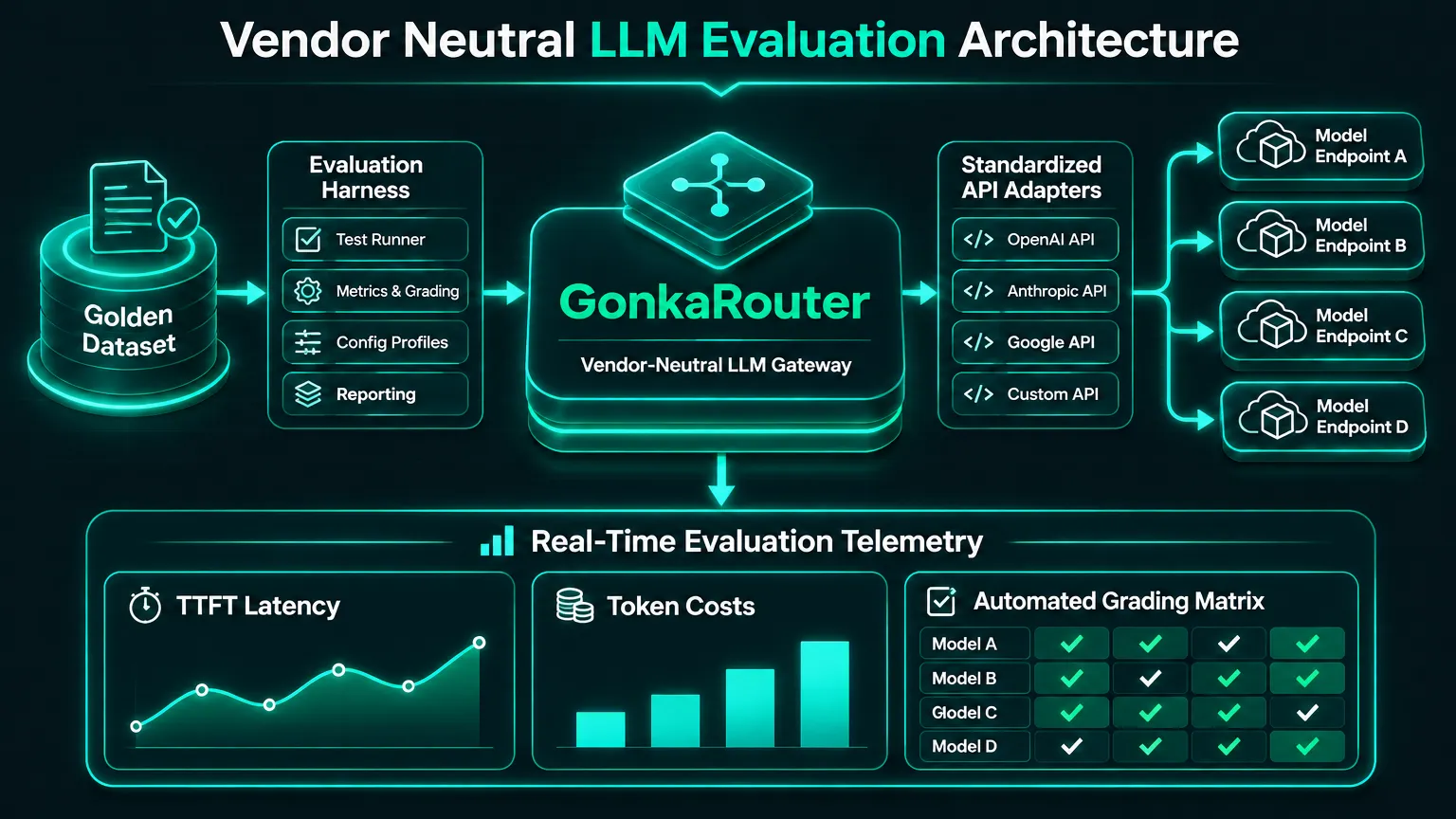
Why Public Leaderboards Are Not Enough
Relying solely on public academic benchmarks to select a production model introduces significant engineering risk. While standardized tests measure general world knowledge and competitive coding puzzles, they seldom mirror the messy inputs, strict schema constraints, and domain-specific edge cases found in real software systems.
When teams skip an internal cross-vendor LLM bake-off and deploy based on headline scores, four failure modes commonly appear in production:
Benchmark Contamination and Overfitting: Public evaluation sets frequently leak into pre-training or post-training corpora. A model that scores near the top of a public leaderboard may struggle when confronted with your proprietary internal documentation or non-standard log formats.
Prompt Template Bias: Many benchmark suites evaluate models using a single prompt structure that inadvertently favors one vendor's instruction-tuning style over another's. Without normalizing system instructions and structured output mechanisms, comparisons remain skewed.
Hidden Operational Fragility: Leaderboards report accuracy, not operational stability. They do not reveal how often a model breaks a required JSON schema on multi-turn tool calls, nor do they capture tail latency spikes during peak traffic hours.
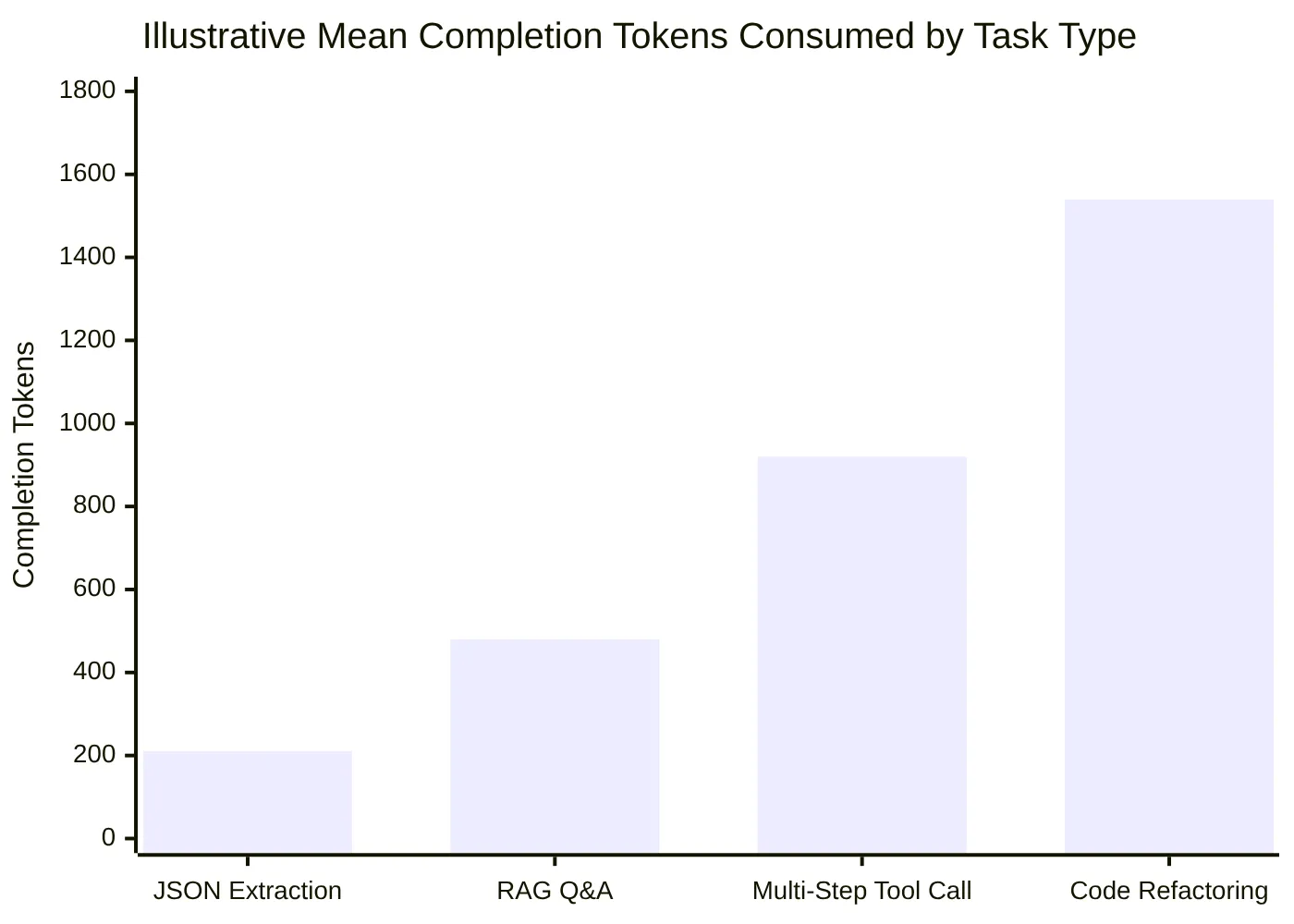
Token Verbosity and Cost Drift: Two models might achieve the same pass rate on a reasoning task, yet one might consume three times as many completion tokens—or trigger repeated retry loops—driving up your actual cost per resolved user request.
Treating model selection as an empirical engineering discipline protects your roadmap. By building a repeatable evaluation pipeline, you shift the conversation from "Which vendor won the latest announcement cycle?" to "Which specific model ID meets our accuracy bar at the lowest latency and cost per successful task?"
Design a Workload Dataset and Scoring Rubric
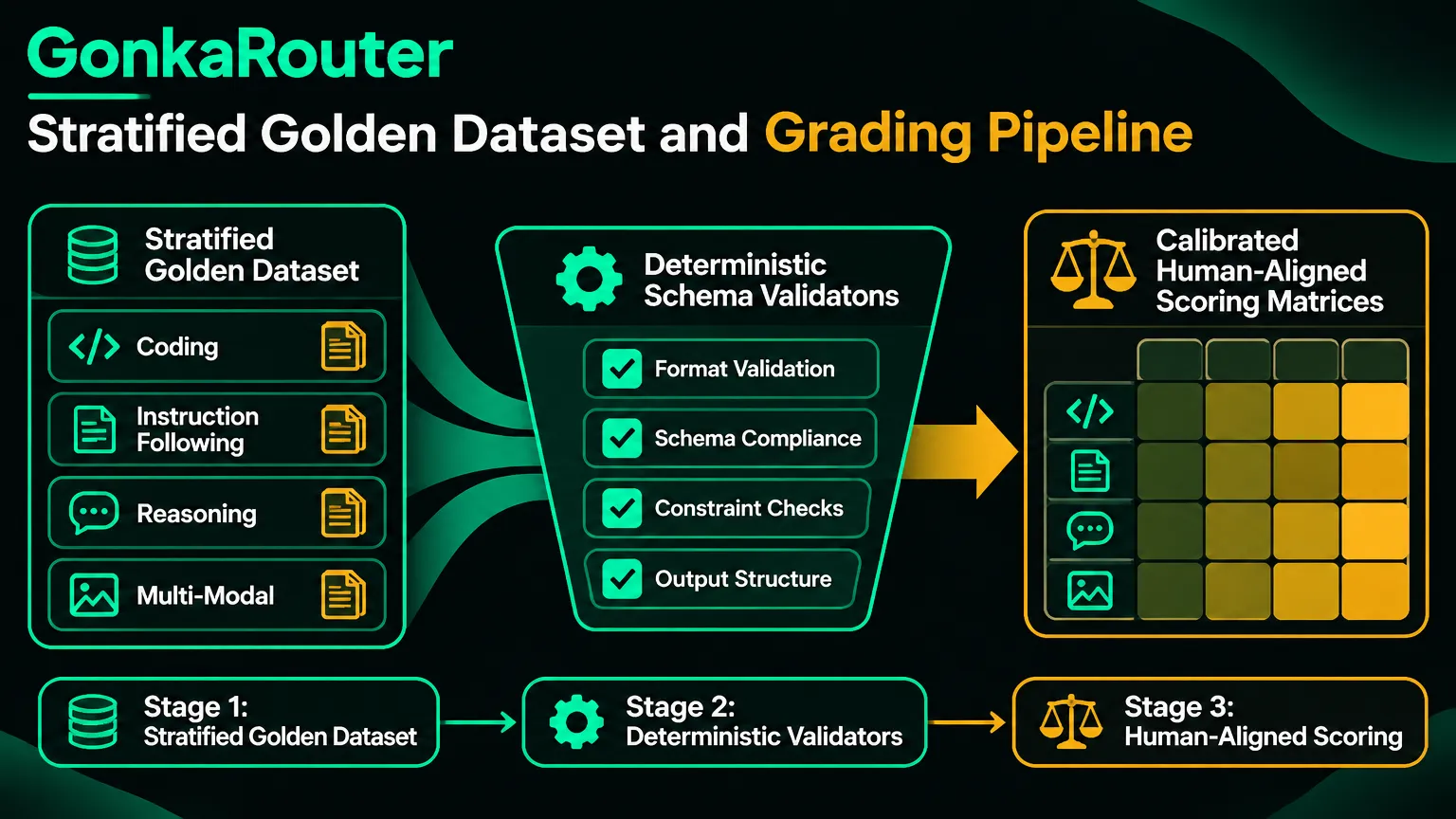
A credible cross-vendor LLM bake-off starts with a frozen, version-controlled Golden Dataset extracted from your own domain. If you test with only ten synthetic prompts in a playground UI, your results will reflect anecdotal luck rather than statistical reality.
1. Curating a Stratified Golden Dataset
Aim to assemble between 100 and 500 representative test cases per core workflow. Rather than pulling a random slice of production logs, stratify your dataset across three clear buckets:
Typical Production Traffic (60%): The most frequent queries, summarization tasks, or code transformations your application handles every day.
Complex and Long-Context Scenarios (25%): Multi-step tool calls, noisy RAG chunks with conflicting timestamps, or prompts that push context utilization past 32k tokens.
Adversarial and Edge Cases (15%): Malformed user inputs, prompt injection attempts, ambiguous instructions, and requests that require a polite refusal or fallback action.
Every item in your dataset should be stored in a structured format (such as JSONL or Parquet) containing the exact input payload, expected deterministic constraints, reference ground-truth answers, and metadata tags for slice-based reporting.
2. Combining Deterministic Checks with Calibrated Grading
Human review is the gold standard for nuance, but manual grading alone prevents rapid iteration. The most effective evaluation pipelines combine fast deterministic assertions with calibrated automated judges:
Evaluation Layer | What It Measures | Implementation Method | Pass Threshold Example |
|---|---|---|---|
Syntactic & Schema Validation | Valid JSON/YAML, regex compliance, required keys, enum constraints | Deterministic code parsers ( | 99.5%+ strict schema adherence |
Execution & Functional Tests | Code compilation, SQL query validity, tool call parameter types | Sandboxed unit test runners or AST syntax checkers | 95%+ syntax validity; task-specific unit test pass rate |
Semantic & Faithfulness Grading | Groundedness in retrieved context, factual completeness, tone compliance | Calibrated LLM-as-a-Judge using explicit 1–5 rubrics and pairwise swaps | Mean rubric score ≥4.2\ge 4.2≥4.2 with zero critical hallucinations |
Human Calibration Audit | Alignment between automated graders and domain experts | Blind human review on a 10%–15% stratified sample of outputs | Cohen's Kappa ≥0.80\ge 0.80≥0.80 agreement with automated judge |
When using an automated judge model to grade free-text responses, guard against self-preference bias (where a judge favors outputs generated by its own model family) and position bias (where a judge favors the first option presented in a pairwise comparison). Always randomize candidate order, strip model identity metadata before grading, and require the grader to evaluate narrow, binary, or three-point criteria rather than vague overall impressions.
Normalize APIs Without Erasing Vendor Differences
Even the best dataset will produce distorted results if your test harness fails to control experimental variables. To make a cross-vendor LLM bake-off scientifically sound, you must standardize how requests are sent and how model responses are parsed.
Controlling Inference Hyperparameters
Before running a batch evaluation, lock down the generation parameters across all candidate endpoints:
Temperature and Sampling: Set
temperature = 0.0(or as close to deterministic greedy decoding as the provider permits) for extraction, classification, and coding tasks. If a model requires non-zero temperature for reasoning tasks, run N=3N = 3N=3 or N=5N = 5N=5 trials per prompt to measure variance (pass@1vs.pass@k).Output Token Caps: Explicitly configure
max_tokensso a verbose model does not get truncated mid-JSON while a concise model completes normally.System Prompt Parity: Keep core task instructions, few-shot examples, and output schemas identical across candidates. Only adapt structural wrappers (such as tool-call definitions) when required by a specific API specification.
Explicit Model Pinning: Never benchmark against a floating alias if a dated or versioned identifier is available. Always log the exact model string returned in the response payload.
Decoupling API Format Compatibility from Vendor Identity
Reducing adapter code is one of the fastest ways to eliminate harness bugs during evaluation. Many modern gateways and inference endpoints support standardized request schemas—specifically OpenAI-compatible (/v1/chat/completions) and Anthropic-compatible (/v1/messages) formats.
As detailed in the GonkaRouter documentation, GonkaRouter supports OpenAI-compatible and Anthropic-compatible API formats. These formats standardize request and response transport; the evaluation manifest should still pin the base URL and exact model ID for every candidate.
When you configure your evaluation runner against GonkaRouter, you use those familiar API formats to test the models actually hosted in the live GonkaRouter model catalog:
zai-org/GLM-5.3-Flashdeepseek-ai/DeepSeek-V4-Flash-0731MiniMaxAI/MiniMax-M2.7
Keeping each model distinct in your test matrix is critical. Never assume two similarly named models across different providers or versions are interchangeable; even minor version timestamps or quantization differences can alter structured output compliance and latency profiles.
Measure Latency, Cost, and Operational Fit
Once quality scores are collected, the next phase of a cross-vendor LLM bake-off evaluates whether each candidate can survive your production service-level objectives (SLOs) and unit economics.
1. Benchmarking Streaming Latency Under Realistic Load
Average response time is a misleading metric for interactive AI applications. Instead, instrument your evaluation client to capture streaming percentiles (P50, P90, and P99) across three distinct dimensions:
Time to First Token (TTFT): The elapsed time from sending the HTTP request to receiving the first non-empty content chunk. High TTFT makes chat interfaces and voice agents feel sluggish, especially when pre-filling large RAG contexts.
Time Per Output Token (TPOT) / Inter-Token Latency: The speed at which tokens stream after the first chunk arrives. This governs how fast a long code block or document summary renders for the user.
End-to-End Request Latency: Total wall-clock duration until the
[DONE]signal arrives. For background batch pipelines or multi-step agent loops that cannot proceed until a full JSON payload is parsed, end-to-end latency is the primary bottleneck.
Below is an example of how P95 TTFT can diverge across candidate slots as input context scales from short prompts to heavy document payloads in a typical benchmark template:
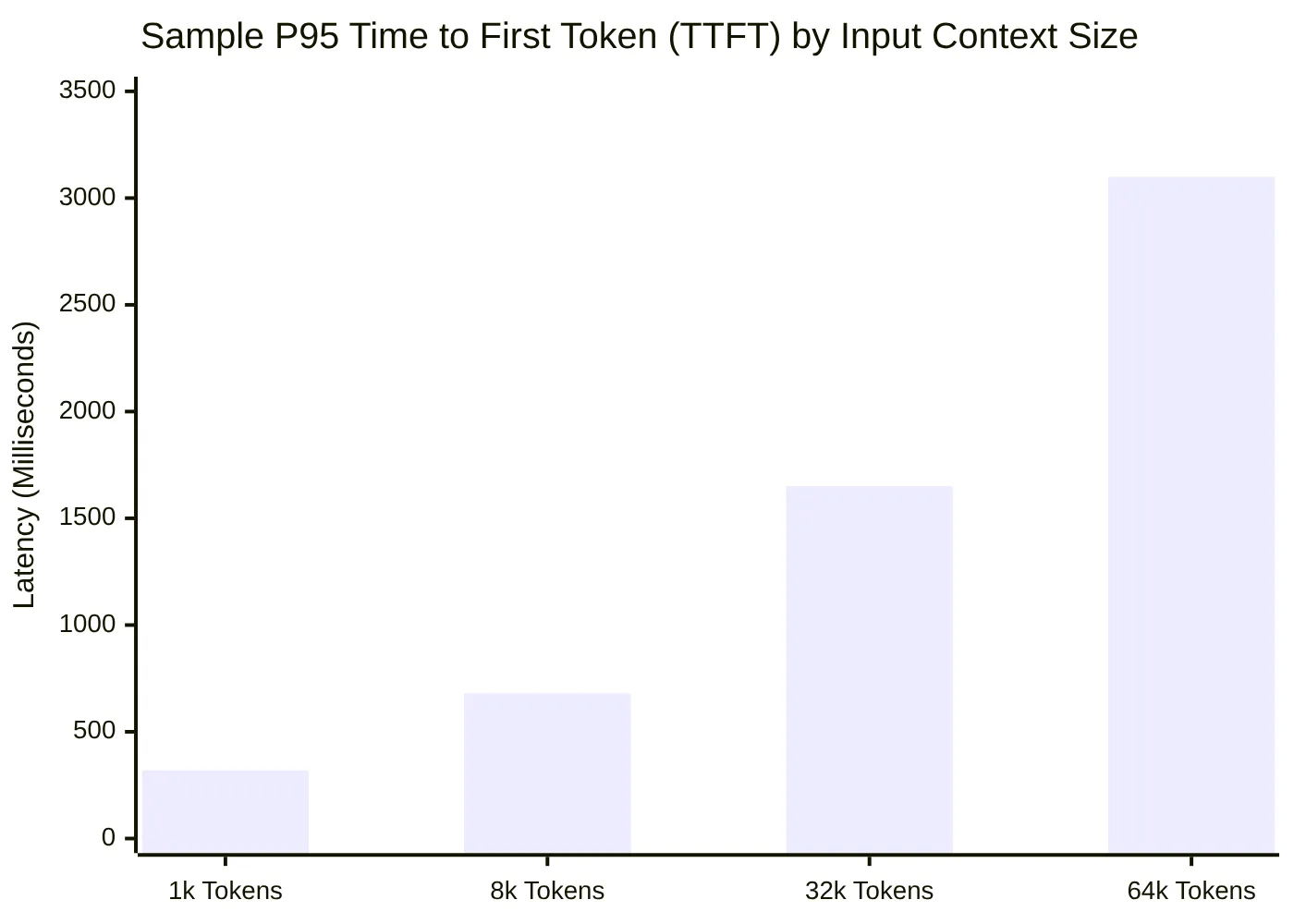
To ensure fair latency comparisons, run all candidate calls from the same cloud region, match concurrency levels to your expected peak traffic, and interleave requests across time windows so transient network congestion does not skew a single candidate's run.
2. Calculating True Cost Per Successful Task
Comparing raw input and output token rates on a pricing table rarely tells the whole story. A model with a lower per-token rate can still cost more per accepted result if its outputs are unnecessarily verbose or schema-validation failures trigger retries.
Instead, evaluate economics using Cost Per Successful Task (CPST):
CPST=Total Input Token Cost+Total Output Token Cost (Including Retries)Number of Tasks Passing All Quality & Schema Checks\text{CPST} = \frac{\text{Total Input Token Cost} + \text{Total Output Token Cost (Including Retries)}}{\text{Number of Tasks Passing All Quality \& Schema Checks}}CPST=Number of Tasks Passing All Quality & Schema ChecksTotal Input Token Cost+Total Output Token Cost (Including Retries)
When reviewing current usage rates on the GonkaRouter pricing page, plug the actual input and output token counts logged during your benchmark runs into this formula. Tracking total tokens consumed per passing test case reveals how verbosity and retry frequency impact your bottom line at scale:
Run a Reproducible Evaluation Workflow
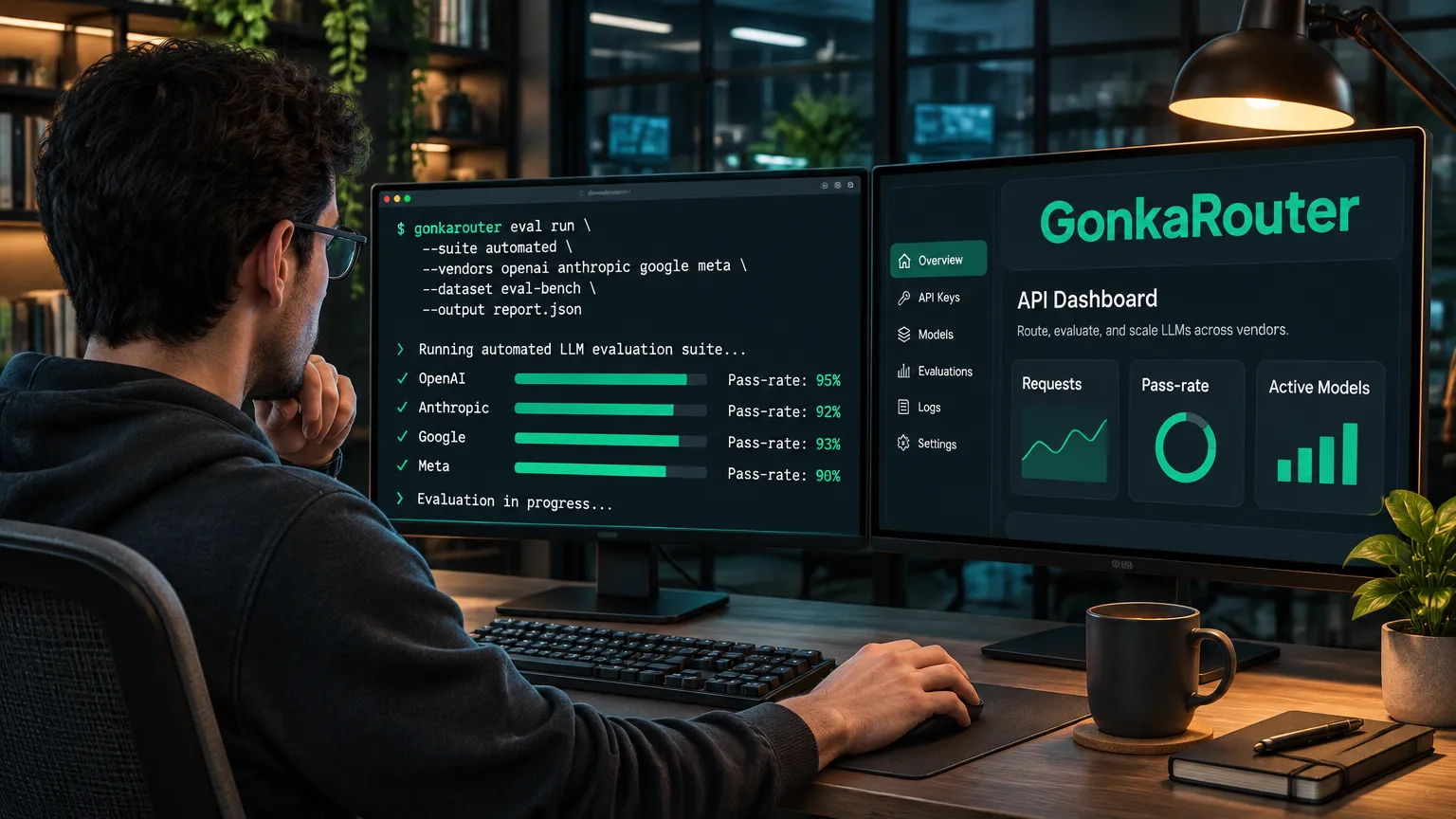
To turn these principles into a repeatable habit rather than a one-off project, package your cross-vendor LLM bake-off into an automated workflow that runs whenever a new model candidate emerges or your core system prompts change.
The Engineering Bake-Off Checklist
Use the following scorecard template to verify that every candidate model has been tested under identical conditions before promoting any changes to production:
Verification Stage | Engineering Requirement | Target Artifact / Evidence |
|---|---|---|
1. Endpoint & Identity Check | Pin each candidate endpoint, exact model ID, and adapter version | Versioned candidate manifest with verified model identity |
2. Dataset Freeze | Lock a stratified set of 100–500 production-representative prompts with ground-truth assertions | Version-controlled |
3. Harness Normalization | Standardize | Containerized evaluation runner with zero vendor-specific prompt hacks |
4. Quality & Schema Gate | Run deterministic parsers first, followed by blind, bias-mitigated rubric grading | Per-category pass rates and schema compliance percentages |
5. Telemetry & Load Profile | Record P50/P95 TTFT, TPOT, end-to-end latency, HTTP error rates, and timeout frequency under concurrent load | Time-series latency distributions across prompt length buckets |
6. Unit Economics Audit | Compute total cost per 1,000 successful tasks, factoring in completion verbosity and retry overhead | Final CPST comparison table verified against official pricing documentation |
Add Current Catalog Models to the Harness
When you are ready to benchmark fast, high-efficiency candidates alongside your existing baseline, keeping your evaluation runner modular saves hours of integration work. Because GonkaRouter provides OpenAI-compatible and Anthropic-compatible API format endpoints, you can add its currently supported catalog models—zai-org/GLM-5.3-Flash, deepseek-ai/DeepSeek-V4-Flash-0731, and MiniMaxAI/MiniMax-M2.7—into your test matrix simply by configuring the base URL, supplying your API key, and specifying the exact catalog model ID.
Use industry announcements from OpenAI, Anthropic, Google, and DeepSeek to decide when to rerun the bake-off. Keep the harness neutral, verify every endpoint and model ID before execution, and let workload metrics—not vendor identity—determine promotion.
To start benchmarking supported models against your own workload criteria, explore the current GonkaRouter model catalog, review the API format setup in the GonkaRouter documentation, check current token rates on the GonkaRouter pricing page, and run a test batch with zai-org/GLM-5.3-Flash, deepseek-ai/DeepSeek-V4-Flash-0731, or MiniMaxAI/MiniMax-M2.7.