A Gemini 3.8 Flash API migration should be treated as a controlled production change, not a one-line model ID swap. Fast-model upgrades can alter streaming behavior, structured output reliability, tool calls, token usage, rate-limit behavior, and tail latency even when the request format looks familiar.
LLM Stats reports that Gemini 3.8 Flash was released on September 2, 2026, with listed pricing of $0.75 per million input tokens and $3.75 per million output tokens. Its model page also covers context-window and benchmark information, but the exact values and methodology should be rechecked directly before they inform an architecture or procurement decision. Google's official model documentation confirms the model name, September 2026 availability, multimodal inputs including text, images, video, audio, and PDFs, plus text output. Google's release notes position it for long-horizon software engineering, autonomous agents, and complex enterprise workflows.
That is meaningful news for platform teams. It is not, by itself, evidence that a candidate will improve your application.
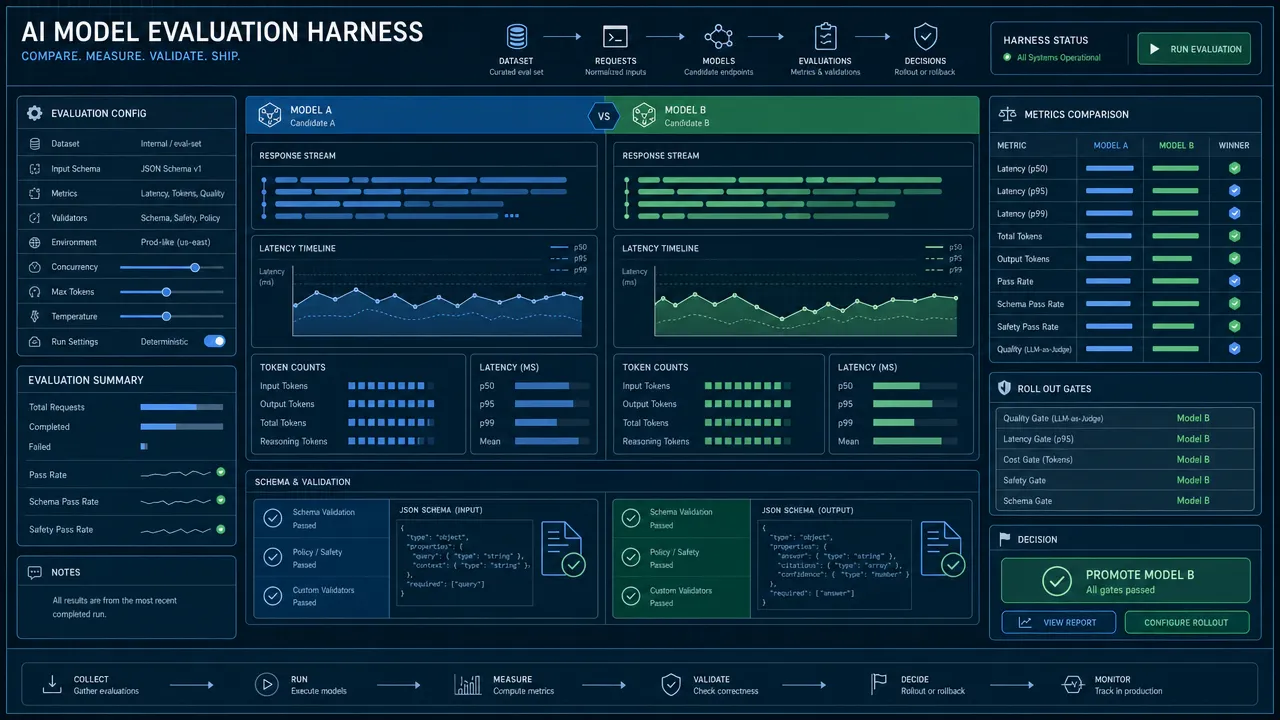
Gemini 3.8 Flash API migration is more than a model ID change
A model upgrade changes the effective API contract at several layers. Your application may continue receiving a 200 response while a downstream workflow quietly begins failing because a tool argument differs, a JSON field is omitted, or a streamed event arrives in an unexpected order.
The first step is to separate reported model metadata from production evidence.
LLM Stats is a useful news hook and reports the release date and listed token rates. However, teams should not translate directory pricing, benchmark summaries, or advertised context limits into unconditional performance claims. A published context limit does not guarantee that retrieval quality remains stable across the full range. A benchmark result does not show whether your extraction schema, customer-support workflow, or agent task will succeed.
Google's documentation provides a more defensible starting point for integration planning:
Gemini 3.8 Flash accepts text, image, video, audio, and PDF inputs.
It returns text output.
Google lists the model as generally available in its Gemini API release notes.
Google positions the model for software engineering, agentic tasks, and enterprise workflows.
For source-specific pricing, use careful language: LLM Stats lists $0.75 per million input tokens and $3.75 per million output tokens. Reconcile those figures against the provider's current documentation and your actual invoice data before setting cost expectations.
The practical question is not, "Is the new model fast?" The practical question is, "Does this model meet our required quality, latency, reliability, and cost thresholds for each workload we operate?"
Build a workload-specific fast-model evaluation
Generic prompts create generic conclusions. Build an evaluation set around the jobs your system actually performs.
A streamed help assistant should be scored differently from an extraction service. A code agent should be assessed differently from a document summarizer. Create a workload inventory before sending any candidate traffic.
Workload | Primary success condition | Metrics that matter most | Frequent migration risk |
|---|---|---|---|
Streamed support chat | The response starts promptly and helps resolve the issue. | Time to first token, p95 completion time, resolution quality, refusal rate. | Better initial speed but weaker task resolution. |
Data extraction | Required fields are correct and complete. | Field-level precision, recall, schema-valid rate, cost per valid record. | Valid JSON with incorrect or missing data. |
RAG answer generation | The answer is grounded in supplied evidence. | Groundedness, citation accuracy, long-context retrieval, unsupported-claim rate. | Ignoring relevant context placed deep in the prompt. |
Classification | The correct label is returned in a strict format. | Accuracy, F1, schema validity, p99 latency. | A small format change breaks downstream automation. |
Code assistance | The output satisfies repository and test constraints. | Test pass rate, compile rate, tool-call success, reviewer preference. | Plausible-looking code that fails project constraints. |
Agent workflows | The system completes a multi-step task safely. | Task success, tool selection, argument validity, retry rate, timeout rate. | Incorrect tool usage or repeated execution loops. |
Use three test layers:
Golden tests contain hand-reviewed examples with clear expected outputs or detailed grading rubrics.
Production replay tests use approved, de-identified historical requests that preserve actual prompt lengths, edge cases, and traffic mix.
Boundary tests cover long context, malformed inputs, conflicting instructions, incomplete tool responses, and schema stress cases.
For each task, keep the incumbent model and the candidate configuration identical where possible. Pin system prompts, tool definitions, maximum output settings, timeout rules, and application versions. Otherwise, a prompt edit or adapter change can be mistaken for a model improvement.
Long-context workloads deserve a separate test ladder. Put the same answerable fact near the beginning, middle, and end of increasingly large context windows. Add realistic distractors. Then measure factual retrieval, citation accuracy, output completeness, latency, and cost at every prompt-length bucket.
Measure the metrics users and budgets actually feel
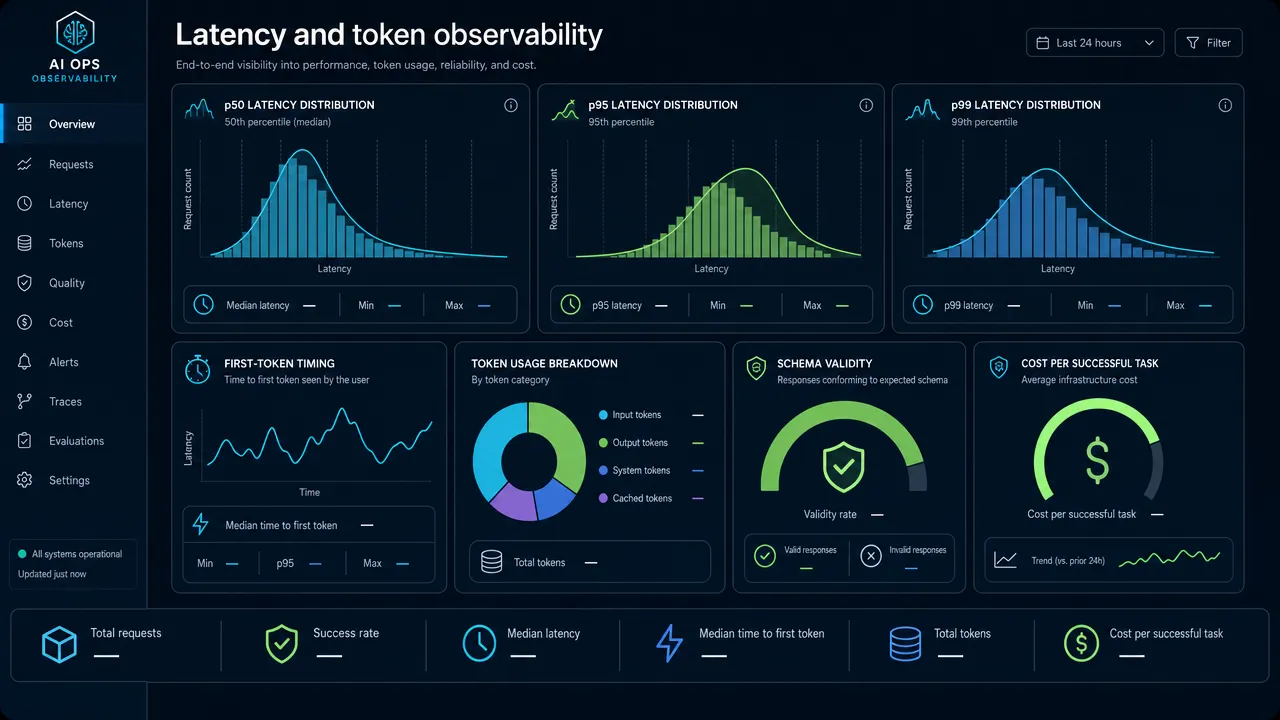
Average latency can hide the conditions that frustrate users and overload services. Measure the entire request path, especially for streaming applications.
Google defines time to first token, or TTFT, as the time until the model produces its first token after receiving a prompt. It is particularly relevant to streaming experiences. OpenAI's latency guidance also notes that output generation commonly dominates total response time for longer completions.
Capture these timestamps:
t0: Client initiates the request.t1: Connection is accepted or the request reaches the provider boundary.t2: First usable streamed token or event arrives.t3: Final model output arrives.t4: Parsing, schema validation, retries, and any tool execution finish.
From those timestamps, calculate:
TTFT =
t2 - t0Completion duration =
t3 - t2End-to-end task latency =
t4 - t0
Report p50, p95, and p99 values. A lower p50 is not enough if p99 latency, timeout frequency, or stream interruption rates rise during load.
Structured output should be treated as a contract, not a presentation detail. Google's structured-output documentation distinguishes output constrained to a specified format from generic JSON formatting. Test both of these outcomes:
The response parses as JSON.
The parsed JSON passes your complete schema and semantic validation.
For tool-using systems, validate more than whether a tool call exists. Track tool selection accuracy, argument validity, execution order, retries, and final task success. A candidate can produce well-formed arguments that still select the wrong tool for the user's intent.
Token accounting deserves the same rigor. Capture provider-reported values when available:
Token category | What to measure | Why it changes decisions |
|---|---|---|
Input tokens | Prompt size by workload and context bucket. | Affects input spend and token-based quotas. |
Output tokens | Actual completion length and configured output limit. | Often drives completion latency and cost. |
Cached input tokens | Cache reads, writes, and hit rate where exposed. | Cache behavior can materially change realized economics. |
Reasoning tokens | Provider-reported billed reasoning usage, if available. | Visible output length may not reflect total billable usage. |
Truncation indicators | Finish reasons, output caps, incomplete JSON. | Reveals silent workflow failures. |
The cost metric that matters most is not nominal price per token. It is cost per successful task:
Total measured request, retry, and tool cost / number of tasks meeting the success criterion
This calculation catches a common false win: a lower-cost first attempt that generates more malformed schemas, retries, tool loops, or human escalations.
Put the candidate behind a stable API contract
A model abstraction layer does not make models interchangeable. It does make experiments easier to repeat, compare, and reverse.
The goal is modest: keep application intent separate from provider-specific transport details and response quirks. A thin internal adapter can be sufficient.
Component | What it should do |
|---|---|
Model registry | Map an internal alias to a specific provider model ID, parameter defaults, limits, and rollout status. |
Standard request contract | Represent messages, content, generation settings, tool definitions, response schemas, streaming preference, and trace IDs consistently. |
Provider adapter | Translate requests, validate capability assumptions, normalize responses, map errors, and extract usage data. |
Compatibility suite | Test golden requests, error handling, streamed event order, finish reasons, and tool-call parsing. |
Validation layer | Parse JSON, enforce schemas, perform semantic checks, and apply a controlled repair or escalation path. |
Observability envelope | Record the resolved model ID, timestamps, usage fields, retries, finish reasons, and failure classes. |
Feature flags | Limit exposure by workload, customer segment, account tier, or other reversible cohort. |
This architecture also makes rollback operationally simple. The application calls an internal alias, while the registry determines whether that alias resolves to the incumbent or candidate configuration.

Compatibility labels need careful interpretation. OpenAI-compatible and Anthropic-compatible request and response formats can reduce integration work, but they do not establish equivalent behavior for streaming, tools, schemas, caching, quotas, or safety outcomes.
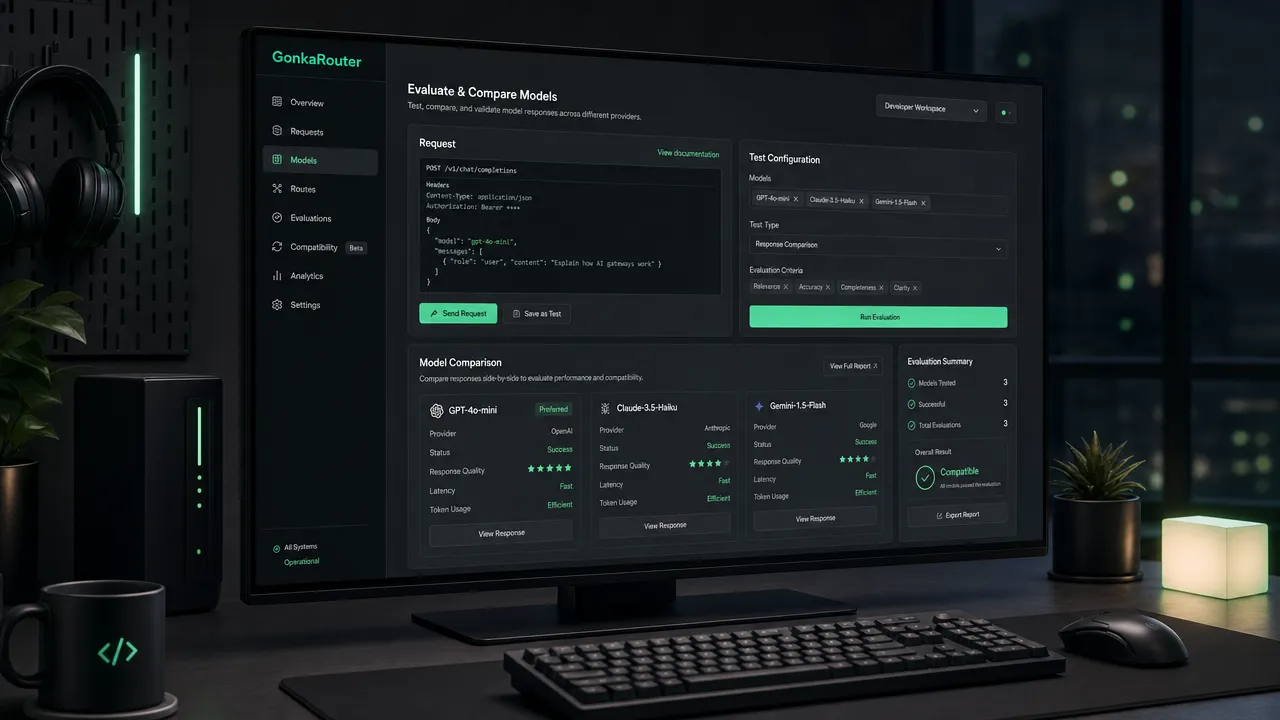
For teams testing multiple supported models through a compatible format, GonkaRouter is an implementation option to evaluate on its own documented scope. It is an OpenAI- and Anthropic-compatible AI Gateway and AI Model Router built for the Gonka Network, with a unified API endpoint.
Its currently listed models are MiniMax-M2.7, Kimi-K2.6, GLM-5.2, and DeepSeek-V4-Flash-0731. The listed price is $0.0004 per 1 million tokens, and new users receive a one-time 20 USDT trial credit after email login. Those facts do not establish support for Gemini 3.8 Flash, Google models, Google AI services, automatic routing, or automatic failover. Confirm the live catalog and documentation before building a test plan.
Roll out the candidate with explicit rollback criteria
Production rollout should be a sequence of bounded experiments. Do not expand traffic because one benchmark, one cost estimate, or one average-latency chart looks favorable.
Start with baseline measurements from the incumbent. Then move through offline replay, approved shadow traffic, a limited canary, segmented expansion, and steady-state monitoring.
Phase | Candidate exposure | Decision evidence |
|---|---|---|
Baseline | None | Current quality, token usage, cost, latency percentiles, schema outcomes, and errors. |
Offline replay | Historical and synthetic test corpus | Compatibility, quality, long-context, cost, and token-behavior results. |
Shadow traffic | Mirrored approved live traffic | Real request shape, streaming behavior, quotas, usage, and error patterns. |
Limited canary | Small reversible cohort | User outcomes and operational metrics within pre-agreed gates. |
Segmented expansion | Gradual by workload or cohort | Stable quality and tail-latency outcomes across segments. |
Steady state | Intended eligible traffic | Ongoing monitoring and scheduled regression reviews. |
Define rollback thresholds before the canary starts. The exact numbers should be workload-specific, but useful triggers include:
A meaningful decline in audited task success.
Any critical-path unrecoverable schema failure.
A p95 or p99 latency breach across consecutive evaluation windows.
A material rise in timeouts, 429 responses, stream disconnects, or retry exhaustion.
Cost per successful task exceeding the approved budget.
Increased wrong-tool selection, invalid tool arguments, or agent loops.
Safety evaluation results outside approved organizational thresholds.
Keep the incumbent configuration available until the candidate has demonstrated stable behavior under representative load. This is especially important for agent workflows, long-context applications, and customer-facing automation where retries can disguise underlying degradation.
FAQs about Gemini 3.8 Flash API migration
Is a Gemini 3.8 Flash API migration just a model ID change?
No. The model ID is only one integration surface. Validate request parameters, streamed events, response fields, structured outputs, tool calls, usage reporting, quotas, latency, and safety behavior.
What should teams use to compare output quality?
Use task-specific rubrics. Measure field-level correctness for extraction, grounding and citation accuracy for RAG, test pass rate for code, and end-to-end completion for agents. Blind human review is valuable for subjective outputs.
Why should TTFT and end-to-end latency be measured separately?
TTFT reflects how quickly a streamed experience begins. End-to-end latency captures generation, parsing, retries, and tool work. A model can have strong TTFT while still producing slower complete task outcomes.
How should token pricing be evaluated?
Capture actual input, output, cached-input, and provider-reported reasoning-token usage where available. Compare cost per successful task after retries and tool costs, rather than comparing only listed per-token rates.
Does API compatibility remove the need for testing?
No. Format compatibility can reduce application-code changes, but it does not guarantee consistent quality, tool behavior, schema reliability, caching, latency, quota treatment, or pricing.
Conclusion: Treat fast-model upgrades like production infrastructure
A Gemini 3.8 Flash API migration is worth evaluating when its documented capabilities align with real workloads, but the release itself is not a production verdict. Treat the candidate as infrastructure: verify current provider details, replay representative traffic, inspect token behavior, measure p95 and p99 outcomes, and expand only when quality, reliability, cost, and latency all meet workload-specific gates.
For a separate compatible-format testing path, review GonkaRouter's live supported-model catalog, documentation, and pricing. Then use the available trial credit to test a small, non-critical workload before making broader architecture or traffic decisions.