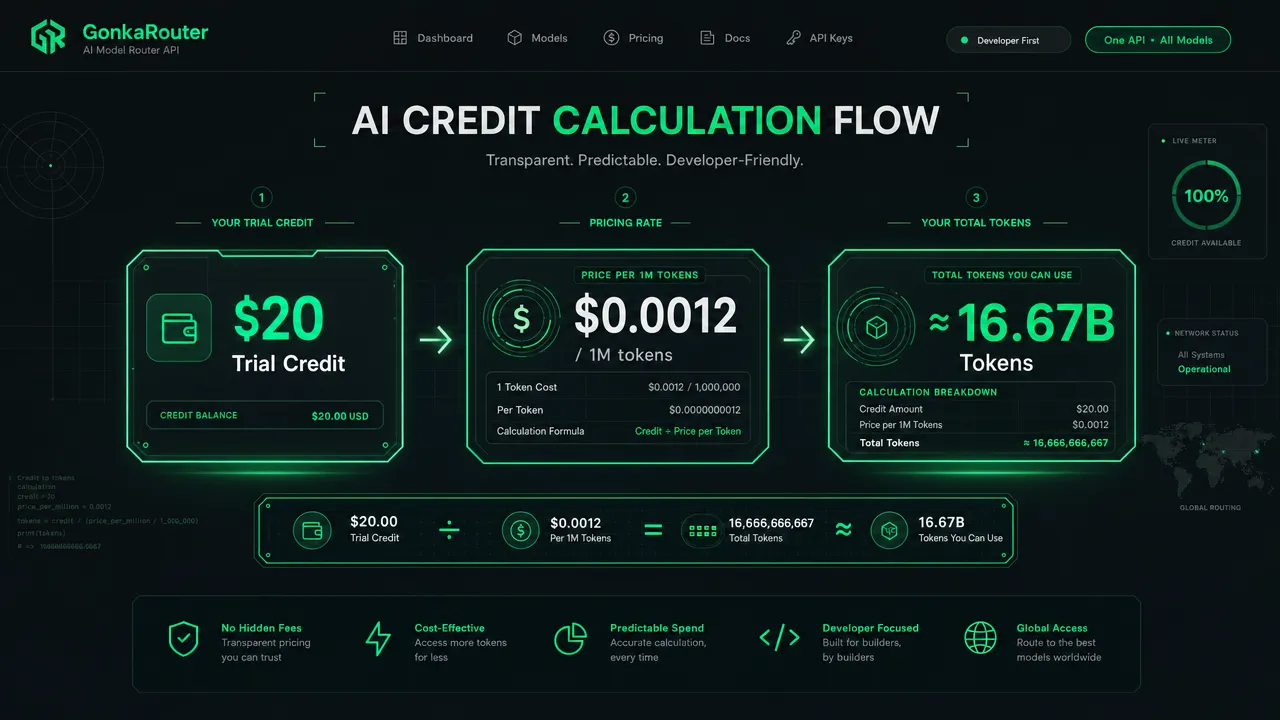
New GonkaRouter users receive $20 in AI API credit after registration, which can equal up to 16.7 billion tokens only as a maximum-equivalent estimate at the displayed $0.0012-per-1-million-token reference rate.
That arithmetic is straightforward:
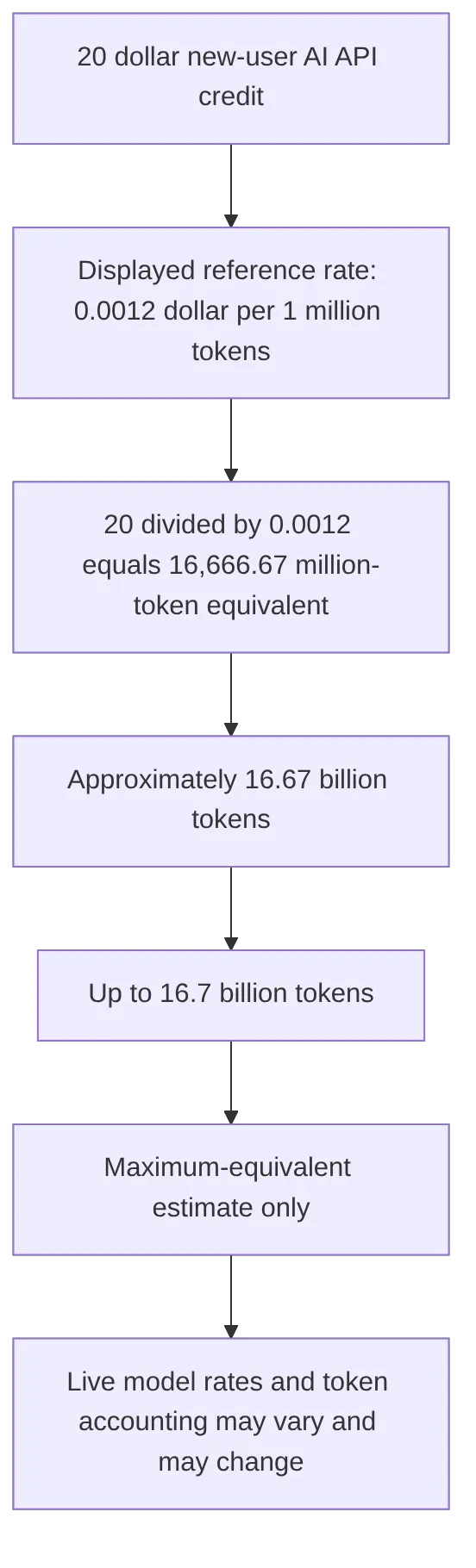
$20 divided by $0.0012 per 1 million tokens equals approximately 16,666.67 million tokens, or approximately 16.67 billion tokens.
The important qualification is equally straightforward: up to 16.7 billion tokens is a maximum-equivalent estimate at the displayed reference rate, not a guaranteed allowance for every model. Actual token usage, token accounting, and rates can vary by model and may change. Confirm the live rate before running a meaningful workload.
How free AI inference credit becomes an up to 16.7 billion token estimate
For developers evaluating free AI inference, the offer is best understood as a credit calculation rather than a fixed token allocation.
Input | Reference value | What it means |
|---|---|---|
New-user credit | $20 | AI API credit supplied after registration |
Displayed reference price | $0.0012 per 1 million tokens | Reference rate used for this example |
Calculation | $20 divided by $0.0012 | Approximately 16,666.67 million tokens |
Rounded result | Up to 16.7 billion tokens | Maximum-equivalent estimate at the displayed reference rate |
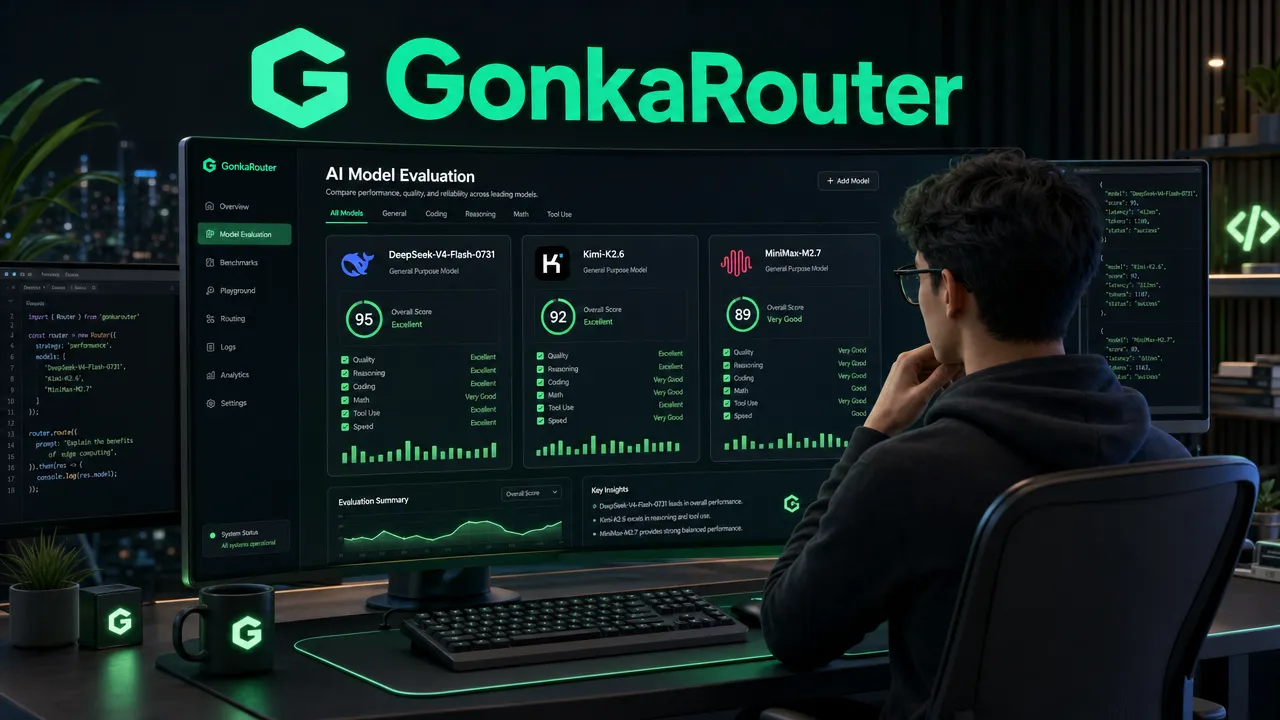
This number should not be read as a promise that DeepSeek-V4-Flash-0731, Kimi-K2.6, and MiniMax-M2.7 each provide the same token volume for $20.
The reference rate supports the calculation, but it is not a production cost forecast. Before sending real traffic, review GonkaRouter pricing, verify the model currently listed, and check how the service accounts for the tokens used by your selected workload.
A useful distinction is this:
A one-time API credit gives a team a budget for evaluation.
A token-equivalent calculation translates that budget at one displayed rate.
A model-specific cost estimate requires the model's current live rate and observed input and output usage.
A production decision requires both cost validation and output-quality validation.
Free AI inference does not mean identical free usage across models
Free AI inference can describe several different things in the market: a trial credit, access to a free model, a limited free tier, or a temporary evaluation budget. The verified GonkaRouter offer discussed here is a one-time $20 AI API credit for new users after registration.
It does not mean unlimited usage. It does not mean permanently free access. It also does not mean every available model has the $0.0012 reference rate.
GonkaRouter currently lists DeepSeek-V4-Flash-0731, Kimi-K2.6, and MiniMax-M2.7. Treat the three models as candidates for a controlled evaluation, not as interchangeable token bundles.
Before a test, confirm these operational details:
The exact live model name or model ID.
The current rate for that model.
Whether input and output tokens are accounted for differently.
Whether additional token categories appear in live usage records.
The request features available through the routed API.
The model behavior that matters for your application.
The displayed $0.0012 rate is useful for explaining the offer, but not for assuming future spend. Pricing excerpts can change, and the relevant price is the one available when your team runs its workload.
Free AI inference model selection for DeepSeek, Kimi, and MiniMax
Choose a first model to test based on task fit, not a universal ranking. The available evidence supports provider positioning and practical test questions, not claims that one model is faster, cheaper, or better than another.
Model | Verified provider positioning | Start with these task-fit questions | Verify live before scaling |
|---|---|---|---|
DeepSeek documents this as the official DeepSeek-V4-Flash release that supersedes the preview version. Its official model materials describe enhanced agentic capabilities. | Do coding, extraction, tool-oriented, multi-step, or assistant prompts meet your acceptance criteria? Does output structure remain usable across prompt variations? | Current model ID, rate, supported request features, token accounting, availability, and limits | |
Kimi positions K2.6 around coding, long-horizon execution, and agent-oriented tasks. Its provider documentation also describes dialogue and Agent tasks. | Is your workload coding help, task decomposition, dialogue, agent behavior, or visual-plus-text input? Do controlled tasks complete safely with your application logic? | Whether provider-native modes and input features are exposed through the routed API, plus rate and accounting | |
MiniMax documents M2.7 in categories including real-world engineering, professional office delivery, and character-rich interaction. | Does the workload require engineering outputs, document deliverables, code changes, formatting discipline, or interactive behavior? Can reviewers validate the output consistently? | Exact variant, model ID, rate, available API features, accounting, and limits |
Provider positioning provides a sensible place to begin, but it does not replace testing. For example, Kimi's documentation may make it relevant for an agent-oriented pilot, while that does not establish that its routed implementation has every provider-native feature enabled. Likewise, MiniMax documentation distinguishes M2.7 variants, but the available information does not establish which variant is exposed in the live catalog.
For a mixed workload with no obvious documented fit, run the same small prompt set across relevant candidates. Hold the instructions, validation rules, and post-processing steps stable where possible. Then select based on your own acceptance criteria, observed usage, and the current live rate.
Run a small OpenAI-compatible API evaluation before scaling
GonkaRouter uses an OpenAI-compatible API endpoint. Use the GonkaRouter developer documentation and the OpenAI-compatible API guidance to reconfirm current request requirements before implementation.
OpenAI compatibility can reduce integration work for teams already using compatible API conventions. It does not, by itself, establish that every client feature, SDK option, request parameter, or provider-native capability is available for every routed model. Validate the live behavior your application needs.
Use this small-test process:
Confirm the live listing and price. Verify that the selected model is available and identify the current applicable rate.
Build a representative prompt sample. Start with a limited set of real task types. Include typical inputs and edge cases, not only polished demonstration prompts.
Define pass criteria before testing. For extraction, check required-field coverage and schema validity. For code, check tests, repository conventions, and reviewability. For drafting, check format, source rules, and audience fit.
Send a small controlled batch. Avoid bulk processing historical data before you understand output quality and observed usage.
Record results consistently. Log model name, date, prompt category, output, errors, token-use information when available, live rate, and pass or fail outcome.
Review consequential outputs. Keep appropriate human review for code deployment, financial actions, security-related workflows, and other business-critical uses.
Estimate cost using live data. Use observed workload token counts and the current model rate. Do not use the $0.0012 reference calculation as a model-specific forecast.
A practical budget-control record can be simple:
Field to track | Why it matters |
|---|---|
Timestamp | Connects results to the rate and model version observed at that time |
Model selected | Keeps comparisons traceable |
Prompt category | Reveals where a model fits or fails |
Acceptance result | Prevents selection based on an anecdotal response |
Observed token use | Supports a workload-based cost estimate |
Live rate | Keeps estimates tied to current pricing |
Error or review note | Captures operational issues that quality scores can miss |
Set an internal dollar cap and request-count cap for the evaluation. Recheck pricing before increasing volume, changing prompts, switching models, or moving from a pilot into production traffic.
Free AI inference FAQs
How is the up to 16.7 billion tokens estimate calculated?
Divide the $20 new-user credit by the displayed $0.0012 reference price per 1 million tokens. The result is about 16,666.67 million tokens, or about 16.67 billion tokens. Calling this "up to 16.7 billion tokens" is accurate only as a maximum-equivalent estimate at that displayed reference rate.
Does every listed model provide exactly 16.7 billion tokens?
No. The calculation is not a per-model allowance. Actual token usage, token accounting, and live rates may vary by model and may change. Confirm the live rate before running workloads.
Which model should a development team test first?
Start with the workload. Consider Kimi-K2.6 for a controlled evaluation of coding, long-horizon execution, or agent-oriented tasks. Consider MiniMax-M2.7 for engineering, office-deliverable, or interactive-workflow tasks. Consider DeepSeek-V4-Flash-0731 when its documented release positioning aligns with the API-oriented workflow you need to validate. Then test representative prompts rather than relying on a ranking.
What should a first API evaluation include?
Use a small representative prompt set, pre-defined acceptance criteria, controlled conditions across models, observed usage tracking, and human review where errors could be consequential. Record the live rate used for each estimate.
How can a team control spending before production?
Set an internal evaluation budget, limit the initial batch size, log observed usage, recheck rates before expanding traffic, and separate evaluation activity from production where your internal tooling allows it.
What endpoint is documented for OpenAI-compatible access?
GonkaRouter supplies an OpenAI-compatible base endpoint. Confirm the current endpoint, authentication requirements, model IDs, and supported parameters in the official documentation before implementation.
The $20 credit makes free AI inference useful as a controlled evaluation budget, while the up to 16.7 billion token figure remains a maximum-equivalent estimate at the displayed $0.0012 reference rate. Select among DeepSeek-V4-Flash-0731, Kimi-K2.6, and MiniMax-M2.7 by testing representative workloads, reviewing live model pricing and token accounting, and measuring output against criteria that matter to your team.
Create a GonkaRouter account, claim the $20 credit, confirm the live model rate, and run a small test request.