GonkaRouter gives new users a $20 AI API credit after registration, and at the displayed reference rate of $0.0012 per 1 million tokens, that credit calculates to approximately 16.67 billion tokens. This is a maximum-equivalent estimate at the displayed reference rate, not a promise of usable MiniMax-M2.7 volume across every model, workload, or future price.
For developers evaluating free AI inference as a controlled trial, the practical path is simple: confirm the live MiniMax-M2.7 rate, validate token accounting and credit terms, then run a small representative request before increasing traffic.
The calculation is:
$20 divided by $0.0012 = 16,666.67 one-million-token units.
16,666.67 multiplied by 1,000,000 = approximately 16.67 billion tokens.
At the displayed reference rate of $0.0012 per 1 million tokens, the $20 credit is a maximum-equivalent estimate of up to 16.7 billion tokens. Actual token usage, token accounting, model-specific rates, eligibility, and pricing may vary or change. Verify the live MiniMax-M2.7 rate and current terms before running a workload.
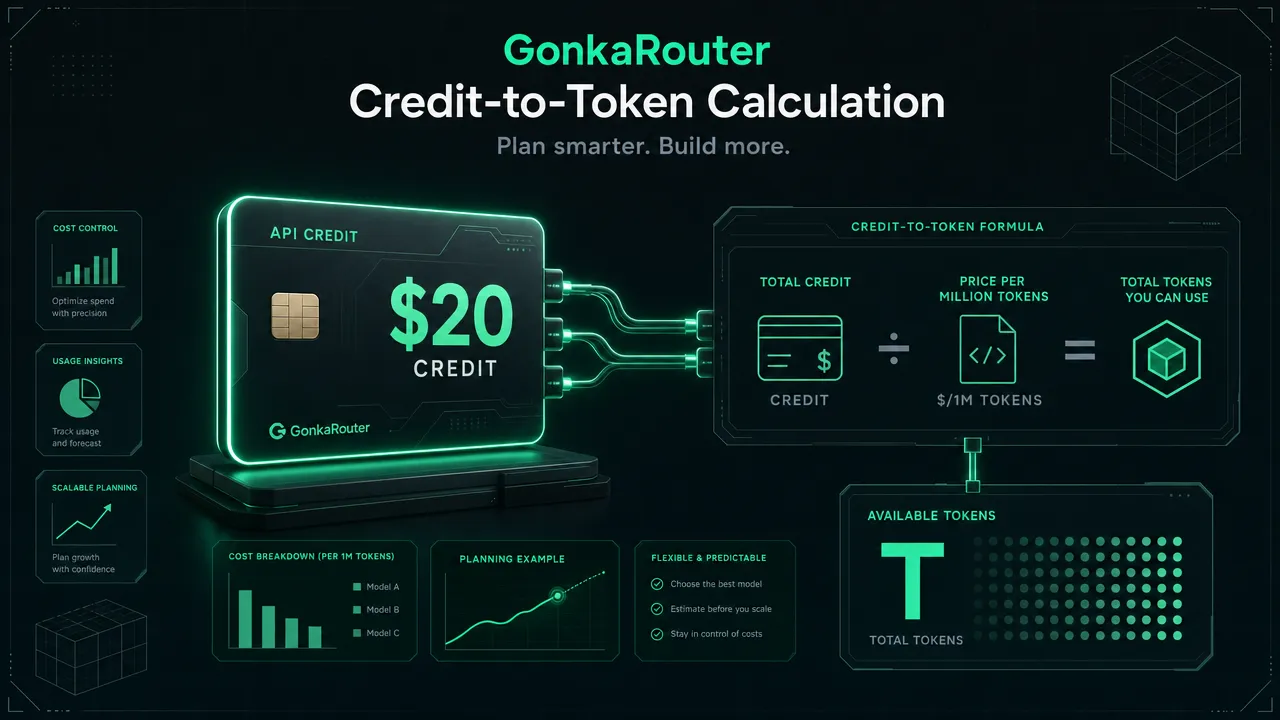
How free AI inference turns a $20 credit into a maximum-equivalent token estimate
The offer supports an evaluation budget, not an unlimited usage plan. GonkaRouter states that new accounts receive a one-time $20 credit, while its live GonkaRouter pricing displays a reference price of $0.0012 per 1 million tokens.
Use the arithmetic as a planning baseline only:
Calculation step | Value |
|---|---|
New-user API credit | $20 |
Displayed reference rate | $0.0012 per 1 million tokens |
$20 divided by $0.0012 | 16,666.67 million-token units |
Estimated token equivalent | Approximately 16.67 billion tokens |
The phrase "up to 16.7 billion tokens" applies only as a maximum-equivalent estimate calculated at the displayed reference rate. It does not mean every model has that rate, that MiniMax-M2.7 will always use that rate, or that all token types are accounted for identically.
Before using the credit, check:
Whether MiniMax-M2.7 is currently available.
The live model-specific price and billing unit.
How input and output tokens are counted.
Current credit eligibility, expiry, and applicable terms.
Whether retries or optional request features affect observed usage.

What free AI inference means when the credit is promotional
Free AI inference in this context means access funded by a one-time promotional API credit. It does not mean permanent access, unlimited requests, or a guaranteed number of tokens for every model.
API costs can depend on more than the length of a single prompt. Longer system instructions, retrieved context, generated outputs, retries, repeated evaluation runs, and multi-step application flows can all increase total token consumption. The current rate and token-accounting method are equally important.
Treat the credit as a bounded test budget:
Start with a small, isolated workload.
Use non-sensitive prompts that resemble your real application.
Record request counts, prompt sizes, output sizes, and retries.
Check available usage or spend reporting after the test.
Reconfirm pricing before starting a batch job or increasing concurrency.
For account use, pricing changes, and service conditions, review the current GonkaRouter Terms of Service. Before sending confidential, regulated, or sensitive material, review the current Privacy Policy and make an internal decision about what data is appropriate for testing.
How free AI inference planning applies to MiniMax-M2.7 and listed models
GonkaRouter lists MiniMax-M2.7 in its catalog at the time of research. The same catalog reference also names Kimi-K2.6 and DeepSeek-V4-Flash-0731. Availability, exact model identifiers, supported parameters, and rates should be confirmed in the live catalog and documentation before use.
Do not transfer pricing, configuration details, or performance claims from another platform to GonkaRouter. MiniMax documents M2.7 on its own platform, but that does not establish the exact model variant, request behavior, or billing configuration available through GonkaRouter.
Evaluation item | Verified information | Confirm before a test | Practical decision |
|---|---|---|---|
MiniMax-M2.7 | Listed by GonkaRouter at the time of research | Current availability, model ID, rate, request requirements | Use only after confirming the live listing. |
Kimi-K2.6 | Listed by GonkaRouter at the time of research | Availability and current rate | Consider as an optional evaluation candidate. |
DeepSeek-V4-Flash-0731 | Listed by GonkaRouter at the time of research | Availability and current rate | Consider as an optional evaluation candidate. |
New-user credit | $20 after registration | Eligibility, expiry, conditions, model applicability | Treat as an evaluation budget. |
Reference rate | $0.0012 per 1 million tokens | Whether it currently applies to MiniMax-M2.7 and how tokens are counted | Use only for qualified planning math. |
API endpoint | OpenAI-compatible campaign-provided endpoint | Authentication, exact endpoint, schema, and model ID | Confirm in current documentation before deployment. |
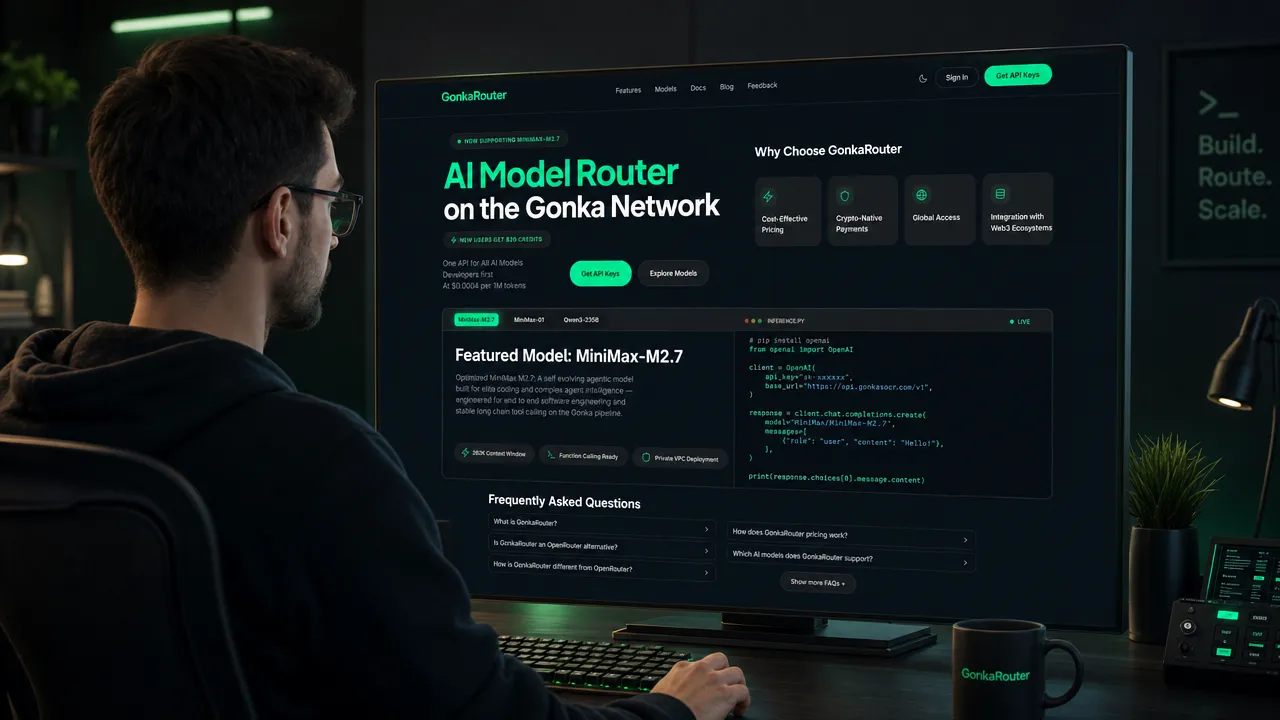
How free AI inference onboarding stays controlled from registration to the first request
GonkaRouter describes its API as OpenAI-compatible. For a broader product explanation, see its guide to an OpenAI-compatible API for multiple AI models. The campaign-provided endpoint is available through the official API setup flow, but developers should confirm the current endpoint, credentials, request format, and model identifier in the current developer documentation before configuration.
Use this restrained onboarding sequence:
Create an account through the official GonkaRouter site.
Confirm that the $20 new-user credit is available and review the live terms.
Open the current documentation and confirm authentication requirements.
Confirm that MiniMax-M2.7 remains listed, then check its live model-specific rate.
Verify how the service currently counts tokens for the request type you plan to send.
Send one short, non-sensitive request representative of your intended workload.
Review actual usage or spend information available through the current API response or account reporting.
Increase volume gradually only when observed consumption fits the budget.
Avoid assuming that OpenAI compatibility means every OpenAI endpoint, SDK behavior, parameter, or feature is supported. Compatibility describes an API approach; the live documentation remains the source of truth for implementation details.
A safe first test is deliberately small. For example, use a short prompt from a normal internal evaluation set, request a bounded response where supported by your client and API configuration, and avoid automatic retries until you understand how usage is reported.
How free AI inference budgets avoid surprise token consumption
The cost equation is useful only when paired with workload controls. A $20 credit may support a meaningful evaluation at the displayed reference rate, but production-like behavior can consume tokens differently from a single manual test.
Use these application-side safeguards where your implementation supports them:
Set a maximum output length for test calls.
Limit the number of requests allowed in an evaluation run.
Disable uncontrolled loops and recursive workflows during early testing.
Log each attempt, including retries and failures.
Track input size and output size for representative prompts.
Separate experimentation from production traffic in your own environment.
Pause before high-concurrency tests and recheck the live price.
Revisit the pricing page before launching a long-running job.
A compact budget worksheet can help technical teams make the credit visible:
Budget-control question | Why it matters |
|---|---|
What is the live MiniMax-M2.7 rate? | The displayed reference rate may not apply in every case. |
What prompt and output size reflects the real workload? | Token use depends on both what you send and what the model returns. |
How many retries can the application make? | Repeated calls can increase consumption unexpectedly. |
Is the test isolated from production traffic? | A controlled test is easier to measure and stop. |
What usage evidence will the team review? | Observed usage should guide any scaling decision. |
When will the rate be rechecked? | Pricing and terms can change over time. |
Free AI inference FAQs for MiniMax-M2.7 cost planning
How is the 16.67 billion-token estimate calculated?
Divide the $20 credit by the displayed $0.0012 rate per 1 million tokens. That produces 16,666.67 one-million-token units, or approximately 16.67 billion tokens.
Does the $20 credit guarantee 16.7 billion MiniMax-M2.7 tokens?
No. Up to 16.7 billion tokens is a maximum-equivalent estimate at the displayed reference rate. Confirm the live MiniMax-M2.7 rate, token accounting, credit terms, and actual usage before running workloads.
Is this unlimited free AI inference?
No. The offer is a one-time $20 promotional API credit for new users, subject to current eligibility and terms.
Where should developers verify the current MiniMax-M2.7 price?
Check live GonkaRouter pricing, the current model catalog, and the developer documentation immediately before use.
Does OpenAI-compatible mean every OpenAI feature is available?
No. It indicates a compatible API approach, not automatic feature parity. Confirm supported endpoints, request fields, authentication, and model IDs in the current documentation.
What is the safest first request?
Send one small, non-sensitive request that resembles your intended workload. Then inspect observed usage or spend information before increasing request volume.
Free AI inference is most useful here as a measured evaluation path: create a GonkaRouter account, claim the $20 credit, confirm the live MiniMax-M2.7 rate, and run one small test request before scaling.