Reliability Starts With Clear Boundaries
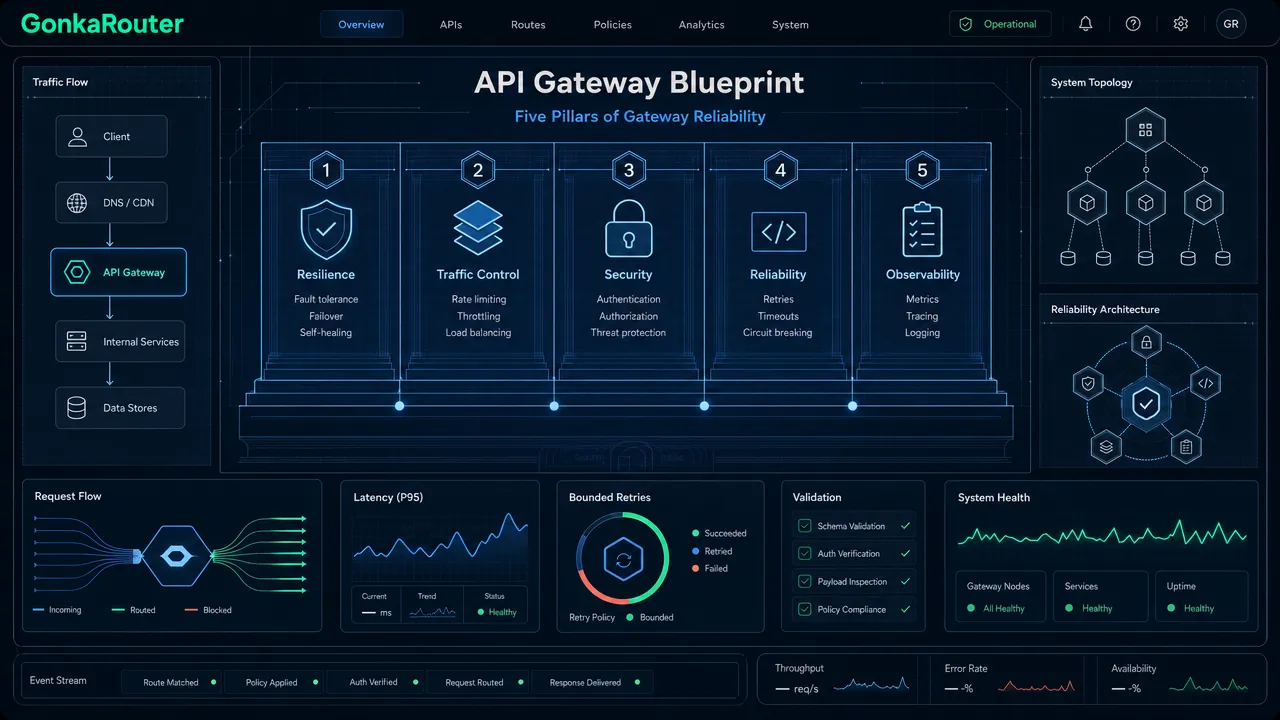
A dependable AI request path starts with clear timeouts, bounded retries, output validation, and recovery behavior in the application. A gateway can simplify model access, while your client still needs to handle upstream errors and protect downstream actions.
GonkaRouter is an OpenAI-compatible and Anthropic-compatible API gateway built on the Gonka decentralized AI compute network. Its current catalog lists GLM-5.3-Flash, DeepSeek-V4-Flash-0731, and MiniMax-M2.7. Compatibility refers to request and response formats, not access to official OpenAI or Anthropic models. Check the current model catalog before choosing a route.
Build Reliability Into the Client
Use explicit request deadlines and classify errors before retrying. Authentication errors, malformed requests, unsupported model IDs, and policy rejections usually need a fix rather than another attempt. Retry transient failures only within a bounded budget, and ensure a single layer owns retries to avoid multiplying traffic.
Validate outputs before passing them to downstream systems. For tool-using agents, check arguments against a schema, enforce permissions in the application, and require approval for consequential actions. Do not silently switch models after a partial response or during an irreversible operation.
Keep a small route test suite for the prompts, context sizes, streaming behavior, and tools your product depends on. Re-run it when changing model identifiers or SDK versions. Record request IDs and operational metadata where available, while following your rules for prompt retention and sensitive data.
Treat the Gateway as a Dependency
A gateway can simplify access to supported models, but it also adds a network hop and a service dependency. Measure end-to-end latency and errors from the client, define a rollback or direct-access contingency where appropriate, and test that procedure before an incident. Do not assume the gateway provides automatic failover, model validation, tracing, or retry behavior unless current documentation explicitly says so.
Define Reliability From the User's Perspective
Availability of an endpoint is not the same as successful completion of a user task. Define a service-level indicator at the application boundary: the percentage of eligible requests that return a valid result within the workload deadline. Exclude only conditions documented in advance, and track validation failures separately from network failures. This prevents a malformed response with HTTP 200 from being counted as success.
Set objectives by workload. An interactive assistant may prioritize time to first token and a tight latency percentile, while a batch extraction job may prioritize completion rate and cost. Record the selected model, request ID, latency, token usage, validation result, and attempt count. Aggregate these signals into accepted-task rate so operators can see whether a change improves the experience rather than merely reducing HTTP errors.
Monitor from outside the gateway as well as inside the application. A synthetic request can detect authentication, DNS, TLS, routing, model access, and response parsing problems across the full path. Keep the test small and non-sensitive, and run it against only the routes that matter. Client-side metrics remain essential because provider dashboards cannot see local timeouts, parser failures, or downstream validation.
Engineer Failure Handling Deliberately
Classify errors before deciding to retry. Authentication failures, invalid parameters, unsupported models, policy rejections, and context-limit errors should stop and surface a clear configuration or request problem. Temporary rate limits, connection failures, or server errors may justify exponential backoff with jitter. Apply a total deadline and maximum attempt count rather than retrying each layer independently.
Make side-effecting workflows idempotent. Assign a unique operation key before an agent calls a tool, store the operation state, and reconcile it after a timeout. Do not assume that a missing model response means the tool action did not occur. For irreversible operations, require confirmation and avoid automatic model fallback after execution has started.
Fallback is a product behavior, not merely an infrastructure switch. The alternate model must support the required context, schema, tools, and data policy, and it must pass the same evaluation suite. Tell the application when a fallback occurred if behavior or quality may differ. If GonkaRouter does not document automatic failover for a scenario, keep that logic in the application and test it explicitly.
Validate Every Model Route
Build a compact regression set from production-like tasks. Include typical prompts, long contexts, malformed inputs, structured outputs, and tool errors. Define expected outcomes and run the set when a model identifier, prompt, SDK, or endpoint configuration changes. A compatible request format reduces integration work but does not make model behavior interchangeable.
Use staged deployment. Send a small share of low-risk traffic to the new route, compare accepted-task rate, latency, and cost, and stop when a predefined threshold is crossed. Keep the previous model and configuration available for rollback during the observation period. Avoid changing the endpoint, model, prompt, and retry policy in the same release because the source of a regression becomes difficult to isolate.
Capacity and rate limits should be tested before peak demand. Measure concurrency, queueing, and long-context behavior rather than extrapolating from a single request. Apply application-level admission control so a burst does not exhaust the entire budget or starve high-priority work.
Prepare for Gateway and Client Incidents
Document who owns the integration, where credentials live, how model changes are approved, and which dashboards and logs support diagnosis. Runbooks should cover invalid credentials, increased latency, rate limiting, a removed model, malformed streaming events, and unexpected spend. Include a communication path for application teams that depend on the shared endpoint.
Decide whether a direct-access contingency is justified by the workload. A backup path adds credentials, code, security review, and ongoing testing, so it should not exist only on paper. If it is necessary, exercise it periodically with a controlled request and verify that the same validation and policy controls apply.
Reliable AI access is produced by clear contracts, measured outcomes, bounded recovery, and tested change. A unified gateway can simplify the request boundary, while the application still owns the controls that turn a model response into a dependable product result.
For implementation context, see GonkaRouter’s API overview. Evaluate the supported catalog, current terms, and your own failure scenarios before production adoption. Register with email, create an API key, and test one supported model on a low-risk workload first.