Hyperbolic provides a verified path to try FLUX.1 [dev], but reviewed official sources do not verify Claude 3.7 availability on the platform.
This guide covers Hyperbolic, the AI cloud and inference platform, not the mathematical term. For developers evaluating named models, the distinction matters: a GPU cloud, a model owner, a hosted inference service, and an AI gateway can each solve different parts of the deployment stack.
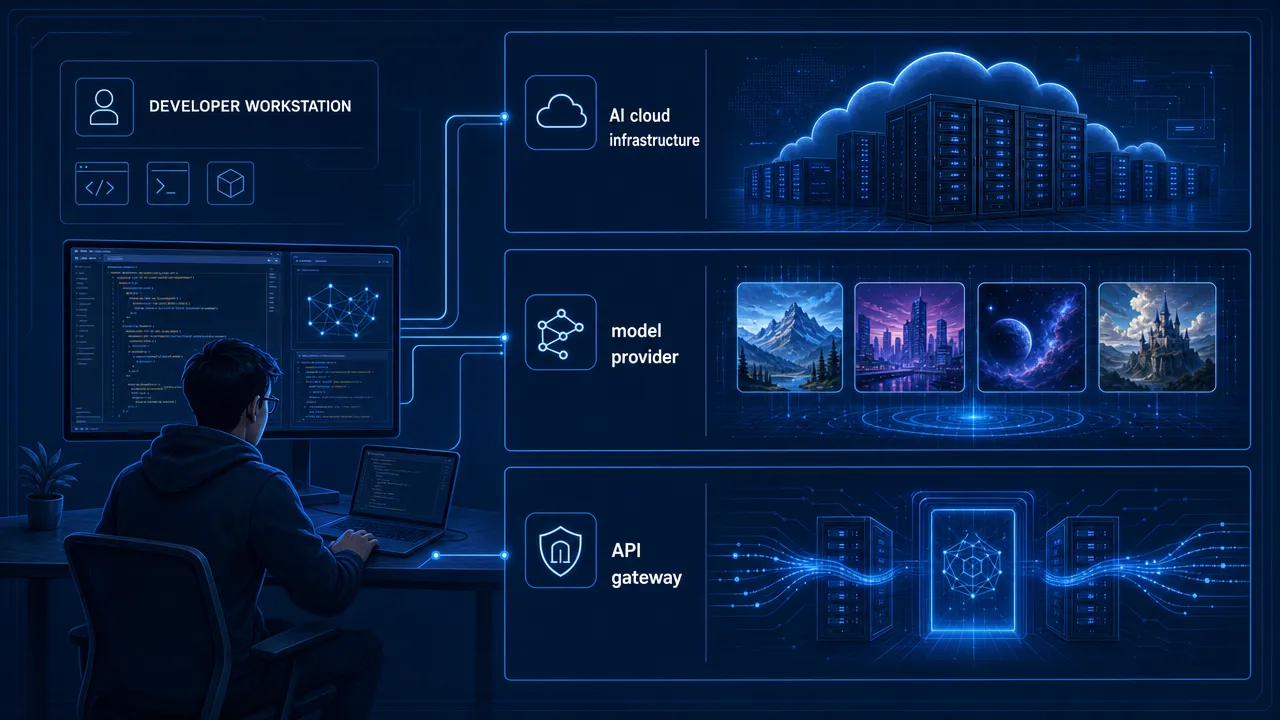
How Hyperbolic model availability differs for Claude 3.7 and FLUX.1
The answer is different for each model family.
Model or platform question | Verified status | What developers should do |
|---|---|---|
FLUX.1 [dev] on Hyperbolic | Verified at the platform-listing level | Confirm the active endpoint, pricing, limits, and provider terms in Hyperbolic's live documentation before implementation. |
Claude 3.7 on Hyperbolic | Not verified in reviewed official Hyperbolic sources | Do not assume support from GPU access, model-serving capabilities, or SDK integrations. Check Hyperbolic's current catalog and Anthropic's live lifecycle documentation. |
Claude 3.7 model status | Anthropic's deprecation documentation lists Claude 3.7 Sonnet as retired | Select a currently supported replacement through an official provider path. |
Flux 1 licensing | Depends on the exact variant | Review the specific FLUX.1 license before self-hosting or commercial use. |
Black Forest Labs lists Hyperbolic as a place to try FLUX.1 [dev] on its official FLUX model availability page. That verification does not establish access to every Flux 1 variant, including FLUX.1 [pro], FLUX.1 [schnell], or later tools.
Claude 3.7 requires more caution. Anthropic introduced Claude 3.7 Sonnet as a hybrid reasoning model, but its live model deprecations documentation should be treated as the source of record for lifecycle status. The reviewed Hyperbolic materials do not confirm Claude 3.7 access through its app, API, dedicated endpoints, or managed inference offerings.
Why Hyperbolic is infrastructure rather than a guaranteed model catalog
Hyperbolic positions itself as an AI cloud for GPU compute, training, fine-tuning, model serving, and inference. Its official documentation overview supports this infrastructure-focused positioning.
That category is important because infrastructure availability does not equal pre-hosted availability for every named model. A platform may let teams rent GPUs, deploy their own workloads, or access selected managed models while not offering another model through a public API.
For Hyperbolic Labs evaluations, validate these operational details before selecting an implementation:
The exact model and variant name.
Whether access is managed inference, self-hosting, or a dedicated deployment.
API schema, authentication method, and output format.
Image pricing, rate limits, and regional availability for FLUX.1 [dev].
License requirements for the underlying model.
Data handling, retention, and production support expectations.
Hyperbolic has also described a Black Forest Labs partnership in its 2024 year-in-review. That is useful context for FLUX.1, but it is not proof of a current endpoint configuration or all-variant support.

Which Hyperbolic FLUX.1 options require license and variant checks
FLUX.1 is an image-model family from Black Forest Labs. Its foundational variants are FLUX.1 [pro], FLUX.1 [dev], and FLUX.1 [schnell], as described in the official FLUX.1 overview.
The variants should not be treated as interchangeable.
FLUX.1 variant | Typical access direction | Licensing consideration |
|---|---|---|
FLUX.1 [pro] | Hosted model access through Black Forest Labs and selected platforms | Proprietary hosted offering. Verify current provider terms. |
FLUX.1 [dev] | Downloadable weights and selected hosted platforms, including the verified Hyperbolic listing | Distributed under a non-commercial license. |
FLUX.1 [schnell] | Downloadable weights and self-hosted workflows | Available under Apache 2.0. |
The official FLUX inference repository distinguishes the FLUX.1 [dev] non-commercial license from the Apache 2.0 license for FLUX.1 [schnell]. Therefore, neither "open weights" nor access through a hosted provider automatically means unrestricted commercial permission.
A team using a phot generator, recreating a photo workflow, or building an image application should separate model selection from deployment selection. FLUX.1 is relevant for text-to-image and image-controlled generation. It is not a substitute for a language and agent model such as the historical Claude 3.7 model.
For self-hosted workflows, the Hugging Face company ecosystem can be useful for distribution and tooling context, while the Diffusers FLUX pipeline documentation provides implementation-oriented reference material. Self-hosting also means accepting responsibility for GPU capacity, scaling, monitoring, access controls, and incident response.
How Hyperbolic compares with model providers and AI gateways
Developers can avoid incorrect integration assumptions by separating four roles.
Category | Primary responsibility | Example in this guide |
|---|---|---|
Model provider | Develops, licenses, and officially maintains a model family | Anthropic for Claude, Black Forest Labs for FLUX.1 |
AI cloud | Supplies GPUs, training, serving, and inference infrastructure | Hyperbolic |
Managed inference host | Runs a specified model and exposes it through a service | Must be verified model by model |
AI gateway or AI Model Router | Centralizes application access to the models it explicitly supports | GonkaRouter |
API-format compatibility is not a model catalog. An OpenAI Compatible API can support request and response patterns resembling an OpenAI-style API without providing OpenAI models. The same principle applies to an Anthropic Compatible API: compatibility with a request format does not establish access to Anthropic models.
This distinction prevents a common implementation mistake. Do not choose an AI Gateway because it sounds compatible with a model provider. Choose it because its documented model list includes the models your application requires.
When Hyperbolic is not the right path for a required model
Use a direct model-provider path when your product requires a specific proprietary model, current provider-native features, or direct lifecycle support. For Claude 3.7, first check Anthropic's current models overview and deprecation guidance because historical availability is not the same as present availability.
Use a hosted inference platform when the exact model variant is confirmed and your team wants to avoid operating serving infrastructure. Confirm the provider's active model catalog, cost unit, usage limits, privacy terms, and regional coverage.
Use Hyperbolic when your requirements fit AI cloud infrastructure, GPU access, model serving, or the specifically verified FLUX.1 [dev] path. Treat operational specifics as live documentation checks, not assumptions.
Use self-hosting when infrastructure control, deployment topology, and licensing alignment justify the added operational responsibility.
Use an AI Model Router when the goal is to reduce integration work among models that the router explicitly supports. That is where GonkaRouter fits: it is a focused AI Gateway for MiniMax-M2.7, Kimi-K2.6, and GLM-5.2 only. It is not an access path for Claude 3.7 or FLUX.1.
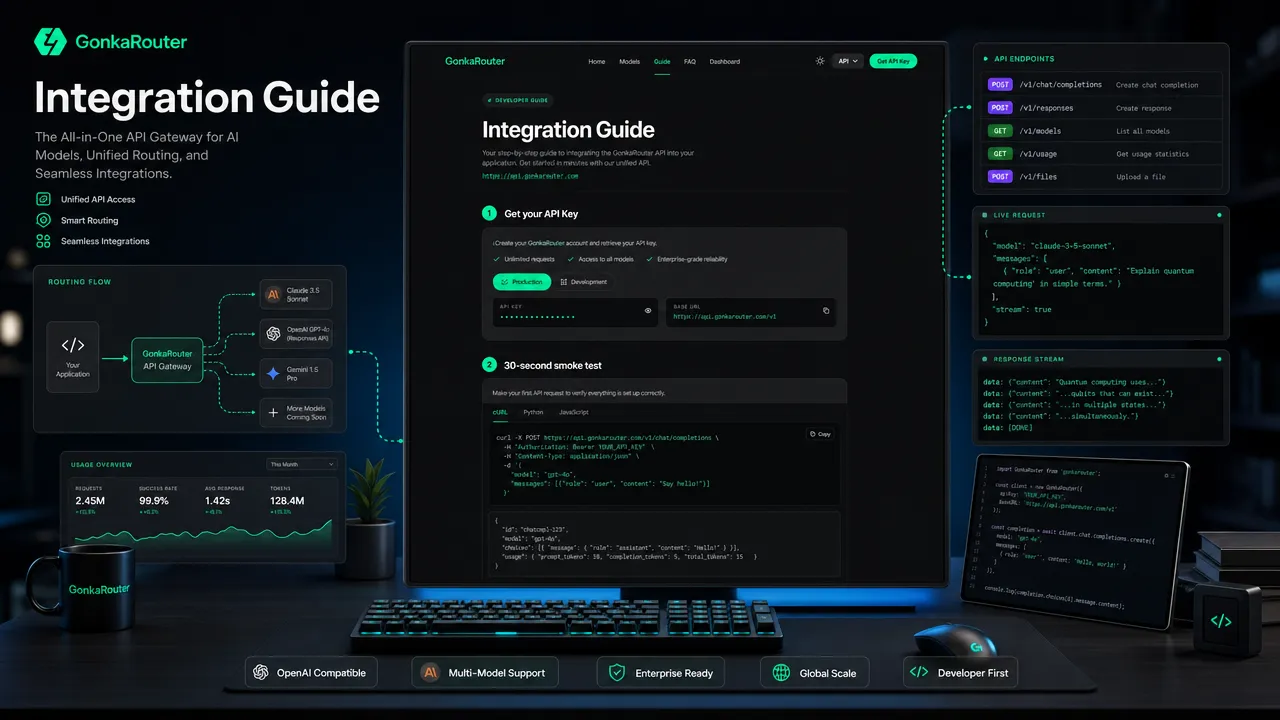
For teams whose requirements match its supported models, GonkaRouter provides one API for MiniMax-M2.7, Kimi-K2.6, and GLM-5.2. Its OpenAI-compatible and Anthropic-compatible formats refer to API formats only. Developers can typically begin by changing the endpoint, then testing supported models in an Agent API, chatbot, code-generation workflow, or automated process.
Learn more about one OpenAI-compatible API endpoint for multiple AI models, review the GonkaRouter AI Model Router, and consult the privacy policy and terms of service during your technical evaluation.
GonkaRouter offers email-based login, token pricing as low as $0.0004 per 1M tokens, and a one-time 20 USDT trial credit after email login for product testing and usage. Start by getting an API key and validating MiniMax-M2.7, Kimi-K2.6, or GLM-5.2 against your application's actual workload.