An LLM gateway becomes production infrastructure when it centralizes routing decisions that applications would otherwise implement inconsistently. A shared endpoint reduces provider-specific integration work, but smart routing determines whether each request reaches an eligible model with acceptable quality, latency, cost, and reliability.

Turn a shared API into an operational control layer
An LLM gateway sits between an application and one or more inference endpoints. At its simplest, it authenticates requests, translates provider formats, and normalizes responses behind a unified LLM API. In production, it also centralizes quotas, telemetry, policies, caching, retries, and provider adapters.
That distinction matters because an OpenAI-compatible interface is a transport convenience, not a guarantee of behavioral portability. Two models can accept similar chat-completion payloads while differing substantially in context capacity, vision support, tool calling, JSON schema adherence, streaming semantics, safety behavior, and token accounting.
Layer | Responsibility | What it does not guarantee |
|---|---|---|
API proxy | Forwards and transforms requests | Intelligent model selection |
Unified LLM API | Provides a common client contract | Feature parity between models |
Model router | Selects a model, provider, region, or deployment | Authentication and governance |
LLM gateway | Combines routing with policy and operations | That all models are interchangeable |
This is why a multi-provider LLM deployment should not rely only on changing base_url and model IDs. A gateway should isolate provider-specific behavior so application services can use stable internal aliases such as support-default, long-context-rag, or code-review.
For a deeper look at that boundary, see why OpenAI-compatible endpoints alone do not solve multi-model infrastructure.
Use policy-driven routing instead of static forwarding
Static forwarding sends every request to a manually selected model. That works for a prototype with one workload and one provider. It becomes fragile when an agent needs different models for classification, planning, structured extraction, tool selection, and final response generation.
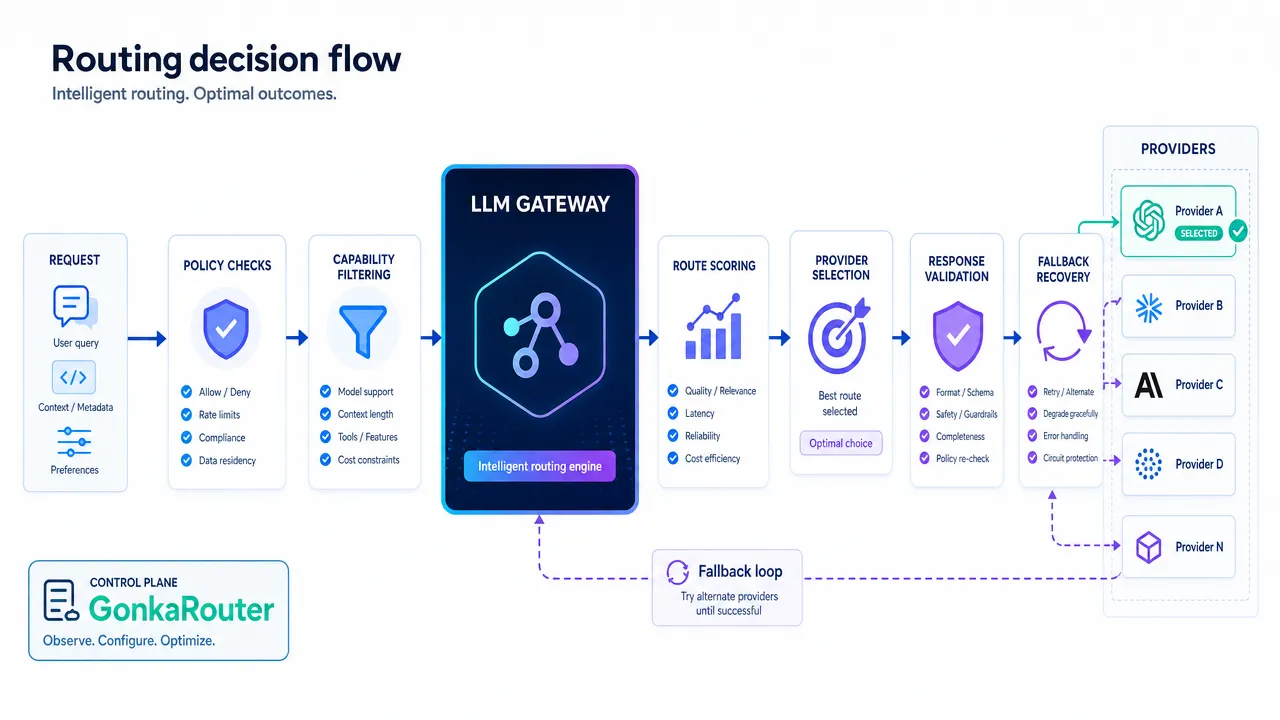
Smart routing, sometimes called an AI routing engine or LLM routing platform, evaluates a request against both hard constraints and live operational signals.
Hard constraints should come first:
Data classification and approved provider policy.
Required region or deployment environment.
Modality requirements such as text, image, audio, or PDF input.
Context-window and output-token requirements.
Tool calling and structured-output support.
Tenant-level budgets and model allowlists.
Only after filtering ineligible routes should the gateway optimize for price, latency, health, or evaluation score. This approach avoids the common mistake of choosing the cheapest LLM API for a task that later fails schema validation or requires an expensive retry.
Workload | Routing priority | Typical route characteristic |
|---|---|---|
Intent classification | Low cost and low latency | Small, reliable text model |
Long-context RAG synthesis | Context capacity and grounding quality | Long-context capable route |
Code review | Reasoning and code quality | Coding-capable model |
Structured extraction | JSON schema reliability | Model with tested structured output |
User-facing final response | Quality, latency, and tone | Balanced default route |
Semantic routing LLM systems add intent or complexity signals to this decision. A classifier, embedding similarity lookup, or explicit metadata such as task_type=code_review can route requests to a suitable capability tier. However, semantic routing should retain a deterministic default route and confidence thresholds because the routing classifier can also be wrong.
Make every route decision observable
A robust LLM gateway architecture separates the data plane from the control plane. The data plane handles live requests. The control plane stores route policies, model capabilities, credentials, budgets, and rollout configuration.

The request lifecycle should be explicit:
Authenticate the client and map it to a tenant, environment, and budget.
Normalize messages, tools, output schemas, streaming options, and trace metadata.
Estimate context usage and filter models that cannot satisfy the request.
Apply data, geography, and allowlist policies.
Score eligible routes by quality threshold, latency target, health, and estimated cost.
invoke the selected provider through an adapter.
Validate structured output or tool-call arguments before downstream execution.
Record the selected route, latency, tokens, retries, fallback reason, and final outcome.
LLM observability should measure more than HTTP success. An HTTP 200 response can still contain malformed JSON, an invalid tool call, or a weak answer that fails the actual business task. Record model version, route-policy version, time to first token, end-to-end latency, cache status, token usage, validation results, and acceptance rate.
Kong AI Gateway documentation describes AI traffic controls across routing, security, observability, and governance. LiteLLM's routing documentation also provides useful implementation patterns for routing and load balancing.
Separate failover, load balancing, and retries
LLM failover is reactive. It moves traffic after a timeout, throttling event, eligible server error, or health failure. LLM load balancing is proactive. It distributes requests across equivalent approved routes based on weights, capacity, latency, or rate-limit state.
Retries are different again: a retry repeats an attempt, usually on the same route, before the system considers model fallback routing.
Mechanism | Trigger | Primary purpose | Main risk |
|---|---|---|---|
Retry | Temporary error or network issue | Recover without changing route | Retry storms |
Load balancing | Normal traffic distribution | Increase throughput and resilience | Uneven output behavior |
Failover | Route outage or degradation | Preserve availability | Higher latency and cost |
Model fallback routing | Ineligible or failed primary outcome | Move to a tested alternative | Schema or quality mismatch |
A fallback route must be pre-evaluated for the same workload. A model that is acceptable for plain-text summarization may be unsuitable for a tool-using agent or a JSON-only extraction pipeline. Fallbacks should also respect the original data policy. A gateway must never use fallback routing as a way to evade a model refusal or safety control.
Use bounded recovery behavior: one retry owner, a total deadline, short fallback chains, exponential backoff with jitter, and circuit breakers for unhealthy providers. LiteLLM's reliability guidance is a useful reference for documented retry and provider-failover patterns. For implementation-oriented guidance, review this intelligent model router and AI model failover article.
Measure cost per accepted task
LLM cost optimization is not simply a search for the lowest input-token rate. A cheaper model can increase total spend when it produces unusable structured data, requires a longer prompt, triggers more tool calls, or sends the task to a premium fallback.
A more useful metric is:
Cost per accepted task = total inference, retry, fallback, tool, infrastructure, and review cost / tasks meeting acceptance criteria
This metric is especially important for agents. One user request may trigger multiple inference steps: intent classification, retrieval-query rewriting, planning, tool selection, validation, and final answer generation. A model router for agents should select routes per step rather than force every stage through the same model.
Cost-aware routing works best when it has guardrails:
Set a minimum quality or validation threshold before considering cost.
Reserve premium models for tasks that demonstrate a measurable benefit.
Cap output tokens for bounded tasks such as classification and extraction.
Track fallback frequency, since frequent failover can eliminate expected savings.
Run controlled A/B tests before changing a default route.
Cost per token versus cost per completed task explains why task-level measurement is more useful for multi-step AI systems than headline pricing alone.
Match routing policy to the workload
The strongest LLM gateway strategy is not "always use the best model" or "always route to the lowest-cost provider." It is to select the lowest-total-cost eligible route that meets the workload's quality, policy, latency, and reliability requirements.
Start with a small registry of approved models, explicit route aliases, and measurable acceptance criteria. Add semantic routing, model failover, and dynamic cost optimization only after collecting production-quality telemetry. This keeps routing reversible, auditable, and aligned with actual application outcomes.
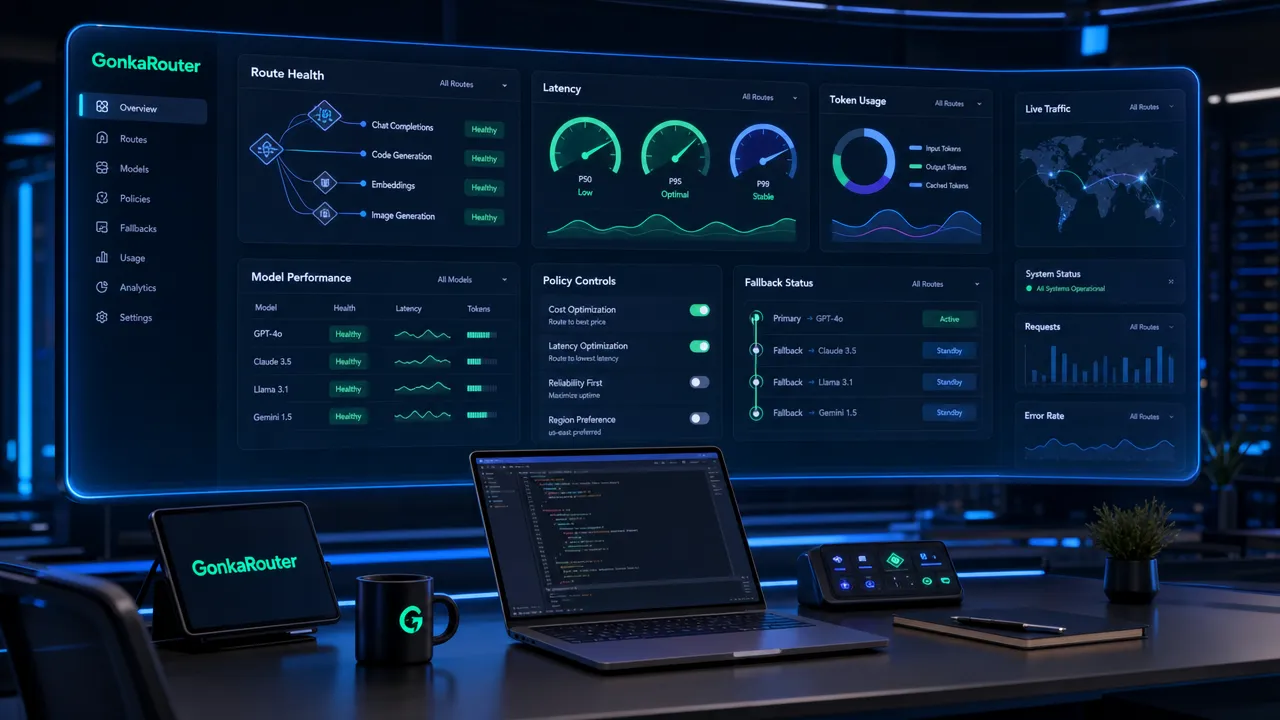
Teams evaluating compatible multi-model access can consider GonkaRouter as one focused example, while verifying its current model catalog, routing controls, data-handling terms, and pricing against their own production requirements.
Review GonkaRouter's current model catalog and confirm the routing controls you need against current documentation before evaluating it for production.