A well-configured LLM gateway can reduce the chance that a provider incident becomes a customer-facing application outage by applying bounded retries, pretested fallback routes, and route-level visibility.
A direct dependency on one model endpoint creates a single operational failure domain. An API can be healthy one moment and return rate limits, elevated latency, partial stream failures, or 5xx responses the next. Model aliases can change, regional capacity can tighten, and a model can be retired while the rest of an application remains fully operational.
The important distinction is between provider availability and application success. An HTTP 200 is not success when an agent receives invalid JSON, exceeds its latency budget, emits an unauthorized tool call, or fails a quality check. A trusted gateway provides the policy layer needed to recognize these different outcomes and respond predictably.
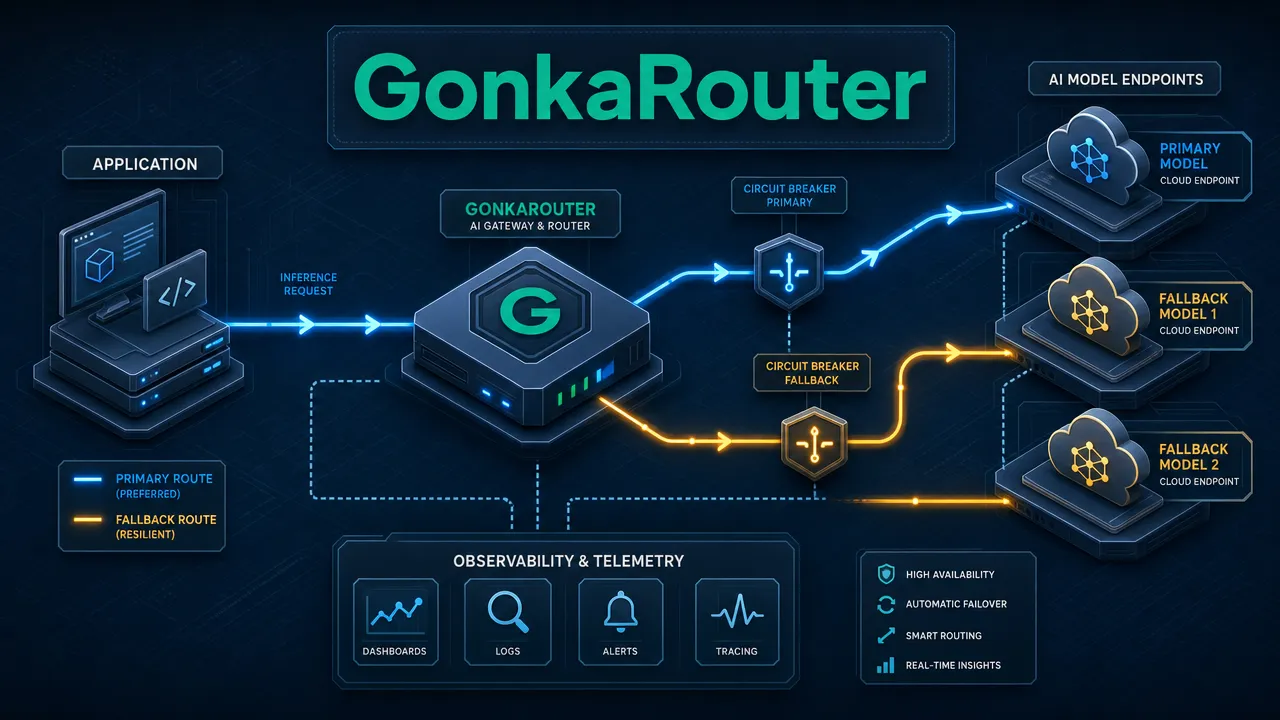
Contain endpoint failures before they spread
A production LLM gateway sits between an application and one or more inference endpoints. Rather than embedding provider-specific retry logic, credentials, quotas, and request transformations in every service, teams centralize them in a request-time control layer.
That layer can authenticate callers, normalize request formats, check model capabilities, select an eligible route, apply bounded retries, and record each decision. A unified LLM API may make integration easier, especially for applications using an OpenAI-compatible request shape, but transport compatibility does not make models behaviorally identical.
Transient failures deserve a bounded recovery path. For example, a 429 response may be retryable within a defined deadline. OpenAI recommends honoring Retry-After when supplied, or using exponential backoff with jitter for temporary rate-limit events. See the OpenAI rate-limit guidance for the underlying behavior.
A gateway should not retry everything. Authentication failures, unsupported parameters, invalid prompts, policy blocks, and schema violations normally require diagnosis rather than repeated traffic. One retry owner is also essential: client SDKs, agent frameworks, applications, gateways, and load balancers should not independently retry the same operation.
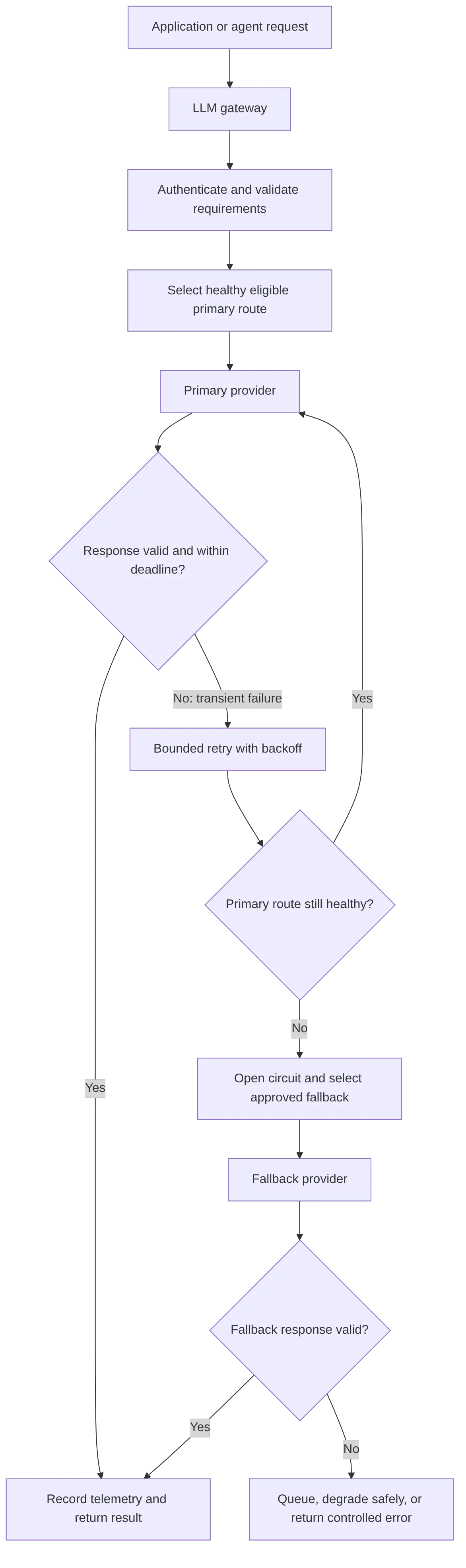
This is the practical value of LLM failover: not an unrealistic promise of uninterrupted inference, but a controlled way to isolate a failed route before every request repeats the same failure.
Treat fallback as a compatibility decision
Model fallback routing must be treated as a compatibility decision, not a list of model names. A fallback can be safe only when it satisfies the workload's requirements for context capacity, modalities, tool calling, streaming, structured output, data location, safety controls, and measured task quality.
For a plain-text internal summarization task, a multi-provider LLM strategy can often use a pre-evaluated alternative model family. For an agent that executes tools, produces strict JSON, or supports a high-impact workflow, an incompatible fallback may be worse than a controlled error or queued job.
A reliable policy typically follows this order:
Admit and validate the request.
Filter routes by capabilities and governance requirements.
Prefer a healthy primary deployment.
Retry classified transient errors within the end-to-end deadline.
Open a circuit when a route crosses a failure threshold.
Attempt a short, approved fallback chain.
Validate the output before returning it downstream.
The distinction between provider fallback and model fallback matters. The lowest-risk option is often the same model version through another approved deployment. Switching model families should be an explicit workload-level decision, not a generic "how to switch between Claude and GPT" rule.
For implementation patterns, GonkaRouter's guide to resilient request paths and its practical routing walkthrough provide useful context on applying policies at the routing layer.
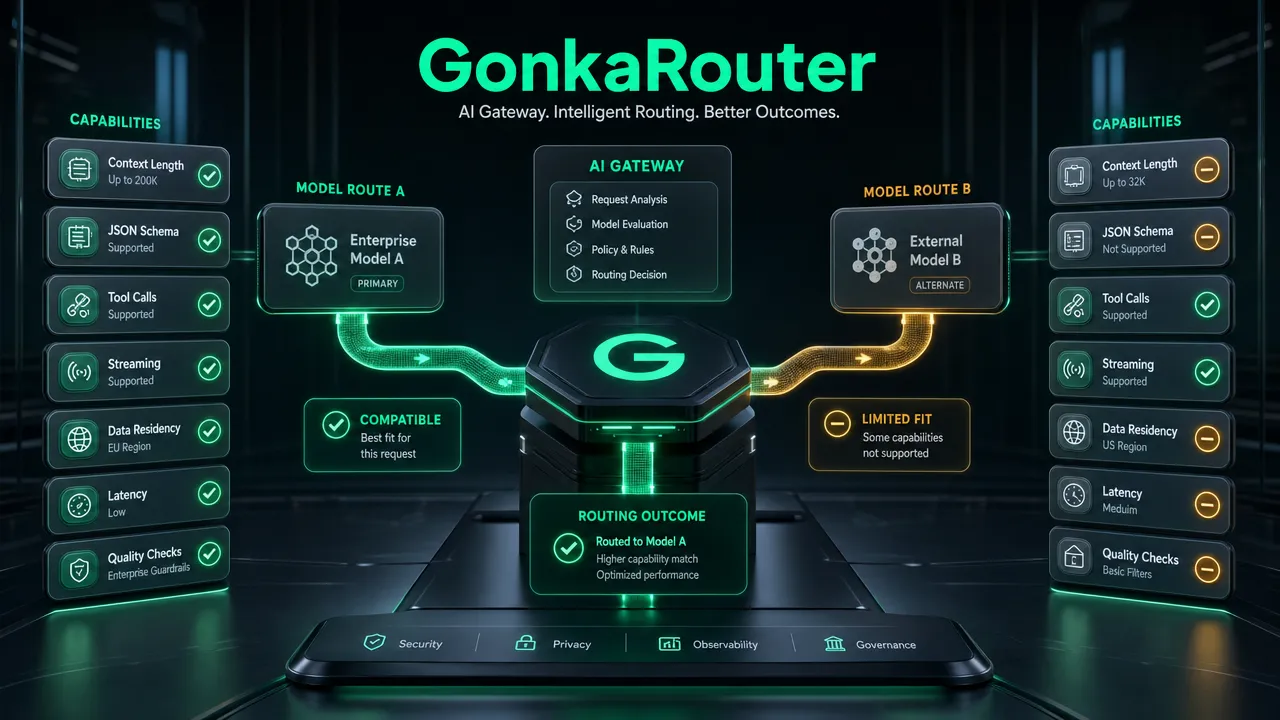
Combine health signals, deadlines, and policy controls
An effective LLM gateway architecture separates the control plane from the data plane. The control plane stores versioned routing policies, capability metadata, secrets, tenant budgets, and approved fallback pairs. The data plane performs low-latency request execution.
Component | Production responsibility |
|---|---|
Request normalizer | Converts a shared request contract to provider-specific formats. |
Model registry | Tracks verified context limits, modalities, tools, regions, and restrictions. |
Routing engine | Selects routes using capability, health, latency, cost, or intent rules. |
Circuit breaker | Temporarily removes unhealthy routes after repeated failures. |
Output validator | Checks JSON schemas, tool-call arguments, and workflow constraints. |
Telemetry pipeline | Records route choice, retries, costs, latency, and quality outcomes. |
An AI routing engine should receive an explicit deadline from the caller. Without one, a primary timeout plus retries plus fallback attempts can exceed the user experience that failover was meant to protect.
A minimal OpenAI-compatible request might look like this:
bash 复制代码

The shared API format is useful, but it does not guarantee parity for tool calls, reasoning controls, structured outputs, or streaming behavior. Both Anthropic's compatibility documentation and Google's OpenAI library support documentation make clear that compatibility layers have feature boundaries.
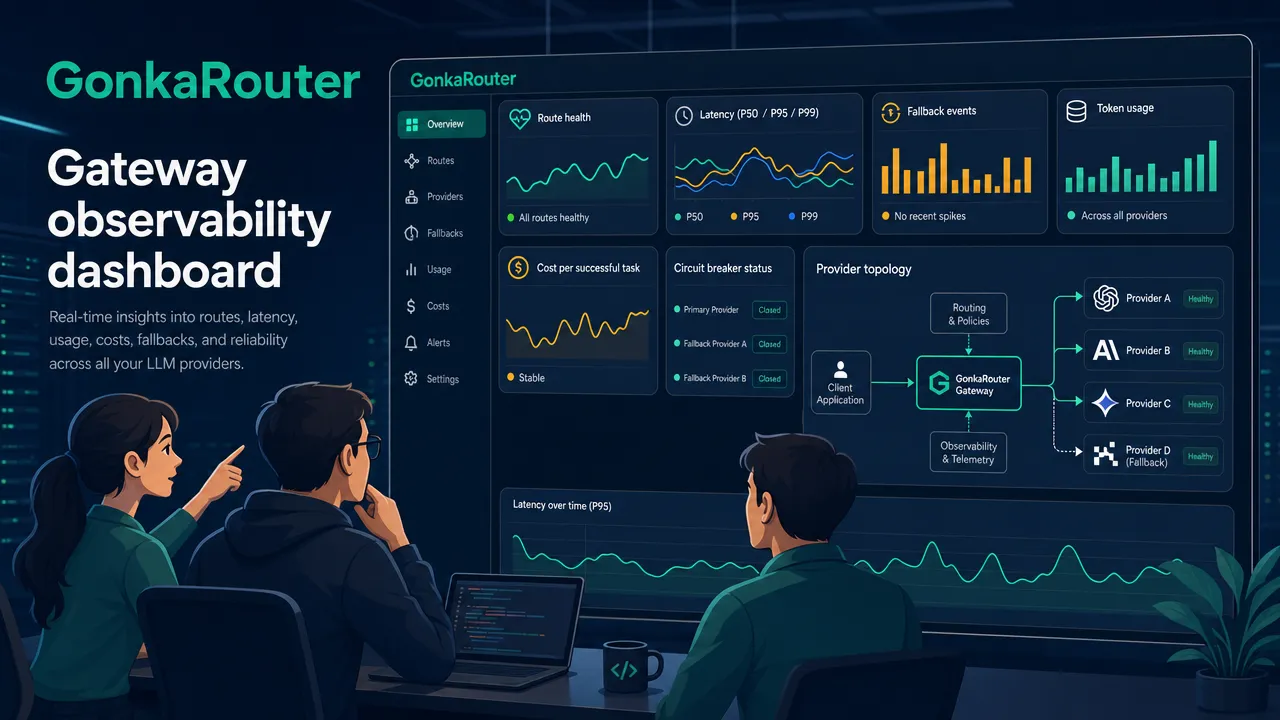
Use observability to verify recovery
LLM observability should measure completed, quality-passing tasks, not merely provider responses. A gateway must make every route attempt explainable: selected provider, model identifier, route-policy version, retry count, fallback reason, token usage, latency, and output-validation result.
Track these metrics by application, tenant, task type, provider, model, and region:
Category | Key measurements |
|---|---|
Reliability | Success rate, timeouts, 429 events, circuit-open duration, fallback frequency |
Performance | p50, p95, p99 latency, gateway overhead, time-to-first-token, stream interruption rate |
Cost | Input and output tokens, failed-attempt spend, cost per accepted task |
Quality | JSON validity, tool-call correctness, evaluation score, refusal rate |
Routing | Route exclusions, policy version, health state, fallback cause |
OpenTelemetry's evolving GenAI semantic conventions offer a useful vocabulary for this instrumentation, including provider, operation, and error attributes. Teams can use the GenAI semantic conventions to avoid creating incompatible telemetry fields across services.
LLM cost optimization also requires a better measure than token price:
Cost per successful, quality-passing task = total inference cost of all attempts divided by accepted tasks.
This includes retries, large-context fallback attempts, output repair calls, and agent loops. A supposedly cheapest LLM API can become expensive when it causes validation failures or downstream rework. For more detail on this relationship during demand spikes, see GonkaRouter's discussion of resilience and completed-task economics.
Decide when a gateway belongs in the stack
A direct provider integration remains sensible for prototypes, narrow workloads, or applications that depend on one proprietary feature. An LLM gateway becomes more compelling when model calls are customer-facing, revenue-sensitive, multi-tenant, multi-region, or part of tool-using agents.
Before adopting a managed platform or an open-source LLM gateway deployment, test these operational questions:
Can policies be versioned, reviewed, and rolled back?
Are fallback pairs evaluated for each workload?
Can prompts, outputs, and tool arguments be redacted from logs?
Are keys isolated, rotated, and auditable?
What happens when the gateway itself is unavailable?
Can route telemetry and policy configurations be exported?
The gateway is itself a critical dependency. Multi-zone deployment, configuration rollback, health checks, and a limited contingency path should be part of its design. Teams should also run failure drills that simulate 429s, slow streams, malformed JSON, provider timeouts, and failed fallback routes.
Turn provider failures into controlled application behavior
A trusted LLM gateway does not make every model interchangeable or erase upstream outages. It gives engineering teams a disciplined way to detect route failures, stop sending traffic to degraded endpoints, use only approved fallback paths, and preserve evidence for incident response.
Start with one low-risk workload. Define a short fallback chain, set a strict deadline, validate outputs, capture route-level telemetry, and inject failures before production traffic does it for you. That approach makes LLM load balancing, AI model failover, and multi-provider routing measurable engineering controls rather than optimistic infrastructure claims.
To evaluate a managed routing layer, review GonkaRouter's current model catalog and run failure-injection tests against the exact routes your application would use.