LLM failover can contain the cost of sudden traffic spikes when it prevents wasteful retries, protects premium capacity for priority work, and moves only validated non-critical workloads to cheaper or delayed handling paths. It is not an automatic savings feature. A poorly designed fallback policy can increase spend through duplicate requests, long model context replay, expensive alternates, and repair prompts caused by lower-quality output.
Before adopting the pattern, verify four things: which requests may safely degrade, who owns retries, whether a fallback has passed task-specific evaluation, and whether the remaining request deadline can accommodate another attempt. The metric that matters is not the lowest token price. It is cost per successful, quality-passing task.
Why llm failover reduces spike costs only with strict workload rules
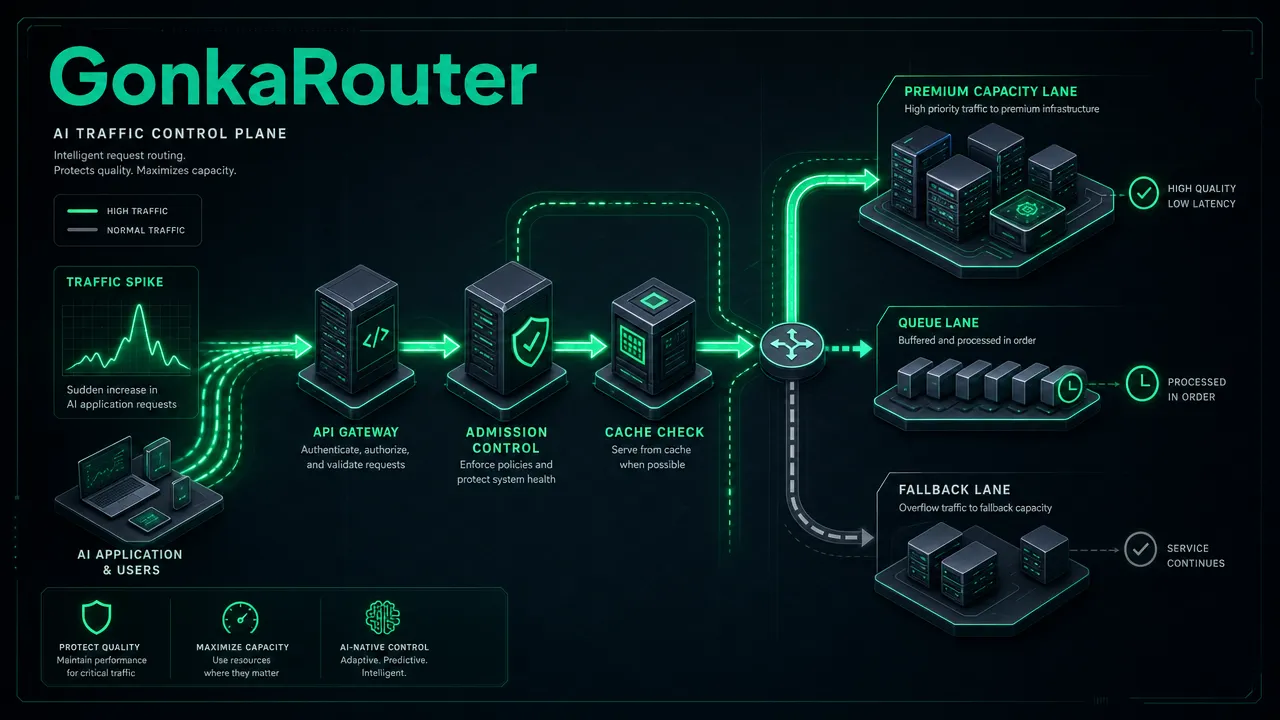
A traffic spike becomes costly when every request competes for the same capacity and every failure leads to another paid model call. That approach creates an expensive feedback loop: timeouts trigger retries, retries amplify overload, and overloaded paths fail more often.
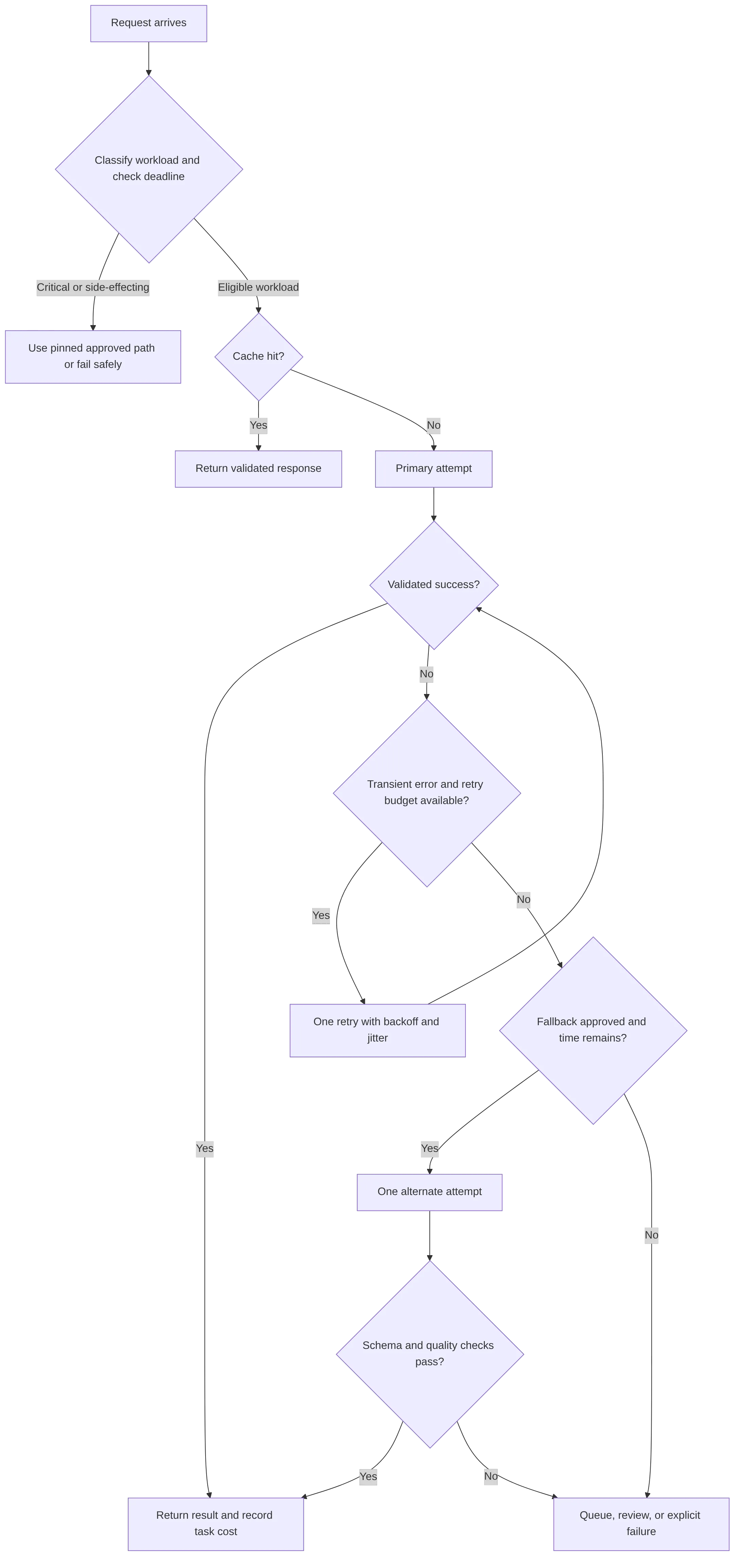
The practical purpose of llm failover is narrower. It should redirect only eligible work after a defined failure signal, such as a temporary rate limit or a timeout within a bounded deadline. It should not mean sending every failed request to another model.
Start by classifying workloads:
Workload type | Spike-time action | Why |
|---|---|---|
Safety-critical or irreversible actions | Pin to an approved path, defer, or fail safely | A silent downgrade can create unacceptable risk |
Customer-facing, quality-critical requests | Reserve capacity and permit only tested same-class fallback | Quality and schema consistency matter more than nominal cost |
Standard interactive tasks | Use a cache check, one bounded retry, then an approved alternate path | These tasks may tolerate controlled degradation |
Async internal jobs | Queue, batch, or defer before fallback | Delayed completion is often cheaper than an emergency call |
Disposable or low-value requests | Shed load or return a transparent degraded response | Protects priority capacity and avoids futile spend |
This is where llm load balancing, model routing, and fallback diverge. Load balancing distributes eligible traffic among approved paths. Model routing selects a path before generation based on rules such as task type, context size, or quality requirements. Failover occurs after a primary path has failed or become unavailable. None of these patterns automatically optimize cost.
A well-designed ai routing engine can apply deterministic restrictions before any model call. For example, a system may reserve a premium path for customer-visible requests while sending low-risk internal summaries to a queue during a burst. That is capacity protection, not a promise of savings.
Google's SRE guidance on handling overload supports the broader principle: overload should be controlled through admission, prioritization, and shedding rather than unlimited demand forwarding.
How llm failover avoids duplicate requests and cascading retries
Retries are often the largest hidden cost in an outage. A timeout only tells the caller that it did not receive a response in time. It does not prove the upstream model did no work. The original request may have processed the full prompt, generated output, or initiated an agent action before the connection failed.
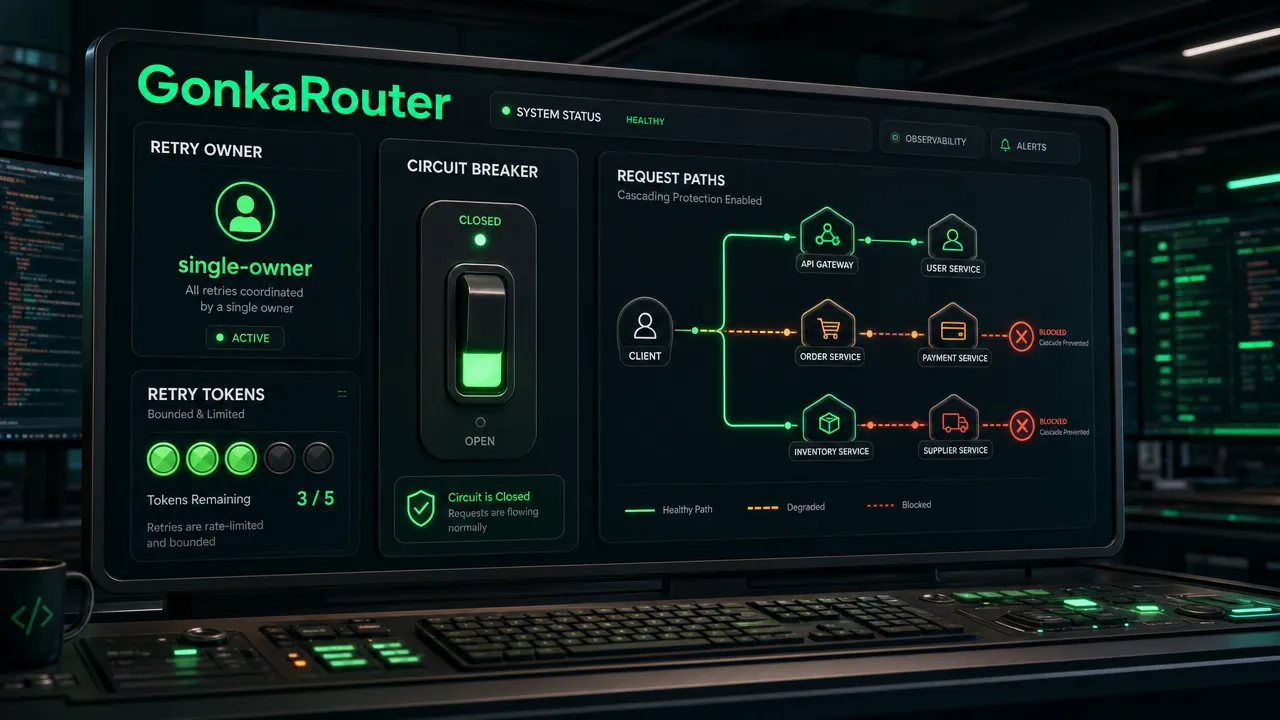
That uncertainty makes retry ownership essential. One layer should own the retry policy for an operation. Do not let the browser, SDK, application server, agent runner, and gateway wrapper all retry independently.
AWS recommends bounded retries, exponential backoff, and jitter because repeated synchronized attempts can worsen the very overload that caused the first failure. See its guidance on timeouts, retries, and backoff with jitter.
Use a small retry budget with these controls:
Retry only classified transient conditions, not invalid requests, authorization failures, unsupported parameters, or schema errors.
Cap both attempt count and total elapsed time.
Apply exponential backoff with jitter.
Stop retrying when a circuit breaker is open.
Record route history so a request cannot loop from primary to fallback and back again.
Use idempotency keys or application-level deduplication for side-effecting operations.
The circuit breaker pattern is useful here because it stops calls to a path that is currently unhealthy, allowing the application to fail fast, queue work, or apply a controlled fallback. Microsoft's Circuit Breaker pattern explains why repeatedly probing a failing dependency can deepen an incident.
For a model router for agents, the constraints should be stricter. Agent workflows can multiply model calls, tool invocations, prompt history, and retries. A duplicate completion may be inconvenient. A duplicate action that changes an external system may not be. An AI gateway for agents can be an integration boundary, but it does not replace idempotency, tool allowlists, output validation, and application-level retry control.
Where llm failover loses money through context replay and weak output
The economic risk rises with model context. Each fallback may replay system instructions, conversation history, retrieved documents, tool definitions, and previous tool results. Even when a second path is cheaper per token, replaying a large input can make the total attempt more expensive than expected.
Input and output tokens are commonly billed separately, which is why repeated attempts need to be accounted for as a complete task cost rather than an isolated API call. A useful internal formula is:
Cost per successful task = total cost of all attempts + review and rework cost, divided by accepted successful tasks
That calculation exposes several common failure modes:
A primary timeout triggers a fallback after the original request already consumed input processing.
A lower-cost alternate produces malformed JSON, requiring a repair prompt.
A model fallback routing rule sends work to a higher-priced path to preserve quality.
A long-context request is replayed to two or three paths.
A fallback output appears plausible but fails downstream business checks.
An agent repeats a tool action after an uncertain completion.
This is why intelligent model routing should not be treated as magic. Probabilistic classifiers can misclassify edge cases. Deterministic restrictions should override automated decisions for high-impact workflows.
Avoid automatic downgrade for identity, authorization, payments, regulated decisions, safety-sensitive use cases, or tool-using agents with irreversible actions. The correct fallback can be a queue, human review, or an explicit unavailable response.
Request caching is often a better first move than failover. Exact request caching can remove a repeat request from the spike entirely, as long as authorization scope, freshness, personalization, and prompt version are compatible. Semantic routing llm is different: it selects a model path based on request meaning. Semantic caching returns a previously generated answer for a similar request. Both require validation, but semantic caching carries an additional false-match risk.
For deferrable work, queueing can be cheaper and safer than an emergency alternate model call. Microsoft's Queue-Based Load Leveling pattern describes how queues absorb bursts and allow downstream processing at a controlled rate.
Which llm failover policies protect premium capacity during a burst
Premium capacity should be protected as a deliberate policy decision. Teams should not let batch enrichment, disposable experimentation, or routine internal summaries consume the same concurrency pool needed by customer-facing or quality-critical requests.
Bulkheads help isolate these pools. Microsoft defines the Bulkhead pattern as resource isolation that prevents one workload from exhausting resources required by another.
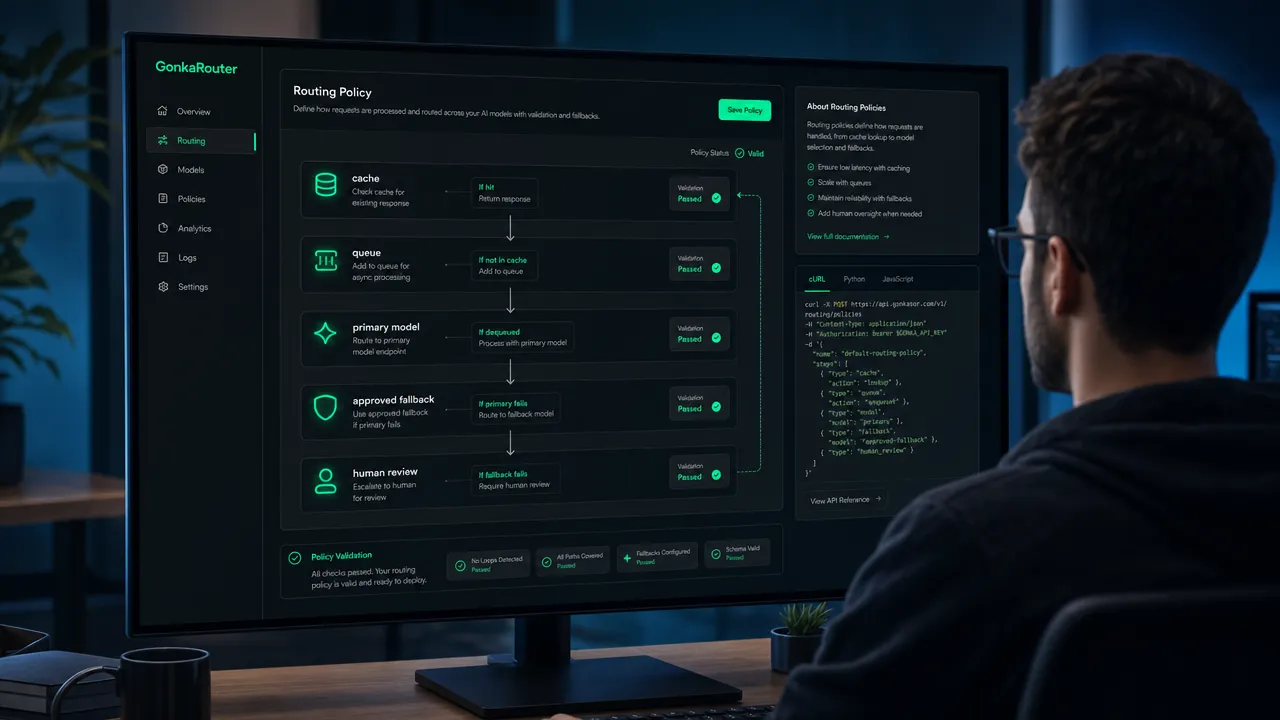
A practical spike-time policy might work like this:
Check an exact cache for approved repeat-heavy requests.
Queue asynchronous work when its service class exceeds a concurrency limit.
Preserve reserved capacity for quality-critical interactive traffic.
Make one bounded retry only for transient failures.
Allow a single fallback only when the workload is approved, the remaining deadline is sufficient, and the alternate has passed evaluation.
Validate structured output before downstream use.
Send failed validation to review, a queue, or an explicit error rather than another uncontrolled model loop.
This approach is a way to use multiple AI models responsibly. More models expand options, but they also expand evaluation, observability, and governance work. Before teams route requests between LLMs, they should test:
Effective context capacity with real histories, retrieval payloads, tool definitions, and output reserve.
Schema adherence and null-handling behavior.
Tool-call format, argument quality, and stopping behavior.
Quality on representative production tasks.
Behavior under partial failures, slow streams, malformed responses, and rate limits.
Data-handling suitability for each request category.
Questions around how to switch between Claude and GPT need a similar caution. API compatibility concerns request and response formats. It does not prove equivalent behavior, context capacity, tool calling, structured output reliability, or access to official models.
GonkaRouter is positioned as an OpenAI- and Anthropic-compatible AI Gateway and AI Model Router. That describes API-format compatibility, not automatic failover, llm load balancing, retry orchestration, automatic model selection, or guaranteed savings. Teams can implement and evaluate application-side policies while using a compatible gateway endpoint, but they should not assume a unified endpoint supplies the operational controls described in this article.
How to evaluate llm failover with a small non-critical pilot
Treat the first rollout as an experiment, not a platform-wide switch. Start with a low-risk, asynchronous, reversible workload where delayed completion is acceptable and outputs can be evaluated objectively.
Use this implementation checklist:
Label every workflow by business impact, data restrictions, side-effect risk, latency tolerance, and quality threshold.
Define which workloads are pinned, fallback-eligible, queueable, cacheable, or disposable.
Assign one retry owner for each operation.
Disable or explicitly account for retries at every other layer.
Set a total time budget before setting model-specific timeouts.
Require a hard maximum number of route changes.
Add idempotency or deduplication controls for actions with side effects.
Measure input tokens, output tokens, retries, fallback attempts, cache hits, queue age, and validation failures.
Track cost per successful task and cost per quality-passing task.
Test fallback behavior under simulated 429s, timeouts, schema failures, and fallback unavailability.
Maintain a kill switch for each fallback rule.
Review data-handling requirements before routing prompts to alternate paths.
A useful pilot comparison is not "primary versus fallback price." It is "bounded policy versus uncontrolled recovery behavior." The bounded policy should show whether caches remove safe repeats, queues absorb deferrable work, premium capacity remains available, and retry controls prevent amplification.
For teams evaluating an llm gateway for agents or an AI routing engine, the operational questions matter more than marketing labels. Can you observe route history? Can you attribute all attempts to one business task? Can you block fallback for restricted workflows? Can you stop a broken route quickly? If not, the system may be adding complexity without enough control.
Llm failover FAQs for cost-conscious platform teams
Is llm failover always cheaper during a traffic spike?
No. It can reduce cost exposure only when it prevents more expensive waste than it creates. Duplicate requests, higher-priced alternate paths, long-context replay, and output rework can all increase total cost.
When should a request be queued instead of sent to a fallback model?
Queue it when completion can be delayed and an immediate alternate call would consume scarce capacity or increase spend. This is often appropriate for batch enrichment, internal summaries, and other asynchronous work.
Can request caching reduce LLM spike costs?
Yes, for safe and reusable requests. Exact caching can eliminate a model call entirely, but cache scope, freshness, tenant isolation, personalization, and content sensitivity must be controlled.
Is semantic routing llm the same as semantic caching?
No. Semantic routing uses inferred request meaning to choose a path before generation. Semantic caching returns a previous answer for a similar request. Both can be useful, but neither is automatically safe.
How do teams route requests between LLMs without lowering quality?
Define approved fallback pairs by workload, then validate context fit, output schemas, tool behavior, task quality, and data restrictions before production use. Measure quality pass rate alongside cost.
Can an agent automatically retry a failed model call?
Only with strict limits. Agent retries require a single retry owner, end-to-end deadlines, idempotent tools or deduplication, output validation, and clear stop conditions after uncertain completion.
LLM failover works best as a bounded cost-control policy: protect priority capacity, serve safe repeat requests from cache, defer non-urgent work, and stop retries before they become a second outage. It may reduce spike-related costs, but only when quality, duplicate-work risk, and full task economics remain under control.
For product context, review GonkaRouter's guide to a compatible multi-model API endpoint, its documentation and model-access guide, current supported catalog, and pricing. Also review the live privacy policy and terms of service before sending sensitive workloads. Then test a small, non-critical workload if the current capabilities fit your requirements.