A benchmark headline can reveal a promising model, but it cannot establish that the model is a dependable production dependency. That distinction matters as developers search for a free coding model API that can move from an interesting demo to a reliable part of an IDE, CI workflow, or coding agent.
On August 21, 2026, Startup Fortune reported that a model called Ox Alpha topped coding benchmarks for free. The report's "mystery model" framing is the central operational issue, not a reason to dismiss the result. A strong reported score is a discovery signal. It is not evidence, by itself, of model identity, API availability, data terms, version stability, or capacity under load.
For infrastructure teams, the right response to a leaderboard surprise is disciplined curiosity: preserve the signal, then test the access path.
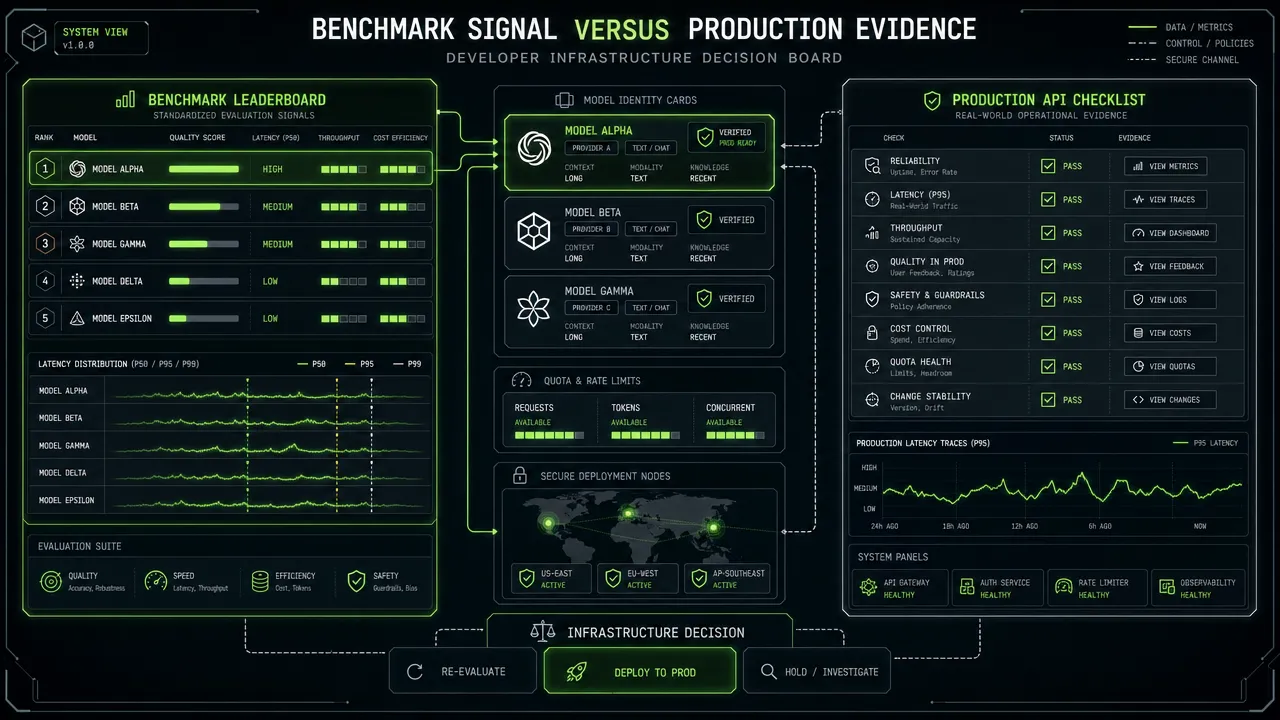
Why a free coding model API benchmark win needs an API evidence trail
Startup Fortune's August 21 report is useful as a news hook because it highlights how quickly coding-model attention can shift. But the publication's reported Ox Alpha result should remain attributed to Startup Fortune. This article does not independently verify the model's identity, benchmark setup, API status, pricing, limits, operator, or data-handling terms.
That gap is important. A model name can represent several very different things:
A versioned model with documented API access.
A temporary preview or subsidized demo.
A routed alias whose underlying model may change.
A benchmark-only submission with no public production contract.
A chat experience that is not designed for automated integration.
A production dependency needs evidence that survives a postmortem. Teams should be able to answer: Which model version generated this patch? Which endpoint handled the request? What were the timeout, retry, and quota conditions? Where did the source code go?
A benchmark score cannot answer those questions.
Evidence area | A benchmark may show | A production team still needs |
|---|---|---|
Capability | Performance on a defined task set | Performance on private, representative work |
Identity | A public model label | Owner, version, release policy, and model ID |
Access | A demo or evaluation result | Authenticated API documentation and error behavior |
Economics | A "free" headline | Credit expiry, token accounting, quotas, and post-trial pricing |
Reliability | A successful evaluation run | Latency, error rate, capacity, incident response, and fallback behavior |
Governance | Usually nothing | Retention, training use, subprocessors, and regional processing |
The operational lesson is simple: celebrate a promising benchmark result, but do not attach an undocumented model to a sensitive repository or automated workflow.
What coding benchmarks measure and what they leave out
Coding benchmarks can be valuable. Under a defined harness, repository, prompt configuration, and scoring rule, they estimate how a model performs on a constrained task. That is real evidence, but it is bounded evidence.
A repository-level benchmark may ask whether a generated patch makes a supplied test suite pass. Production engineering is broader. Developers work with incomplete tickets, internal dependencies, ambiguous requirements, undocumented conventions, code review expectations, rollout controls, and incident response.
Benchmark interpretation also has methodological limits. A 2024 study on code-generation benchmark contamination found substantial overlap between popular coding benchmarks and open training corpora. That does not invalidate any individual score, nor does it prove contamination for Ox Alpha. It does mean teams should inspect benchmark age, task provenance, and reproducibility before treating a ranking as decisive.
Similarly, OpenAI has argued that SWE-bench Verified has become increasingly contaminated for frontier evaluation purposes. Its separate discussion of signal and noise in coding evaluations reinforces a practical point: task quality and harness design affect the meaning of a result.
Pass@k deserves special caution. The metric estimates whether at least one answer in several generated candidates succeeds. That may suit an agent that can test, retry, and select patches. It does not describe the first response a developer receives in an editor, and it can conceal the cost and latency of multiple attempts.
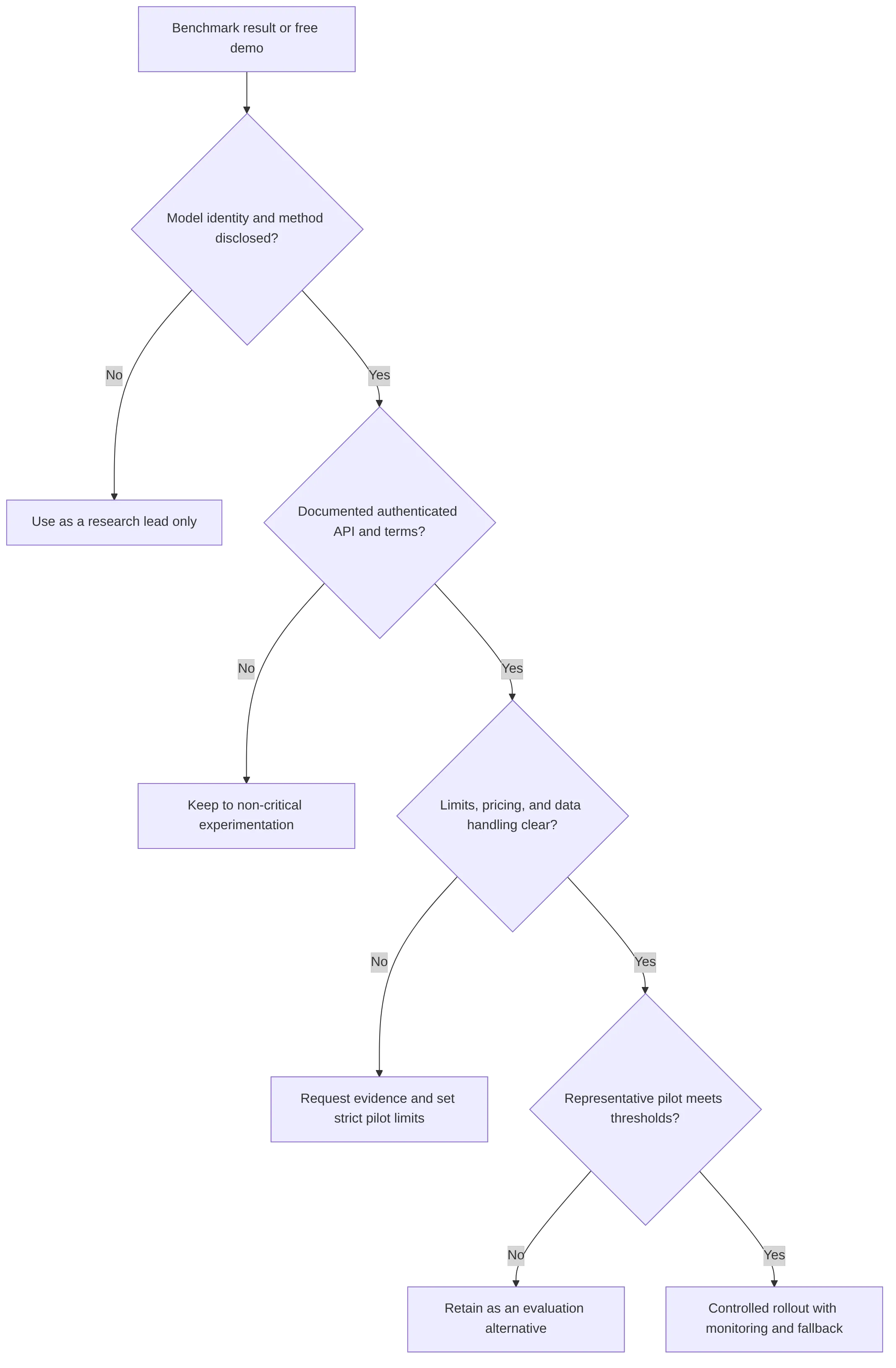
The useful mental model is not "benchmark versus production." It is "benchmark plus production evidence." A high score can earn a candidate a place in your test queue. It should not skip the queue.
How to evaluate a free coding model API before integrating it
Treat "free" as an access description, not a reliability guarantee. It may mean trial credit, temporarily subsidized inference, a rate-limited free tier, a free model with capacity restrictions, or a benchmark and chat demo without an API contract.
Use the following checklist as an adoption gate.
Evaluation category | Questions to ask | Pilot evidence to capture |
|---|---|---|
Model identity | Who operates it? What exact version or snapshot is served? | Model ID, owner statement, release notes, model card where available |
Versioning | Can requests pin a version? What happens at deprecation? | Changelog, migration policy, regression-test results |
API availability | Is there a documented authenticated API with clear errors? | API reference, sample request, response fields, request IDs |
Free access terms | What is free, for how long, and under what conditions? | Dated pricing evidence, credit terms, expiry details |
Limits and capacity | What are RPM, TPM, concurrency, queues, and 429 rules? | Limit headers, burst-test logs, retry traces |
Tool use | Are function calls supported for the selected model? | Tool-call validity rate, schema failures, permission-denied behavior |
Structured output | Is JSON schema enforcement available or best effort? | Parse rate and schema-validation rate |
Operational stability | What are p50 and p95 latency, timeout, and error rates? | Timestamped pilot logs segmented by workload |
Data handling | Are prompts retained, used for improvement, or processed by others? | Privacy policy, written clarification, internal approval |
Workload fit | Does the combination solve your actual coding tasks? | Build pass rate, test pass rate, human acceptance, cost per accepted task |
Exit path | Can the application switch to another tested option? | Fallback drill, adapter design, migration runbook |
The most important test is not generic code generation. It is your task mix.
For interactive completion, measure first-token latency, p95 completion time, and developer acceptance. For bug fixing, use sealed historical issues, isolated repositories, and reviewer-approved patches. For CI automation and agents, measure valid JSON, tool-call success, retries, cancellations, idempotency behavior, and the consequences of a failed request.
Do not mix first-attempt success with retry-assisted success. Both can be useful, but they describe different user experiences and different cost profiles.
A practical seven-day pilot can remain small:
Use 20 to 50 anonymized or synthetic tasks that resemble real work.
Fix the prompt, parameters, tool permissions, and evaluation rubric.
Run single-attempt quality tests before enabling retries.
Load-test representative concurrency and record p50, p95, and error behavior.
Test malformed tool arguments, quota exhaustion, timeout, and cancellation paths.
Compare reported usage with internal request logs.
Simulate a primary-model failure and verify a graceful fallback.
The goal is not to prove that a model is universally best. The goal is to collect enough evidence to make a bounded decision.
Where model routers fit in a cautious evaluation strategy
A router can reduce integration friction while a team compares supported models, but it does not remove the need for model-specific validation. One interface may simplify request formatting, yet models can still differ in context handling, structured-output reliability, tool behavior, latency, and cost.
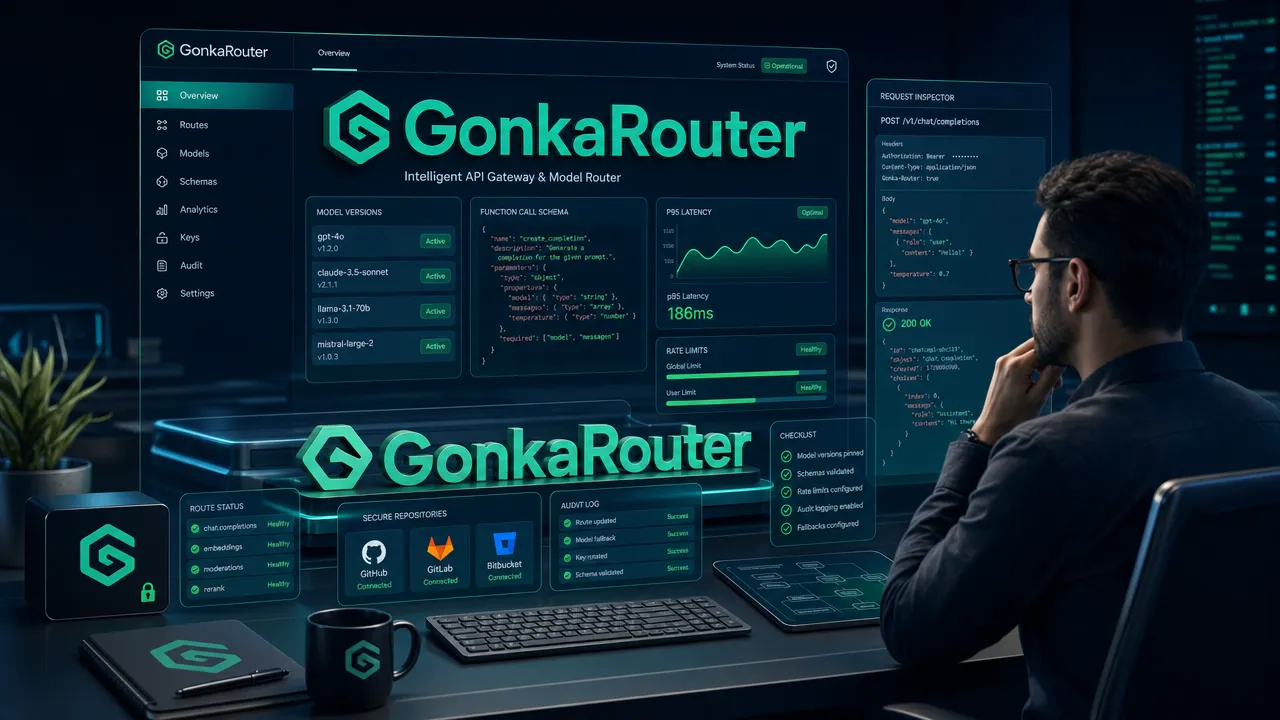
GonkaRouter is an AI Model Router built for the Gonka Network. Its site displays an OpenAI-compatible endpoint, while its live model catalog currently lists DeepSeek-V4-Flash-0731, Kimi-K2.6, and MiniMax-M2.7. This does not imply any coding benchmark ranking for those models, and it does not mean GonkaRouter offers Ox Alpha.
The site also displays Function Calling, Private VPC Deployment, and Web3 Ecosystem Integration. Those signals are relevant to an evaluation checklist, not substitutes for it. Teams should confirm model-by-model support, schema behavior, deployment scope, operational terms, and regional handling before relying on any capability.
For broader category context, see GonkaRouter's explanation of how an AI Model Router API works and its discussion of one OpenAI-compatible API endpoint for multiple AI models. The practical advantage is a cleaner experimentation boundary: application logic can be separated from a single hard-coded model choice.
That boundary does not eliminate risk. It makes disciplined testing easier to repeat.
For confidential code, read the live GonkaRouter privacy policy before sending prompts. The policy states that API inputs and outputs may be retained for a limited period for debugging, service improvement, and security monitoring, and that third-party providers may process data on its behalf. Security, legal, and procurement teams should determine whether that arrangement fits their use case.
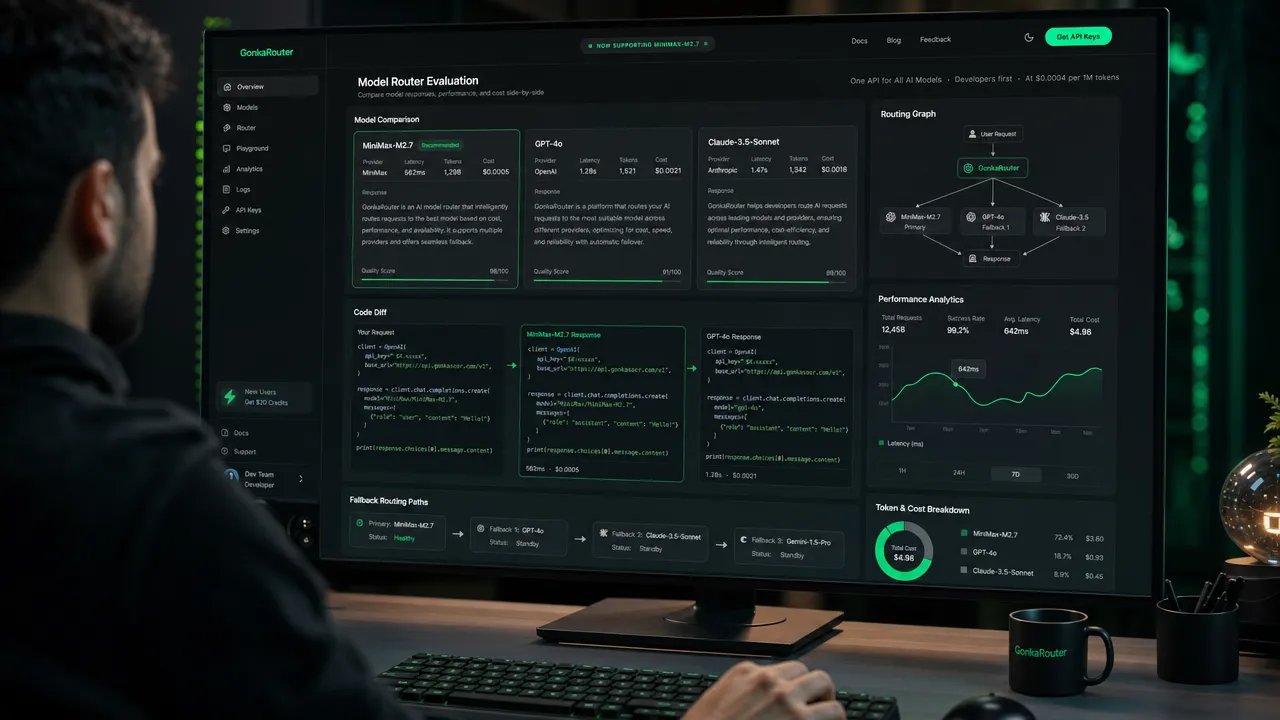
The production decision is about workload fit, not leaderboard excitement
A free offer can be useful for a tightly scoped test. GonkaRouter's pricing page displays $20 in API credit for new users. At the displayed reference rate of $0.0012 per 1 million tokens, that equates to up to 16.7 billion tokens. Rates, token accounting, and actual usage vary by model and may change.
That is an experiment budget, not proof of permanent free inference, predictable capacity, or production readiness.
The same standard applies to every provider and model. A strong public benchmark may identify a candidate worth testing. Production adoption should follow only after the team has verified identity, API behavior, rate limits, cost, data handling, observability, and workload-specific outcomes.
What is a free coding model API?
A free coding model API is API-based access for coding-related tasks without an immediate charge. It may use a free tier, promotional credit, preview access, subsidized inference, or a rate-limited free model. It does not necessarily mean unlimited, permanent, or production-ready access.
Can a benchmark-leading model go straight into production?
No. Benchmark performance should be supplemented with verified API terms, model identity and versioning, privacy review, quota behavior, operational testing, and a representative workload pilot.
Why is pass@k different from a real developer experience?
Pass@k allows multiple generated attempts. A developer may receive only one response, while an agent may spend several retries, tool calls, and test runs to find a successful answer. Measure first-attempt and retry-assisted outcomes separately.
What should teams test before adopting a free coding model API?
Test task success, p95 latency, error rates, rate-limit behavior, token usage, structured-output validity, function-call reliability, retention terms, and fallback behavior under simulated failure.
Do repository benchmarks prove a model will work on private code?
No. Private codebases contain internal dependencies, domain conventions, incomplete requirements, secrets boundaries, and deployment constraints that public benchmark environments do not reproduce.
When should a team move beyond free access?
Move beyond free access when a workflow needs predictable capacity, approved data handling, documented commercial terms, observability, support expectations, or controlled production scaling.
The best use of a free coding model API is evidence gathering. Review GonkaRouter's live model catalog and pricing, create an account if it fits your organization's security and procurement policies, and test a small non-sensitive workload before expanding integration.