Agentic AI infrastructure is becoming a layered system in which model access must support repeated reasoning, tool use, stateful workflows, and operational controls rather than a single prompt-response exchange. In that stack, GonkaRouter fits as a focused inference-access boundary for developers who want one API for its currently supported models: MiniMax-M2.7, Kimi-K2.6, and GLM-5.2.
An agent can classify a request, retrieve context, select a tool, interpret results, retry a failed step, and generate a final answer. That workflow creates many points where application logic, data services, model inference, and monitoring must work together. A clean gateway layer does not solve every agent problem, but it can keep model integration from becoming another source of complexity.
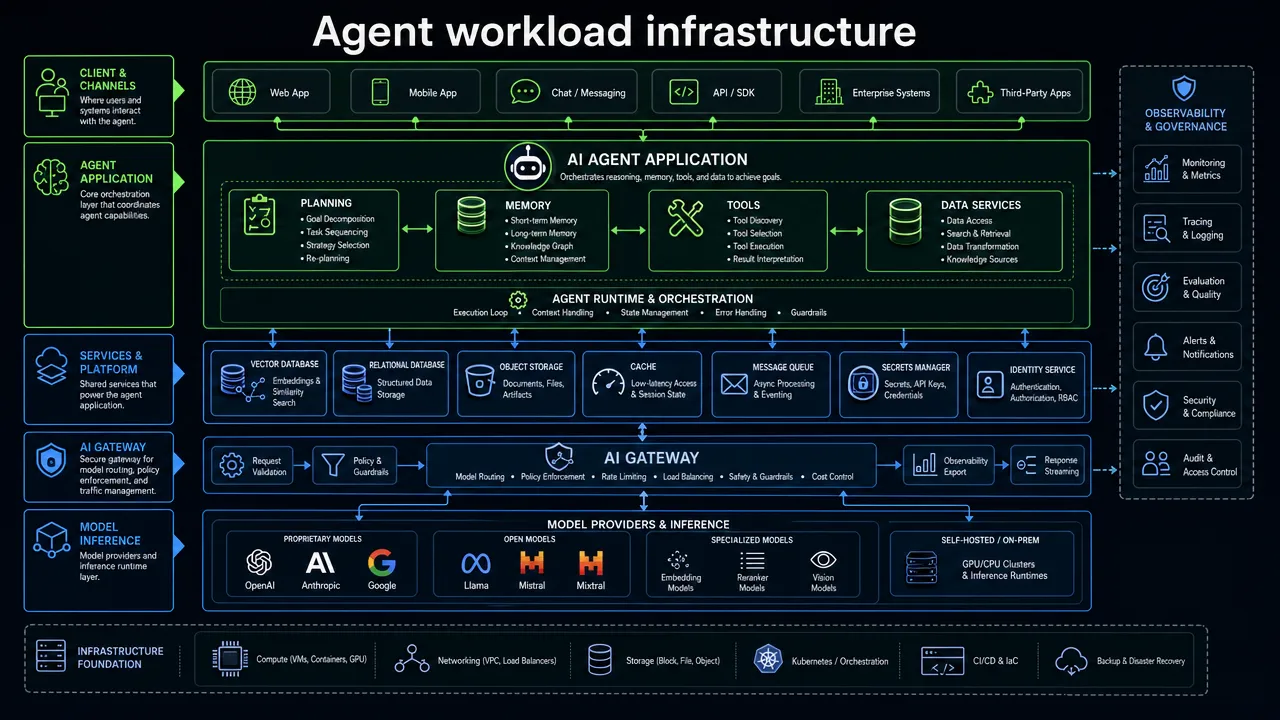
Why agentic AI infrastructure needs a clean inference boundary for multi-step work
Agentic AI infrastructure differs from a standard chat application because one visible user request may create many system events. The application may send several model calls, query retrieval systems, validate outputs, call external APIs, and decide whether another step is necessary.
This changes the engineering question from "Which model answers this prompt?" to "How does the application control an entire sequence of model and tool interactions?"
Public guidance on AI agents from Google Cloud describes agents as goal-oriented systems that can use reasoning, planning, memory, and autonomy. Tool use adds further requirements. A model response may recommend an action, but the application still needs to validate permissions, enforce schemas, and decide whether the action is safe to execute.
For production teams, the important distinction is responsibility:
Layer | Primary responsibility | Why it matters for agents |
|---|---|---|
Agent application | Workflow logic, state, decisions, and user experience | Controls how the agent progresses through a task |
Tools and data | Retrieval, APIs, databases, and business systems | Supplies context and executes approved actions |
AI inference layer for agents | Model requests, credentials, compatible request formats, and supported-model access | Reduces model integration fragmentation |
Observability and evaluation | Traces, metrics, logs, test cases, and quality review | Shows what occurred and whether it was correct |
Observability answers "What did the system do?" Evaluation answers "Did the system complete the task well?" OpenTelemetry documentation provides a vendor-neutral foundation for traces, metrics, and logs across distributed applications. For agent teams, that means tracing should span the agent workflow, model calls, tool calls, latency, errors, and user outcomes.
A gateway can simplify the inference boundary, but it is not automatically an agent runtime, memory layer, tool connector, evaluation suite, or agent operations platform.
How agentic AI infrastructure uses an AI gateway for agent workloads
An AI gateway for agent workloads sits between application logic and model inference. It gives the application a consistent access path instead of requiring separate endpoint patterns, credentials, and request handling for every supported model.
MLflow's AI Gateway guidance describes the broader category as a centralized proxy that routes requests through a unified API. The exact controls differ by product, so developers should verify documented behavior rather than assuming that every gateway offers the same routing, tracing, governance, or fallback features.
For an agent application, the request flow often looks like this:

The practical value is separation of concerns. The agent application remains responsible for planning, tool permissions, retries, termination conditions, and user-facing behavior. The gateway becomes the model-access layer that helps reduce duplicated integration work.
This boundary is particularly useful when different agent steps need different model characteristics. A lightweight classification step, a long-form summarization task, and a structured generation workflow may not require the same model choice. A multi-model API for AI agents makes testing easier, but it does not replace application-side evaluation.
Teams should still benchmark models on real tasks and measure:
Output quality and instruction following.
Total latency for completed workflows.
Token use per completed task.
Error behavior and retry handling.
Structured-output validity where required.
Tool-result interpretation and final-answer quality.
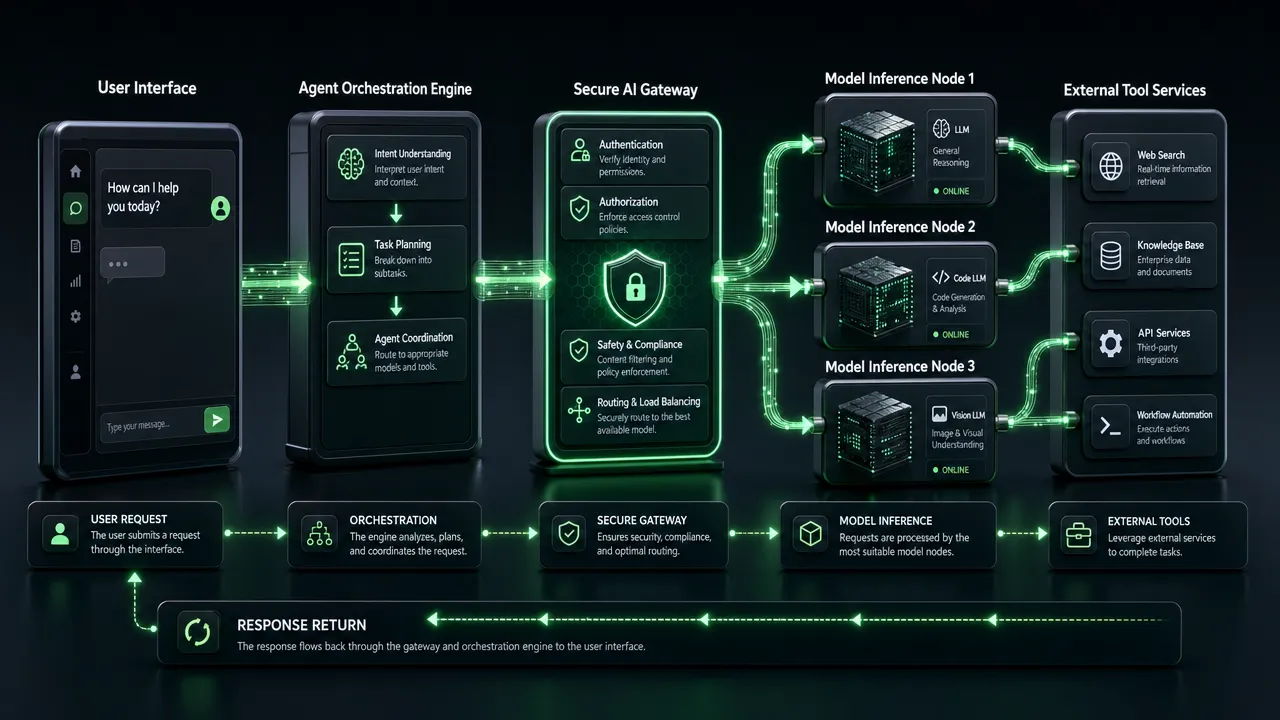
Where agentic AI infrastructure places GonkaRouter for AI agents
GonkaRouter is best positioned as an OpenAI-compatible and Anthropic-compatible AI Gateway and AI Model Router within the inference-access layer. It provides unified access through one API for its currently supported models only:
MiniMax-M2.7.
Kimi-K2.6.
GLM-5.2.
This is a focused position. GonkaRouter is not a universal catalog, a full agent runtime, or an agent operations platform. Its OpenAI-compatible API and Anthropic-compatible API refer to API-format compatibility. They do not mean access to official OpenAI or Anthropic models.
For teams already using familiar API patterns, the integration approach can be straightforward: configure a GonkaRouter API key, confirm the current model identifiers and request fields, and change the endpoint where supported. The endpoint migration guide explains this unified-access approach in more detail.
GonkaRouter is relevant for:
Agent applications that need supported-model inference through one API.
Chatbots and intelligent Q&A systems.
Content-generation pipelines.
Code-generation workflows.
Automated business workflows.
Data-analysis applications.
Enterprise AI products that need a cleaner inference boundary.
The developer value is not that every workflow should use multiple models. It is that teams can test MiniMax-M2.7, Kimi-K2.6, and GLM-5.2 without maintaining separate application integration paths for each supported option. The unified API platform guide and the model selection article offer useful context for building that evaluation process.
What agentic AI infrastructure should not expect from GonkaRouter
Clear boundaries make an infrastructure decision more useful. GonkaRouter can provide a unified AI inference API for its supported models, but the following functions remain separate responsibilities unless independently documented:
Capability | Primary owner in an agent system |
|---|---|
Planning, memory, and workflow loops | Agent application or orchestration framework |
Tool execution and permission checks | Application and tool-control layer |
Retrieval and database access | Data and retrieval systems |
End-to-end traces and evaluations | Observability and evaluation tooling |
Security policy, retention, and compliance review | Team architecture and verified product controls |
Model-task selection | Developer testing and application logic |
This distinction matters because agents can amplify small failures. An incorrect tool call, poorly formatted output, stale context, or retry loop can affect the final result even when the underlying model call succeeds.
GonkaRouter can reduce integration-surface complexity. It does not remove the need to test model behavior, validate agent actions, define fallback policies, or monitor the workflow after launch.
Developers should also verify the latest documentation before production use, especially for current endpoint details, supported request fields, streaming behavior, tool-calling behavior, structured-output support, rate limits, and error handling.
Why agentic AI infrastructure will make gateways more important in 2026
The agentic cloud 2026 conversation will likely focus less on standalone model access and more on how teams operate multi-step AI systems responsibly. As agents move from demonstrations into customer-facing products and internal workflows, teams will need stronger boundaries between business logic, tools, model calls, and operational telemetry.
Three trends are especially likely to matter:
Workflow-level measurement will replace token-only thinking. A low token price is useful, but teams will increasingly measure cost, latency, and quality per completed task.
Interoperability will remain a practical advantage. Familiar API formats can reduce migration friction, though teams must still validate feature-level compatibility for their own workloads.
Gateway layers will become more deliberate architecture choices. Developers will want to avoid hard-coding their application around disconnected model integrations when their product requires experimentation across supported options.
GonkaRouter supports this direction with one API for MiniMax-M2.7, Kimi-K2.6, and GLM-5.2, OpenAI-compatible and Anthropic-compatible API formats, and endpoint-change integration. It is built on the Gonka decentralized AI compute network, which connects globally distributed GPU resources for AI inference.
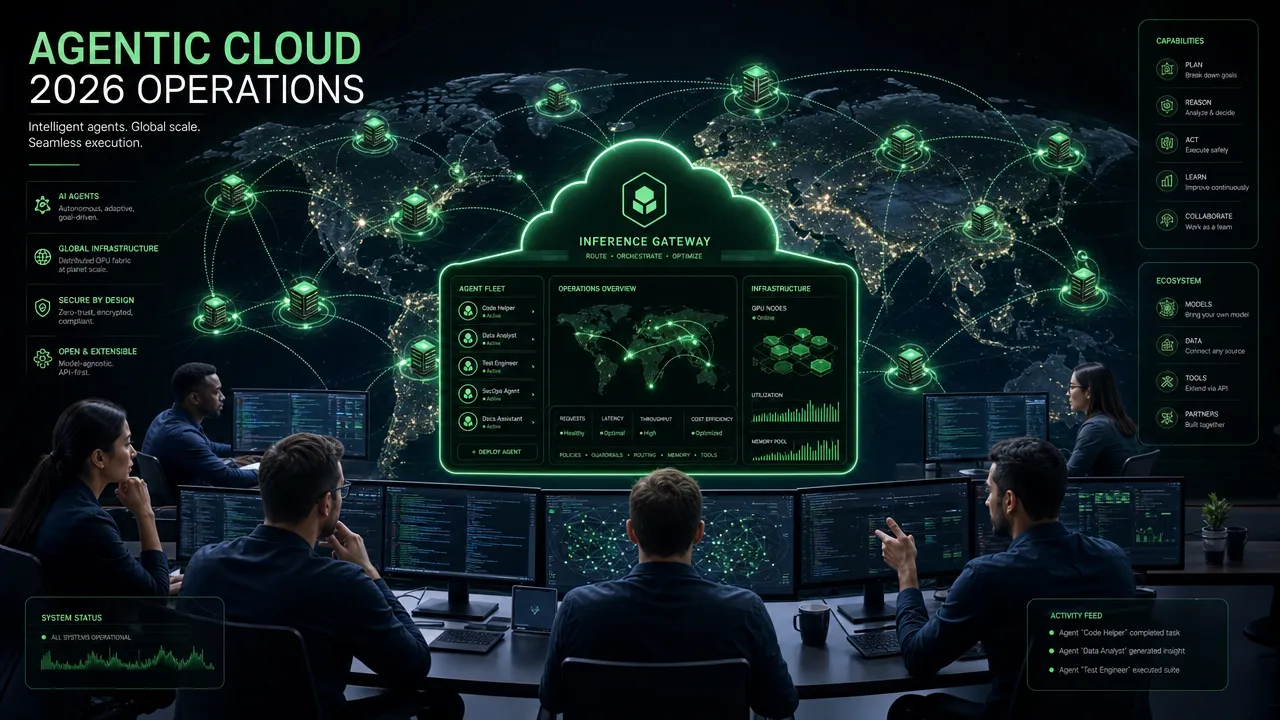
How agentic AI infrastructure teams can start with GonkaRouter
The best first step is a controlled test, not a broad architecture claim. Build a small evaluation set from real prompts, representative tool results, edge cases, and required output formats. Then test the currently supported models against the same workflow criteria.
A practical activation path is:
Log in with email.
Get an API key.
Use the one-time 20 USDT trial credit for product testing.
Confirm the current integration details.
Test MiniMax-M2.7, Kimi-K2.6, and GLM-5.2 on real tasks.
Compare quality, latency, and token use.
Integrate the selected supported model into an agent application or workflow.
Token pricing is listed as low as $0.0004 per 1M tokens. That can help teams start testing efficiently, but production decisions should be based on actual workload results rather than price alone.
For a focused model-access layer, GonkaRouter provides a practical place to begin: one API, a defined supported-model list, and compatible formats that can reduce integration friction. Explore the GonkaRouter blog for related implementation guidance, then validate the latest product behavior before moving agent traffic into production.