Agent operations turn model access into a production design decision. In 2026, developers will increasingly separate agent logic from inference plumbing so they can evaluate supported models, control integration complexity, and improve the economics of completed tasks rather than optimize a single API call.
Why agentic AI infrastructure now requires an operating boundary
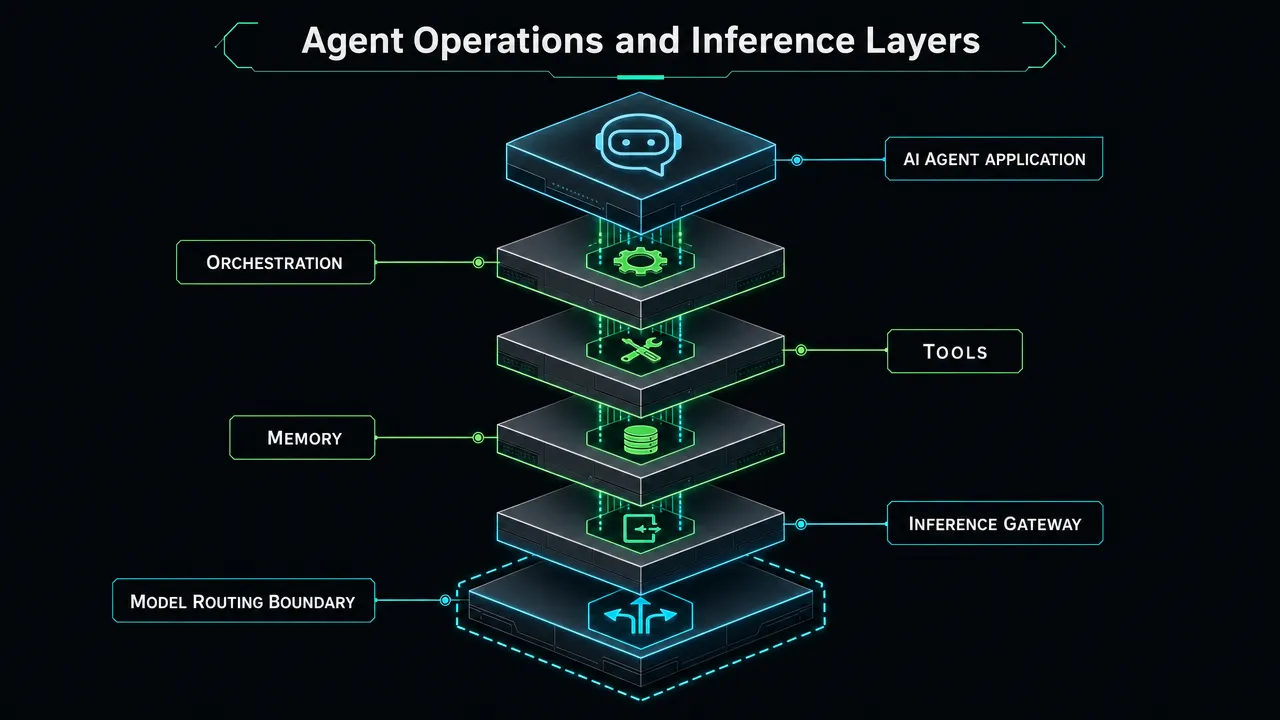
Agentic AI infrastructure is no longer just a prompt and a model endpoint. Production agents plan, retrieve information, call tools, validate outputs, preserve state, and sometimes retry failed steps before they deliver an answer or complete an action.
That workflow changes the engineering problem. A conventional chatbot can often make one model call and display the result. An agent may make several inference calls while also interacting with external data and application services. Google Cloud's agent architecture guidance distinguishes frameworks, tools, memory, runtime, models, and model runtime. AWS likewise treats governance, security, operational excellence, and controlled model access as distinct parts of an enterprise agent architecture.
A practical agent stack often looks like this:
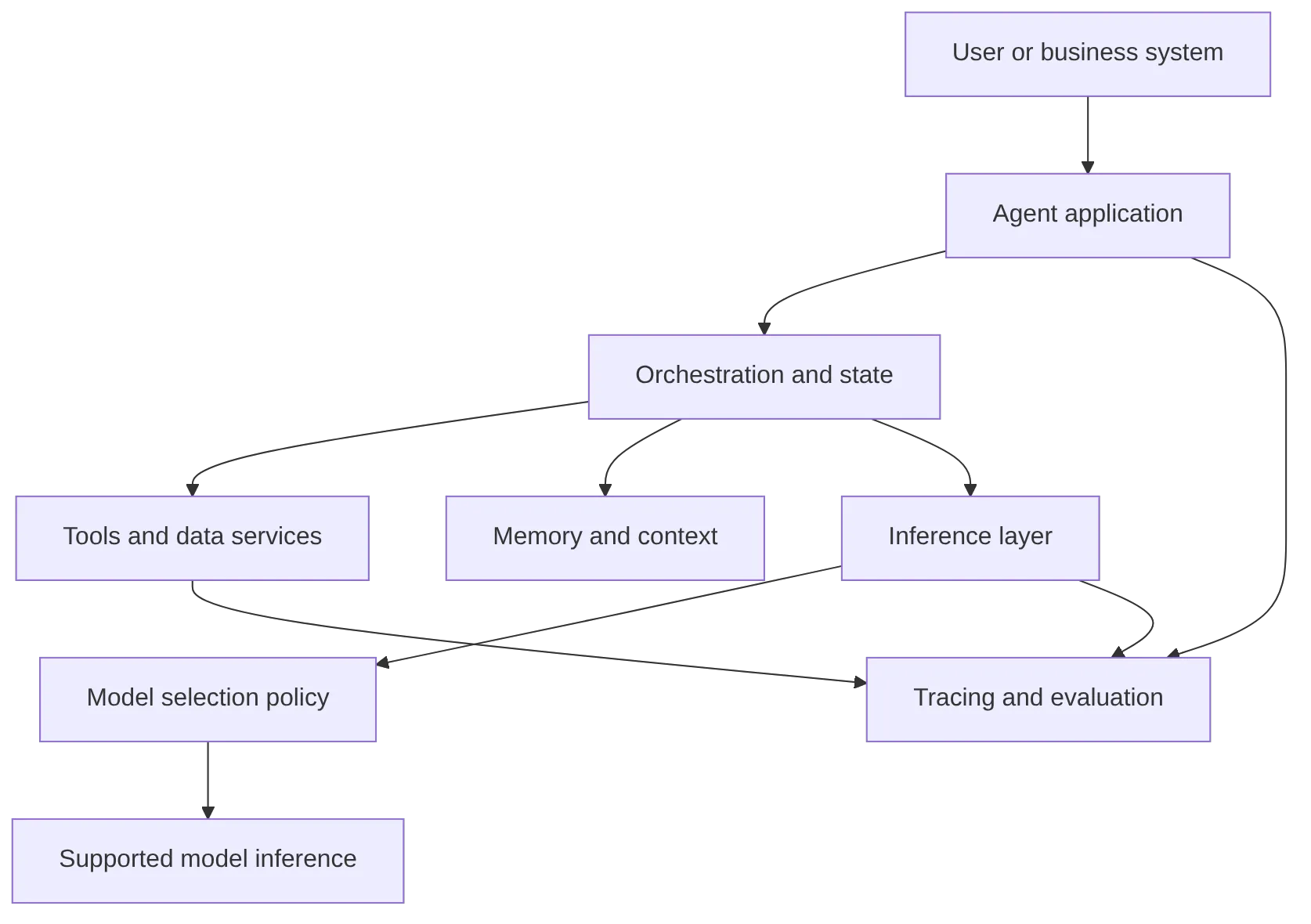
The inference layer is important because it creates a boundary between your product's agent behavior and the model-access implementation. That boundary does not replace tracing, tool permissions, security controls, or an agent operations platform. It gives those systems a clearer place to connect.
For developers, the goal is straightforward: keep planning logic, business rules, and tool behavior in the application, while keeping model access adaptable enough for testing and supported-model changes.
How agentic AI infrastructure makes model-as-a-service more operational
Agentic AI infrastructure makes model-as-a-service for agents more consequential than ordinary hosted inference. The visible answer may be the final step in a larger chain that includes classification, planning, retrieval, tool selection, tool execution, validation, summarization, and final generation.
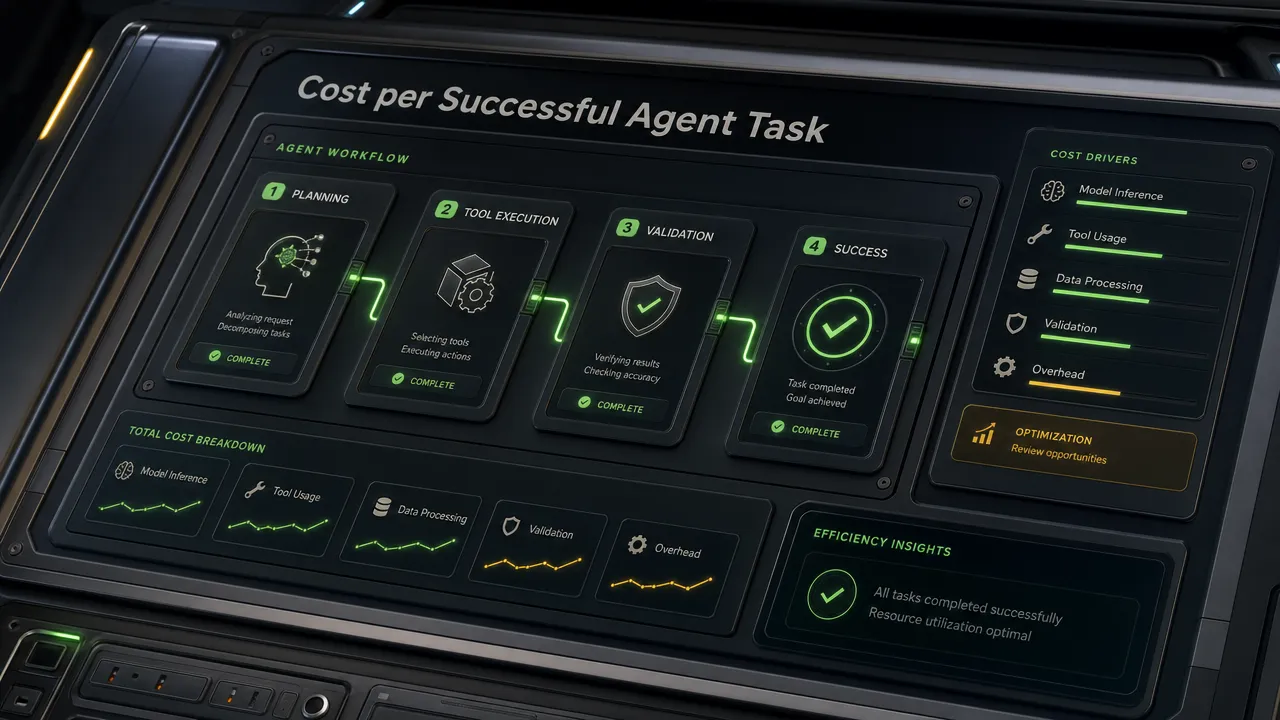
This is why token usage alone is an incomplete metric. A lower-cost request that produces invalid structured output or triggers repeated retries can cost more per completed task than a higher-cost request that succeeds on the first pass.
Operational concern | Why it matters for agents | Developer response |
|---|---|---|
Model fit | Planning, extraction, code, and synthesis may have different requirements. | Test each task against a representative evaluation set. |
Context growth | Messages, tool schemas, retrieval results, and state can expand quickly. | Summarize, retrieve selectively, and enforce context limits. |
Validation | A model response may look plausible but fail a required schema or business rule. | Add deterministic checks before a tool action or final response. |
Retries | Multi-step workflows can amplify a single transient failure. | Define bounded retries and safe user-facing failure states. |
Task economics | One user request can generate multiple hidden model calls. | Track cost, latency, output validity, and successful completion together. |
The agentic cloud 2026 discussion should therefore focus less on a single default model and more on explicit operating policies. Teams will likely version model-selection rules, evaluate task-level outcomes, and measure cost per successful workflow.
That does not mean every team needs a complex control plane on day one. It means teams should avoid embedding provider-specific assumptions deep inside agent business logic. A portable inference boundary gives developers room to test, adapt, and make changes without rebuilding the entire application.
Where agentic AI infrastructure meets an AI inference layer for agents
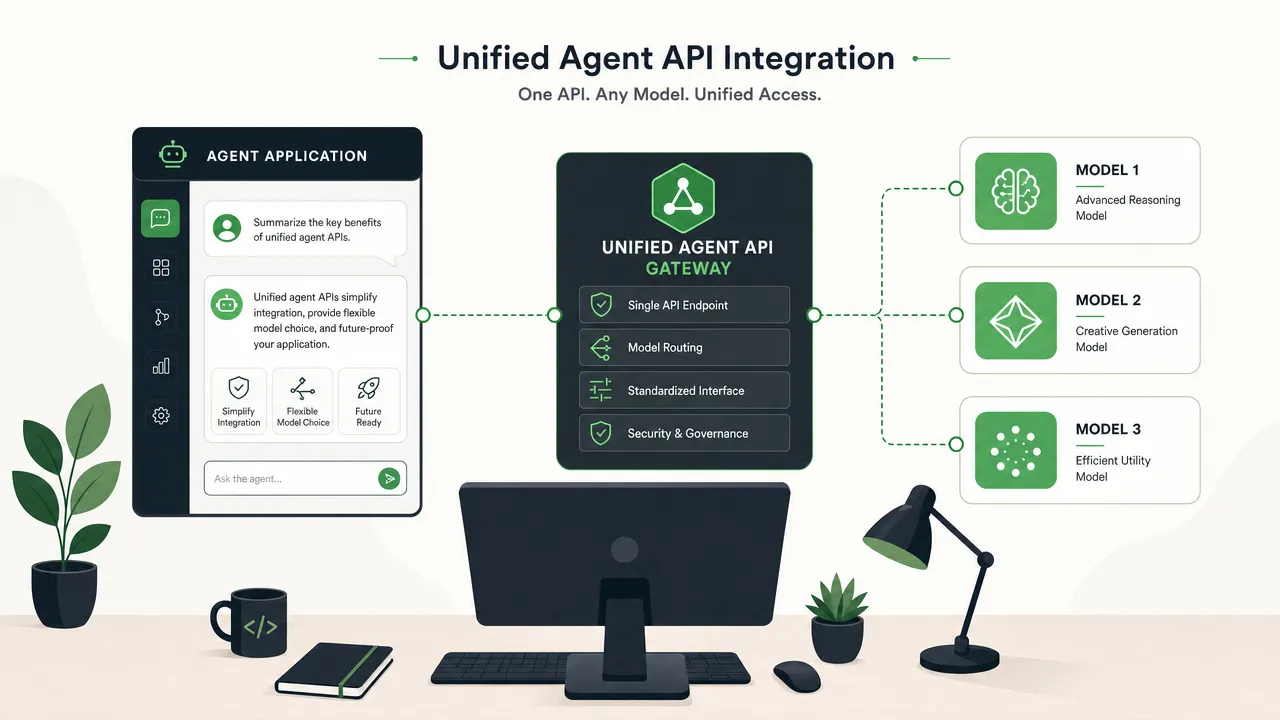
Within agentic AI infrastructure, an AI inference layer for agents handles the connection between agent requests and supported model inference. It can provide a consistent API surface, authentication path, request normalization, and a place for model-selection decisions.
An AI gateway for agent workloads is a related concept. Depending on the platform, gateways may also offer routing, budgets, monitoring, or fallback controls. Those capabilities vary by product and should never be assumed without current documentation.
For an agent team, the architectural distinction matters:
The agent framework decides what to do next.
The tool layer performs approved external actions.
The inference layer sends model requests and receives responses.
The application owns the business logic, validation rules, and user experience.
Observability connects the full execution trail for debugging and evaluation.
A multi-model API for AI agents is useful when a team wants one integration pattern for more than one eligible model. It can reduce the maintenance burden of separate endpoints, credentials, request conventions, and error-handling paths.
The routing policy itself should remain testable. A team might select a model based on task type, quality thresholds, context requirements, or workload cost. But a developer should distinguish a desired routing pattern from a verified router feature.
Routing pattern | Good fit | Important caution |
|---|---|---|
Task-based selection | Extraction, coding, planning, or summarization workloads with clear differences. | Validate each task independently. |
Quality escalation | Workflows that can start with a lower-cost route and validate the result. | Weak validation can create hidden failures. |
Reliability-aware handling | User-facing flows where timeouts and errors need safe handling. | Confirm actual platform behavior before relying on it. |
Policy-based selection | Teams with application-specific data or environment rules. | Keep the policy visible and versioned in your stack. |
Vercel's AI Gateway documentation is evidence that unified access, provider routing, fallbacks, budgets, and monitoring are established category patterns. It is not evidence that every AI gateway provides every one of those controls.
Why agentic AI infrastructure benefits from compatible API formats
Agentic AI infrastructure becomes easier to adopt when developers can retain familiar request patterns. OpenAI-compatible and Anthropic-compatible API formats can reduce migration friction for teams that already use those conventions.
GonkaRouter is positioned as an AI Model Router and AI Gateway with one API for its currently supported models:
MiniMax-M2.7
Kimi-K2.6
GLM-5.2
For a compatible integration, developers can often begin by changing the API endpoint, credentials, and model identifier instead of maintaining separate direct integrations for each supported path. The practical approach is to validate the live behavior of parameters, streaming, tool schemas, structured outputs, and error handling before sending production traffic.
OpenAI-compatible and Anthropic-compatible refer to API format compatibility. They do not mean GonkaRouter currently provides OpenAI or Anthropic official models.
That limitation is a strength when it is communicated clearly. GonkaRouter does not need to promise an unlimited catalog to be useful. Its focused proposition is simpler: unified access to MiniMax-M2.7, Kimi-K2.6, and GLM-5.2 for teams whose agent workloads fit those models.
For implementation context, read how one OpenAI-compatible API endpoint can support multiple AI models. Teams comparing routing approaches can also review this LLM routing platforms guide for 2026.
How agentic AI infrastructure positions GonkaRouter for AI agents
Agentic AI infrastructure needs focused components, not vague claims that one platform does everything. GonkaRouter for AI agents fits as an inference-access boundary for applications that can use MiniMax-M2.7, Kimi-K2.6, or GLM-5.2.
The developer value is concrete:
GonkaRouter capability | What it can help simplify |
|---|---|
One API for supported models | Reduces the need to maintain separate direct integrations for the three supported model paths. |
OpenAI Compatible API | Supports familiar OpenAI-style API format patterns where applicable. |
Anthropic Compatible API | Supports familiar Anthropic-style API format patterns where applicable. |
Endpoint-based integration | Can speed up initial testing for compatible existing applications. |
Email-based login | Lowers onboarding friction for developers and teams. |
One-time 20 USDT trial credit | Supports initial product testing after email login. |
Pricing as low as $0.0004 per 1M tokens | Provides a cost-conscious starting point for supported-model evaluation. |
The right workflow is not to assume a model will fit every agent step. Use the trial credit to run your own prompts, tool outputs, schemas, and failure cases. Compare response quality, structured-output validity, latency, retry frequency, and total cost per successful task.
Current pricing details are available on GonkaRouter pricing. For practical cost analysis, the guide on reducing LLM costs provides a useful companion perspective: lower token rates matter, but completed-task efficiency matters more.
What agentic AI infrastructure teams should verify before production
Agentic AI infrastructure is strongest when each layer has clear ownership. Before adopting an inference layer, ask what your application will own and what the provider explicitly documents.
Use this checklist:
Confirm supported-model fit. Evaluate MiniMax-M2.7, Kimi-K2.6, and GLM-5.2 only against the tasks your agent actually performs.
Test compatibility behavior. Verify request formats, streaming, schema handling, tool-related patterns, and error responses in a proof of concept.
Instrument agent runs. Record request IDs, model identifiers, prompt sizes, tool results, duration, validation outcomes, and task completion.
Define failure behavior. Decide how the application handles timeouts, invalid output, failed tools, and user-safe recovery.
Keep operations separate. Do not treat an AI Model Router as a replacement for orchestration, tool permissions, observability, governance, or application-level retry logic.
Review current product details. Pricing, supported models, and API behavior can change, so validate live documentation before launch.
A durable 2026 strategy is to build agent logic once and keep model access adaptable. Start with email login, get an API key, test the supported models against your own evaluation set, and use GonkaRouter developer resources to guide the integration path.