LLM routing platforms are becoming a core infrastructure layer for 2026 AI applications because production teams need a faster way to manage model access, cost, reliability, and integration complexity through a unified API.
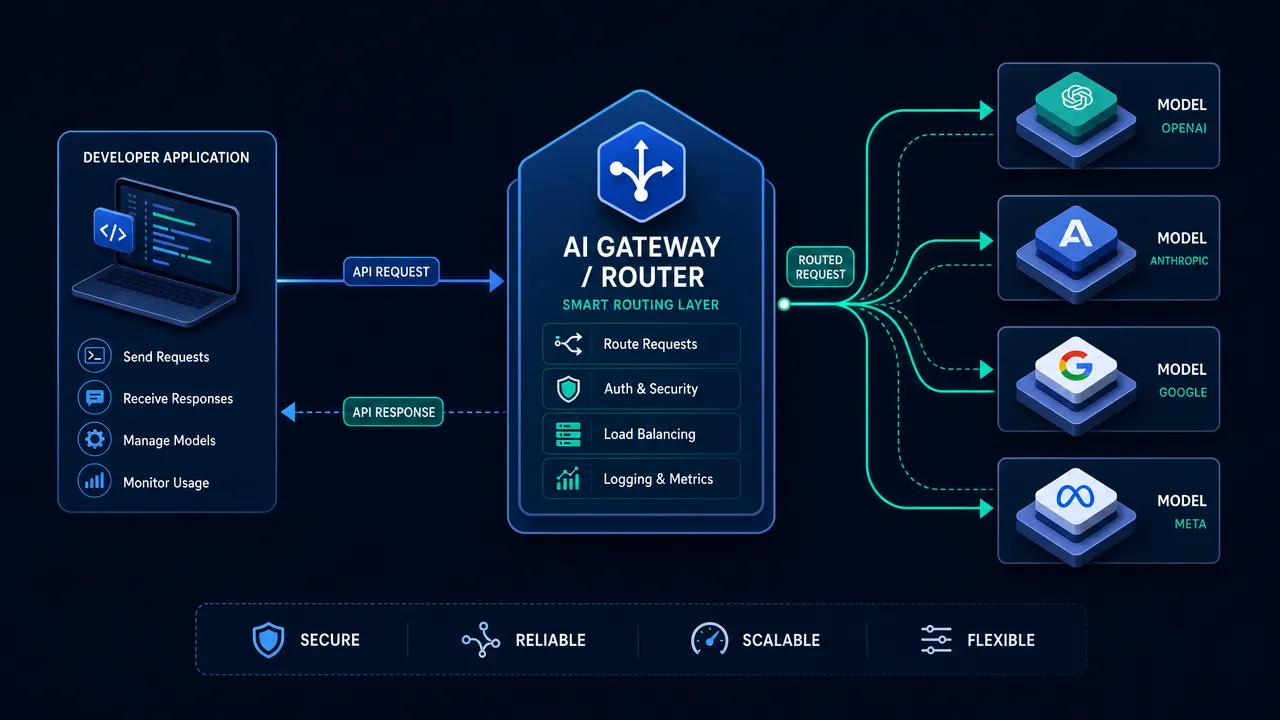
Why an AI model router API became essential for production AI teams
An AI model router API is an API layer that sits between your application and supported AI models. Instead of hard-coding every model integration, your app sends inference requests through a unified AI endpoint or unified LLM API, and the gateway handles access, routing logic, authentication, and response normalization where supported.
This matters because modern AI products rarely depend on a single static model call. AI agents, chatbots, automated workflows, code generation tools, and enterprise AI applications often make many model requests per user task. That creates pressure around cost, latency, availability, observability, and developer maintenance.
Research from Braintrust frames LLM routers around model choice, cost, latency, quality, observability, and lock-in reduction. Maxim AI similarly describes LLM routers and gateways as a response to inconsistent APIs, provider outages, rate limits, and rising costs in production AI systems.
For developers, the practical value is simple: an AI gateway or LLM gateway reduces the need to manage separate SDKs, keys, endpoints, and provider-specific schemas. A focused model routing API can also make it easier to test supported models before committing them to an application workflow.
Developer problem | Why it slows teams down | How an AI model router API helps |
|---|---|---|
Multiple integrations | Each provider or model may require different setup work. | One API surface for supported models. |
Model switching | Testing a new model can require backend changes. | Change endpoint or model config where supported. |
Cost pressure | Agents can multiply token usage quickly. | Centralize model access and compare usage. |
Reliability gaps | Direct integrations expose apps to API failures. | Gateways may support retries or fallback patterns. |
Limited observability | Debugging cost, latency, and errors gets fragmented. | Central request tracking can simplify operations. |
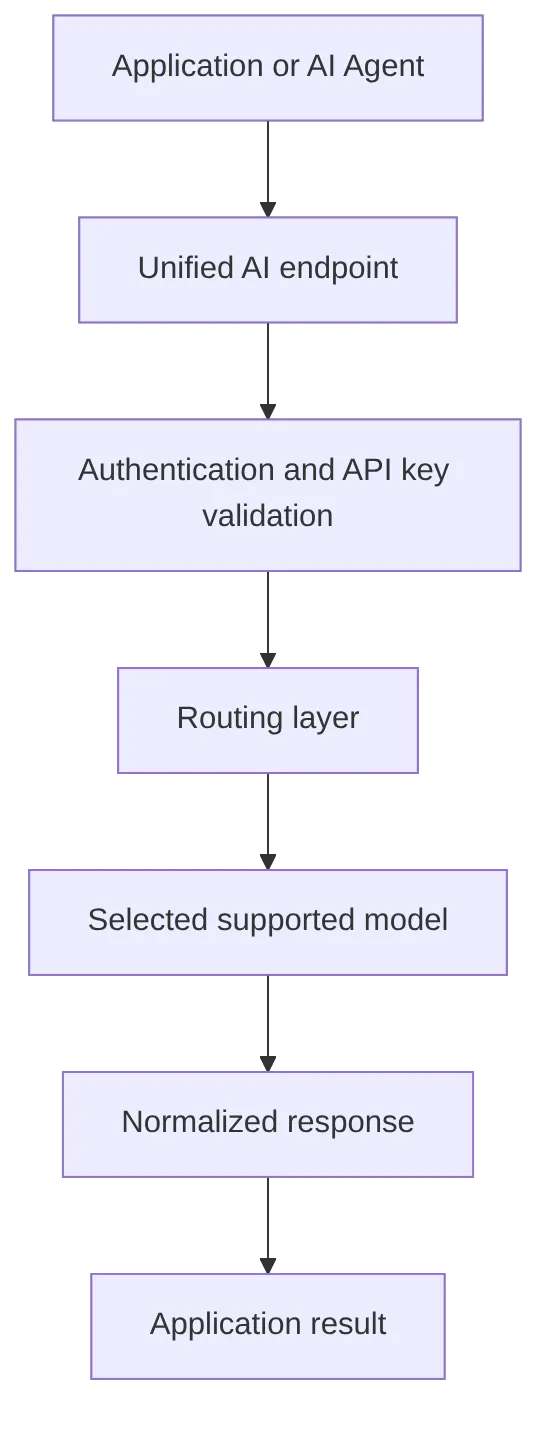
How an AI model router API differs from an AI gateway and LLM gateway
The terms AI model router API, AI gateway, LLM gateway, AI API gateway, multi model API, and multi provider AI API often overlap, but they are not identical.
An AI gateway is the broad infrastructure layer. It centralizes AI API access, authentication, policy, routing, cost tracking, observability, and usage controls. An LLM gateway is a gateway specifically focused on large language model traffic, such as chat completions, messages, streaming, token usage, and text generation workflows.
An AI model router API is more routing-focused. It helps an application send a request through one API layer and select from supported models based on configuration, use case, availability, cost, or other routing rules. Some platforms are broad ai provider aggregation services. Others are focused multi model API products built for a smaller supported model set.
That distinction is important for GonkaRouter. GonkaRouter is an OpenAI- and Anthropic-compatible AI Gateway / AI Model Router that provides one API for its currently supported models: MiniMax-M2.7, Kimi-K2.6, and GLM-5.2. Its compatibility refers to API format compatibility only. It does not mean official OpenAI or Anthropic model access.
Term | Developer meaning | Example buying question |
|---|---|---|
AI gateway | Central control layer for AI traffic. | How do we manage AI API usage in one place? |
LLM gateway | Gateway focused on LLM calls. | How do we normalize chat, messages, streaming, and usage? |
AI model router API | API layer for routing requests to supported models. | How do we switch or test models without rebuilding integrations? |
unified LLM API | One API surface for multiple LLM workflows. | How do we reduce SDK and endpoint sprawl? |
openai compatible api | OpenAI-style request and response format. | Can we change base URL and reuse familiar code patterns? |
For more detail on the endpoint-change approach, see GonkaRouter's guide to one OpenAI-compatible API endpoint for multiple AI models.
Top AI model router API and LLM routing platform categories for 2026
The best LLM routing platform depends on what your team values most. A startup experimenting with many models may choose a broad model access platform. An enterprise may prioritize governance and observability. A team building on open models may prefer an inference cloud. A team that already knows its target supported models may benefit from a focused, lower-cost route.
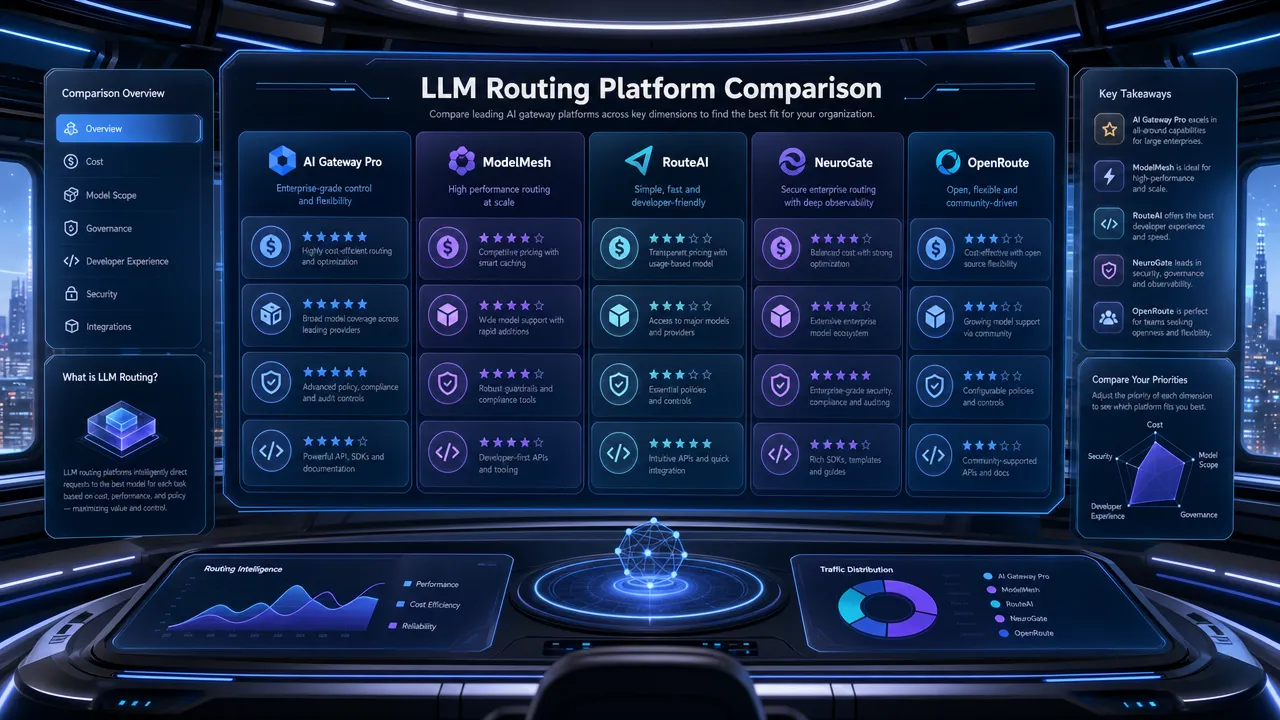
Platform category | Representative platforms | Best fit | Watch-out |
|---|---|---|---|
Broad model access platforms | OpenRouter, Poe | Fast experimentation and wide catalog access. | Provider scope, pricing, and governance details can change. |
Enterprise gateway platforms | Requesty, Vercel AI Gateway | Governance, observability, key management, retries, and production controls. | Best fit may depend on enterprise needs or platform ecosystem. |
Open-model inference clouds | Fireworks AI, Together AI, Hyperbolic | Hosted open-model inference, fine-tuning, GPU-backed workloads, or batch inference. | Not always neutral multi-provider routing platforms. |
Privacy-first AI APIs | Venice AI | Privacy-focused or Web3-friendly AI applications. | Enterprise policy fit should be evaluated carefully. |
Focused low-cost AI model router | GonkaRouter | Developers using MiniMax-M2.7, Kimi-K2.6, or GLM-5.2 through one API. | GonkaRouter should not be evaluated as a broad model marketplace. |
The phrase one API for all AI models is common in search behavior, but teams should read it carefully. Some platforms use broad model aggregation as their main value proposition. GonkaRouter's accurate positioning is different: it offers one API for currently supported models, not every model or every provider.
A practical comparison should include these criteria:
API compatibility: Does the platform support OpenAI-style or Anthropic-style formats?
Model scope: Does it support the exact models your workload needs?
Integration path: Can your team change only the endpoint, or is deeper refactoring needed?
Cost structure: Can you estimate cost per successful task?
Reliability: Are retries, fallback, or availability controls documented?
Observability: Can you monitor usage, errors, latency, and token consumption?
Governance: Does the platform support enterprise controls if required?
For cost-sensitive teams, StackScout's infrastructure landscape notes that cost/performance selection has become an important part of LLM infrastructure planning.
Where GonkaRouter fits as an AI model router API
GonkaRouter fits best as a focused AI model router API for developers who want unified access to MiniMax-M2.7, Kimi-K2.6, and GLM-5.2 through OpenAI-compatible and Anthropic-compatible API formats.
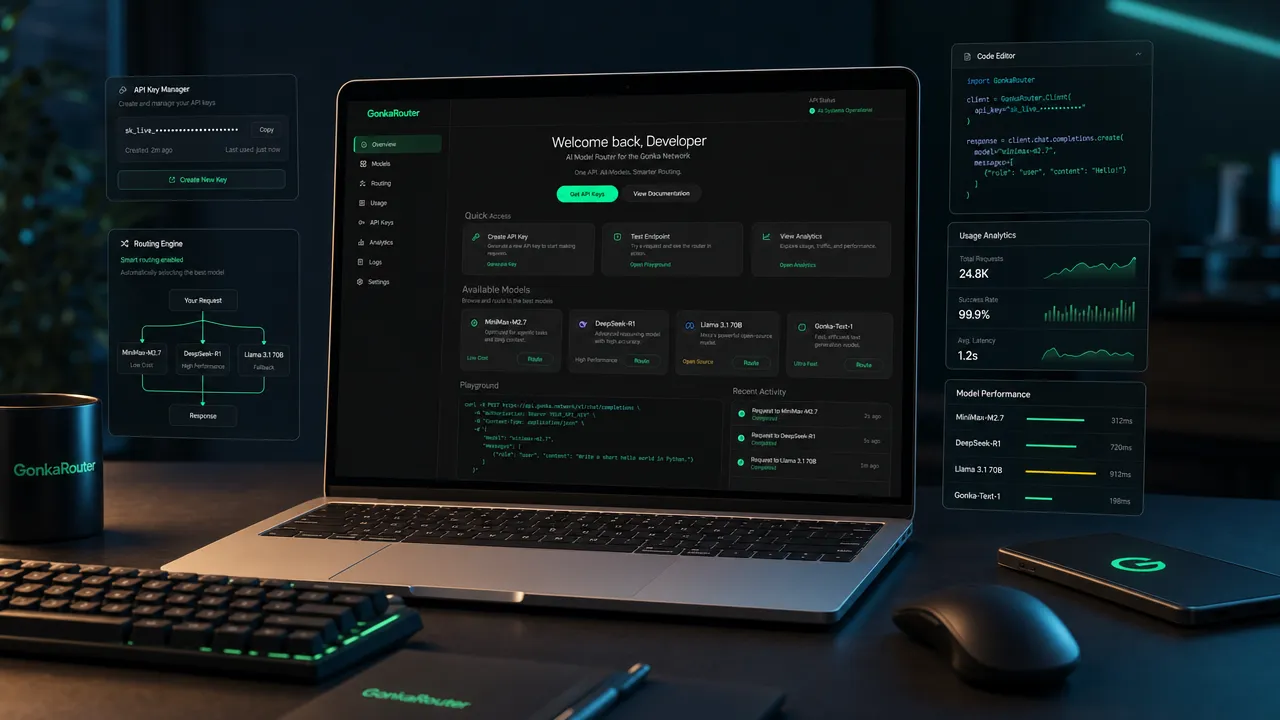
The product is built on the Gonka decentralized AI compute network and is designed for fast developer onboarding. Developers can log in with email, get an API key, review the developer documentation, change the API endpoint, and test supported models.
Current GonkaRouter model support is exactly:
Supported model | SEO use case phrasing | Where to verify |
|---|---|---|
MiniMax-M2.7 | MiniMax-M2.7 API, MiniMax API | |
Kimi-K2.6 | Kimi-K2.6 API, Kimi API | |
GLM-5.2 | GLM-5.2 API, GLM API |
GonkaRouter is especially relevant when your application can use one or more of these supported models for AI Agents, chatbots, content generation, code generation, intelligent Q&A, data analysis, enterprise workflows, or automated tasks.
Its pricing message is also straightforward: token pricing is as low as $0.0004 / 1M tokens, and new users receive a one-time 20 USDT trial credit after logging in with email. You can check current pricing on the GonkaRouter pricing page.
The key is to evaluate GonkaRouter accurately. It is not a model marketplace and should not be described as supporting all major models, every provider, official OpenAI models, or official Anthropic models. Its OpenAI-compatible API and Anthropic-compatible API access refer to API format compatibility.
For teams comparing model quality and fit, GonkaRouter's related guides on verified AI models, choosing AI models for faster work, and reducing LLM costs provide useful next steps.
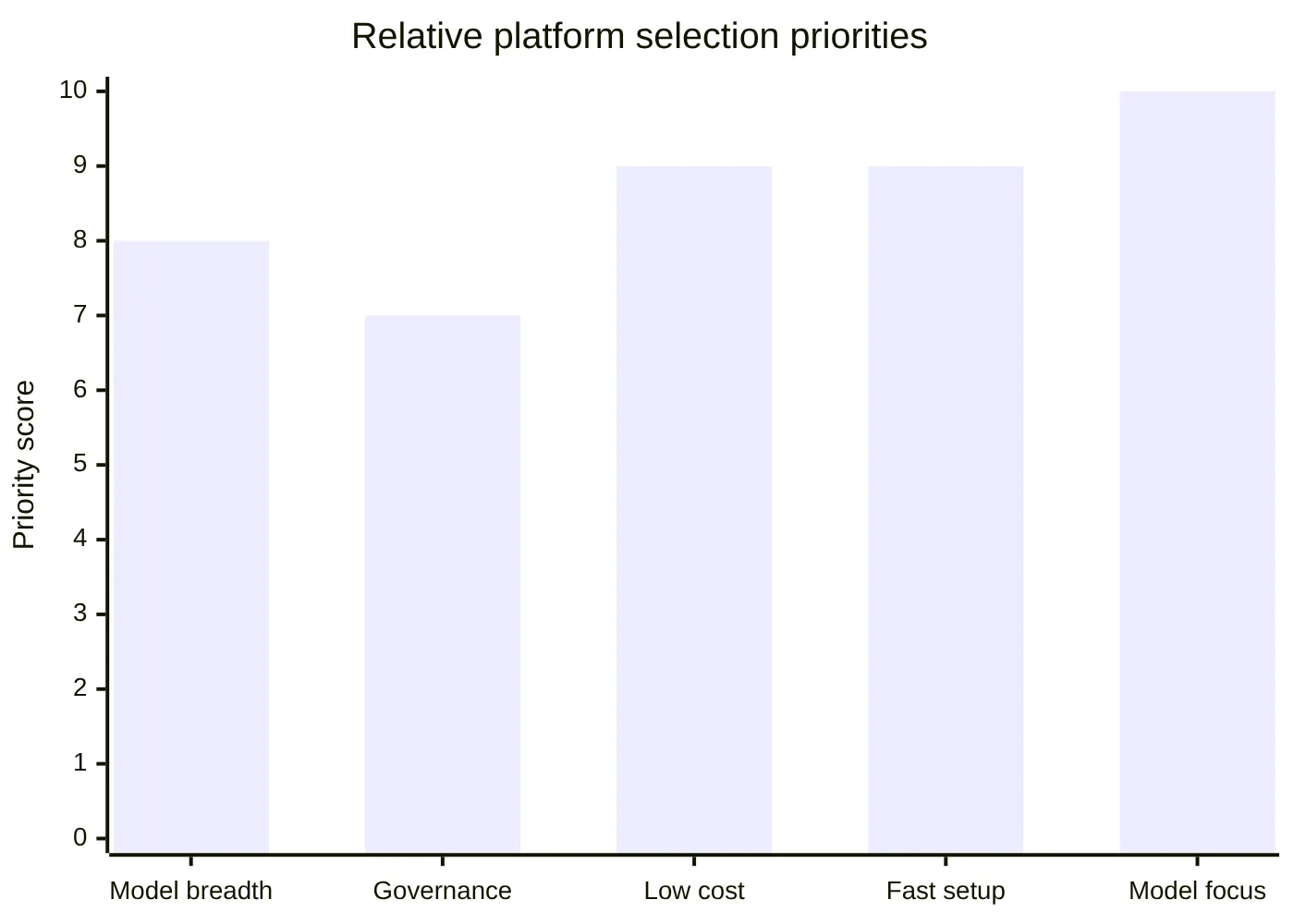
How to choose the right AI model router API for your stack
The right AI model router API is the one that fits your production constraints, not the one with the longest feature list. For many teams, the decision starts with model fit. If your workload specifically benefits from MiniMax-M2.7, Kimi-K2.6, or GLM-5.2, GonkaRouter gives you a focused multi model API with one integration path.
Use this framework:
Decision factor | Choose a broad platform when... | Choose GonkaRouter when... |
|---|---|---|
Model scope | You need a very wide catalog for experimentation. | You need MiniMax-M2.7, Kimi-K2.6, or GLM-5.2. |
Integration | You accept provider and model variability. | You want endpoint-based integration with supported models. |
API format | You need familiar SDK-style compatibility. | You want OpenAI-compatible and Anthropic-compatible formats for supported models. |
Cost | You are comparing many pricing models. | You want token pricing as low as $0.0004 / 1M tokens for supported use cases. |
Onboarding | You can handle longer procurement or setup. | You want email login, API key access, and trial credit for testing. |
A clean GonkaRouter onboarding path looks like this:
Visit GonkaRouter.
Log in with email.
Receive the one-time 20 USDT trial credit for product testing.
Get your API key.
Read the developer docs.
Change the API endpoint.
Test MiniMax-M2.7, Kimi-K2.6, and GLM-5.2.
Integrate the best-fitting supported model into your Agent or product workflow.
For additional implementation context, GonkaRouter's guide to decentralized AI API access explains how developers can approach API-based AI adoption.
AI model router API FAQ
What is an AI model router API?
An AI model router API is an API layer that receives inference requests from an application and routes them to selected supported models through a unified endpoint.
What is a unified LLM API?
A unified LLM API gives developers one API surface for accessing multiple supported LLMs or model endpoints, reducing separate integrations and provider-specific code.
What does OpenAI-compatible API mean?
OpenAI-compatible API means the request and response format follows OpenAI-style patterns. For GonkaRouter, this means format compatibility only. It does not mean official OpenAI model access.
Does Anthropic-compatible mean GonkaRouter provides official Anthropic models?
No. Anthropic-compatible access refers to API format compatibility. GonkaRouter currently supports MiniMax-M2.7, Kimi-K2.6, and GLM-5.2.
Which models does GonkaRouter currently support?
GonkaRouter currently supports MiniMax-M2.7, Kimi-K2.6, and GLM-5.2.
What is GonkaRouter pricing?
GonkaRouter token pricing is as low as $0.0004 / 1M tokens. New users receive a one-time 20 USDT trial credit after logging in with email. Check the latest details on the pricing page.
Who should use GonkaRouter?
GonkaRouter is a strong fit for AI developers, Agent builders, startup teams, Web3 project teams, product managers, and enterprise technical teams that want one API for the currently supported models with fast endpoint-based integration.