GonkaRouter gives developers a unified LLM API path for using supported models through one AI model router API, reducing integration work while keeping API formats familiar.
An AI gateway is commonly described as middleware between applications and AI services. IBM defines an AI gateway as a layer for integrating, deploying, and managing AI tools and LLMs in enterprise environments, while Kong describes AI gateways as middleware for routing, authentication, rate limiting, and observability across AI traffic. For developers, the practical value is simple: fewer provider-specific integrations, fewer duplicated code paths, and a cleaner way to test supported models.
GonkaRouter fits this category as an OpenAI- and Anthropic-compatible AI Gateway / AI Model Router. It currently provides unified access to MiniMax-M2.7, Kimi-K2.6, and GLM-5.2 through one API for supported models. It does not claim access to every model ecosystem, and its OpenAI-compatible API and Anthropic-compatible API support refer to API format compatibility, not official model access from those providers.
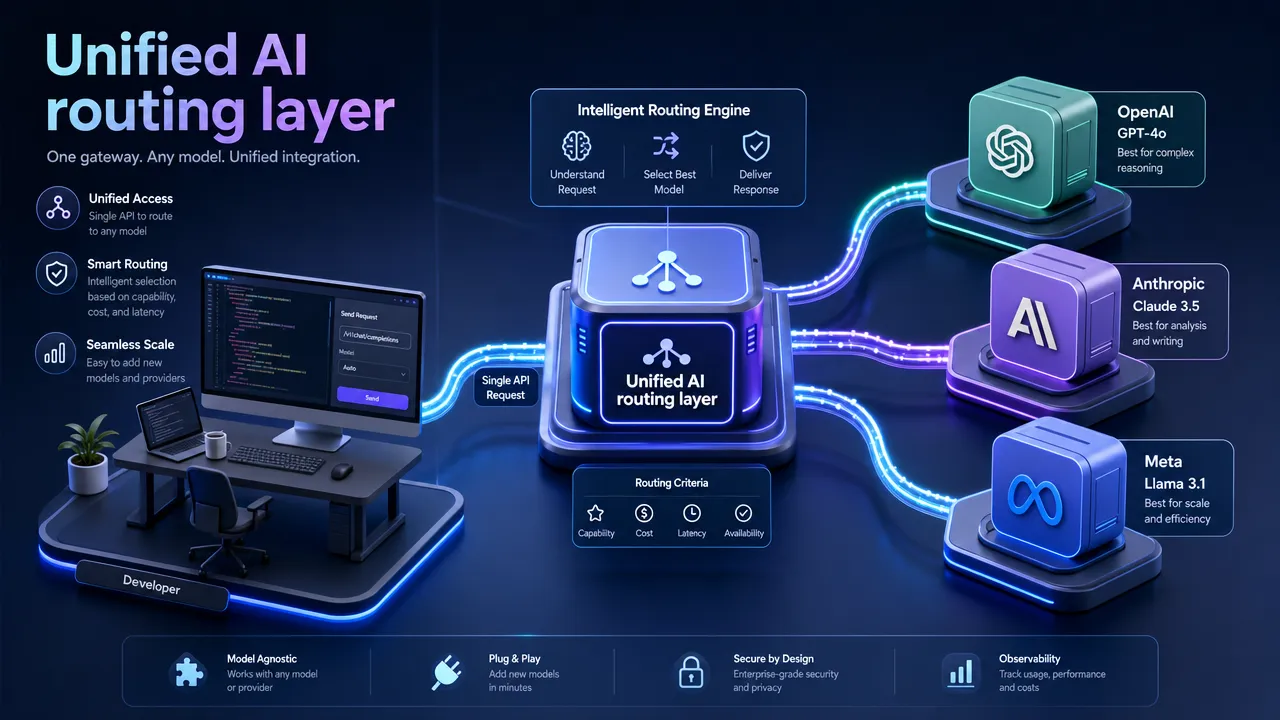
How an AI model router API reduces integration friction
An AI model router API gives applications one routing layer for supported AI model inference. Instead of building and maintaining separate SDK logic, authentication handling, request schemas, and response parsers for each model path, developers send requests through a unified ai endpoint and select from the models currently available through the platform.
For GonkaRouter, that means one API for MiniMax-M2.7, Kimi-K2.6, and GLM-5.2. This is especially useful for AI developers, Agent developers, startup teams, AI product managers, Web3 project teams, and enterprise technical teams that need faster experimentation without multiplying backend complexity.
A unified LLM API can help reduce:
Integration challenge | Developer impact | GonkaRouter approach |
|---|---|---|
Multiple API formats | More request and response handling | OpenAI-compatible API and Anthropic-compatible API formats |
Separate model integrations | Slower testing and more maintenance | One API for supported models |
Endpoint changes across systems | More configuration work | Fast integration by changing the API endpoint |
Cost pressure from frequent calls | Higher experimentation cost | Token pricing as low as $0.0004 / 1M tokens |
Onboarding friction | Slower first test | Email-based login and API key access |
Industry sources also reinforce the same pattern. TrueFoundry describes AI gateways as abstraction layers that unify access to LLMs through a single API interface, and Evolink notes that LLM APIs often differ in streaming, tool calling, error handling, and token accounting even when they appear similar. That is why a model routing API can be valuable: it gives teams a cleaner integration boundary.
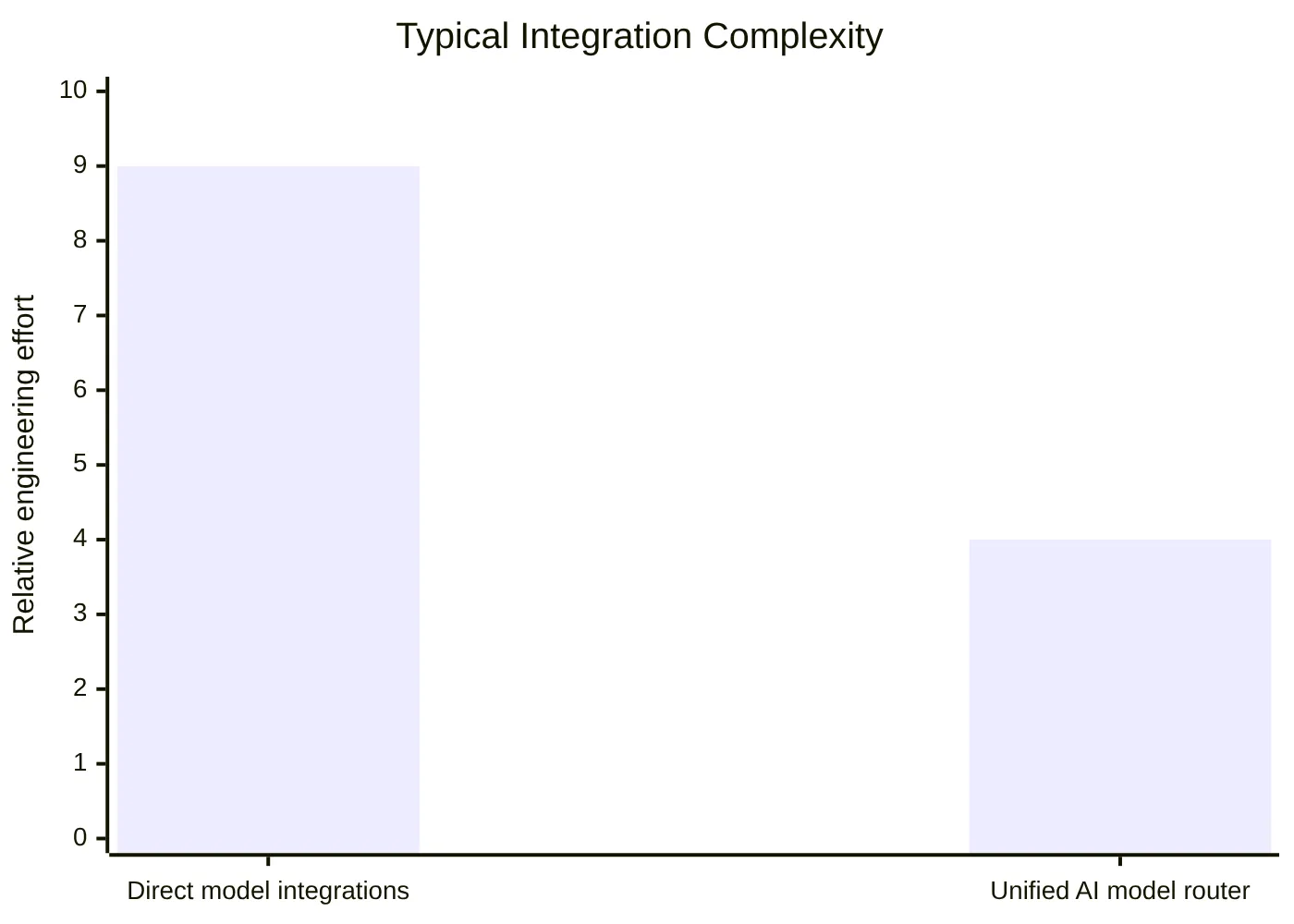
Why this AI model router API supports a unified LLM API workflow
A unified LLM API workflow works best when developers can preserve familiar application patterns while reducing model-specific maintenance. GonkaRouter supports this by offering OpenAI-compatible and Anthropic-compatible API formats for its currently supported models.
Compatibility matters because many AI applications already structure requests around familiar chat or messages patterns. With GonkaRouter, developers can often move faster because the integration path focuses on endpoint configuration, API key setup, and supported model selection.
A typical GonkaRouter workflow looks like this:
Log in with email.
Receive a one-time 20 USDT trial credit for product usage after logging in.
Get an API key.
Configure the GonkaRouter endpoint.
Test MiniMax-M2.7, Kimi-K2.6, or GLM-5.2.
Integrate the selected supported model into an Agent, chatbot, workflow, or application.
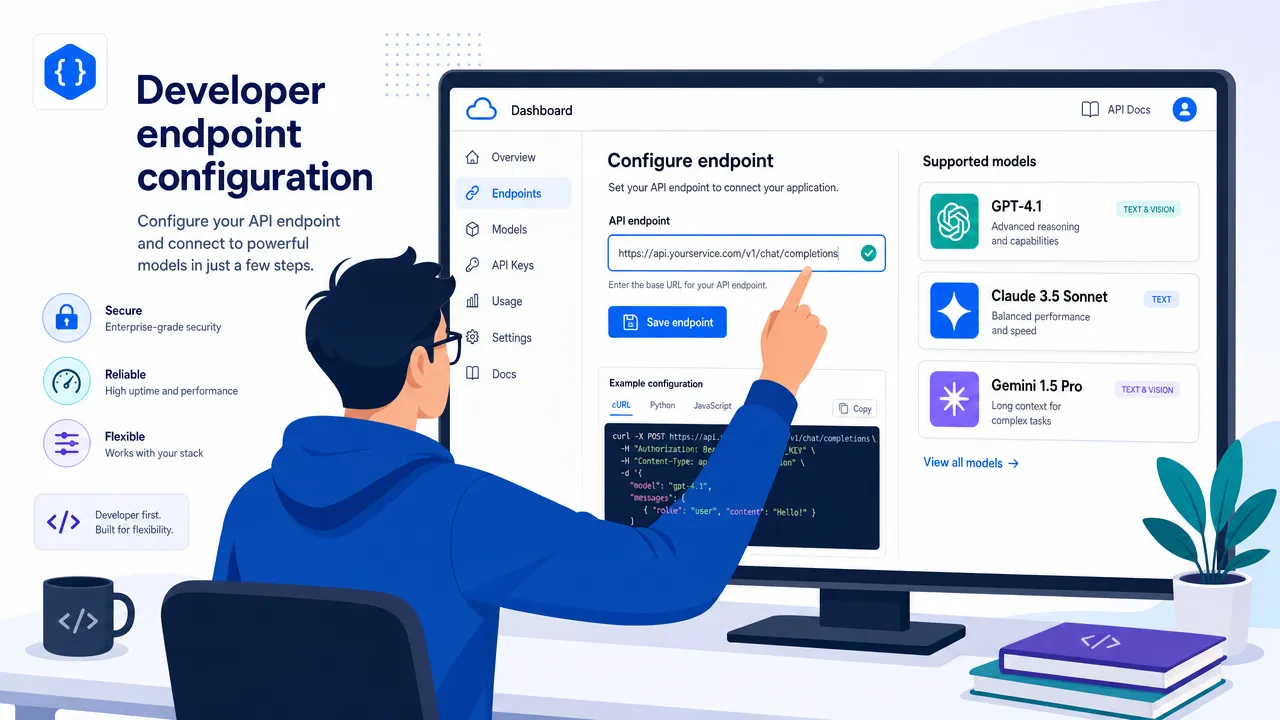
The key phrase is "format compatibility." GonkaRouter's OpenAI-compatible API format does not mean official OpenAI model access. Its Anthropic-compatible API access does not mean official Anthropic model access. It means developers can use familiar request patterns where supported while accessing MiniMax-M2.7, Kimi-K2.6, and GLM-5.2 through GonkaRouter.
For implementation details, developers should use the current developer documentation before deployment. The exact endpoint, supported request fields, model identifiers, streaming behavior, and error handling rules should always come from the latest docs.
What this AI model router API currently supports
GonkaRouter is intentionally positioned around its current supported model set. It is a multi model API for MiniMax-M2.7, Kimi-K2.6, and GLM-5.2, not a universal model marketplace and not one API for all AI models in the literal sense.
Supported model | Model-specific API keyword | Common fit |
|---|---|---|
MiniMax-M2.7 | MiniMax-M2.7 API, MiniMax API | Chatbots, content generation, workflow tasks |
Kimi-K2.6 | Kimi-K2.6 API, Kimi API | Intelligent Q&A, summarization, Agent workflows |
GLM-5.2 | GLM-5.2 API, GLM API | Data analysis, structured generation, enterprise AI applications |
Developers can review the current model list on the supported AI models page. This is the safest source for confirming which models are available before integrating a product, Agent API, or automated workflow.
GonkaRouter's value is not based on claiming the broadest catalog. Its value is focused: one API for supported models, fast integration, familiar API formats, and cost-conscious AI Inference API access built on the Gonka decentralized AI compute network.
For related product guidance, GonkaRouter has also published useful internal resources on one OpenAI-compatible API endpoint, how verified AI models can reduce selection risk, how to find cost-efficient AI model routing, and how teams can choose AI models faster.
How this AI model router API helps AI gateway developers ship faster
AI gateway developer teams usually care about three things: integration speed, operational simplicity, and production fit. GonkaRouter supports those goals by letting teams start with a unified ai endpoint and route requests to currently supported models through familiar formats.
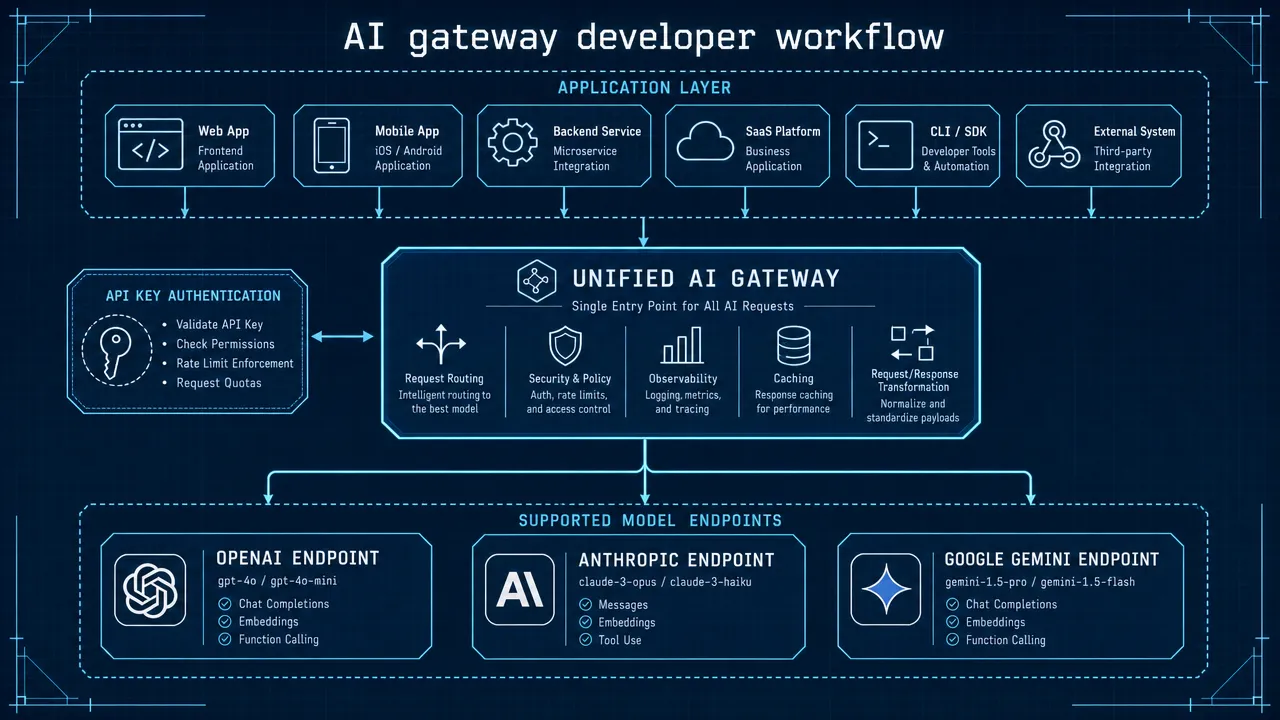
Common use cases include:
Use case | Why a unified API helps | GonkaRouter fit |
|---|---|---|
AI Agents | Agents make repeated calls for planning, reasoning, validation, and output | One Agent API path for supported model inference |
Chatbots | Teams need to test tone, quality, and cost quickly | Unified access to MiniMax-M2.7, Kimi-K2.6, and GLM-5.2 |
Content generation | Different prompts may perform better on different supported models | Faster model comparison through one API |
Code generation | Development workflows often require multiple prompt iterations | Lower integration overhead for model testing |
Enterprise workflows | Teams need maintainable infrastructure boundaries | AI gateway layer for supported model access |
Web3 project scenarios | Global teams may need flexible product usage and payment scenarios | Email login, trial credit, and developer-friendly access |
A unified LLM API does not remove the need for testing. Developers should still verify model IDs, authentication headers, request parameters, streaming behavior, output shape, error handling, latency, and workload-specific quality. The benefit is that those checks happen through one integration path rather than multiple disconnected provider-specific paths.
The GonkaRouter pricing page lists token pricing as low as $0.0004 / 1M tokens. New users receive a one-time 20 USDT trial credit after logging in with email, and that credit should be treated strictly as product usage credit for testing supported models.
How to start using the AI model router API with GonkaRouter
GonkaRouter gives developers a direct activation path: log in with email, get an API key, use the one-time 20 USDT trial credit for product testing, and try MiniMax-M2.7, Kimi-K2.6, or GLM-5.2 through one unified API.
Start with these steps:
Visit GonkaRouter and log in with email.
Get your API key.
Open the developer documentation.
Confirm the latest endpoint and model identifiers.
Test MiniMax-M2.7, Kimi-K2.6, and GLM-5.2 with your own prompts.
Review usage on the pricing page.
Integrate the selected supported model into your AI Agent, chatbot, workflow, or enterprise application.
GonkaRouter is best understood as a focused AI Gateway and AI Model Router for supported model access. It is built for developers who want a practical unified LLM API, OpenAI Compatible API format, Anthropic Compatible API format, fast endpoint-change integration, and transparent token pricing for supported model usage.
Start building with GonkaRouter today: log in with email, get your API key, use your one-time 20 USDT trial credit, and test MiniMax-M2.7, Kimi-K2.6, and GLM-5.2 through one AI model router API.