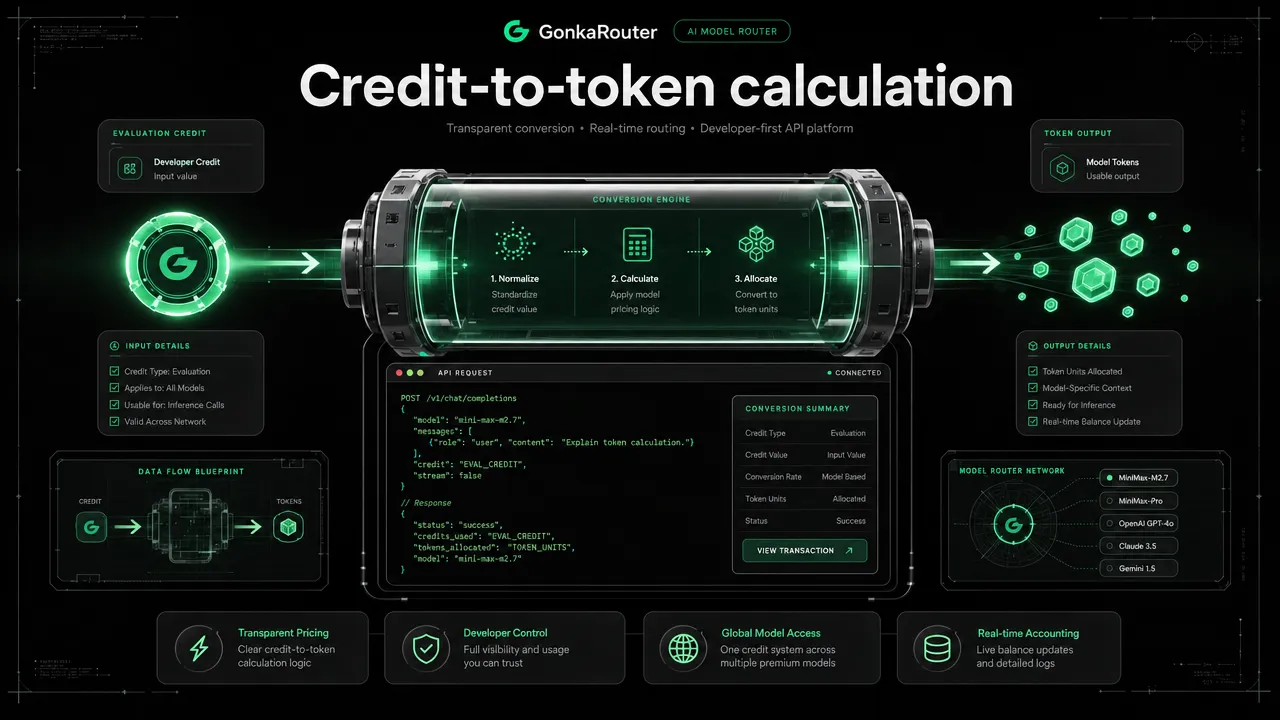
New GonkaRouter users receive $20 in AI API credit after registration, which can represent approximately 16.67 billion tokens at the displayed reference rate of $0.0012 per 1 million tokens. That is the basis for an "up to 16.7 billion tokens" maximum-equivalent estimate at that displayed rate, not a universal token allocation for every model or workload.
For developers assessing free AI inference, the practical value is controlled evaluation: confirm the live model rate, send a small representative request, observe usage, and scale only after the measured cost fits the application budget.
The calculation is straightforward:
$20 / $0.0012 per 1 million tokens = 16,666.67 million tokens = approximately 16.67 billion tokens.
Actual token usage, token accounting, and rates can vary by model and may change. The displayed reference rate should therefore be treated as a calculation input, not a production-planning guarantee. Check live GonkaRouter pricing before running a large test or deployment.
Free AI Inference With A $20 Credit: What The Maximum-Equivalent Estimate Means
GonkaRouter provides new users with $20 in AI API credit after registration. At the campaign's displayed reference price of $0.0012 per 1 million tokens, the arithmetic produces the following maximum-equivalent estimate:

The wording matters. "Up to 16.7 billion tokens" applies only when immediately qualified as a maximum-equivalent estimate at the displayed reference rate. It does not mean that every listed model receives exactly that amount of usage.
GonkaRouter currently lists DeepSeek-V4-Flash-0731 API access, Kimi-K2.6, and MiniMax-M2.7. Confirm the rate, billing details, and exact model identifier for the model you intend to call. A live-pricing difference from the campaign reference rate may occur, so the current pricing page is the source for an active workload.
Model | Listing status on GonkaRouter | Cost-planning position | What to verify before testing |
|---|---|---|---|
DeepSeek-V4-Flash-0731 | Listed in official GonkaRouter material | Focal model for controlled API evaluation | Current rate, exact API model ID, and token accounting |
Kimi-K2.6 | Listed in official GonkaRouter material | Alternative for a same-prompt comparison | Current model rate and request configuration |
MiniMax-M2.7 | Listed in official GonkaRouter material | Alternative for a bounded test harness | Current model rate and billing details |
Use the reference calculation to understand the offer, but use current live pricing and observed consumption to plan actual spend.
Free AI Inference For DeepSeek-V4-Flash-0731 Evaluation
DeepSeek-V4-Flash-0731 is listed as available through GonkaRouter. The service describes its integration as OpenAI-compatible, meaning teams can assess whether its API format fits an existing client or application architecture.
That compatibility description does not verify every implementation detail. Before writing production code, confirm the current documentation for the exact model identifier, request route, authentication header, body fields, response schema, and any returned token-usage fields.
This makes the $20 credit most useful for bounded experiments such as:
A one-request smoke test using a short, non-sensitive prompt.
Prompt-template checks with a fixed set of 5 to 10 representative inputs.
Output parsing and validation tests in a development environment.
Retry and error-handling tests with explicit stop conditions.
A small same-prompt comparison among listed models after verifying each model ID.
A manually reviewed proof of concept that is isolated from end-user traffic.
Avoid treating early results as broad claims about model quality or suitability. A small test tells you whether your integration, prompts, parsing logic, and budget assumptions work for your own workflow.
Before sending confidential, regulated, or sensitive personal information, review the Privacy Policy, Terms of Service, and your organization's internal requirements.
Free AI Inference Setup Using The OpenAI-Compatible Endpoint
A concise setup path starts with the confirmed details and leaves unverified implementation details to the live documentation.
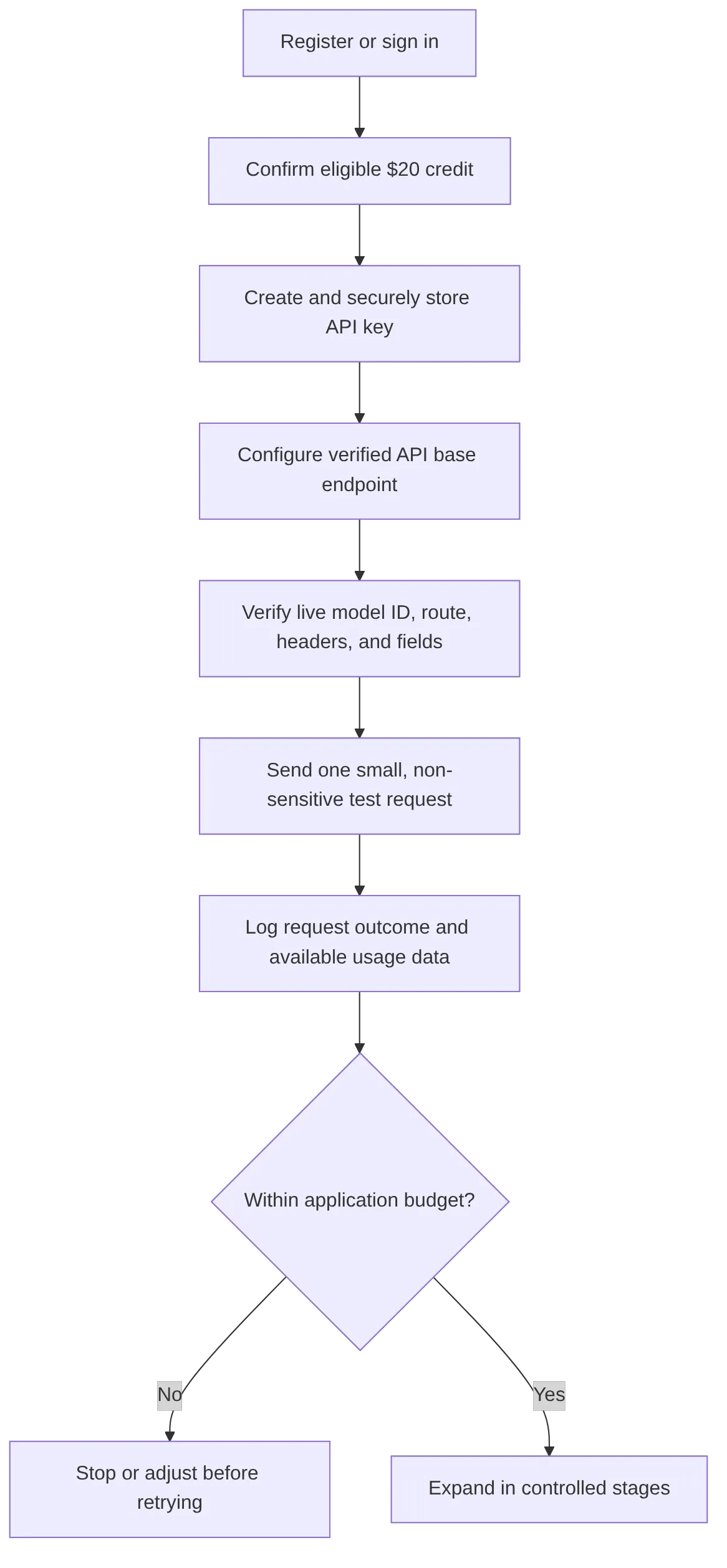
Register or sign in to GonkaRouter and confirm eligibility for the $20 new-user credit.
Create an API key and store it securely. The GonkaRouter login and API-key guide describes key creation and secure handling.
Configure the GonkaRouter API base endpoint https://api.gonkarouter.io/v1.
Confirm the current DeepSeek-V4-Flash-0731 API model ID, request path, authentication format, and request fields in current documentation.
Submit one short, non-sensitive request.
Record the model used, request outcome, retry count, available token data, and estimated or observed cost.
Expand only in controlled stages after reviewing usage and live pricing.
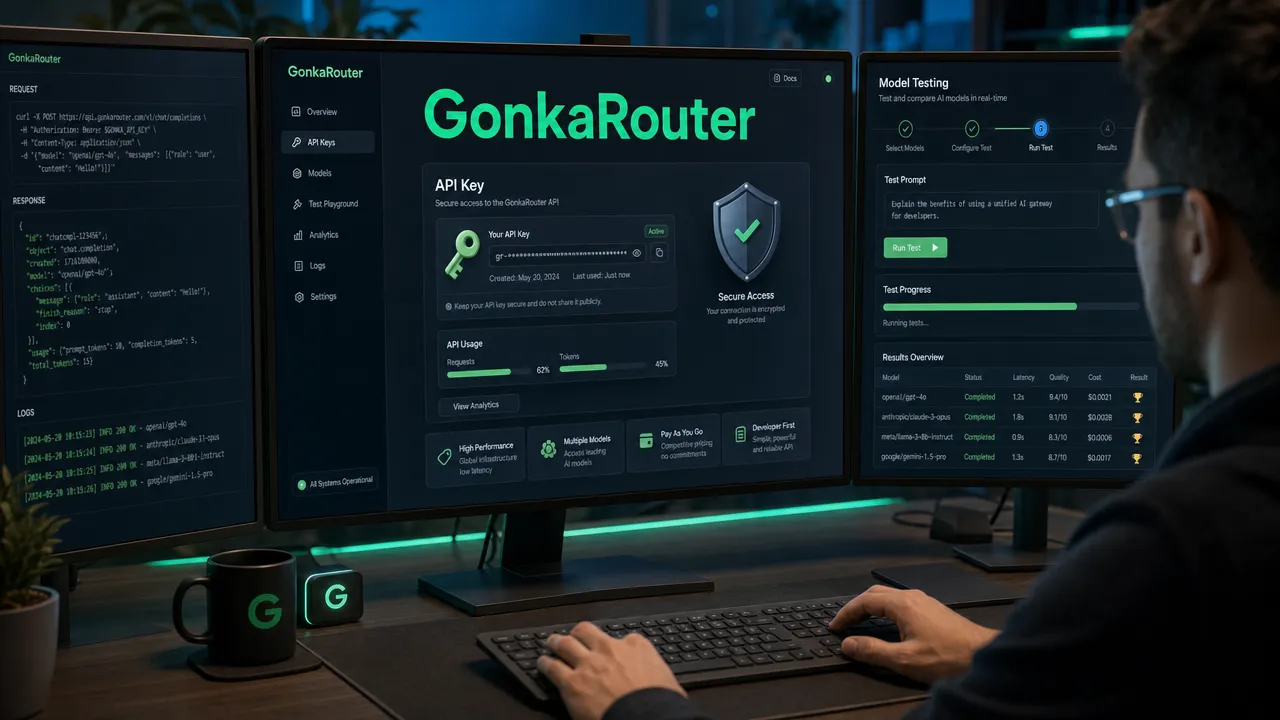
Do not guess a runnable request from general OpenAI conventions. GonkaRouter states that it supports an OpenAI-compatible API endpoint for multiple AI models, but the current documentation should govern the exact client setup.
Keep API keys in environment variables or a secrets manager. Do not place them in browser code, repositories, screenshots, or application logs.
Free AI Inference Credit Monitoring And Budget Controls
GonkaRouter's pricing material states that users can track usage and billing in real time through the dashboard. Check the current dashboard information after your first test, then compare it with the price snapshot you recorded before the request.
For dependable budget control, combine provider visibility with application-side safeguards:
Control | Practical action | Why it matters |
|---|---|---|
Price snapshot | Record the live model rate and timestamp before a test | Rates may change and can differ by model |
Request cap | Limit requests per job, user, queue, or test stage | Prevents loops from expanding usage |
Retry cap | Set a maximum retry count and stop after it | Retries can consume credit unexpectedly |
Small pilot | Run five requests before approving a larger batch | Tests measured consumption on representative inputs |
Spend threshold | Pause the workload when estimated cumulative cost reaches a preset amount | Creates an application-owned stop condition |
Model-change review | Recalculate estimates after changing models or versions | Do not assume comparable billing |
Safe logs | Log metadata rather than unnecessary prompt content | Supports analysis while reducing exposure |
Useful log fields include the timestamp, environment, verified model ID, job ID, request count, status outcome, retry count, live-pricing snapshot, and estimated cumulative spend. Log input, output, and total token counts only when those values are returned or can be measured reliably under the documented integration.
If the service does not provide verified per-request token fields for your configuration, use a conservative combination of request counts, prompt-size estimates, live price snapshots, and observed account-balance changes.
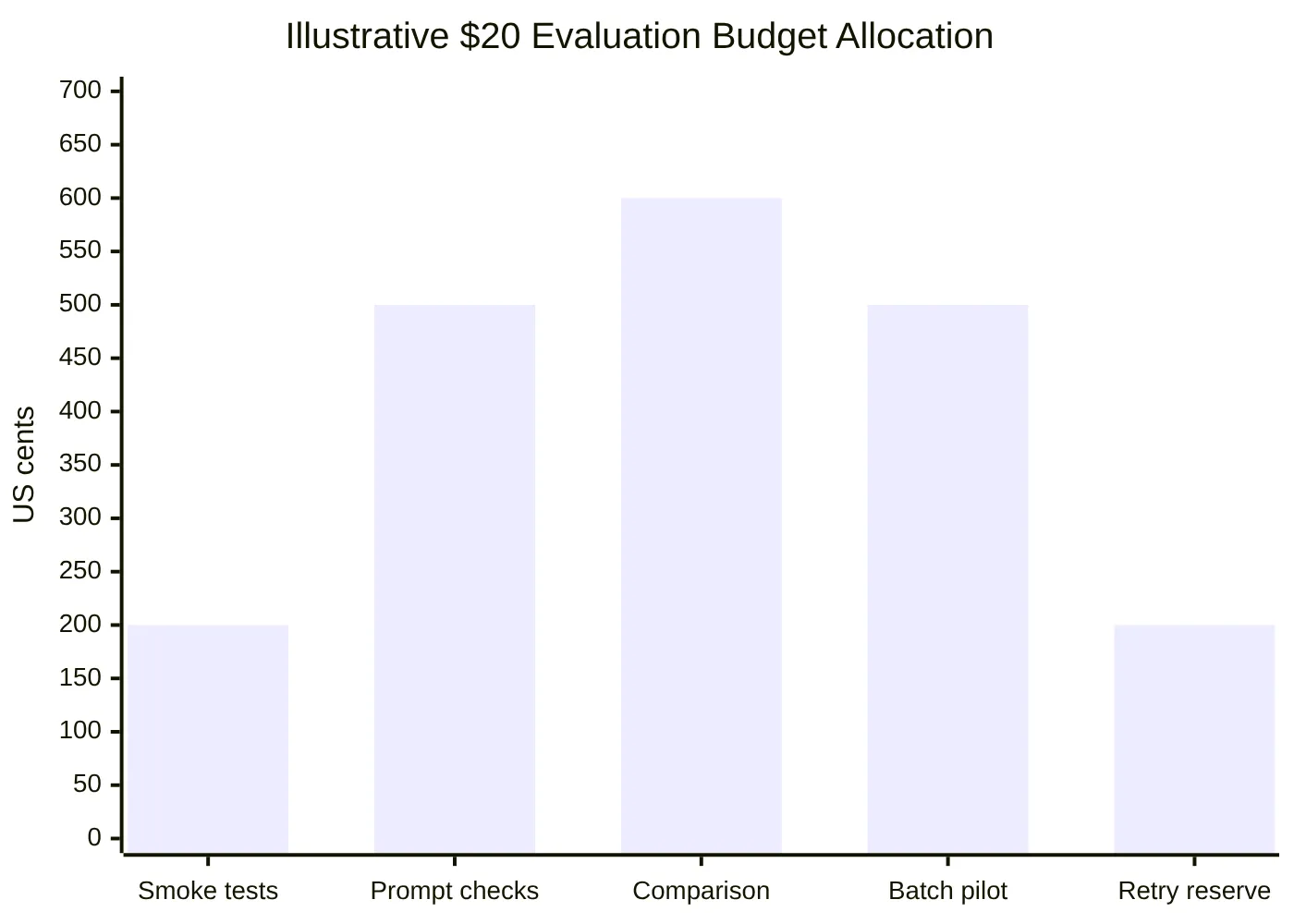
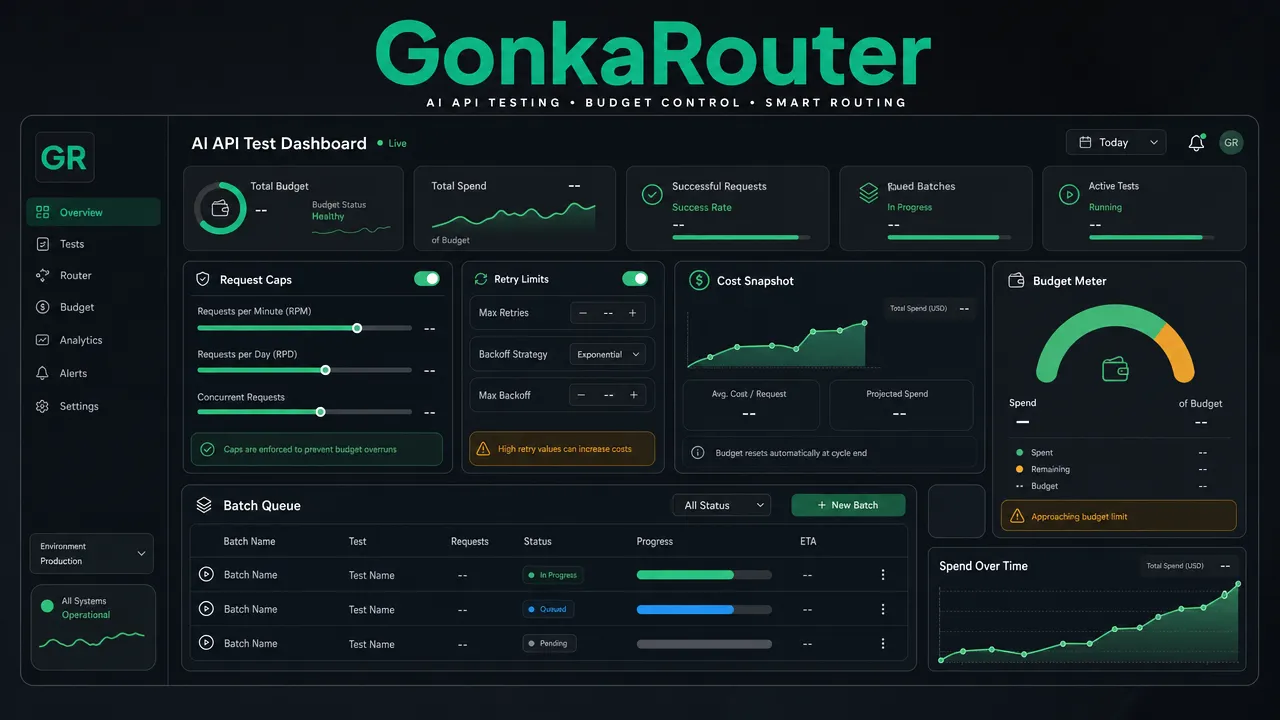
The chart below is an illustrative application-side plan for allocating a $20 evaluation budget. It is not provider pricing, a platform spending limit, or a claim about how credit is consumed.
Free AI Inference Questions For Developers
Does $20 always equal 16.7 billion tokens?
No. It equals approximately 16.67 billion tokens only as a maximum-equivalent estimate at the displayed $0.0012 per 1 million-token reference rate. Actual rates, token accounting, and usage vary by model and may change.
Is DeepSeek-V4-Flash-0731 available through GonkaRouter?
Official GonkaRouter material lists DeepSeek-V4-Flash-0731 as available. Confirm the current API model identifier before implementation.
Can an OpenAI-compatible client be used?
GonkaRouter describes its API format as OpenAI-compatible. Verify the current request path, authentication method, client settings, request fields, and response format before relying on a specific integration.
How can a team avoid consuming credit too quickly?
Start with short prompts, fixed test sets, request caps, retry limits, application-side spend thresholds, and staged batch sizes. Review dashboard usage after each stage.
Should the displayed reference price be used for production planning?
No. Use the live rate for the specific selected model, then validate cost with representative requests before scaling.
Are Kimi-K2.6 and MiniMax-M2.7 billed exactly like DeepSeek-V4-Flash-0731?
Do not assume they are. Confirm current model-specific rates, token accounting, and billing details on the live pricing page before use.
For developers evaluating free AI inference, the disciplined approach is simple: use the credit math as a transparent estimate, validate DeepSeek-V4-Flash-0731 with a small test, and make scaling decisions from current rates and measured usage. Create a GonkaRouter account, claim the $20 credit if eligible, confirm the live model rate, and run a small test request before scaling.