Hyperbolic Labs is an AI cloud and GPU infrastructure provider, but current official evidence does not confirm Gemini or GLM-4.5 as publicly documented managed model offerings on its platform. That distinction matters because renting GPU capacity, deploying your own model, and calling a provider-managed inference endpoint are different technical paths.
For developers searching for hypebolic, hyper bolic, or similar variants, the relevant entity is Hyperbolic Labs rather than the mathematical term. Its official materials describe on-demand GPUs, reserved capacity, private cloud options, model training, fine-tuning, and serving through an OpenAI-compatible API.
How Hyperbolic Labs separates GPU infrastructure from managed model access
Hyperbolic is best evaluated as infrastructure first. Its official AI cloud site and platform overview documentation position the service around GPU access and AI workload operations.
That can support several deployment patterns:
Deployment path | What the team manages | What to verify |
|---|---|---|
GPU rental | Model files, serving stack, scaling, observability, security | GPU availability, hourly billing, networking, storage, and operations |
Managed inference | API requests to a provider-hosted model | Exact model ID, rate limits, token pricing, streaming, and supported endpoints |
Dedicated deployment | Private or reserved serving environment | Current contractual terms, capacity, operational responsibilities, and service expectations |
An OpenAI-compatible API means a service can support an OpenAI-style request and response format. It does not confirm access to official OpenAI models, Google Gemini models, or every model a developer may want.
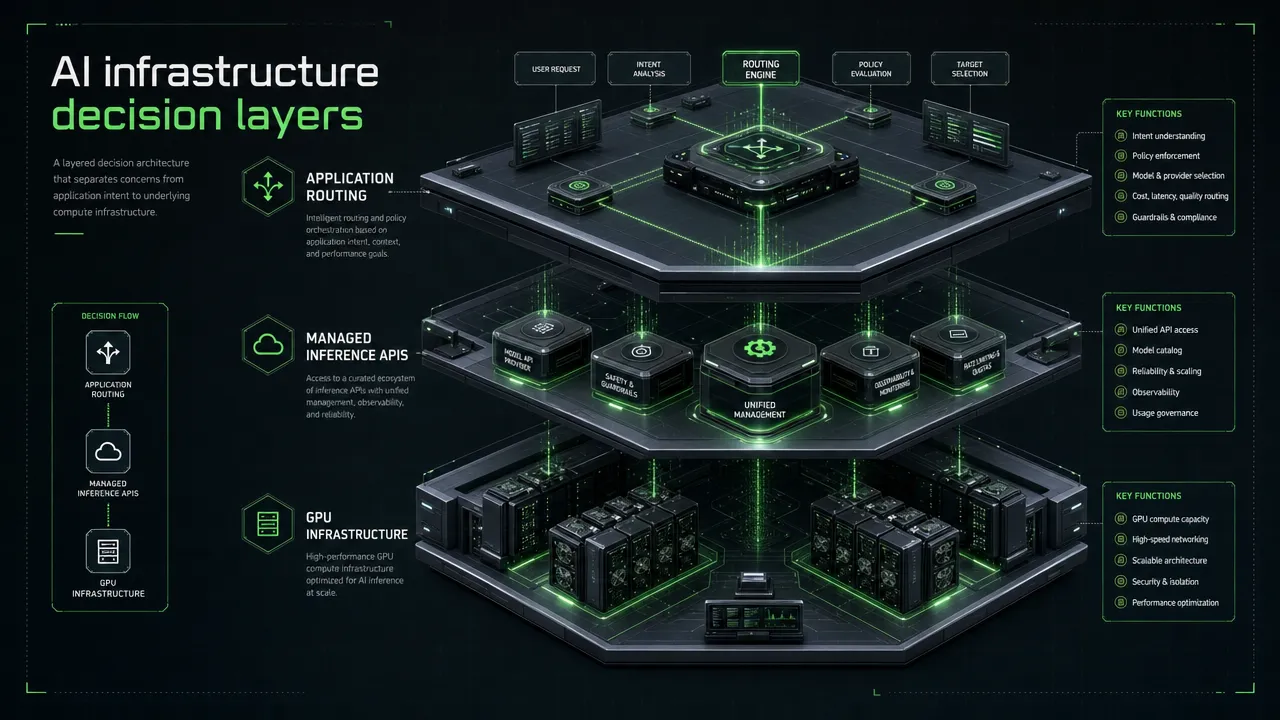
The practical lesson is simple: before selecting Hyperbolic for a production workload, identify whether the requirement is compute capacity, a managed endpoint, or a dedicated deployment environment.
Why Hyperbolic Gemini and GLM-4.5 claims need verification
Current research found no official Hyperbolic catalog, pricing page, API reference, or announcement that confirms Gemini models or GLM-4.5 as current public Hyperbolic offerings. Developers should therefore treat both phrases as unverified availability queries, not established product claims.
Gemini is Google's model family. Its live status, model identifiers, and lifecycle details are maintained in Google's Gemini model documentation and Gemini API release notes. Availability through Google's own channels does not prove Gemini runs through Hyperbolic.
The same precision applies to GLM versions. GLM-4.5 and GLM-5.2 are separate version-specific claims. A provider listing one does not establish access to the other. In particular, do not conflate GLM-4.5 with GonkaRouter's currently supported GLM-5.2.
Use this verification sequence before designing around a model:
Find the exact model ID in first-party documentation.
Confirm whether the provider offers it as managed inference or only supports self-deployment on GPUs.
Review API features such as streaming, tool calling, structured output, and context limits.
Check rate limits, pricing structure, data handling, and model lifecycle policy.
Run representative workload tests before making an architecture commitment.
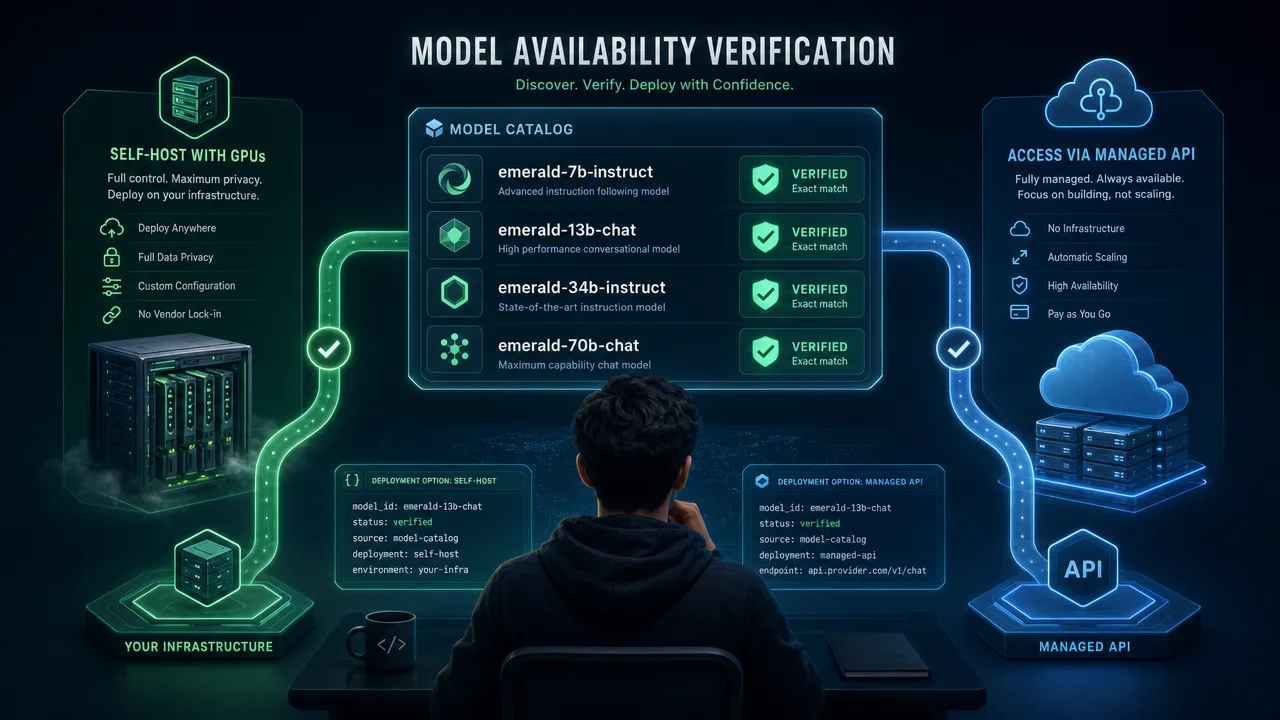
A historical Hyperbolic post discusses inference access to selected Llama and Hermes-family models through a Poe relationship in 2024. That is useful context, but it is not evidence of a current catalog or proof that Gemini and GLM-4.5 are available today.
How Hyperbolic compares with an AI gateway or model router
Hyperbolic and an AI gateway address different layers of the stack. Hyperbolic is infrastructure-oriented, while an AI gateway or AI model router is designed to reduce application-side integration work across its specifically supported models.
Evaluation question | Hyperbolic-oriented approach | AI gateway or model router approach |
|---|---|---|
Primary need | GPU capacity and deployment control | Unified API access and simpler integration |
Model operations | May require self-hosting responsibility | Provider exposes supported models through one API layer |
Billing focus | Often capacity and infrastructure usage | Often token or request-based inference usage |
Portability focus | Deployment flexibility | Endpoint, client, and routing flexibility |
Best fit | Training, fine-tuning, custom serving, controlled infrastructure | Agents, chatbots, workflows, and products that need supported models through one integration |
The right choice begins with the hard requirement. A team that requires Gemini should validate access through Google's official channels or another provider that explicitly documents Gemini. A team that must deploy or fine-tune its own open model may prefer GPU cloud infrastructure. A team that wants to reduce separate integrations for a limited, verified model set may benefit from a focused model router.
This category distinction also helps filter misleading search combinations such as hyperbolic labs, kimi moonshot, flux-1, anthropic claude code docs, or gemini model list. Similar terms can appear in the same developer workflow, but they do not establish shared provider availability.
How Hyperbolic research clarifies GonkaRouter's focused model access
GonkaRouter is an OpenAI-compatible and Anthropic-compatible AI Gateway for a focused set of currently supported models: MiniMax-M2.7, Kimi-K2.6, and GLM-5.2.
It should not be positioned as a Gemini provider, a GLM-4.5 provider, a Hyperbolic model host, or a broad model marketplace. API-format compatibility describes how developers integrate. It does not mean access to official OpenAI or Anthropic models.
For teams whose workload fits its supported set, GonkaRouter provides practical advantages:
One API for MiniMax-M2.7, Kimi-K2.6, and GLM-5.2.
OpenAI-compatible and Anthropic-compatible API formats.
Faster adoption by changing the API endpoint rather than rebuilding an application integration.
Email-based login and API-key onboarding.
Token pricing as low as $0.0004 per 1M tokens.
A one-time 20 USDT trial credit after email login for product testing.
A unified LLM API platform guide explains the value of reducing separate model connections, while this AI model router API guide provides useful category context for teams evaluating routing layers. Developers migrating an existing client can also review the guidance for one OpenAI-compatible API endpoint.
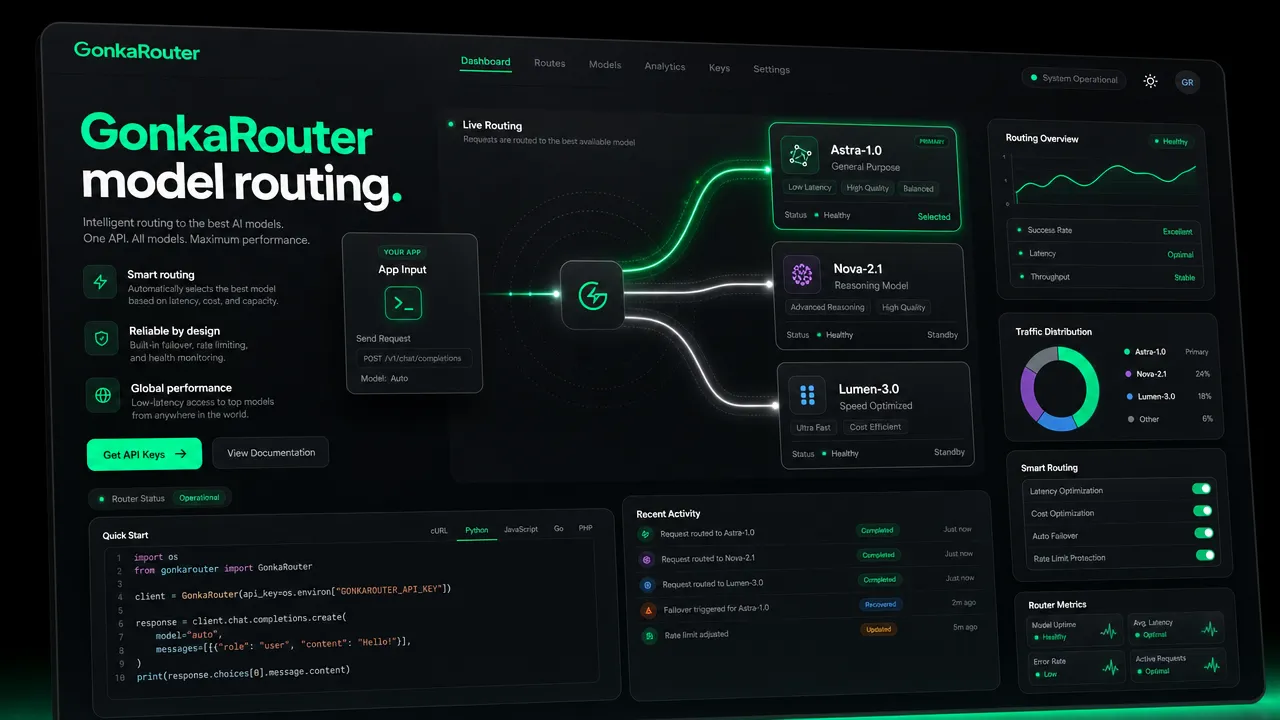
For AI Agents, chatbots, content workflows, code-generation tasks, intelligent Q&A, and automated workflows, a focused router can keep application logic separate from provider-specific connection logic.
How Hyperbolic evaluation becomes a production-ready checklist
The strongest architecture decisions are evidence-led. Rather than relying on a model name in a video, post, or search result, document the exact model and access path before implementation.
Checkpoint | Production question |
|---|---|
Model requirement | Which exact model IDs are non-negotiable? |
Access type | Is the model managed by the provider, self-hosted, or deployed on reserved infrastructure? |
API behavior | Does the endpoint support the features the application needs? |
Reliability | What are the concurrency limits, retry behavior, and escalation path? |
Cost | Is pricing token-based, GPU-based, capacity-based, or mixed? |
Data handling | What request data is logged, retained, or processed? |
Portability | Can model IDs, base URLs, and fallback policies remain configurable? |
For GonkaRouter-specific evaluations, select only MiniMax-M2.7, Kimi-K2.6, or GLM-5.2, then test actual prompts and expected production failure cases. Review current pricing before scaling, and consult the multi-provider LLM gateway guide for implementation-oriented routing considerations.
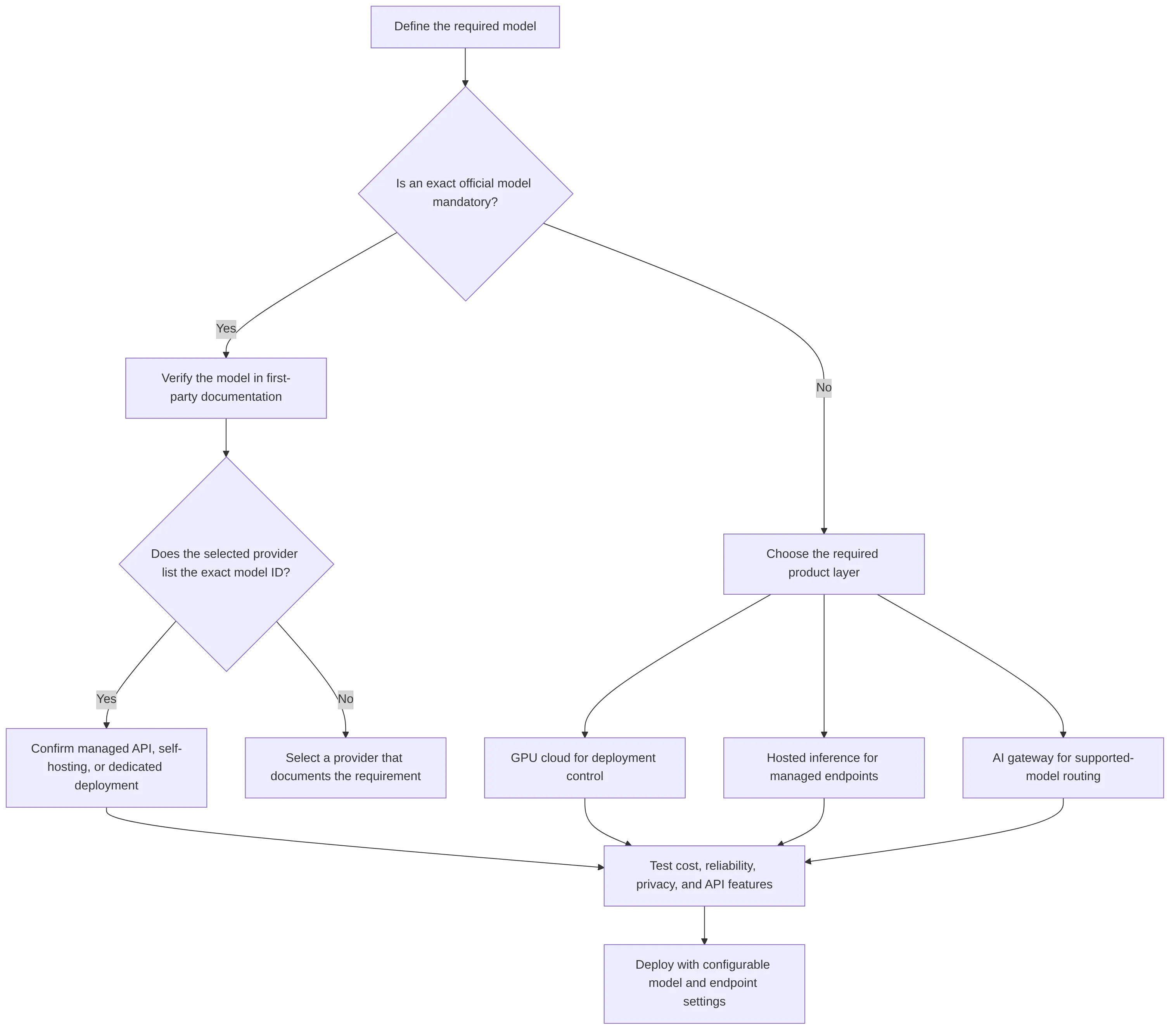
Hyperbolic is a valid infrastructure option when GPU capacity and deployment flexibility are the priority. When a team needs unified access to MiniMax-M2.7, Kimi-K2.6, and GLM-5.2, GonkaRouter offers a more focused API-routing path. Log in with email, use the one-time 20 USDT trial credit, get an API key, and validate a supported model against real application workloads before rollout.