Hyperbolic Labs is an AI cloud and inference infrastructure provider, while GonkaRouter is a focused AI Gateway for developers who need unified API access to a defined set of supported models.
The distinction matters because "hyperbolic" searches can describe very different technical needs. A team evaluating GPU capacity, reserved infrastructure, or deployment control is making a different decision from a team that wants one application-facing API for selected model workflows. This guide covers Hyperbolic Labs, not the mathematical term.
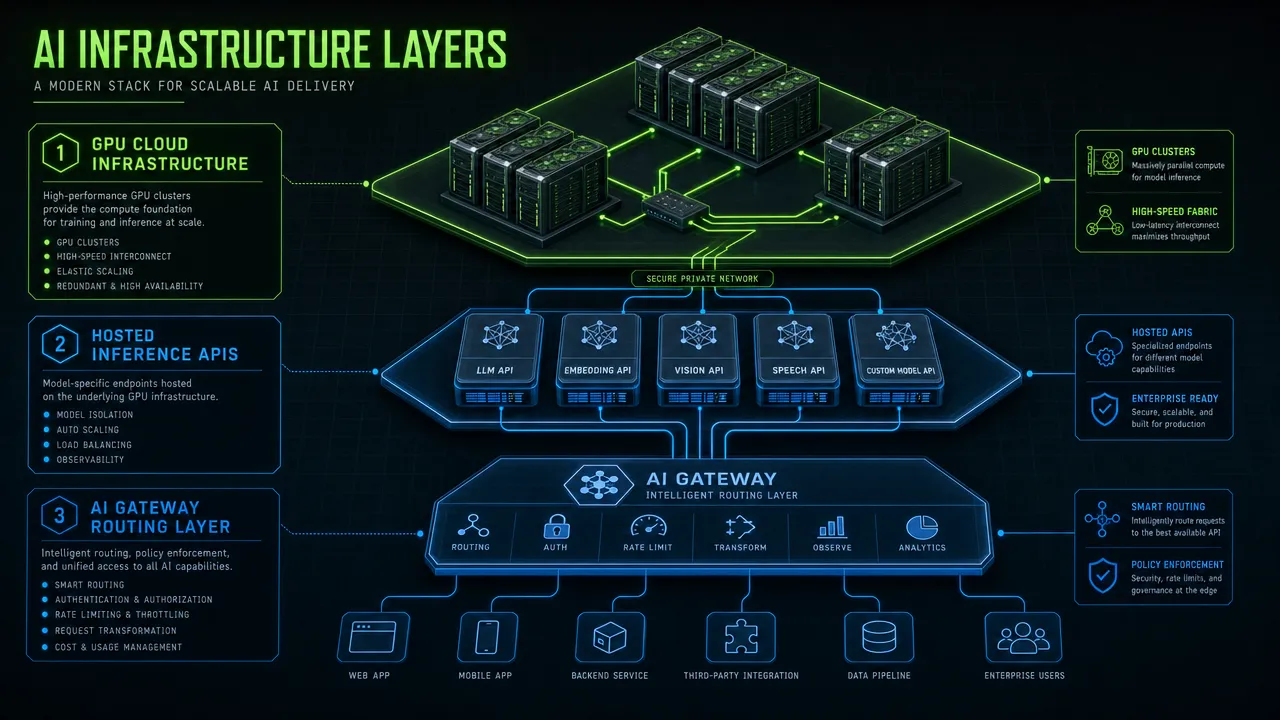
How Hyperbolic Labs fits GPU cloud and inference requirements
Hyperbolic Labs positions itself as an AI cloud provider with on-demand GPUs, reserved capacity, private GPU infrastructure, and inference-related services. That makes it relevant when a team needs compute capacity for training, fine-tuning, deployment, or hosted inference.
Its historical documentation has used the hyperbolic.xyz domain, while more recent company materials point to hyperbolic.ai. Treat these as related company web properties, but verify the current canonical documentation and account flow before committing a production workload.
A GPU cloud and an AI model router solve separate layers of the stack:
Product layer | Primary job | Typical buyer question |
|---|---|---|
GPU cloud | Provides compute capacity and deployment options | Do we need GPUs, reserved capacity, or private infrastructure? |
Hosted inference | Runs models behind an API | Can we call a model without operating serving infrastructure? |
AI Gateway or AI Model Router | Centralizes application access to selected models | Can we reduce API and integration sprawl? |
Consumer AI tool | Provides a ready-to-use interface | Do users need a chat or content workspace? |
Hyperbolic is best evaluated as a GPU cloud and AI infrastructure option. It should not be treated as a pure model router, and a model router should not be described as a replacement for GPU infrastructure.
Hyperbolic infrastructure versus a focused AI Gateway
A Hyperbolic-style infrastructure evaluation starts with capacity and operational requirements. Teams may need to assess GPU types, availability, provisioning, regions, data handling, service terms, deployment controls, and current inference API behavior. Those details can change, so live documentation should be the source of truth.
An AI Gateway evaluation starts from the application layer. The goal is usually to avoid maintaining multiple endpoint patterns, credentials, SDKs, and model-specific integration paths.
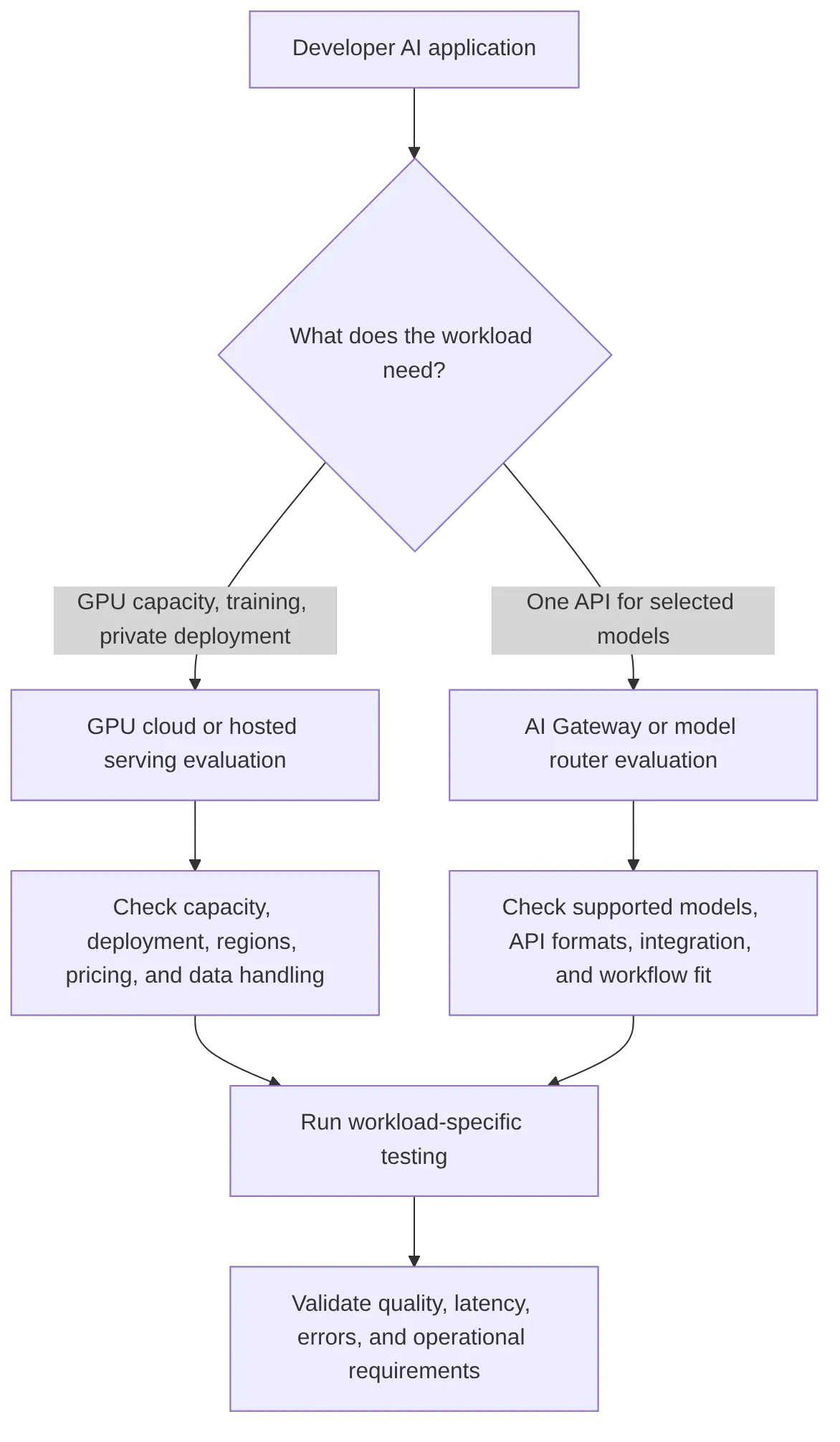
GonkaRouter fits the second path. It is an OpenAI-compatible and Anthropic-compatible AI Gateway and AI Model Router. These compatibility statements describe API formats only. They do not mean access to official OpenAI or Anthropic models.
GonkaRouter currently supports only:
MiniMax-M2.7
Kimi-K2.6
GLM-5.2
Developers can use one API for these supported models, keep a cleaner application boundary, and test model fit without building separate integrations for each workflow. For a deeper category explanation, see this guide to an AI model router API.
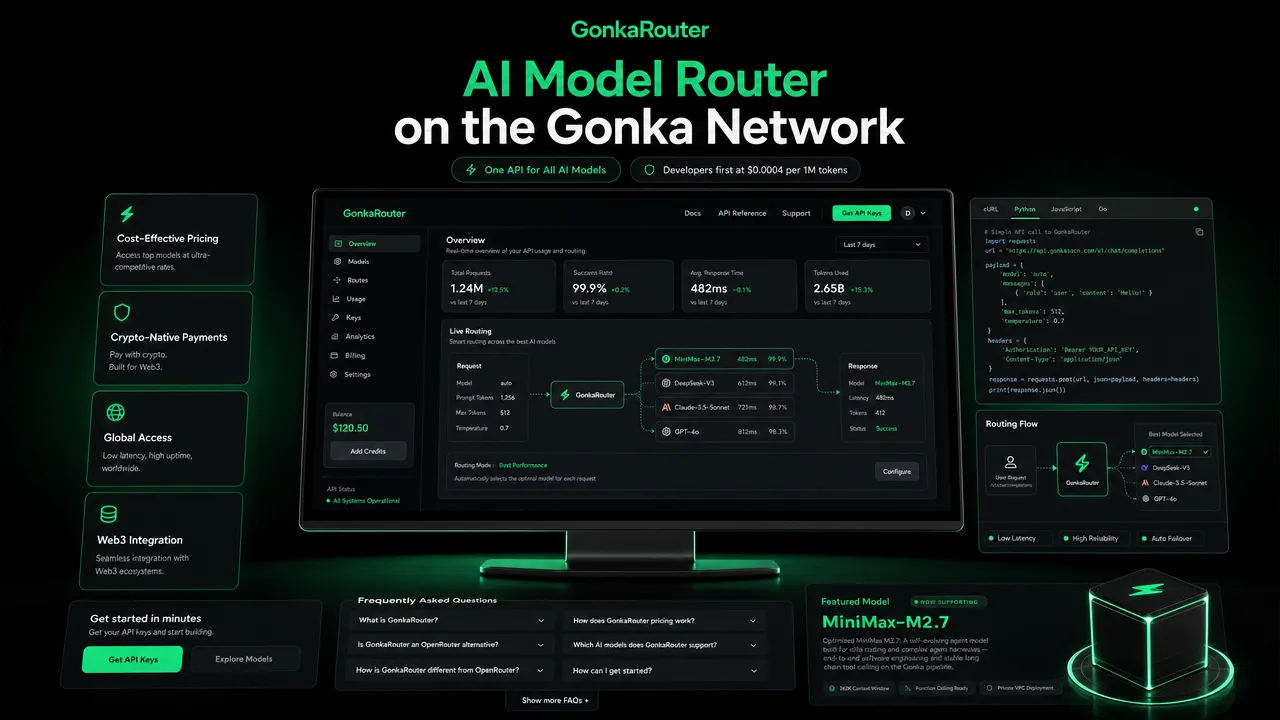
Hyperbolic evaluation criteria for developers and AI teams
Hyperbolic may be relevant when a team needs more than a text-model API. Before choosing any AI cloud, hosted inference platform, or routing layer, validate the requirements that affect real production work.
Evaluation area | Why it matters | Practical question |
|---|---|---|
Exact model availability | Product catalogs change frequently | Is the required current model ID available for the intended workload? |
API compatibility | Compatibility can be partial | Which endpoints, streaming behaviors, and request fields are supported? |
Capacity model | On-demand and reserved capacity solve different needs | Does the workload need burst capacity, steady throughput, or dedicated infrastructure? |
Cost per successful task | Token or hourly pricing alone is incomplete | What do retries, long outputs, concurrency, and overhead add to total cost? |
Reliability design | Production applications need failure handling | What are the rate limits, timeout behavior, retry guidance, and incident processes? |
Data handling | Prompts may contain confidential information | Where is data processed, retained, and governed? |
Portability | Model requirements change | Can the application move models or providers without a full rewrite? |
For an AI Agent, chatbot, code workflow, or automated process, benchmark using real prompts rather than general claims. Measure output quality, formatting accuracy, latency, error behavior, and cost for completed tasks.
GonkaRouter is useful when the workload only requires its supported model set and a simpler integration path. Developers can log in with email, get an API key, change the API endpoint, and test MiniMax-M2.7, Kimi-K2.6, and GLM-5.2 through compatible API formats.
The service lists token pricing as low as $0.0004 per 1M tokens. New users receive a one-time 20 USDT trial credit after email login for product usage and API testing. Review the OpenAI-compatible API endpoint guide before connecting a production application.
Hyperbolic and GonkaRouter serve different technical decisions
Choose a Hyperbolic-style GPU cloud evaluation when your team needs GPU procurement options, capacity reservations, private infrastructure, training, fine-tuning, or deployment control. Those needs extend beyond a standard application API integration.
Choose GonkaRouter when your team wants a focused Multi Model API for MiniMax-M2.7, Kimi-K2.6, and GLM-5.2. It is designed for developers building AI Agents, chatbots, content systems, code generation workflows, intelligent Q&A, data analysis tools, and automated workflows.
Situation | Better starting point |
|---|---|
Need GPUs or private compute infrastructure | GPU cloud or hosted serving provider |
Need training or fine-tuning infrastructure | GPU cloud or model deployment platform |
Need one application-facing API for three supported models | GonkaRouter |
Need OpenAI-compatible or Anthropic-compatible request formats for supported workflows | GonkaRouter |
Need a broader model catalog than the three supported models | Evaluate a provider whose live catalog matches the requirement |
Need to compare model behavior before product integration | GonkaRouter benchmark workflow for its supported models |
GonkaRouter does not claim to be a universal model marketplace or a replacement for every AI infrastructure provider. Its value is narrower: one API, a focused supported-model list, endpoint-first integration, and a developer-oriented gateway layer.
For practical evaluation guidance, review how to choose AI models for faster work, then test the models against your own prompt set and success criteria.
Hyperbolic search terms, model terms, and common misspellings
Several queries associated with hyperbolic have unrelated intent. Terms such as power point creator, write humanizer, phot generator, people height, humanize rewriter, ai picture math, ai power point, essay wirter, powerpoint generation, recreate photo, humanizer', font letter, squarespacer, google fontys, tempate, ioonos, iononos, proplexity, and алибаба do not describe Hyperbolic Labs or GonkaRouter's focused API offering.
Other searches may represent brand navigation, model research, or typing variations:
Common Hyperbolic Labs variations include hypebolic, hyper bolic, hyperbolix, hyperbloic, hyperbic, hyberbolic, hyperbolistic, hyperbolic., huperbolic, hypervolic, hyperbollic, hyperbolies, hyperpolic, and hypoerbolic.
Model and ecosystem searches include flux-1, models a, flux 1, flux. 1, hugging face company, kimi moonshot, mistral.ia, claude 3.7 model, glm 4.5, gemini model list, claude 3.7 sonnet and claude code anthropic, glm 4.5 model, gemini 3 image, gemini thinking, claudwe, anthropic claude code docs, and anthropic claude model.
GonkaRouter's current model scope remains MiniMax-M2.7, Kimi-K2.6, and GLM-5.2 only. Searches for GLM 4.5, Claude, Gemini, Flux, or other models should not be interpreted as GonkaRouter availability.
Is "Hypebolic" the same as Hyperbolic Labs?
Hypebolic, hyperbloic, hyberbolic, huperbolic, hyperbollic, and hypoerbolic are likely misspellings of Hyperbolic Labs. Hyperbolic Labs is an AI cloud and inference infrastructure provider, not a mathematics guide.
Does OpenAI-compatible mean official OpenAI model access?
No. OpenAI-compatible describes an API format and integration convention. It does not establish access to official OpenAI models. The same principle applies to Anthropic-compatible API formats and official Anthropic models.
Which models does GonkaRouter support?
GonkaRouter currently supports MiniMax-M2.7, Kimi-K2.6, and GLM-5.2 only. Developers can access these supported models through one API and evaluate them for real application workflows.
What is the fastest way to try GonkaRouter?
Log in with email, receive the one-time 20 USDT trial credit for API testing, get an API key, and change your application endpoint. Start with a small benchmark across the three supported models, then integrate the best fit into your Agent or product workflow.