Local agents do not make multi-model APIs obsolete; they make the inference boundary more important. The strongest agentic AI infrastructure separates workloads that must remain local or private from workloads that benefit from elastic, API-accessed inference.
A local setup can keep selected prompts, retrieval steps, and model execution inside a controlled environment. That is valuable for offline operation, data-boundary requirements, and predictable workloads. But local inference also transfers responsibility for GPU capacity, serving runtimes, upgrades, monitoring, security, and incident response to the development team.
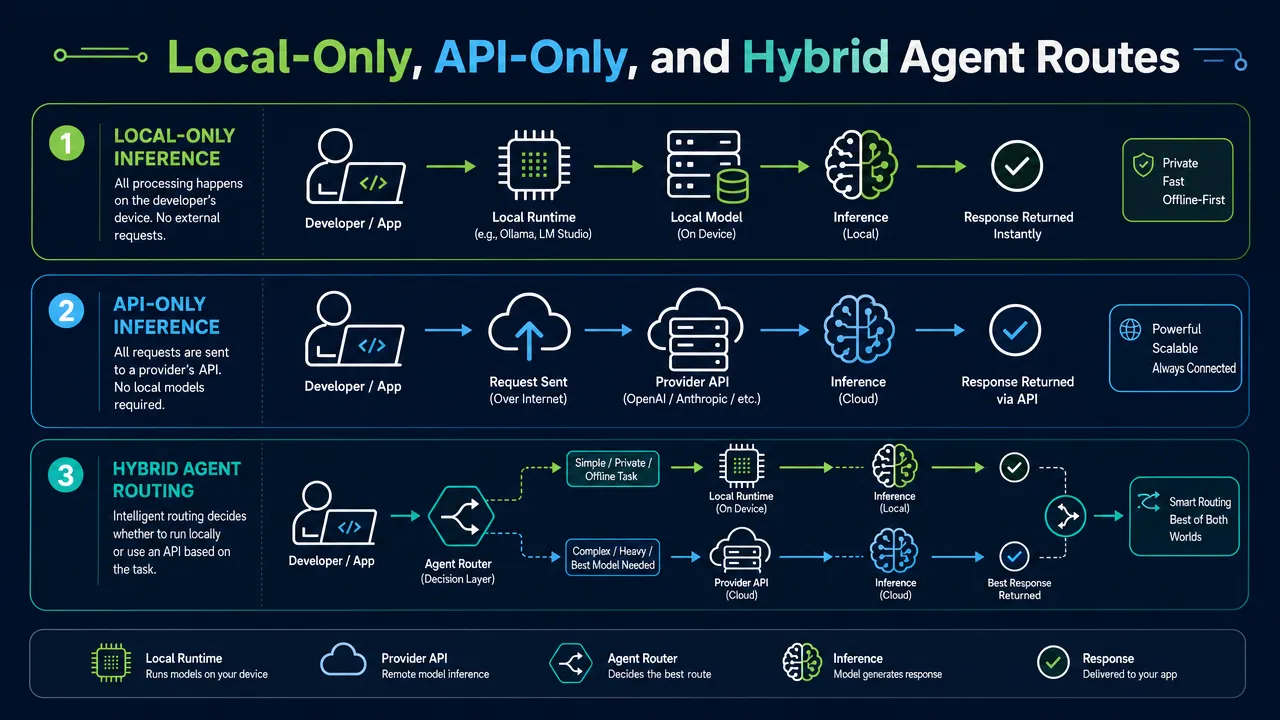
The practical answer is usually not local-only or API-only. It is deliberate hybridization: keep controlled workloads on the route that meets their data and locality requirements, and use an external inference layer where model evaluation, fast integration, or variable demand matter more.
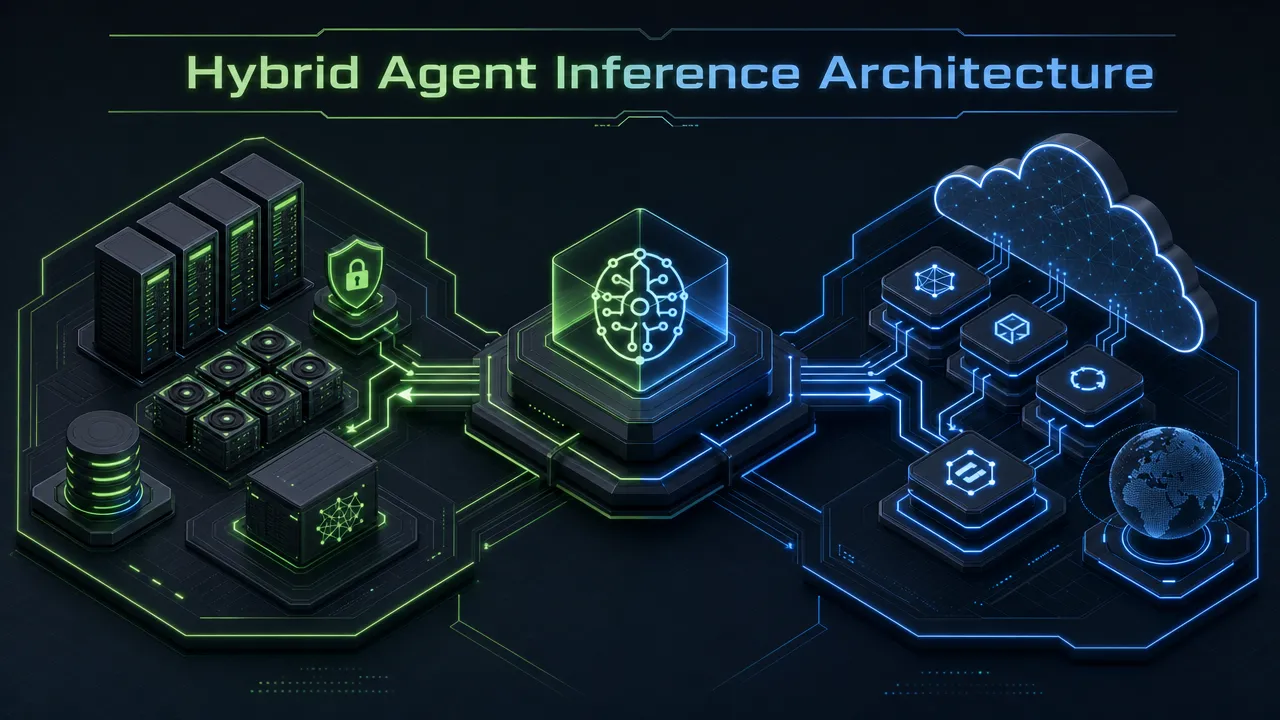
Why agentic AI infrastructure still needs an inference boundary for local agents
Local agents are growing for sound engineering reasons. Organizations may need more control over prompt handling, output handling, model deployment, network access, and physical infrastructure. Edge and offline use cases can also require inference that does not depend on a continuous external connection.
However, local inference is not simply a model downloaded onto a machine. Production serving involves capacity planning, accelerator availability, model versioning, runtime configuration, patching, request queues, observability, and recovery procedures. Google Cloud's comparison of self-hosted and managed AI application development makes the core trade-off clear: more deployment control comes with more operational ownership.
That is why an AI inference layer for agents remains useful even when some inference runs locally. It gives the application a defined place to make workload decisions, record model calls, validate outputs, and apply retries without scattering provider-specific logic across every agent step.
A disciplined route policy may look like this:
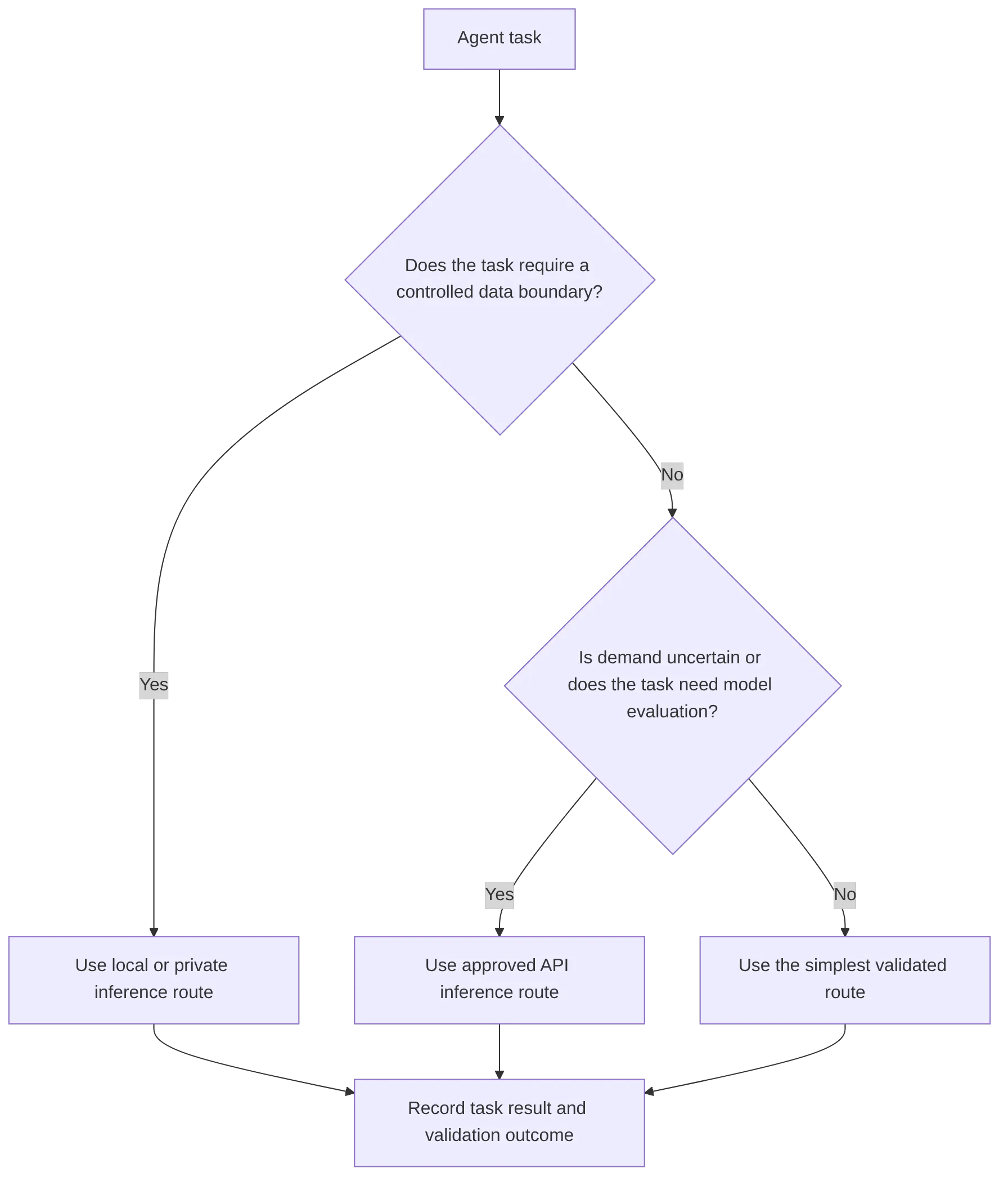
The goal is not to force every task through multiple routes. It is to make route eligibility explicit. A private retrieval step, for example, may stay local, while a non-sensitive content transformation or evaluation task may use an approved external route.
How agentic AI infrastructure changes the local-only versus hybrid decision
The right architecture depends on the workload rather than an abstract preference for local or hosted inference. Agent systems create more operational pressure because one user request can trigger planning, retrieval, tool selection, validation, memory compression, and a final response.
Decision factor | Local-only inference | API-only inference | Hybrid inference |
|---|---|---|---|
Data control | Strong potential control when correctly operated | Depends on provider policies and data path | Keeps selected workloads controlled |
Variable demand | Requires capacity headroom and operations planning | Often simpler for bursts | Can combine a local baseline with approved API routes |
Time to test models | Requires deployment and serving work | Faster for supported-model testing | Supports targeted experimentation |
Reliability ownership | Team owns redundancy and recovery | Provider operates inference, but apps still need error handling | Requires tested route and failure policies |
Engineering complexity | High | Lower for inference operations | Medium to high, depending on routing rules |
A hybrid design only earns its complexity when you can classify workloads, define data policies, and observe what happens after a route decision. Without those controls, a hybrid system can create more failure modes than it solves.
This distinction matters for an AI gateway for agent workloads. A model router forwards requests to an eligible route. A broader gateway category may centralize credentials, usage records, traffic controls, governance, and observability, though actual features vary by implementation. MLflow's AI Gateway overview describes this broader operational role.
When agentic AI infrastructure benefits from a multi-model API for AI agents
A multi-model API for AI agents makes sense when model choice solves a real operational problem. It should not be added just because routing is fashionable.
Use a unified interface when your team needs to:
Evaluate eligible models against real agent tasks. Measure task completion, output validity, latency, retries, and cost per successful task. A leaderboard ranking alone cannot show whether a model works for your tools, schemas, or prompts.
Separate agent logic from model integration. A single integration boundary can reduce duplicated authentication, endpoint, SDK, and response-handling work.
Assign models to distinct task types. Classification, summarization, planning, tool-call validation, and customer-facing generation can have different requirements. Route only after those differences are tested.
Plan tested fallbacks. A secondary route can help when the primary route times out or returns an error, but only when output formats, context needs, and safety behavior have been validated. Cloudflare's dynamic routing documentation illustrates why routing policies need explicit configuration rather than assumptions.
Handle uncertain or bursty demand. Hosted access can avoid early overcommitment to controlled capacity. This is not proof that API access is always less expensive; total cost includes idle capacity, operations time, retries, and failed tasks.
A model-as-a-service for agents approach is therefore a selective operating model, not a replacement for local inference. The agent application should decide which data and tasks are eligible for an external route before the request leaves its controlled boundary.
For teams building routing logic, how to route requests between LLMs smoothly and this semantic routing and model fallback guide offer useful next steps for thinking about explicit route policies.
What agentic AI infrastructure may look like in the agentic cloud 2026
"Agentic cloud 2026" is a useful planning phrase, not a technical standard. The evidence-supported direction is toward more managed inference operations: explicit routing rules, policy controls, evaluation, tracing, and fallback metadata.
The likely shift is from asking, "Which model should we use?" to asking, "Which approved model route should handle this specific agent step under this data, latency, and quality policy?"
An agent operations platform can help teams understand that decision at the workflow level. The important records are not just token counts. Teams should capture:
Agent-step identity and task class.
Selected model route and reason for selection.
Latency, error type, and retry count.
Structured-output validation result.
Tool-call success or failure.
Cost per successful task, not just cost per request.
Dynamic routing should come later, not first. Start with static rules and a small evaluation suite. Add complexity only after you have safe fallback candidates, clear quality thresholds, and route-level logs. Vercel's routing rules documentation reinforces the value of explicit, configurable rules over opaque automation.
Where agentic AI infrastructure and GonkaRouter for AI agents meet
GonkaRouter fits teams that want one API for a narrow, explicit set of supported models rather than separate integrations for each route. It is an AI Model Router and AI Gateway built for unified inference access through OpenAI-compatible and Anthropic-compatible API formats.
Those compatibility labels refer to request and response formats only. They do not mean access to official OpenAI or Anthropic models.
GonkaRouter currently supports:
MiniMax-M2.7
Kimi-K2.6
GLM-5.2
For teams evaluating GonkaRouter for AI agents, the benefit is straightforward: use one API interface to test and integrate those supported models while keeping model-specific decisions in the agent's own routing policy. Developers can integrate by changing the API endpoint, then validate behavior with production-like prompts, schemas, tools, and error cases.
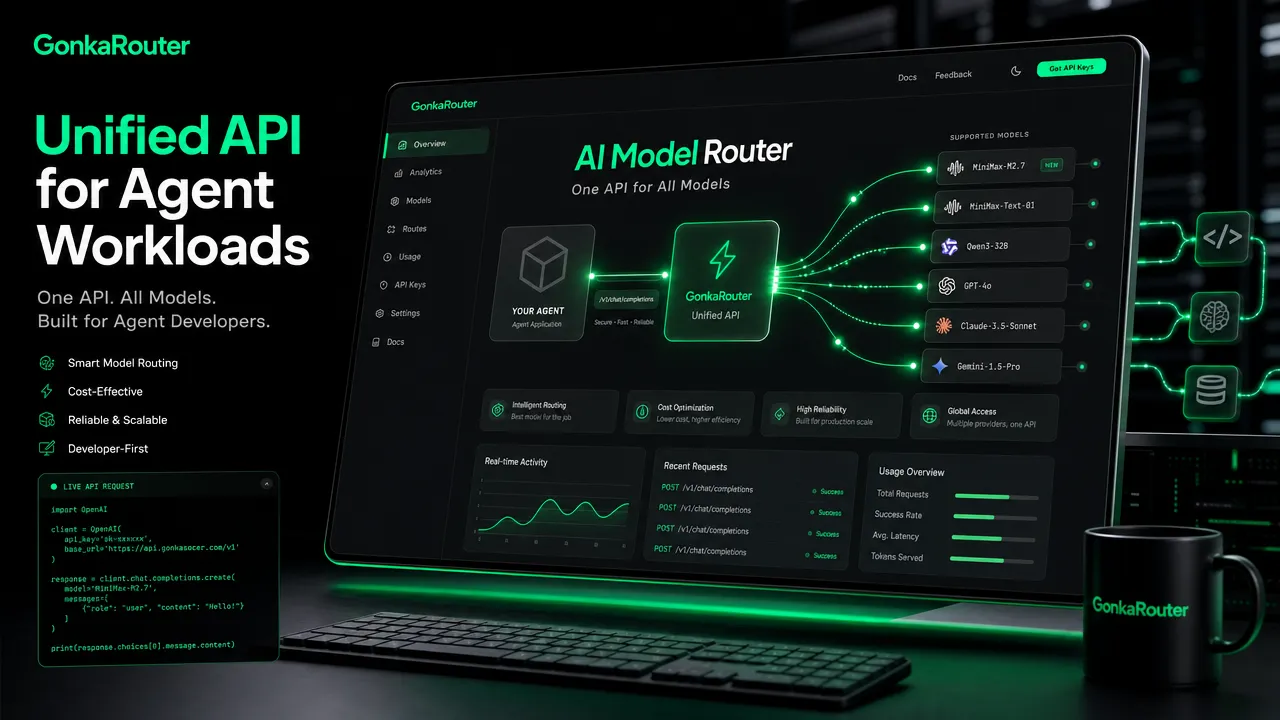
GonkaRouter states token pricing as low as $0.0004 per 1M tokens. New users can log in with email and receive a one-time 20 USDT trial credit for product testing. Before sending sensitive information, review the current Privacy Policy, including its information on API request processing, limited retention, and third-party processing.
A practical evaluation path is:
Log in with email.
Get an API key.
Run the same agent-task test set against MiniMax-M2.7, Kimi-K2.6, and GLM-5.2.
Compare valid outputs, tool behavior, latency, retries, and cost per successful task.
Review the GonkaRouter developer documentation before production integration.
For further context on the product category, read what an AI model router API is and how it works.
Agentic AI infrastructure FAQ for local and API-based agents
Is local inference always better for agentic AI infrastructure?
No. Local inference can improve control, offline capability, and deployment flexibility, but it also requires the team to run serving infrastructure and manage capacity, upgrades, monitoring, and recovery.
Does a multi-model API replace local inference?
No. A multi-model API can complement local inference in a hybrid design. Keep controlled or sensitive workloads on an approved local or private route, and use API-accessed inference for eligible workloads that need model evaluation or elastic capacity.
When should an agent use multiple models?
Use multiple models only when agent steps have validated differences in quality, output format, availability, latency, or cost requirements. Every additional route should have a documented purpose and a tested fallback plan.
Which models does GonkaRouter support?
GonkaRouter currently supports MiniMax-M2.7, Kimi-K2.6, and GLM-5.2 only.
What should teams validate before production?
Validate task success, structured-output behavior, tool-call fit, latency under expected load, error handling, retry limits, privacy requirements, and total cost per successful task. Use the one-time 20 USDT trial credit to test supported models against real agent workflows before scaling.