NVIDIA's NeMo Switchyard announcement makes a distinct routing layer more relevant for agent systems whose individual steps have different capability, latency, cost, and tool-use requirements.
Published on August 11, 2026, NVIDIA's technical blog describes NeMo Switchyard as an open-source library for routing AI-agent workloads across model pools. According to NVIDIA's announcement, the system uses signals, decision policies, execution paths, and feedback to select routes for individual agent steps rather than treating every request as a fit for one default model.
That framing matters because an agent is not simply a chat interface with a longer prompt. It may plan work, retrieve information, call tools, repair structured output, summarize results, and decide whether to continue. Each step can carry a different operational requirement.
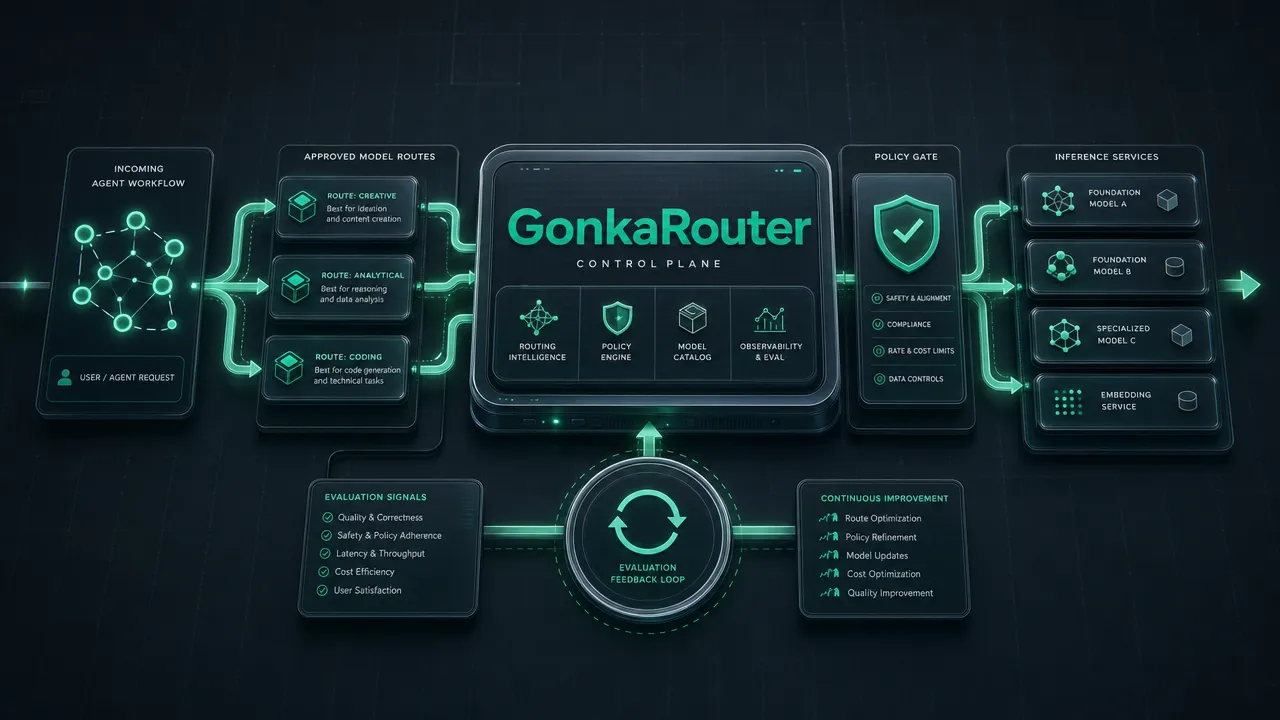
Why NVIDIA NeMo Switchyard makes routing a separate infrastructure decision
NVIDIA describes several policy families for Switchyard, including classifier-based routing, cascade or escalation routing, and trainable prefill routing. Its related technical explainer describes signals that can include request characteristics, agent state, tool results, progress, and model-related information.
The important takeaway is not that every application should adopt learned routing. It is that model selection becomes a system decision once workloads are varied enough to justify it.
A fixed model remains a sensible choice when an application has a narrow task, low volume, stable traffic, and a single model that meets its requirements. Routing becomes more compelling when teams have an approved pool of alternatives and can show meaningful differences across real workloads.
For example, a single agent request might include:
A low-risk classification or extraction step.
A function-calling step that needs valid arguments and schema adherence.
A long-context synthesis task.
A higher-risk reasoning or code-review task.
A user-facing response where time to first token matters.
Those jobs should not automatically share the same model, provider, deployment location, or retry policy. But they should not be routed dynamically until the team has evidence that a more complex policy improves task outcomes.
NVIDIA's announcement is a useful category signal because it makes the routing problem explicit. It does not independently prove that any one policy, model pool, or routing method will improve every deployment.
Why multi-model AI agent routing changes infrastructure decisions
Multi-model AI agent routing is best understood as an optimization process operating inside hard eligibility rules. Before a system considers cost, latency, or general model reputation, it must remove routes that do not meet data, deployment, tool, context, or contractual requirements.
That order matters. A lower-cost route is not an acceptable route if it cannot handle the required tool schema, support the needed context length, or satisfy the application's data-handling policy.
Agent workload condition | Questions for the routing policy | Evidence to collect |
|---|---|---|
Structured extraction | Does the model consistently return valid fields and types? | Field-level accuracy and JSON parse rate |
Function-calling step | Are tool names and arguments valid for real tools? | Tool-call success rate and argument validation |
Long-context synthesis | Does performance remain useful at production prompt lengths? | Long-document test set and truncation checks |
Interactive workflow | Is first-token responsiveness acceptable? | TTFT, P95 latency, and end-to-end latency |
Complex task | Does the task justify escalation to a more capable route? | Expert review and critical-error rate |
Sensitive workload | Which routes are approved before optimization begins? | Data-flow review and policy tests |
The metrics should also reflect the entire workflow. Token price alone can hide expensive failures. A less expensive call that triggers retries, invalid tool parameters, or human repair can cost more than a higher-priced call that completes the task correctly.
A better operational measure is cost per successful agent task. Pair it with quality, reliability, and latency metrics:
Task success and critical-error rates.
Function-calling and structured-output validity.
Time to first token, time per output token, and total completion time.
Timeout, retry, and throttling rates.
Route distribution and escalation frequency.
Policy compliance and eligibility rejections.
NVIDIA and other infrastructure sources distinguish time to first token from output generation speed. NVIDIA's benchmarking guide is a useful reminder that a model can begin responding quickly while still taking too long to finish a tool-heavy or long-form task.
Keep routing, orchestration, and gateways separate
An agent orchestrator decides what work happens next. A routing layer chooses an eligible destination for a particular inference call. A gateway provides an application-facing interface that can mediate access to model endpoints. These functions can live in one platform, but they should remain separate in architecture and accountability.
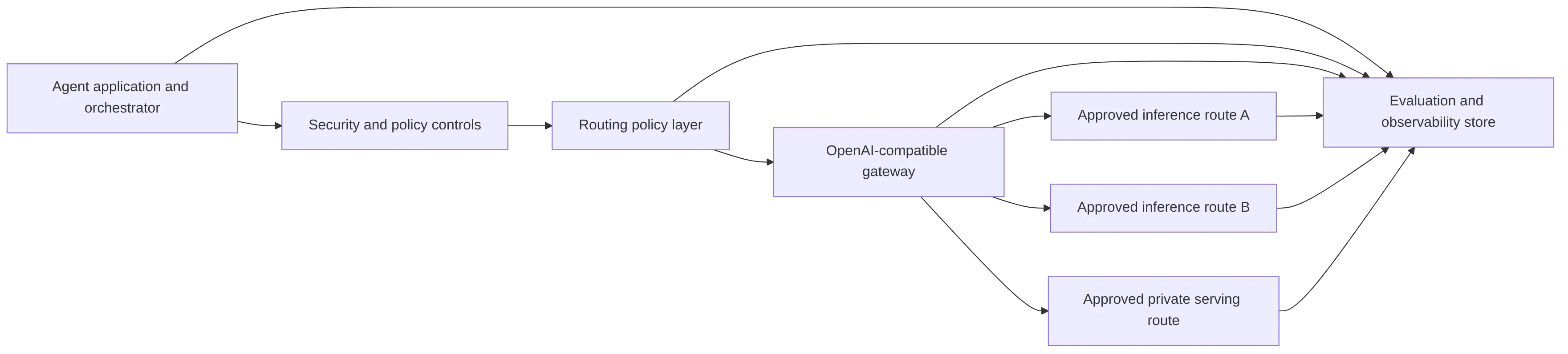
Layer | Primary responsibility | Do not assume it provides |
|---|---|---|
Agent orchestrator | State, plans, tools, approvals, retries, and stopping conditions | Model selection based on quality or cost |
Policy controls | Tenant restrictions, route allowlists, data classification, and egress rules | Semantic task scoring |
Routing layer | Selection among eligible routes under a defined policy | Business authorization for tool actions |
AI gateway | API mediation, request normalization, and centralized model access | Automatic task-aware routing or failover |
Inference service | Model execution, capacity, and output streaming | Agent planning and policy governance |
Evaluation and telemetry | Measurement of decisions, latency, errors, and outcomes | A replacement for deployment controls |
This distinction prevents a common architecture error: treating an OpenAI-compatible gateway as proof of semantic routing. Compatibility can lower integration friction by letting an application use familiar request patterns. It does not establish identical behavior across models or providers.
Teams still need to validate streaming, tool semantics, structured-output behavior, model-specific controls, context limits, error formats, token accounting, and response handling. Together AI's OpenAI compatibility documentation illustrates the category boundary: API compatibility is a useful interface property, not a universal portability guarantee.
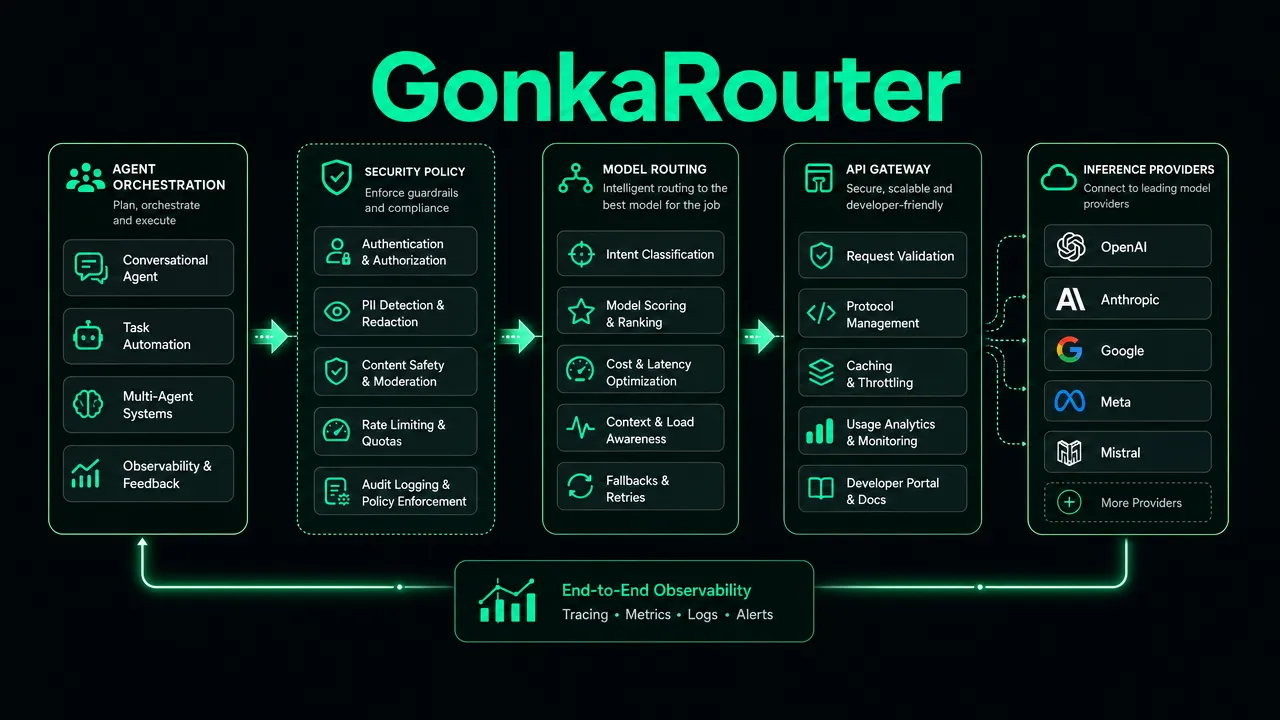
Build a routing policy from evidence before adding intelligence
The safest first routing policy is usually deterministic. Start with rules that engineers can explain, test, and roll back.
A simple initial policy might restrict routes by data class and tool support, use a designated default for a task type, and escalate only after a clearly defined failure signal. This produces a known baseline before teams introduce classifiers, adaptive thresholds, or learned policies.
A practical routing checklist
Step | What teams should decide | Useful output |
|---|---|---|
Define workload slices | Which agent steps differ in risk, volume, context, and tool use? | Versioned task taxonomy |
Apply hard constraints | Which models, providers, and deployment paths are eligible? | Approved candidate pool |
Establish baseline policy | What fixed rules govern initial model selection? | Versioned deterministic policy |
Build evaluation cases | Which normal, edge, and failure cases represent production? | Test dataset and tool fixtures |
Measure outcomes | Which route succeeds at acceptable quality, cost, and latency? | Per-route scorecard |
Add decision telemetry | Can teams reconstruct why a route was chosen? | Route-decision records |
Roll out gradually | What traffic cohort, rollback trigger, and review cadence apply? | Controlled release plan |
Observability should cover the route decision and the downstream result. Record the policy version, eligible candidates, chosen route, model identifier, latency, usage data, tool result, error class, and task outcome where permitted.
OpenTelemetry's GenAI semantic-convention work provides useful direction for tracing generative-AI activity. Teams should still verify convention stability and implementation support before treating any field as a long-term contract.
Dynamic routing is justified when a deterministic baseline leaves measurable value on the table. It is not justified by a vague promise of smarter model selection.
What developers should validate with an OpenAI-compatible gateway
An OpenAI-compatible gateway can reduce coupling at the application boundary. For an existing application, that may mean less provider-specific client code and a cleaner way to test supported models. But the gateway should sit beneath application-owned orchestration, authorization, evaluation, and output validation.
This is the practical implication for developers: keep model access flexible, but keep decision ownership explicit.
Before moving beyond a small workload, validate:
Exact supported endpoint behavior and model identifiers.
Function-calling behavior with the application's real tool set.
Structured-output and schema-validity rates.
Streaming, error, retry, and cancellation behavior.
Context limits and behavior under long inputs.
Actual token accounting and cost per successful workflow.
Data-handling, deployment, and governance requirements.
The ability to diagnose failures without exposing unnecessary prompt or tool data.
GonkaRouter provides an AI Model Router built for the Gonka Network. Its site presents an OpenAI-compatible endpoint and currently lists DeepSeek-V4-Flash-0731, Kimi-K2.6, and MiniMax-M2.7. It also displays Function Calling, Private VPC Deployment, and Web3 Ecosystem Integration.
That makes GonkaRouter relevant as a model-access boundary for teams evaluating a focused catalog through familiar request patterns. It should not be described as an integration with NVIDIA NeMo Switchyard, as using NVIDIA routing technology, or as providing automatic task-aware selection, observability, or failover. Those are separate capabilities that require explicit product verification and workload testing.
For additional context on the interface layer, read GonkaRouter's guide to an AI model router API, its perspective on choosing AI models for faster work, and its discussion of why one compatible interface is becoming common.
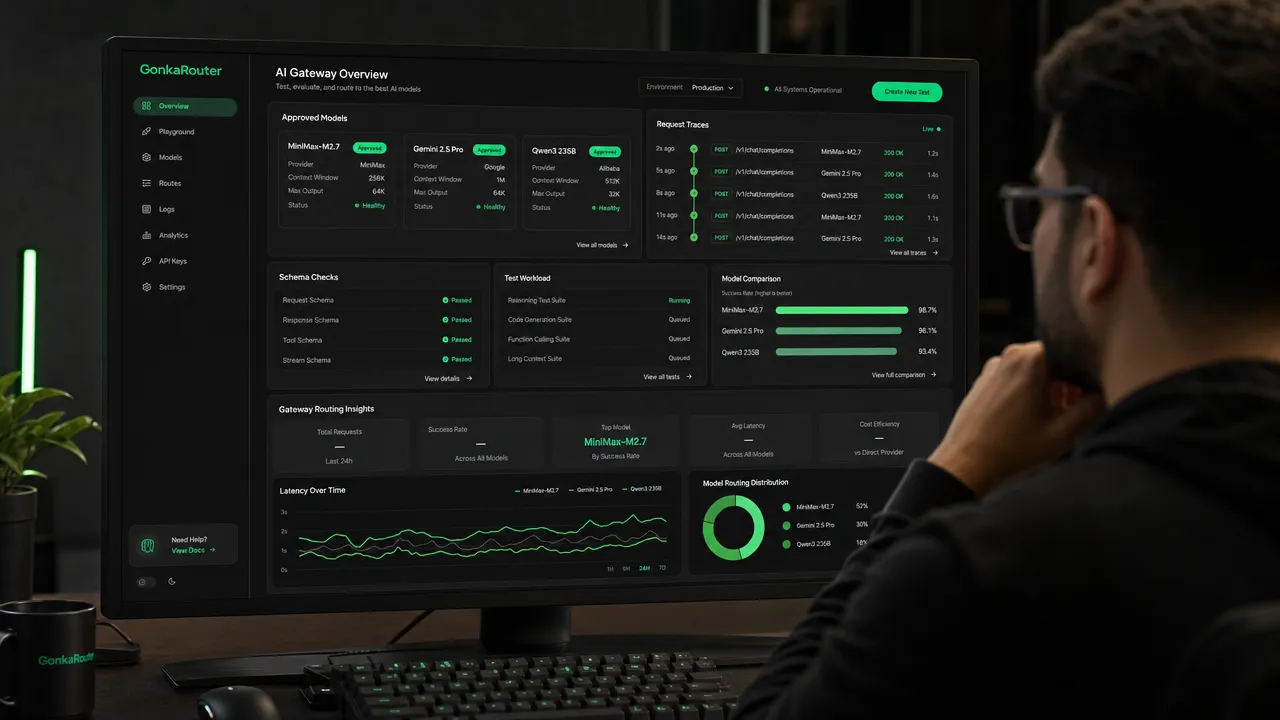
The durable lesson from NVIDIA's announcement is not that more models automatically create a better agent. It is that multi-model AI agent routing becomes valuable when teams can define eligible routes, measure outcomes, and maintain control over the policy that selects among them.
Review GonkaRouter's live model catalog and pricing, create an account if appropriate, and test a small representative workload before making broader routing or deployment decisions.
Frequently asked questions
What is multi-model AI agent routing?
Multi-model AI agent routing selects an eligible model, provider, or serving destination for a specific model invocation within an agent workflow. The selection may be fixed, rule-based, dynamic, or learned.
Why might an AI agent need more than one model?
An agent does not always need more than one model. Multiple candidates become worth evaluating when its steps differ substantially in complexity, tool use, latency sensitivity, context requirements, deployment constraints, or failure cost.
Is an AI gateway the same as an agent router?
No. A gateway mediates access to model APIs and can normalize request formats. A router chooses a route from an eligible pool under a policy. Agent orchestration separately controls workflow state, tools, approvals, and retries.
What should teams measure before changing a routing policy?
Measure task success, critical errors, tool-call success, structured-output validity, cost per successful task, time to first token, total latency, retries, timeouts, and policy-compliance outcomes.
Does OpenAI compatibility solve model portability?
No. It can reduce request-format integration work, but it does not prove parity for streaming, tools, structured outputs, context limits, errors, token accounting, or model-specific features.
When should a team keep a fixed model policy?
A fixed policy is often best when the workload is narrow, model requirements are stable, the candidate pool is small, and there is no measured evidence that dynamic selection improves outcomes enough to justify added complexity.