BadHost shows that exposed agent services can inherit serious web-layer weaknesses, even when the models and agent logic themselves are functioning as intended. The original BadHost report was published on May 27, 2026, and described CVE-2026-48710, a Starlette issue involving malformed Host headers and authorization patterns that relied on unsafe URL or path interpretation.
The key lesson for platform teams is straightforward: an AI endpoint is not merely an inference API once it can invoke tools, retrieve tenant data, hold workflow state, or access downstream services. It becomes an operational boundary that requires layered identity, authorization, networking, and recovery controls.
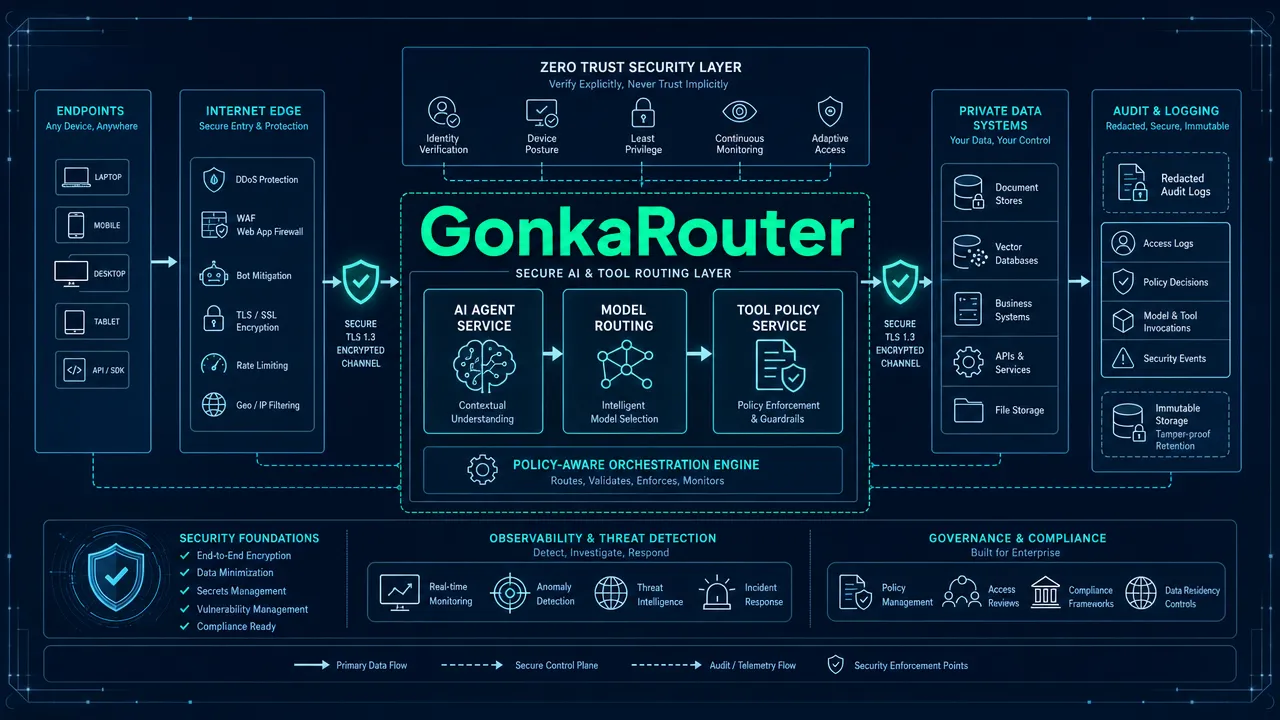
Why agentic AI infrastructure makes exposed endpoints more consequential
Agentic AI infrastructure turns a single inbound request into a potentially multi-step workflow. A request may trigger retrieval, multiple model calls, function calling, internal API access, and a final response. That sequence expands the consequences of an authentication or authorization mistake.
BadHost was not an AI model vulnerability. The corroborated issue involved Starlette and the way malformed Host input could affect URL or path interpretation in deployments using vulnerable authorization patterns. The Starlette security advisory and the Belgian Cybersecurity Centre notice identify CVE-2026-48710 and point to Starlette 1.0.1 as the corrected release.
That does not mean every FastAPI, agent server, or AI-serving stack was vulnerable. Actual exposure depended on dependency versions, middleware design, reverse-proxy behavior, endpoint reachability, and patch status. Still, the event is a useful warning: path-based authorization shortcuts are fragile when proxies, frameworks, and application code interpret requests differently.
For an AI inference layer for agents, the practical blast radius can include:
Retrieved documents and agent memory.
Tenant data passed into prompts or tool calls.
Service identities used to reach internal APIs.
Model quotas and inference budgets.
Function-calling workflows with external side effects.
Logs and traces that may contain sensitive request context.
OWASP describes related risks across broken authentication, broken object-level authorization, unrestricted resource consumption, SSRF, and unsafe API consumption in its API Security Top 10.
How agentic AI infrastructure should separate routing from authorization
A router decides which approved model route receives a request. Authorization decides whether a principal may access a tenant resource, invoke a tool, export data, or perform a privileged operation. Those are different responsibilities.
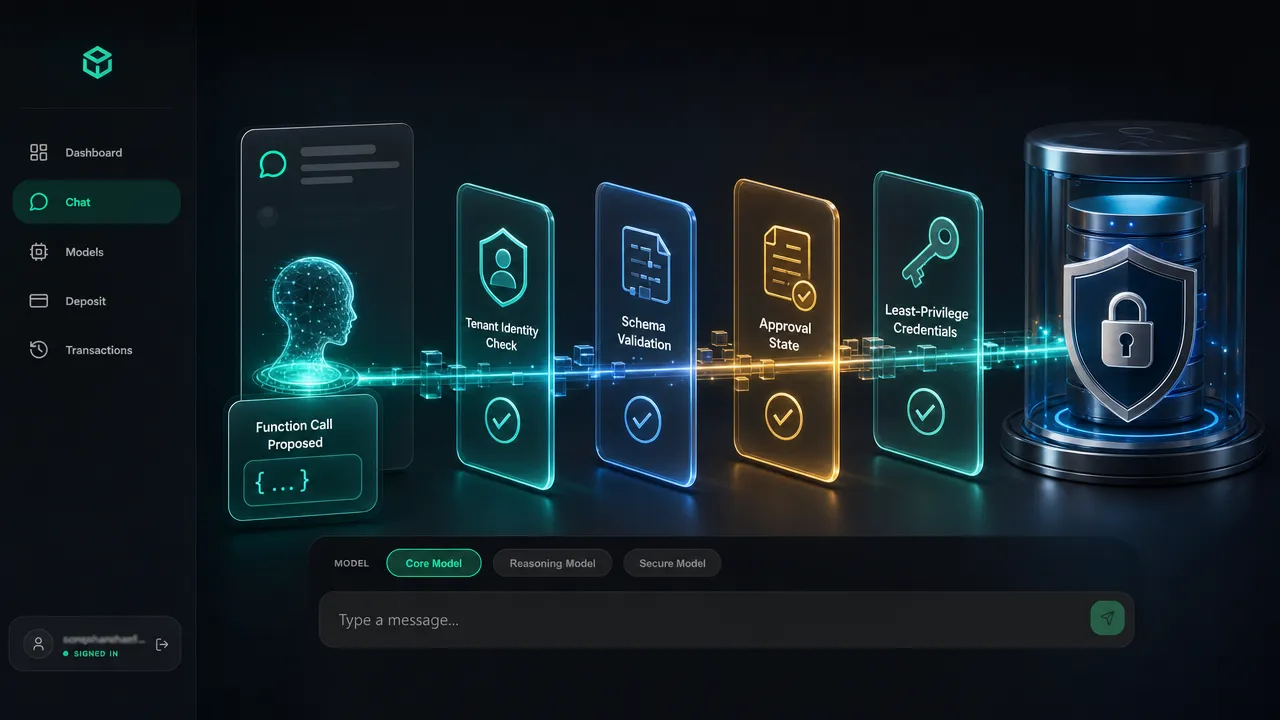
An AI gateway for agent workloads can centralize useful entry-point controls, including authentication, schema validation, rate limits, request-size limits, route allowlists, and tenant-context propagation, but a gateway decision should never be the only authorization decision in an agent workflow.
The resource-owning service must enforce its own checks. For example, a tool that retrieves account records must verify tenant and user permissions itself, even if the request arrived through an authenticated gateway.

This separation matters most for function calling. A model-generated tool call is an untrusted proposal, not permission to act. OWASP's excessive agency guidance recommends least privilege, complete mediation, narrow tool scope, and approval flows for high-impact actions.
A sound multi-model API for AI agents should therefore bind each request to explicit policy:
Policy area | Example decision |
|---|---|
Identity | Which user, workload, or service initiated the request? |
Tenant | Which tenant owns the data, budget, and tool scope? |
Model route | Which model identifiers are approved for this workload? |
Tools | Which functions can this agent propose or invoke? |
Data access | Which records, indexes, or object IDs are permitted? |
Limits | What are the token, cost, retry, time, and concurrency limits? |
Approval | Which actions require user or operator confirmation? |
The agentic AI infrastructure checklist after BadHost
The highest-priority work is reducing reachable attack surface and removing weak authorization assumptions. Patch management is necessary, but it is not enough.
Priority | Control | Practical evidence |
|---|---|---|
Critical | Patch vulnerable framework dependencies and rebuild deployment artifacts | SBOM and runtime image digest show approved dependency versions |
Critical | Inventory all public and private endpoints | DNS, load balancer, gateway, certificate, and route inventories reconcile |
Critical | Remove unnecessary public access to tool, admin, and internal agent endpoints | Network policies and external testing show only intended edge routes are public |
Critical | Validate hostnames at the edge and reject unexpected | Negative tests cover invalid hosts and proxy-to-app path mismatches |
Critical | Use short-lived workload identity instead of broad static credentials | Expired, wrong-audience, and cross-environment tokens fail safely |
Critical | Enforce object, function, and tenant authorization downstream | Tenant A cannot access Tenant B data, tools, traces, or caches |
Critical | Treat function-call arguments as hostile input | Unapproved tools, resource IDs, URLs, and arguments are rejected |
High | Deny outbound network access by default | Agent workloads cannot reach cloud metadata or unapproved private IP ranges |
High | Apply request, token, retry, and tool-call budgets | Controlled limits activate before resource or cost exhaustion |
High | Redact sensitive fields from logs and traces | Authorization headers, keys, and sensitive tool results do not appear in samples |
Ongoing | Test prompt injection, SSRF, cross-tenant access, and tool abuse | Release gates include adversarial and negative test cases |
Ongoing | Maintain revocation and incident playbooks | Teams can disable credentials, routes, or tools without improvisation |
Host validation deserves special attention because BadHost involved request interpretation at the framework boundary. Teams should keep an explicit hostname allowlist, normalize proxy behavior, retire stale routes, and avoid making security decisions from ambiguous request-path representations.
Prompt injection is a second control plane concern. Retrieved web pages, documents, support tickets, and user-provided files can contain instructions intended to influence model behavior. The correct response is not to trust the model to detect every attack. It is to ensure that untrusted content cannot grant access, alter permissions, or bypass server-side validation. OWASP's prompt injection guidance is useful for structuring these tests.
What agentic cloud 2026 changes for routing and operations
The agentic cloud 2026 conversation is moving beyond simple provider selection. Teams increasingly need a controlled execution path that accounts for routing, tool permissions, data boundaries, observability, and failure handling.
A model router can simplify the connection between an application and approved inference paths. An agent operations platform addresses a broader question: what happened across the full workflow, including retries, model calls, tool decisions, policy denials, and outcomes.
Neither layer eliminates the need for application-owned security controls.
Useful operational practices include:
Bind a signed tenant and workload context to every request.
Allow only approved model routes for each workload.
Store long-lived provider credentials outside prompts, browser code, and agent memory.
Mint short-lived, scoped credentials for individual tool actions.
Limit outbound destinations to approved providers and services.
Record redacted, correlated audit events across gateway, agent, model, and tool layers.
Add kill switches for sensitive tools and high-risk routes.
Test fallback behavior so retries do not silently bypass policy or budget limits.
Teams planning model-as-a-service for agents should also test the operational differences between routes. OpenAI-compatible request syntax may ease integration, but compatibility does not prove identical authorization, retention, logging, network, or tool behavior.
For routing design, the internal guide on semantic routing and model fallback is a useful complement to this security posture: fallback logic should be bounded, observable, and governed by the workload's policy rather than allowed to expand indefinitely.
Applying agentic AI infrastructure controls to GonkaRouter for AI agents
GonkaRouter is an AI Model Router built for the Gonka Network. Its site presents an OpenAI-compatible API endpoint, lists DeepSeek-V4-Flash, MiniMax-M2.7, and Kimi-K2.6 as featured models, and displays Function Calling, Private VPC Deployment, and Web3 Ecosystem Integration.
Those facts make GonkaRouter for AI agents relevant to teams designing a routed model-access layer. They do not change the core security responsibilities described above.
Before connecting an agent workload, teams should validate their own deployment choices:
Which endpoints are public, private, or reachable only through controlled ingress.
How API keys are stored, rotated, and kept outside autonomous agent context.
Which model routes are approved for each tenant and workload.
Which function calls are allowed, denied, or sent through approval.
How private connectivity and outbound access are segmented.
What is retained in logs, traces, and workflow records.
How an affected route, credential, or tool can be disabled during an incident.
For credential design, see how AI gateways keep API keys away from autonomous agents. For architecture decisions, AI inference layer, AI gateway, or both? provides a practical framing for keeping model access separate from broader agent control logic.
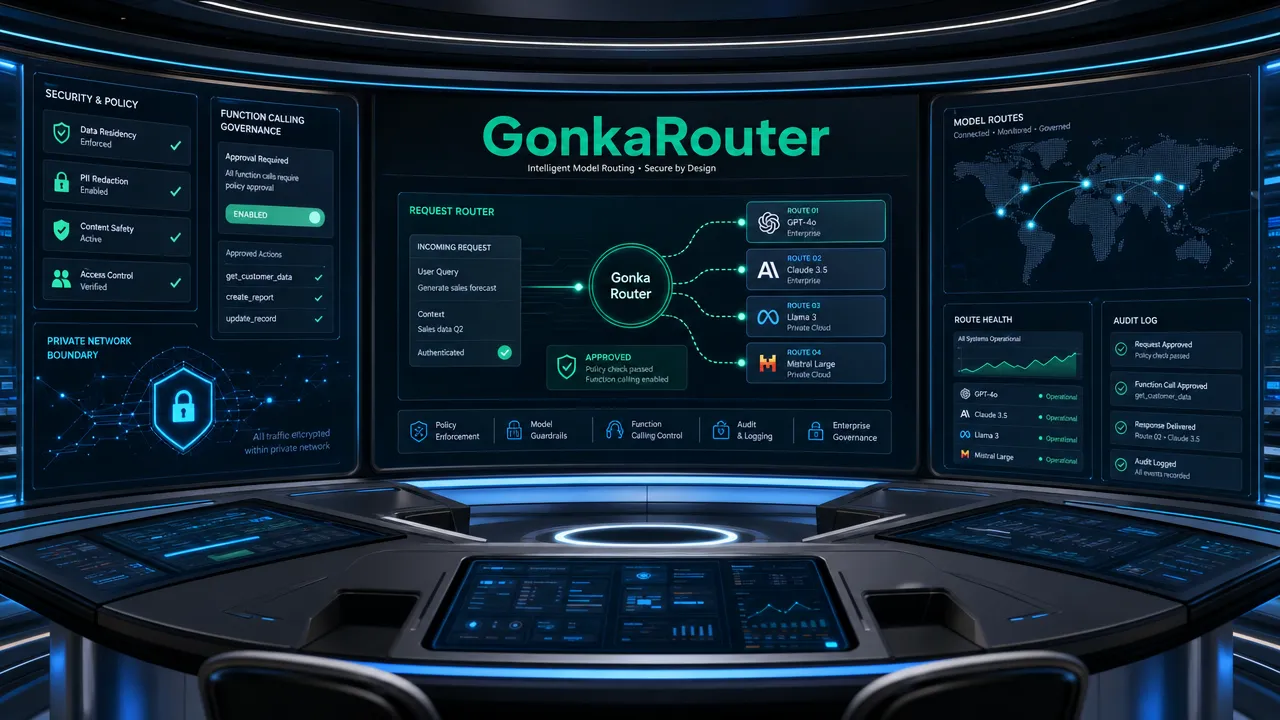
Agentic AI infrastructure requires defense in depth, not gateway trust alone
BadHost remains a useful case study because it demonstrates how a web-framework flaw can undermine assumptions around protected endpoints. The May 27, 2026 reporting should not be read as proof that every AI deployment was exposed. It should be read as a reason to verify the layers around every exposed agent service.
Secure agentic AI infrastructure combines patched dependencies, explicit host validation, private-by-default services, strong workload identity, downstream authorization, constrained tool access, egress controls, budgets, redacted auditability, and rehearsed recovery.
A router or gateway can be a valuable enforcement point. It is not a substitute for the authorization and operational controls that keep agent workflows safe.