Physical AI inference needs deliberate model routing because a model response that affects a robotics workflow has to be measured, validated, recoverable, and kept outside deterministic control and safety authority.
TechCrunch reported that Hugging Face unveiled Microduck, a duck-like open-source robot listed at $399. Pollen Robotics describes Microduck as a 25 cm open-source biped available for pre-order, and says its SDK, simulation environment, and full reinforcement-learning stack are available on GitHub. Those facts matter less as a novelty-product story than as a visible example of a software-to-robotics transition: accessible hardware now arrives with an iteration loop around simulation, reinforcement learning, and developer tooling.
That transition raises the bar for infrastructure. A model that summarizes a simulation run or drafts a test case may be useful. A model output that travels closer to a robot's decision path introduces different concerns: tail latency, jitter, network loss, malformed structured output, data provenance, budget overruns, and escalation paths.
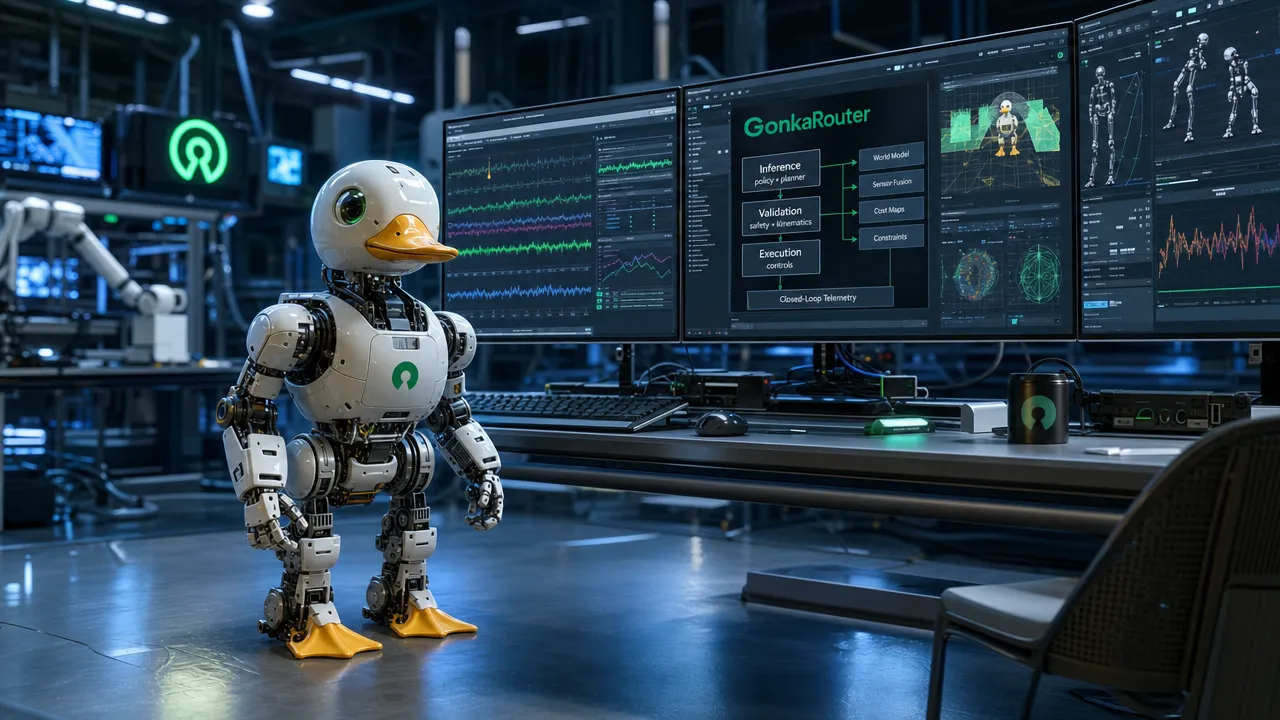
Why Microduck makes physical AI inference an operational problem
Microduck makes the lifecycle visible. The project is framed around more than a robot body: Pollen says developers can work with an SDK, simulation, and a full RL training stack. That creates a loop of experiments, policy revisions, simulator runs, code changes, and eventually controlled physical validation.
Simulation can make that loop faster. It cannot prove that a policy will behave safely or reliably on physical hardware. Sim-to-real work must account for differences in sensing, contact dynamics, environment conditions, and system configuration. The sim-to-real reinforcement learning survey explains why techniques such as domain randomization and adaptation exist in the first place: the simulator is useful, but it is not the world.
For developers and platform teams, physical AI inference therefore means more than "calling a model from a robot application." It is the runtime use of AI outputs in workflows connected to sensing, planning, testing, operations, or human supervision around physical systems.
The placement of that output determines the engineering burden:
Workload | Suitable inference pattern | Required boundary |
|---|---|---|
Simulation-log summaries | Cloud, local, or hybrid inference | Human review and traceable experiment context |
Test generation and documentation | Routed model access | Validation against repository and test rules |
Fleet diagnostic triage | Asynchronous model assistance | Redaction, timeout policy, escalation path |
Operator-assist planning drafts | Hybrid workflow | Deterministic checks and human approval |
On-device perception | Local or edge inference | Workload-specific validation and hardware testing |
Motor control, emergency stops, interlocks | Deterministic control systems | No dependency on generative routing |
The last row is the central boundary. A model router can help an application choose or access model inference for appropriate tasks. It is not a motion controller, safety mechanism, emergency stop, or substitute for system-specific robot engineering.
TechCrunch's Microduck report is also surrounded by a separate corporate story that deserves care. CNA, citing Reuters reporting, reported that NVIDIA had agreed to buy Hugging Face for $12.9 billion. Reuters and CNBC attributed the claim to reporting by The Information. The sources reviewed do not establish an official closing announcement, so this should remain a reported transaction, not a completed acquisition. If completed, it could further connect model-distribution infrastructure to NVIDIA's broader AI platform footprint. It does not establish any Microduck integration, architecture, or roadmap.
How physical AI inference changes model-routing decisions
In a conventional text product, a slow response can be frustrating. In physical AI, a slow or invalid response can disrupt a test window, delay an operator, obscure an incident, or create an unsafe assumption downstream. The correct response is not to route every robotics task through a gateway. It is to classify the task before selecting a model path.
A useful policy starts with five questions:
What authority does the model output have?
Can it only inform a person, or can it affect a downstream workflow? The closer it gets to consequential action, the stronger the validation and isolation requirements.What is the end-to-end timing requirement?
Measure the complete path: sensing, preprocessing, network transport, queueing, inference, validation, decision logic, and any downstream execution. A fast average does not compensate for unacceptable p95 or p99 latency.What happens when connectivity fails?
WAN loss, DNS problems, expired credentials, rate limits, partial streaming responses, and provider errors need explicit behavior. "Try another model" may be appropriate for a non-critical report-generation task. It is not a robot safety fallback.Can the output be validated deterministically?
Use schemas, bounded fields, policy checks, confidence thresholds where meaningful, and human approval when the task warrants it. Plausible text is not automatically valid operational input.Can the team reconstruct the decision later?
Record model identifier, prompt or policy version, request ID, timestamps, validation result, retry outcome, simulator version, software revision, and human override events.
A routing policy should be explicit rather than implied by model popularity or token price. The right model for summarizing thousands of simulation logs may not be the right model for creating a structured engineering report. The right model for an operator-assist draft may be unacceptable when a workflow requires a strict response-time bound.
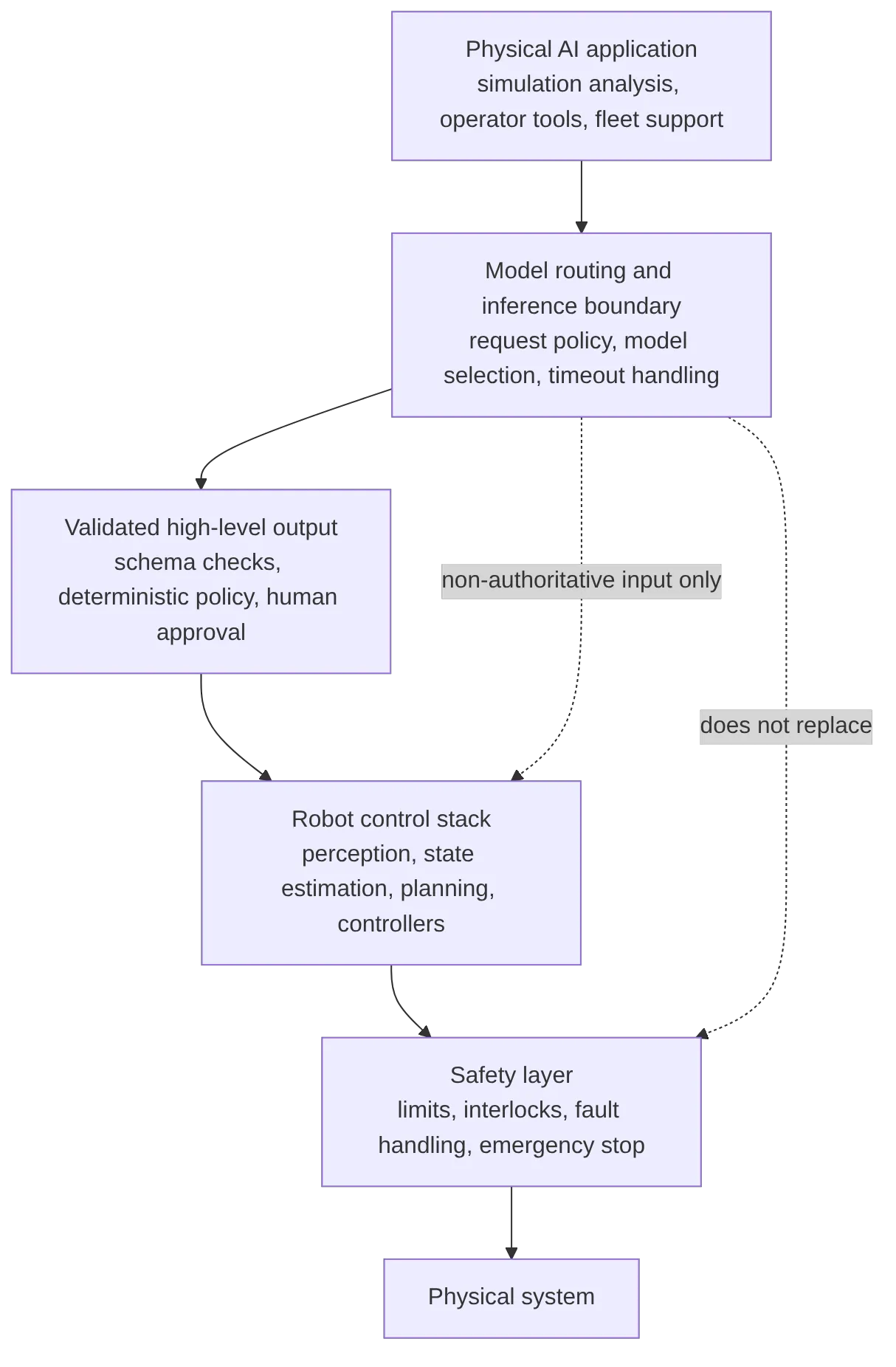
The layered separation is consistent with research into robotics architectures that distinguishes perception, planning, control, quality-of-service concerns, and fault containment. The ROS 2 architecture research is useful context here. It does not describe Microduck's actual architecture.
Where physical AI inference belongs in simulation-to-device workflows
The strongest use cases for model routing around open-source robotics are generally non-critical, asynchronous, and reviewable. Microduck's public simulation and RL framing makes these practical examples more relevant than a generic chatbot use case.
Teams can apply routed inference to:
Summarize simulator failures across many runs.
Draft experiment notes from structured telemetry.
Generate regression-test ideas for known failure modes.
Assist with configuration review and documentation.
Classify non-sensitive fleet or lab diagnostics for human review.
Compare model outputs on fixed robotics prompts and schemas.
Create initial labels or descriptions that a reviewer verifies.
These workflows still need controls. A simulation-analysis service should not be able to trigger actuation just because its output looks confident. A maintenance-triage assistant should surface an evidence-backed recommendation, not silently issue a physical command.
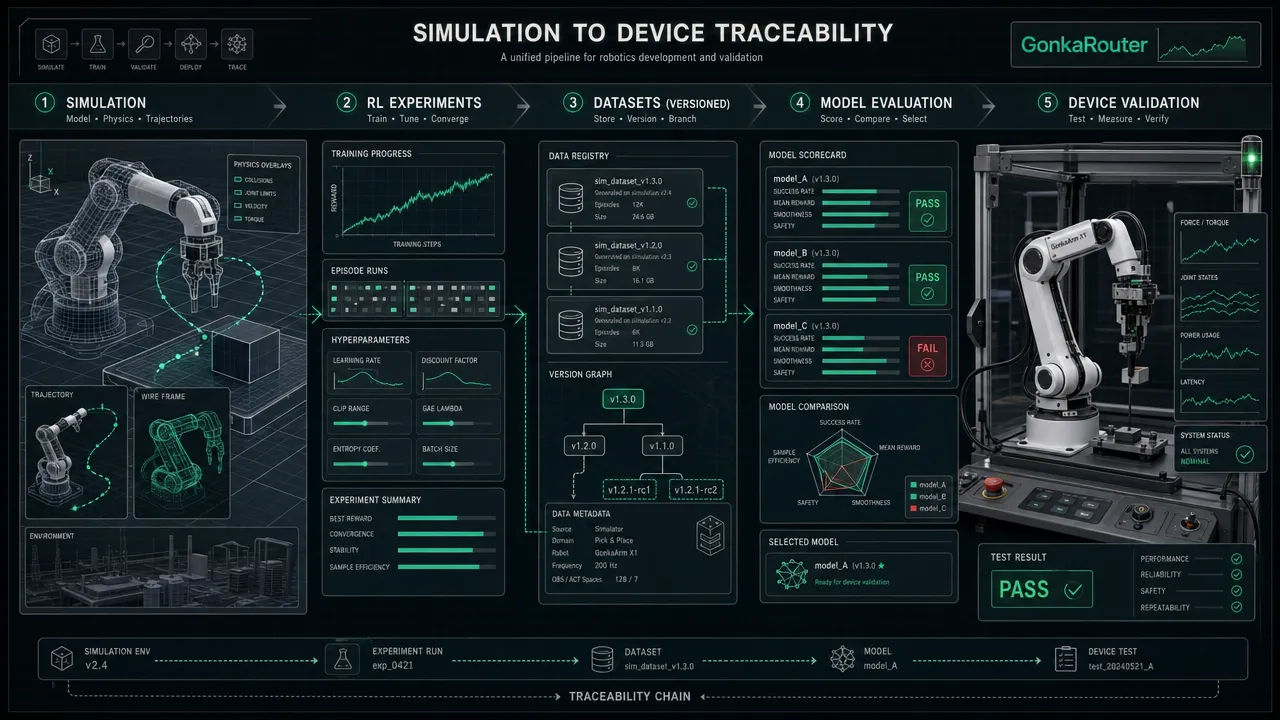
The sim-to-real gap also makes observability non-negotiable. When a policy, model-assisted workflow, or evaluation changes behavior, teams need evidence that spans both software and environment:
Simulator and environment version.
Experiment seed and scenario configuration.
Robot software revision and hardware configuration.
Model identifier and prompt or routing-policy version.
Input and output validation status.
End-to-end latency, timeouts, and retries.
Human approvals, overrides, and rejected recommendations.
Cost and request-volume records.
This is where model routing becomes operationally useful, not magical. A clean inference boundary can reduce scattered integrations and make evaluation easier. But the application still owns task classification, output validation, control authority, and the decision to defer.
How physical AI inference should handle latency, fallback, and cost
Physical AI workloads expose an important difference between availability and safety. An available model service can still return an unsuitable answer. A low-latency endpoint can still exhibit jitter. A fallback model can still fail a structured-output requirement. Each property must be tested against the actual workflow.
A practical model-routing checklist for robotics-adjacent work looks like this:
Classify criticality before integration. Label workloads as offline, non-critical operational assist, mission-relevant, or safety-critical.
Measure tails, not averages alone. Track p50, p95, p99, worst observed latency, timeout rate, queue time, and end-to-end completion time.
Set bounded failure behavior. Define how the workflow reacts to unavailable inference, invalid output, low-quality results, exhausted budgets, and degraded connectivity.
Use meaningful fallback. A fallback might be cached output, deterministic rules, a local model, a queued review case, or a request for operator confirmation.
Version every change. Treat model changes, prompts, schemas, and routing policies as change-controlled dependencies.
Control experimentation costs. Add per-environment budgets, token limits, retry caps, concurrency limits, and alerts for anomalous usage.
Minimize sensitive inputs. Physical-AI data can include facility imagery, maps, telemetry, video, incident records, and proprietary designs. Redact and minimize before external processing.
Cost control deserves special attention in reinforcement-learning and simulation-heavy projects. A single experiment may produce many episodes, traces, images, labels, and diagnostic requests. The cheapest token rate is not automatically the cheapest completed task. Retries, invalid structured output, human rework, and long outputs can erase an apparent unit-price advantage.
For teams that want a unified inference endpoint for suitable workloads, GonkaRouter is a restrained example of an AI gateway and model router built for the Gonka Network. It supports OpenAI-compatible and Anthropic-compatible API formats through a unified AI inference endpoint.
Its current supported catalog includes MiniMax-M2.7, Kimi-K2.6, GLM-5.2, and DeepSeek-V4-Flash-0731. The domain's published pricing is listed as low as $0.0004 per 1 million tokens, with a one-time 20 USDT trial credit after email login. Those are current product facts, not a promise that every supported model has the same price, allowance, latency, or behavior.
The appropriate evaluation pattern is small and isolated: try an offline simulator-log summary, documentation task, or human-reviewed diagnostic classification. Measure quality, output validity, latency, errors, usage, and data-handling fit. Do not treat a compatible API format as evidence of robotics integration, real-time operation, automatic routing, or safety capability.
For related implementation context, teams can also review GonkaRouter's guidance on choosing AI models for measurable workload fit, AI control-plane considerations, and the distinction between an inference layer and an AI gateway.
Why physical AI inference needs boundaries more than hype
Microduck's significance is not that every small robot needs cloud model access. Its value as a hook is that the project's SDK, simulation, and reinforcement-learning framing puts modern open-source robotics within reach of more developers. Once teams add model-driven analysis, planning assistance, or experimentation around an embodied system, inference becomes part of operational design.
That is why physical AI inference needs a routing policy rather than a vague "best model" choice. Teams need model selection based on real tasks, measured latency distributions, defined connectivity assumptions, traceable experiments, cost limits, and tested fallback behavior.
They also need a hard boundary: model routing may support non-critical analysis and human-reviewed workflows, but it must not inherit authority over low-level actuation, collision avoidance, emergency stops, interlocks, or deterministic safety functions.
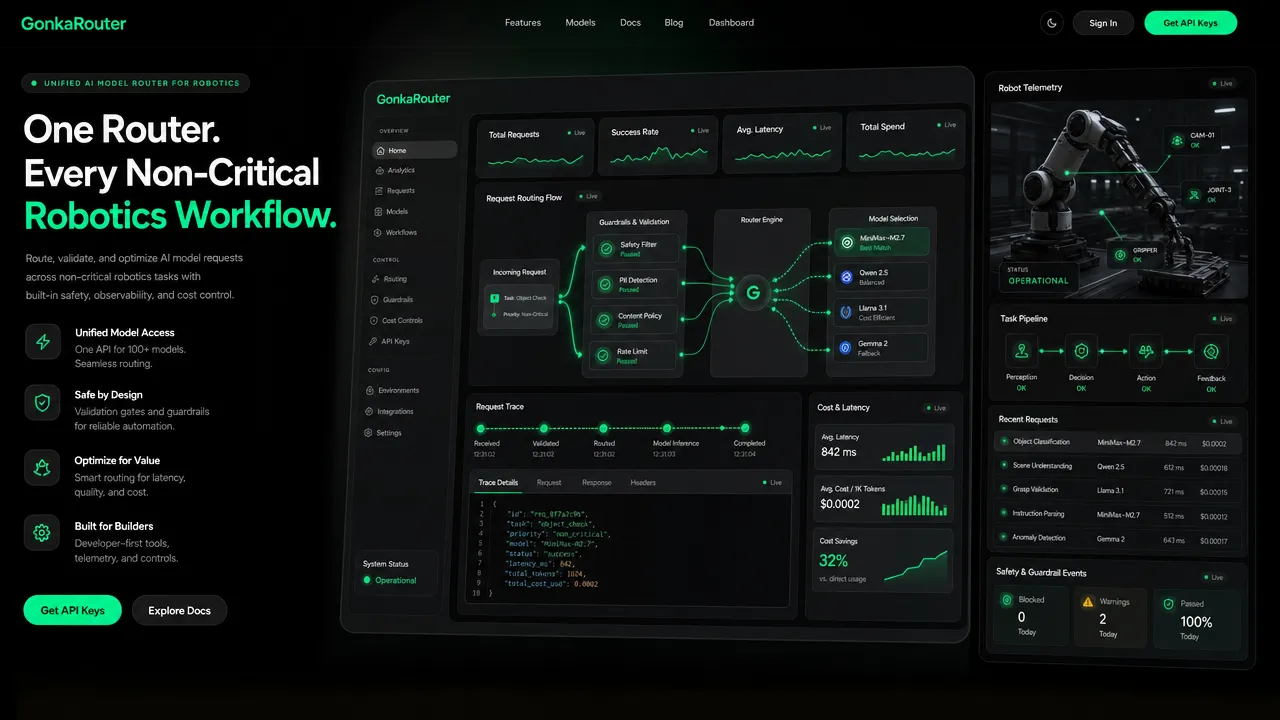
Review GonkaRouter's live model catalog, current pricing, and data-handling terms before making an architecture decision. If its supported models fit a non-critical workload, test a small isolated use case first, then decide from measured quality, latency, failures, usage, and governance fit.
Physical AI inference FAQs
What is physical AI inference?
Physical AI inference is the runtime use of AI models to classify, predict, interpret, plan, or assist within a workflow connected to the physical world. It does not inherently mean direct motor or actuator control.
Why does physical AI inference need model routing?
Physical AI inference can involve different tasks with different requirements for output quality, modality, latency, data handling, and cost. A routing policy helps teams keep model selection and inference access separate from core application logic, but only when the workload is appropriate for routed inference.
Can a model router control a robot?
No. A model router or AI gateway is an application-facing inference-access layer. It is not a deterministic robot controller, a safety interlock, an emergency-stop mechanism, or a replacement for control-stack engineering.
What is known about Microduck?
Pollen Robotics describes Microduck as a 25 cm open-source biped listed for $399 pre-order, with an SDK, simulation, and full RL training stack on GitHub. TechCrunch's report states that Hugging Face unveiled the duck-like robot. Hardware performance, adoption, delivery timing, and specific integrations require separate verification.
What should teams measure before using cloud inference near robotics workflows?
Measure end-to-end latency, jitter, timeouts, error rates, structured-output validity, cost per completed task, degraded-network behavior, data-handling fit, and the effectiveness of fallback and human-escalation paths.