Healthcare makes model-routing decisions visible because the cost of an unclear data path, undocumented fallback, or untraceable model change is unusually high. A healthcare AI gateway is therefore less a marketplace concept than an architecture test: can a team control where requests go, explain why they went there, and reconstruct what happened afterward?
On August 19, 2026, Healthcare Digital asked who might become the "OpenRouter of healthcare AI." Its category framing is useful, but the bigger question is not which vendor wins. It is what a routing layer must prove when model selection can alter data handling, operational accountability, and incident response.
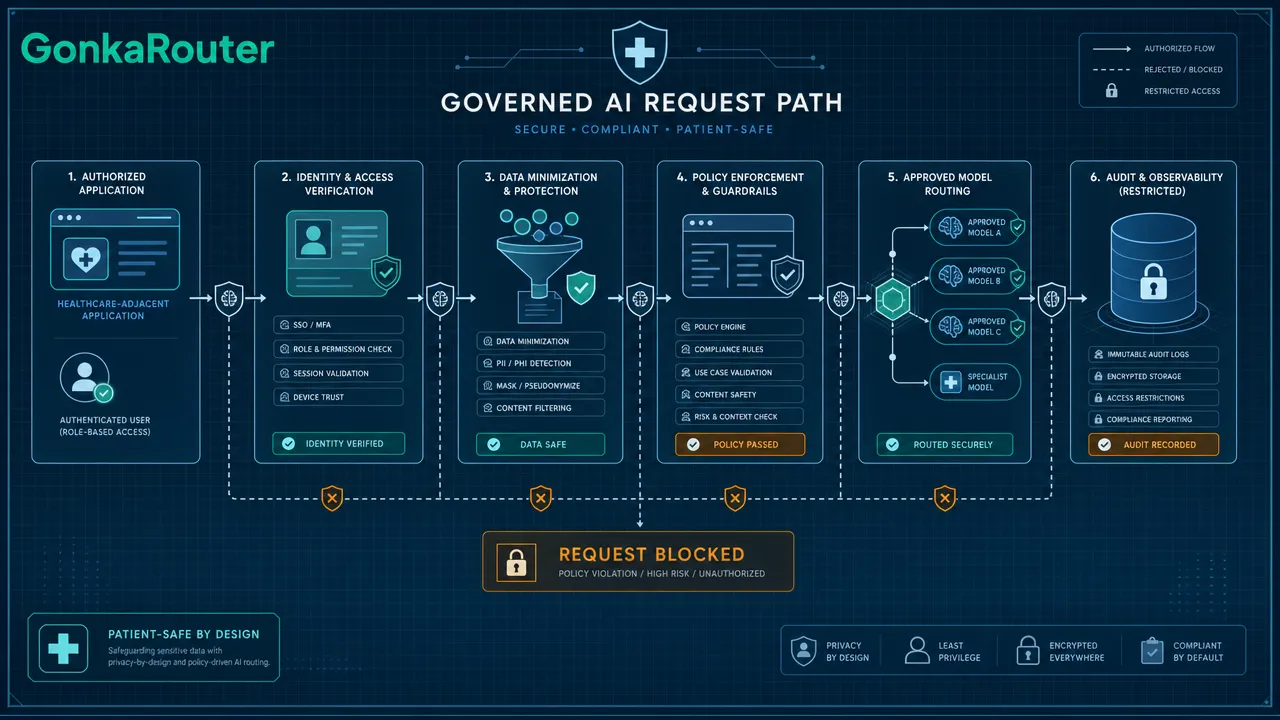
Why a healthcare AI gateway turns model choice into a control decision
A healthcare AI gateway is a control layer between an application and one or more model endpoints. It can centralize access, request classification, routing policy, telemetry, and deployment decisions. It is not automatically a model provider, a clinical system, or proof of regulatory compliance.
That distinction matters because a model request is not merely a prompt. It may include patient-related context, identifiers, retrieval excerpts, metadata, tool inputs, or records that should not travel to every endpoint available through a unified API.
The infrastructure decision becomes a series of operational questions:
Which workload is making the request?
What data class does it carry?
Which models and providers are permitted for that class?
What is removed or transformed before a request leaves the application boundary?
What route and policy version processed the request?
What happens if the preferred endpoint fails?
A gateway can make these questions easier to enforce. It cannot answer them by itself.
The architectural lesson applies well beyond healthcare. Financial systems, legal workflows, public-sector services, and enterprise SaaS products all face the same core problem: choice creates accountability. Adding models without defining the boundaries around them simply spreads that accountability across SDKs, dashboards, and vendor contracts.
What the August 19 healthcare AI gateway debate gets right
Healthcare Digital argued that healthcare-oriented routing needs stronger attention to deployment control, deterministic inspection or redaction, and auditability than a general model-access layer. That is a source-attributed thesis, not an independently validated standard or market ranking.
Still, its underlying concern is sound. A routing decision can affect far more than latency and price. It can change:
Routing decision | Infrastructure consequence |
|---|---|
Selected provider or endpoint | Changes the processor and service terms in the request path |
Selected model version | Changes output behavior, formatting, and evaluation assumptions |
Fallback route | May introduce a different capability profile or data-handling path |
Logging configuration | Determines whether content, metadata, or both become a second sensitive-data system |
Deployment pattern | Changes the organization's operational responsibility and control boundaries |
The U.S. Department of Health and Human Services Office for Civil Rights has emphasized, in its guidance on online tracking technologies, that covered entities and business associates must evaluate disclosures and safeguards when third-party technologies receive protected data. That guidance is not an LLM gateway rulebook. But the engineering inference is relevant: an intermediary is not operationally invisible just because it sits between an application and another service.
The same principle appears in the NIST AI Risk Management Framework, which organizes AI risk work around Govern, Map, Measure, and Manage. A gateway can support these activities by creating a consistent enforcement point, but its presence does not prove that governance is working.
The practical takeaway is simple: routing logic should be treated as versioned production policy, not incidental application code.
How healthcare AI gateway architecture makes data boundaries testable
The central tension in AI infrastructure is abstraction versus accountability. A unified endpoint can reduce duplicated provider integrations, but it can also conceal where prompts travel, which revision served a response, and what information was retained.
A useful architecture separates the request path into explicit control points.

This framework is analytical. It does not imply that every gateway provides every control.
The most important design choice is to distinguish content-bearing data from operational metadata. Teams may need model IDs, route IDs, latency, token usage, error types, and correlation IDs for diagnosis. They do not necessarily need broad access to complete prompts, outputs, retrieval documents, or user identifiers.
Control area | Strong question to ask | Weak assumption to avoid |
|---|---|---|
Data minimization | Can unnecessary identifiers and fields be removed before routing? | "More context is always better." |
Route policy | Is model selection explicit, testable, reviewable, and versioned? | "The fallback can be any available model." |
Traceability | Can the team identify the provider, model, version, route, and policy used? | "A request ID alone is sufficient." |
Logging | Who can access content-bearing logs, and for how long? | "Logging everything is observability." |
Deployment | Where do the data plane, control plane, keys, logs, and support tools operate? | "A VPC option answers every boundary question." |
Change management | Can the team test and roll back model or policy changes? | "Latest" aliases are safe in production. |
This is why OpenAI-compatible APIs should be viewed carefully. Compatibility can reduce integration effort, but it does not guarantee equivalent tool behavior, structured outputs, token accounting, context handling, rate limits, or retention conditions. Portability is a tested capability, not a label.

A practical healthcare AI gateway checklist for infrastructure teams
Healthcare is a high-stakes lens, but the evaluation method is broadly useful. Before moving a multi-model workflow beyond a controlled pilot, platform teams should request evidence rather than rely on category labels.
Evaluation area | What to verify | Evidence to request |
|---|---|---|
Data flow | Every system that receives prompts, outputs, attachments, embeddings, and metadata | Current data-flow diagram and subprocessor information |
Retention and data use | What is retained, deleted, accessible, or used for service operations | Product documentation, account-specific terms, and configuration details |
Access control | Whether access can vary by tenant, environment, workload, and identity | IAM model, credential-scope documentation, and access-log samples |
Routing | Whether routes and fallbacks can be constrained by workload and data class | Policy examples, change records, and failure-test results |
Model lifecycle | Whether model versions can be identified, evaluated, and rolled back | Release history, version records, and evaluation results |
Observability | Whether teams can diagnose an issue without indiscriminate content retention | Trace schema, retention design, and log access controls |
Resilience | What happens during timeouts, malformed responses, or endpoint failures | Retry and fallback documentation, plus incident runbooks |
Deployment | The location and ownership of inference, control, logging, keys, and support access | Architecture diagram and shared-responsibility matrix |
A governed pilot should also use a representative evaluation set. Test normal requests, edge cases, malformed outputs, required schemas, failure conditions, and fallback behavior. Measure task completion, not only token cost or first-token latency.
For sensitive workloads, the default fallback should not be "send it somewhere else." It should be a documented policy decision that specifies which alternative route is permitted, what behavior changes are expected, and whether the response requires additional validation or human review.
What developers should build before adding more models
Developers do not need a giant platform on day one. They do need an intentional integration boundary before model-specific logic spreads into every service.
A practical first implementation includes:
An internal model client or gateway boundary between applications and external endpoints.
A small approved model catalog rather than arbitrary production model IDs.
Request labels for workload, environment, tenant, data class, and correlation ID.
Version-controlled routing configuration.
A regression suite using real, approved examples.
Separate treatment for content-bearing logs and operational telemetry.
Explicit retry limits, timeouts, and fallback conditions.
These controls make application teams faster over time. They also reduce the cost of changing a model, provider, or deployment assumption later.
For broader context on this architectural shift, GonkaRouter has explored why AI control planes are becoming essential, why AI gateways can keep provider credentials outside autonomous agents, and how to distinguish an inference layer from an AI gateway. The consistent point is that a gateway is a boundary, not a substitute for application-owned authorization, evaluation, incident response, or governance.
Where GonkaRouter fits in a restrained evaluation
GonkaRouter is an AI Model Router built for the Gonka Network. Its site presents an OpenAI-compatible API endpoint and currently lists DeepSeek-V4-Flash-0731, Kimi-K2.6, and MiniMax-M2.7. It also displays Function Calling, Private VPC Deployment, and Web3 Ecosystem Integration.
Those facts make it relevant as a focused option for teams evaluating a unified model-access boundary. They do not establish healthcare specialization, suitability for protected health information, regulatory approval, security certifications, service-level commitments, automatic routing, or guaranteed savings.
The appropriate use case is a small, non-sensitive evaluation. Test API compatibility, supported model behavior, error handling, documentation, pricing mechanics, and the current data-handling terms for the exact service configuration under consideration. Readers can also review GonkaRouter's privacy policy, terms of service, and its explanation of one OpenAI-compatible API endpoint for multiple AI models.
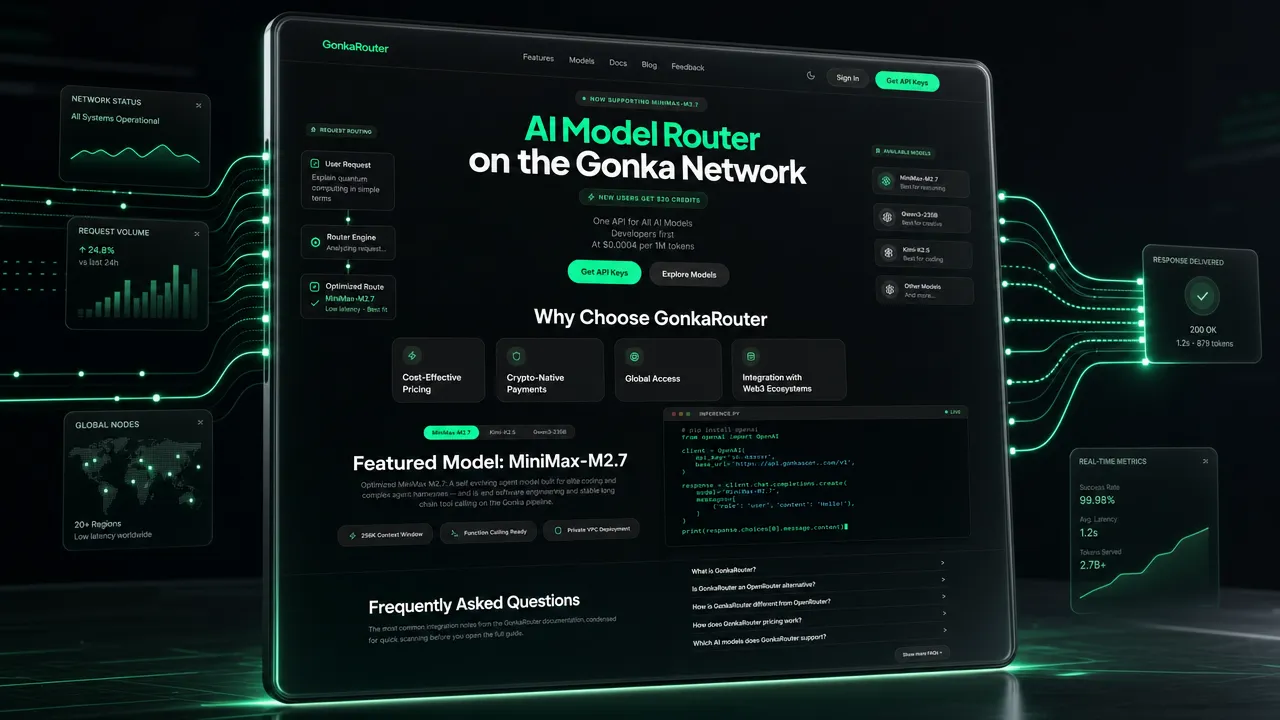
The lesson of the healthcare AI gateway discussion is not that every organization needs a healthcare-branded router. It is that any team handling consequential data needs a visible, testable control point between an application and a fast-changing model ecosystem. Model choice is useful only when it remains governable.
Review GonkaRouter's live model catalog and pricing, create an account if that evaluation fits your needs, and test a small workload before making a production architecture decision.
Healthcare AI gateway FAQs
What is a healthcare AI gateway?
A healthcare AI gateway is a control layer between a healthcare-related application and one or more model endpoints. It may centralize access, routing, data-handling policy, telemetry, and deployment decisions. It is not automatically compliant, certified, clinically validated, or approved for sensitive healthcare data.
Is a healthcare AI gateway the same as a model provider?
No. A model provider hosts or serves inference. A gateway intermediates application access to one or more endpoints and may apply routing or operational controls. Some services may overlap, but the responsibilities should be evaluated separately.
Why does routing matter for privacy and auditability?
Routing determines which model or provider path processes a request. That selection can affect data processing conditions, output behavior, failure modes, retention assumptions, and the evidence needed to investigate an incident.
Does private or VPC deployment automatically make an AI workload compliant?
No. Deployment is only one part of an assessment. Teams must still review data flows, access controls, logging, retention, upstream providers, support access, contracts, and use-case governance.
What should teams record for an AI request?
At minimum, teams should be able to identify the workload, route, policy version, provider, model or version, timing, error state, and controlled correlation identifier. They should limit broad retention of sensitive content unless it is necessary, authorized, and access-controlled.