The reported OpenRouter $113M funding claim should be treated cautiously. The available material in the research report was future-dated and could not be independently verified for publication. If a current primary announcement confirms it, the development may indicate growing interest in model-routing infrastructure. It would not, however, prove that one routing architecture, provider, or AI Gateway is automatically better than another.
For developers, the bigger story is practical: AI applications increasingly need a clean way to evaluate models, reduce provider-specific integration work, and keep model access aligned with product requirements.
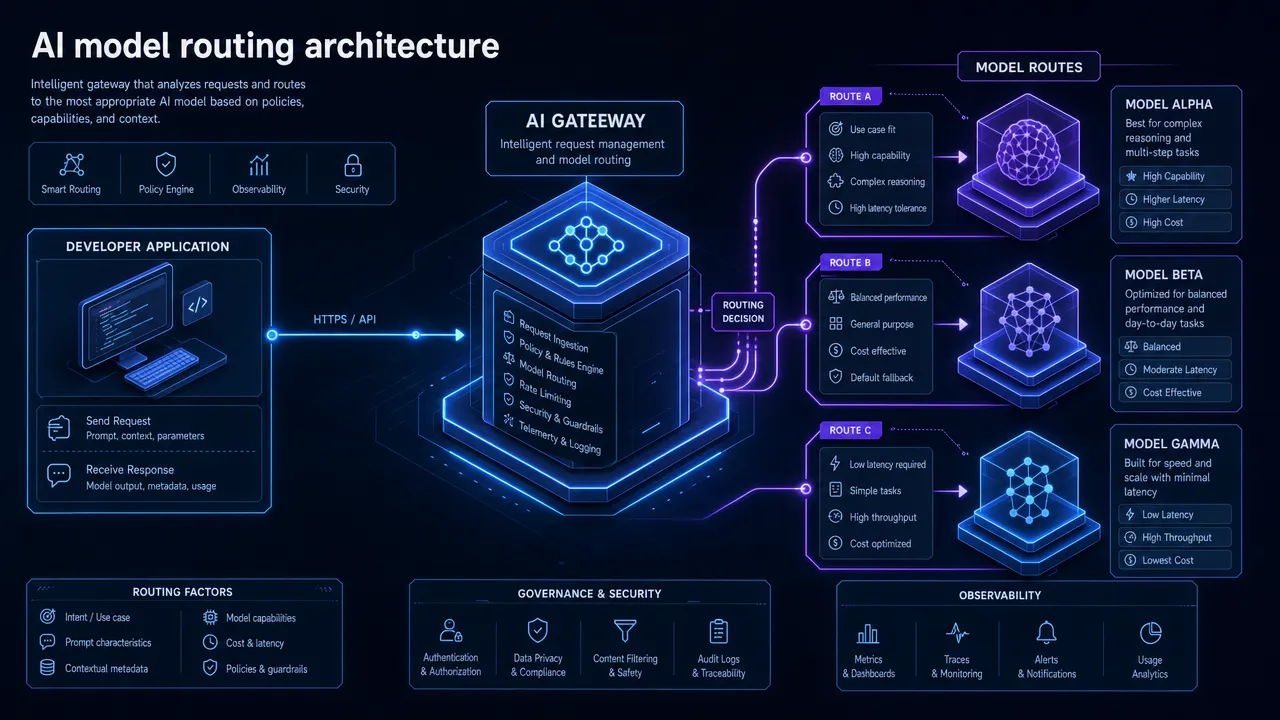
What an OpenRouter alternative should solve
An openrouter alternative is not necessarily a replacement for every OpenRouter use case. Developers often search for one because they need a more focused model set, a different API format, an alternate billing path, direct inference infrastructure, or fewer vendor integrations to manage.
It helps to separate several related categories:
Category | Primary purpose | Developer question |
|---|---|---|
AI Gateway | Creates a central integration layer for AI traffic | How can we standardize AI access? |
AI Model Router | Lets an application select an eligible model route | Which model should handle this request? |
Multi Model API | Makes more than one model available through one interface | How can we avoid separate model integrations? |
Inference platform | Hosts and serves models through API endpoints | Where can we run a suitable model? |
Aggregation layer | Provides broad access across model and provider routes | How can we explore many available routes? |
A gateway or router does not remove the need for engineering evaluation. Teams should still test output quality, supported parameters, streaming behavior, error responses, privacy requirements, and cost per successful task.
For agents, chatbots, content generation tools, and automated workflows, a unified integration layer can reduce repeated API work across services. Learn more about the role of an AI model router API before deciding whether routing belongs in your application architecture.
OpenRouter alternative decisions start with model fit
An OpenRouter review should begin with product fit, not headline-driven assumptions. OpenRouter is publicly positioned as a broad model-access and routing layer with documented routing concepts and model-level pricing information. That can be useful when a team needs catalog discovery and provider-route evaluation.
Still, broad access brings a trade-off: more available options can mean more testing, governance, and route-level validation.
When comparing an openrouter alternative, use this decision framework:
Evaluation area | What to validate |
|---|---|
Required model | Confirm the exact model and version are currently available |
API format | Check request fields, authentication, streaming, and error behavior |
Cost | Compare input, output, and total workflow cost, not just token rates |
Model routing | Verify static selection, fallback policies, and route behavior where documented |
Data handling | Review logging, retention, and processing terms |
Reliability | Test timeouts, rate limits, and recovery behavior with real workloads |
Migration effort | Determine whether an endpoint change is enough or whether code changes are needed |
Exit path | Keep an internal abstraction or contingency plan for critical workloads |
This approach also applies to openrouter pricing. Published token rates are useful, but they do not tell the full story. A higher-performing route for a specific task may reduce retries, shorten workflows, or improve task completion. The right comparison is cost per successful outcome.

OpenRouter alternative categories: Together AI, Fireworks AI, and more
The phrase best openrouter alternatives covers products with different technical priorities. They should not be treated as identical services.
OpenRouter vs Together AI
The openrouter vs together ai comparison is primarily a comparison between routing and aggregation on one side, and hosted inference options on the other.
Together AI is publicly documented as an inference platform with serverless and dedicated endpoint options. OpenRouter is more closely associated with multi-model access and provider-routing controls. Both may be relevant to API developers, but the deciding requirement differs.
Consideration | OpenRouter | Together AI |
|---|---|---|
Primary evaluation lens | Model aggregation and routing | Hosted model inference |
Useful for | Broad model-route exploration | Teams seeking available serverless or dedicated inference options |
Key validation task | Route behavior, pricing, and provider availability | Model availability, endpoint behavior, and deployment requirements |
Integration question | Which model and provider route should receive traffic? | Which hosted model endpoint fits the workload? |
A together ai alternative search may therefore reflect a different need from an OpenRouter search. A team that needs hosted inference should prioritize infrastructure and endpoint requirements. A team that needs a model-access layer should prioritize compatibility, routing semantics, and model availability.
Fireworks AI vs OpenRouter
The fireworks ai vs openrouter comparison also requires category awareness. Fireworks AI is commonly evaluated as a managed inference option, while OpenRouter is positioned around aggregated model access and routing.
The research report did not independently verify Fireworks AI's current model catalog, pricing, routing behavior, or performance characteristics. That means it would be inaccurate to claim Fireworks AI is faster, cheaper, more reliable, or easier to integrate than OpenRouter without fresh documentation and workload testing.
For a fireworks ai alternative evaluation, compare:
Exact model availability.
Request and response compatibility.
Deployment and inference requirements.
Current pricing and usage terms.
Reliability behavior under your expected traffic.
Data-handling requirements.
Requesty, Reqestly, Poe, Hyperbolic, and Venice AI
Searches for requesty ai alternative and reqestly can be difficult to interpret because the research report did not verify whether Reqestly is a separate product or a spelling variation of Requesty. Confirm the current official brand, product scope, model catalog, and documentation before using either service in a production comparison.
The same caution applies to Poe, Hyperbolic, and Venice AI. These products may overlap with AI access, compute, consumer AI, or privacy-oriented use cases, but they should not be described as direct OpenRouter equivalents without current evidence.
The useful question is not, "Which platform is best?" It is, "Which product category matches our architecture?"
When a focused OpenRouter alternative makes more sense
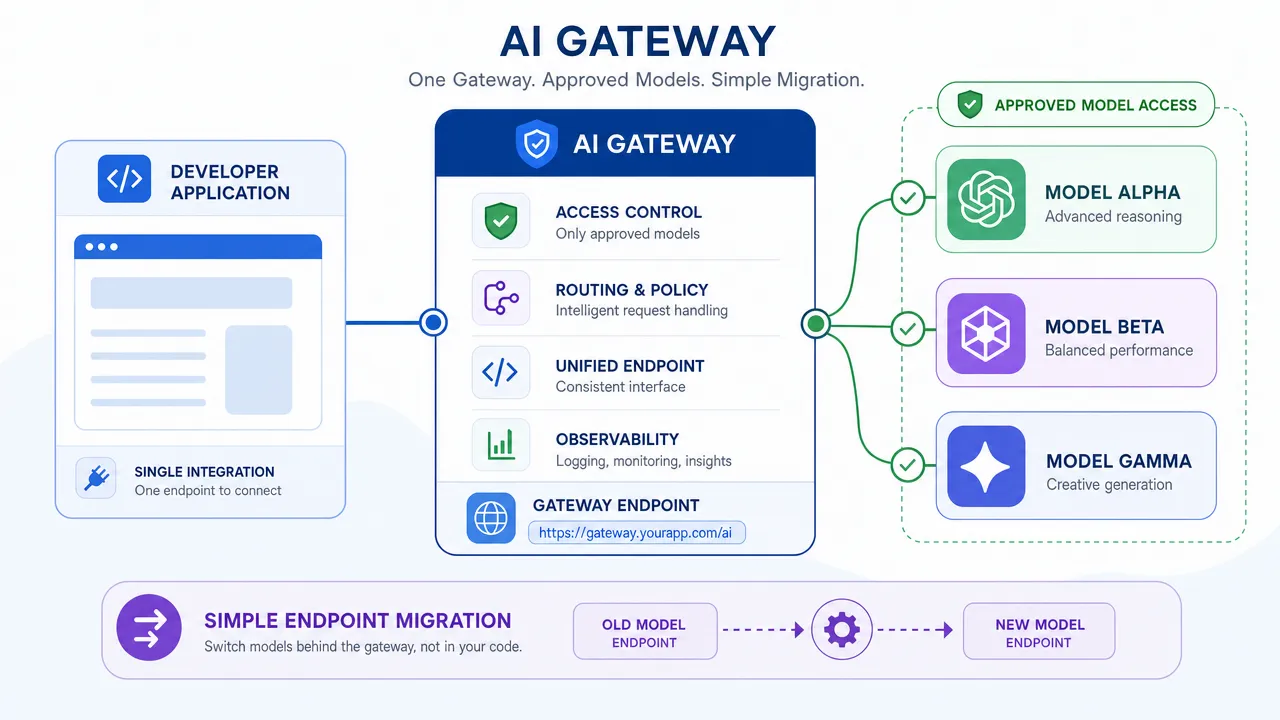
A focused AI Gateway can be a better fit than a broad aggregation layer when your team already has a defined model shortlist. This is common for teams that want simpler governance, faster onboarding, and a smaller evaluation surface.
GonkaRouter is a focused AI Gateway and AI Model Router for developers who specifically need unified API access to:
MiniMax-M2.7.
Kimi-K2.6.
GLM-5.2.
It supports OpenAI-compatible and Anthropic-compatible API request and response formats. This compatibility refers to integration formats only. It does not mean GonkaRouter provides official OpenAI or Anthropic models.
GonkaRouter capability | What it means for developers |
|---|---|
One API for supported models | Centralized access to MiniMax-M2.7, Kimi-K2.6, and GLM-5.2 |
OpenAI Compatible API | A familiar integration pattern for compatible applications |
Anthropic Compatible API | An additional compatible request and response format |
Endpoint-based migration | Developers can change the API endpoint where their request pattern is compatible |
Email login | Low-friction access for global developers |
Pricing | Token pricing as low as $0.0004 per 1M tokens |
Trial access | A one-time 20 USDT trial credit after email login |
GonkaRouter is not positioned as a universal model marketplace. Its value is a defined supported-model set, a Multi Model API integration surface, and lower friction for teams building AI Agents, chatbots, code-generation tools, content workflows, and enterprise AI applications.
For an implementation perspective, see how one OpenAI-compatible API endpoint can simplify supported-model access. Agent builders can also review whether AI agents need an inference layer, an AI Gateway, or both.
How to choose the best OpenRouter alternative for your workload
There is no universal best OpenRouter alternative. The right choice depends on whether you need broad discovery, hosted inference, a platform-specific gateway, or a focused model set.
Use the following practical guide:
Workload | Priority | Likely fit |
|---|---|---|
AI agent development | Structured outputs, retries, tool workflows, model quality | Evaluate compatible gateways and inference APIs using real agent tasks |
Early prototype | Fast setup, transparent costs, trial access | Choose a platform with low-friction onboarding and clear pricing |
Defined model shortlist | Exact availability and simple governance | Consider a focused AI Model Router |
Broad experimentation | Provider and model discovery | Consider aggregation and routing platforms |
Hosted model deployment | Endpoint and infrastructure options | Consider inference platforms |
Rapid migration | Compatible request formats and endpoint changes | Consider an OpenAI Compatible API or Anthropic Compatible API option |
Before production deployment, test representative prompts and failure cases. Review current terms, privacy details, supported parameters, and usage limits. You can also use this guide on how to evaluate AI models for real workloads to create a repeatable model-selection process.
OpenRouter alternative FAQ
What is an OpenRouter alternative?
An OpenRouter alternative is any AI access product that may better match a developer's need for model availability, API compatibility, inference hosting, routing controls, pricing visibility, payment options, or governance.
Is Together AI a direct OpenRouter replacement?
Not necessarily. Together AI is primarily evaluated as a hosted inference platform, while OpenRouter is associated with aggregated model access and routing. They overlap for API users but solve different architectural needs.
Is Fireworks AI a direct OpenRouter alternative?
It can be part of the same evaluation process, but it should not be treated as an identical product category. Verify Fireworks AI's current documentation, models, pricing, and endpoint behavior before making a decision.
Is Reqestly the same as Requesty?
The research report could not confirm that relationship. Treat reqestly and Requesty as terms requiring verification through current official sources.
Which models does GonkaRouter support?
GonkaRouter currently supports MiniMax-M2.7, Kimi-K2.6, and GLM-5.2 only.
Does OpenAI-compatible API access mean official OpenAI model access?
No. OpenAI-compatible API access means a platform supports a compatible API format. It does not confirm access to official OpenAI models.
How can developers get started with GonkaRouter?
Log in with email, get an API key, and test MiniMax-M2.7, Kimi-K2.6, and GLM-5.2 against your own workloads. Review the latest GonkaRouter developer resources and validate quality, latency, error handling, and token usage before directing production traffic.